Topics (384k) Articles (398k) Users (410) Discussions (242) Comments (383) Files (13k) New article

A reagent is a substance used to cause, reveal, or analyze a chemical reaction. The term describes its experimental role rather than a distinct class of molecular structure.
A reagent may contribute atoms to a product, change oxidation state, or give a measurable response to an analyte. A catalyst has the more specific role of accelerating a reaction while being regenerated in the net catalytic cycle. The same chemical substance can serve as reagent, solvent, or catalyst in different experiments, so the role must be specified in context.
A chemical equation represents a chemical reaction using chemical formulas, with reactants on the left and reaction products on the right. A balanced chemical equation has the same number of chemical atoms of each chemical element on both sides. For molecular hydrogen and molecular oxygen forming water,The coefficients give the relative numbers of molecules; the coefficient is normally omitted. Count hydrogen as on the left and on the right, and oxygen as on the left and on the right. See Flowers et al., Chemistry 2e, §4.1: writing and balancing chemical equations.
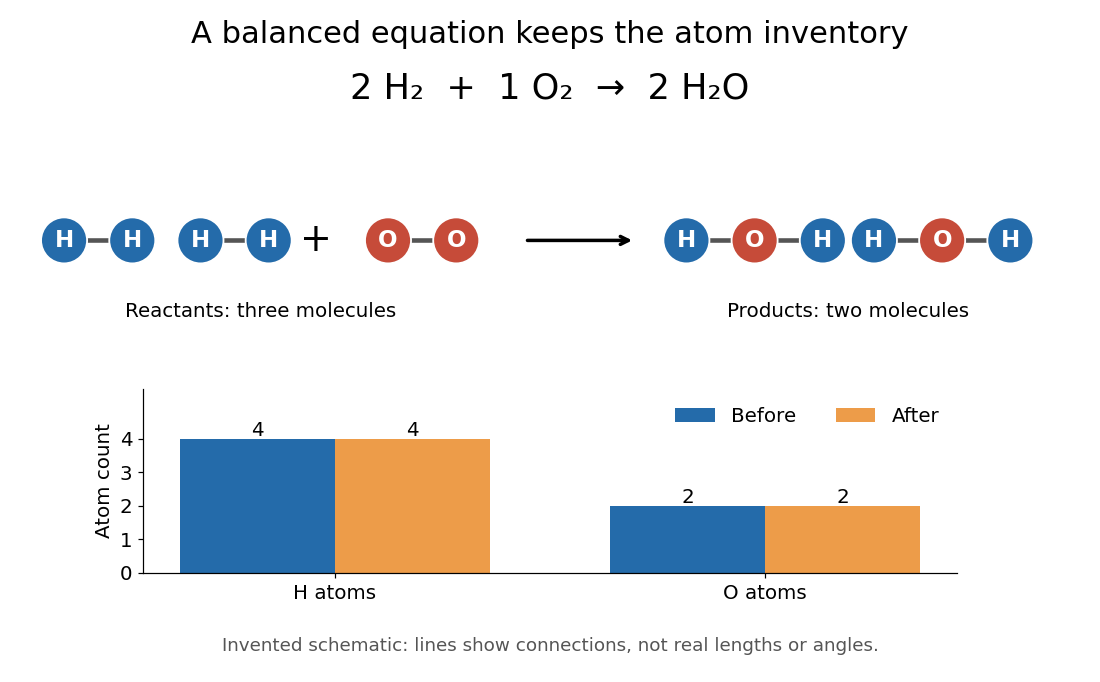
To balance the initial expression , first put before water to match the two oxygen chemical atoms. This creates four hydrogen chemical atoms on the right, so put before molecular hydrogen. Changing a coefficient multiplies the entire chemical formula. Changing a subscript changes composition and usually the chemical substance: is two water molecules, whereas is one hydrogen peroxide molecule. Never balance a chemical equation by changing its subscripts.
The bookkeeping follows from conservation of the atomic nuclei in ordinary, non-nuclear chemical reactions; chemical bonds and the distribution of electrons can change. For a chemical equation involving ions, total electric charge must also match. For example, the existing self-ionization of water equation has zero total electric charge on each side, since the of hydronium cancels the of hydroxide. See 2.6 Ionic and Molecular Compounds (§2.6: nuclei and ions).
The same ratio relates changes in amount of substance: two moles of molecular hydrogen consumed per mole of molecular oxygen correspond to two moles of water formed. A mole is a defined unit, not one molecule; the little whole-number picture is an abstract counting model, not a claim that a macroscopic sample contains just five molecules. See molecular count and amount of substance for the exact conversion and SI base unit: mole by Bureau International des Poids et Mesures for the definition.
This is why a balanced chemical equation is useful: stoichiometry turns the same atom accounting into relations between measurable quantities. It does not determine reaction rate, the final conversion set by chemical equilibrium, or the actual yield of recovered reaction products. The limiting reagent gives an upper bound under the specified chemical reaction.
Protonation adds a proton to a species. For a base , the acid-base relation is , with the proton actually supplied by a donor in the surrounding medium.
Protonating ammonia gives an ammonium ion. Protonation can change charge, molecular geometry, solubility, and reactivity; protonating a carbonyl oxygen often increases the electrophilicity of its carbon. Which atom is protonated and how much of the sample is protonated depend on competing basic sites, solvent, and pH.
Chemical kinetics studies how quickly chemical reactions proceed and how their reaction rates depend on composition and conditions. It connects a measured change in concentration to a rate law, then uses a rate equation to predict future concentrations. This makes it useful for choosing how long to wait for conversion and for testing a proposed reaction mechanism. Changing temperature, reactant concentrations, or the presence of a catalyst can change reaction rates; see Flowers et al., Chemistry 2e, §12.2: factors affecting reaction rates.
Chemical equilibrium specifies the eventual balance under given constraints; chemical kinetics determines how rapidly it is approached. At fixed temperature and pressure, a decrease in Gibbs free energy favours conversion but does not guarantee a fast chemical reaction: reaching a transition state can require crossing a substantial barrier. Thus a mixture can change imperceptibly over an observation period without being at chemical equilibrium. The distinction separates which direction is favoured from how long conversion takes. See 12.5 Collision Theory (§12.5: collision theory and reaction barriers) and Chemistry 2e, §16.1: spontaneity and speed.
Phosphorylation attaches a phosphate group to a molecule. Transfer from ATP to a substrate or enzyme can participate in energy coupling; the name alone does not specify the complete reaction mechanism. See OpenStax Biology 2e, 6.4: phosphorylation.
An endergonic reaction has positive molar reaction change in Gibbs free energy under the specified conditions. Sustained net forward conversion needs a driving process, such as energy coupling. See OpenStax Biology 2e, 6.2: endergonic reactions.
An exergonic reaction has negative molar reaction change in Gibbs free energy under the specified conditions. At fixed temperature and pressure, its forward direction is thermodynamically favourable; its reaction rate remains a separate question. See OpenStax Biology 2e, 6.2: exergonic reactions.
Energy coupling links an endergonic reaction to an exergonic reaction through a reaction mechanism, so that the combined transformation has a favourable change in Gibbs free energy. ATP hydrolysis is a common driving chemical reaction. A shared reaction intermediate, produced in one step and consumed in another, can physically connect the transformations; merely placing two independent chemical reactions in the same chemical solution does not establish energy coupling. See Alberts et al., Molecular Biology of the Cell: coupled reactions and activated intermediates.
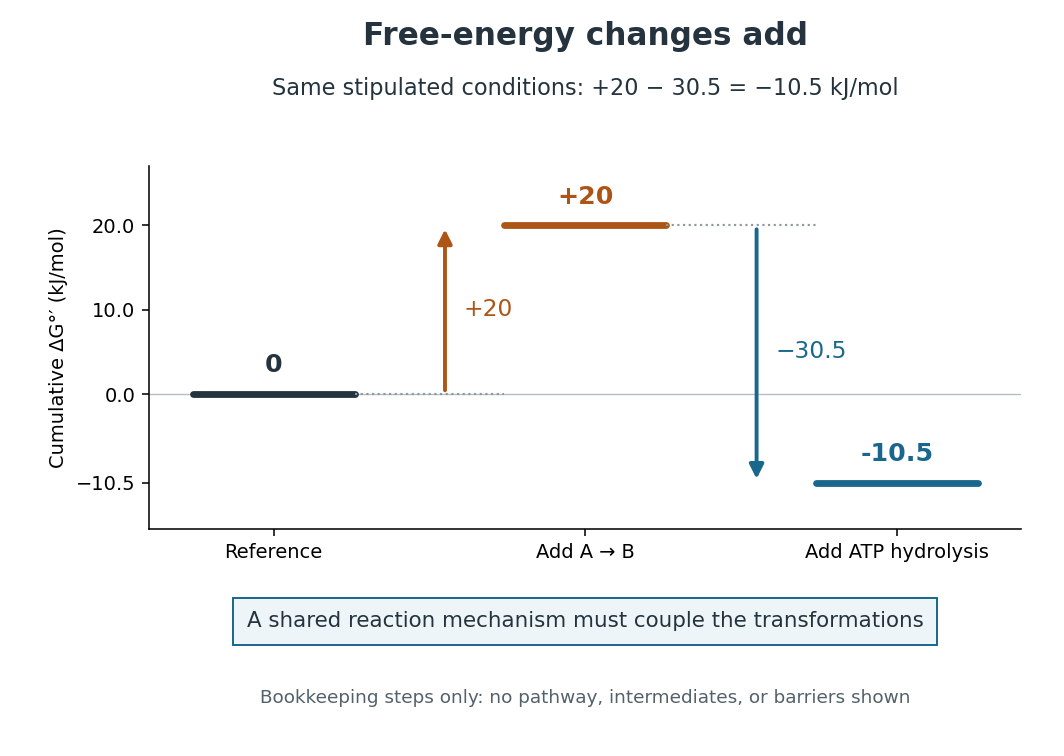
Energy coupling: under the same stipulated conditions
. Original diagram of cumulative changes in Gibbs free energy as two contributions are added. The levels are bookkeeping steps, not a reaction mechanism, actual reaction intermediates, elapsed time, or activation energy barriers. A reaction mechanism must enforce the joint transformation for the net favourable value to drive the desired conversion. Details.For a computed example, stipulate an endergonic reaction with under precisely the same biochemical standard state conditions as the quoted ATP hydrolysis value. Assume a reaction mechanism couples one ATP hydrolysis to each A-to-B conversion. The formal sum isThe sum gives an exergonic reaction. The is a chosen teaching value, not a measured property of an identified substance. Outside these reference conditions, add the actual and , each evaluated using consistent thermodynamic activities; mixing a standard value for one chemical reaction with an unrelated cellular value for the other gives no justified prediction.
Why do the changes in Gibbs free energy add? Gibbs free energy is a state function. Adding consistent reaction changes cancels any shared reaction intermediate and leaves the difference between the combined reactants and combined reaction products. This explains the thermodynamic accounting; it does not construct the reaction mechanism. In many ATP-dependent routes, phosphorylation transfers a phosphate group to a substrate or an enzyme, and subsequent transformation consumes that modified material. The shared material is what connects the steps. Other reaction mechanisms use ATP differently. See Alberts et al., Molecular Biology of the Cell: ATP-driven biosynthesis.
The useful achievement is that a common regenerated nucleotide can connect many different processes in metabolism. The net negative change in Gibbs free energy permits the coupled conversion, but supplies no reaction rate: enzymes can lower activation energy barriers without changing the endpoint difference. Energy coupling changes which overall chemical reaction is being considered; catalysis accelerates an available route. See OpenStax Biology 2e, 6.2: free-energy changes and reaction barriers.
A historical landmark is Fritz Lipmann's [ref]
https://doi.org/10.1002/9780470122464.ch4. 1941 essay, Metabolic Generation and Utilization of Phosphate Bond Energy
. Its sections on the phosphate cycle, generation and utilization of phosphate-bond energy, and group transfer organized these processes around a reusable chemical carrier. The historical terminology should be read with the modern distinction between net hydrolysis and the cost of breaking a chemical bond.Hydrolysis is a chemical reaction involving water that breaks a chemical bond. The free energy released by suitably coupled ATP hydrolysis can drive active transport; the available free energy depends on the actual composition and conditions.
A redox chemical reaction couples oxidation and reduction. In the electrode examples here, oxidation releases electrons and reduction accepts them. [ref]
Chemistry 2e by Paul Flowers and others. §4.2, “Oxidation-Reduction Reactions”: paired electron loss and gain
Redox can be recognized by changes in oxidation state: an increase records oxidation, a decrease reduction. These are formal electron assignments, distinct from measured partial atomic charges. Half-reactions expose the matching loss and gain, making electric charge conservation visible.[ref]
Chemistry 2e by Paul Flowers and others. §4.2, “Oxidation-Reduction Reactions”: oxidation-number definition and complementary processes
The electron accounting need not describe free electrons travelling between spatially separated chemical species. For example, in , hydrogen changes from oxidation state to and oxygen from to . Four hydrogen chemical atoms lose four formally assigned electrons in total; two oxygen chemical atoms gain four. The water product has covalent bonds, and these assignments do not turn it into separated ions. See ionic approximation of bonds and electron transfer and ionic character.
By contrast, neutralization can rearrange chemical bonds without changing oxidation states:Hydrogen remains and oxygen remains . The aqueous proton notation abbreviates its interaction with water. This acid-base chemistry example conserves electric charge but has no matching increase and decrease of oxidation state; movement of ions or a change of chemical bonds alone does not establish redox.
Precipitation is formation of a solid from a chemical solution; the formed solid is a precipitate. Dissolved chemical species enter a separate thermodynamic phase. A newly formed solid can create a surface for heterogeneous catalysis; observing it does not establish the composition or catalytic role of that surface.
For example, mixing suitable chemical solutions of calcium chloride and sodium carbonate can form calcium carbonate:Here means dissolved in water, and marks the solid. Both sides contain one calcium chemical atom, one carbon chemical atom, and three oxygen chemical atoms; net electric charge is on the left and zero on the right. The arrow describes the net change when precipitation occurs, rather than promising complete removal of either ion. The calcium carbonate precipitation experiment makes this phase separation visible.[ref]
Carbon Captured Chalk by Tony Butterfield. Carbon Captured Chalk, Summary and Background for Teachers: sodium carbonate and calcium chloride form calcium carbonate
The attraction is that an invisible dissolved inventory becomes a recoverable solid. Net ionic equations track that transfer; the saturation criterion for precipitation determines whether it is favored under specified conditions. This combination supports separations and chemical analysis.[ref]
Chemistry 2e by Paul Flowers and others. Chemistry 2e, §4.2, Precipitation Reactions and Solubility Rules: separations and analytical uses
A valence electron belongs to the electronic arrangement used to describe a chemical atom's chemical bonds and ordinary chemical reactions. For the neutral hydrogen, carbon, nitrogen, and oxygen chemical atoms used here, the valence electrons occupy the outermost occupied electron shell. Their respective electron configurations are , , , and , giving one, four, five, and six valence electrons. See Chemistry 2e, 6.4: electron configurations and valence electrons.
Lewis structures show these valence electrons while omitting the inner electrons. Consequently, eight drawn valence electrons in water do not mean eight total electrons: neutral water has ten, with two inner oxygen electrons omitted. Neutral Ammonia likewise has ten total electrons but eight valence electrons; neutral carbon dioxide has twenty-two total electrons but sixteen valence electrons.
This distinction makes the small counts useful: connections and possible lone pairs can be organized without representing every electron or solving the entire many-electron wavefunction. The outermost-electron shell shortcut applies to the examples above, rather than serving as a universal definition for all chemical elements; the electronic arrangement relevant to chemical bonds can also involve other electron subshells.
A covalent bond joins chemical atoms through shared electrons. In the familiar two-centre description, one bond pair contributes to a connection between two atomic nuclei. Sharing means that the electrons belong to the combined arrangement and interact with both atomic nuclei; it does not mean that identifiable dots shuttle along drawn paths. The [ref] emphasizes the concentration of electrons between atomic nuclei and the resulting attraction and characteristic separation. The pair picture is especially useful for simple molecules, but is not a universal description of every covalent bond.
A Lewis structure turns this picture into practical bookkeeping. Count the valence electrons, indicate which chemical atoms are connected, and allocate two electrons to each line. A bond pair is shared; a lone pair is assigned to one chemical atom without connecting it to another. A double line represents two bond pairs. Dots and lines record allocations, rather than positions, trajectories, or a measured three-dimensional arrangement. [ref]
https://openstax.org/books/chemistry-2e/pages/7-3-lewis-symbols-and-structures. Flowers et al., Chemistry 2e, Lewis symbols and structures
For molecular hydrogen, , each neutral hydrogen chemical atom supplies one valence electron. Thus valence electrons make one bond pair, represented by , with no lone pairs. Each hydrogen counts the same shared pair when checking its two-electron arrangement. The molecule still contains two electrons, not four: counting a pair around both endpoints does not create extra electrons.
For water, , neutral oxygen supplies six valence electrons and the two hydrogen chemical atoms supply one each: . Two O–H connections consume four electrons as two bond pairs. The remaining electrons form two lone pairs on oxygen. Around oxygen, the two bond pairs and two lone pairs count as eight electrons; each hydrogen counts two. The whole water molecule has ten electrons, because two additional oxygen electrons are omitted from this valence electron drawing.
For Ammonia, , the total is valence electrons: five from nitrogen and three from hydrogen. Three N–H connections use six electrons as three bond pairs, leaving two electrons as one lone pair on nitrogen. Thus water and Ammonia have the same total of eight valence electrons but different allocations: two plus two pairs versus three plus one. This small calculation already distinguishes their connectivity without a detailed quantum mechanics calculation.
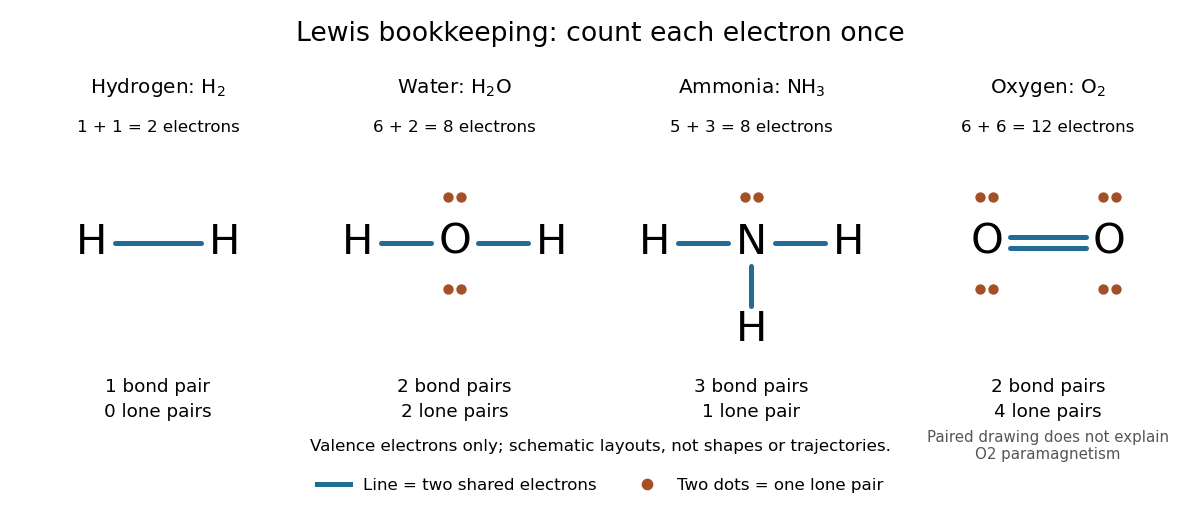
Lewis structures count bond pairs and lone pairs in molecular hydrogen, water, Ammonia, and molecular oxygen; schematic layouts do not specify molecular shapes
. Details. For molecular oxygen, , valence electrons give the conventional Lewis structure. Its two bond pairs use four electrons, leaving eight as four lone pairs, two on each oxygen. Each oxygen consequently counts eight electrons locally. However, actual molecular oxygen has two unpaired electrons and exhibits paramagnetism: it is attracted into a stronger magnetic field. The all-paired Lewis structure cannot capture this observation. Molecular orbital theory describes the unpaired electrons; the successful counting diagram alone is insufficient. [ref]
Why does sharing produce a stable separation? For molecular hydrogen, the electronic arrangement responds as the atomic nuclei approach. Their interactions can lower the energy, but pushing them too close raises it. A curve of potential energy against separation therefore has a local minimum, rather than falling forever. Attraction and repulsion balance there. This is a statement about the combined system, not a claim that stationary electrons sit between otherwise motionless atomic nuclei. [ref]
The following Morse potential makes those features calculable. Set , where is separation and its equilibrium value, and let be the well depth. With the self-chosen parameter , define the dimensionless quantitiesHere is the net separating force, obtained from the derivative of the potential energy. Positive pushes the chemical atoms apart; negative draws them together. These are illustrative curves with in chosen units, not measured molecular hydrogen data or fitted parameters.
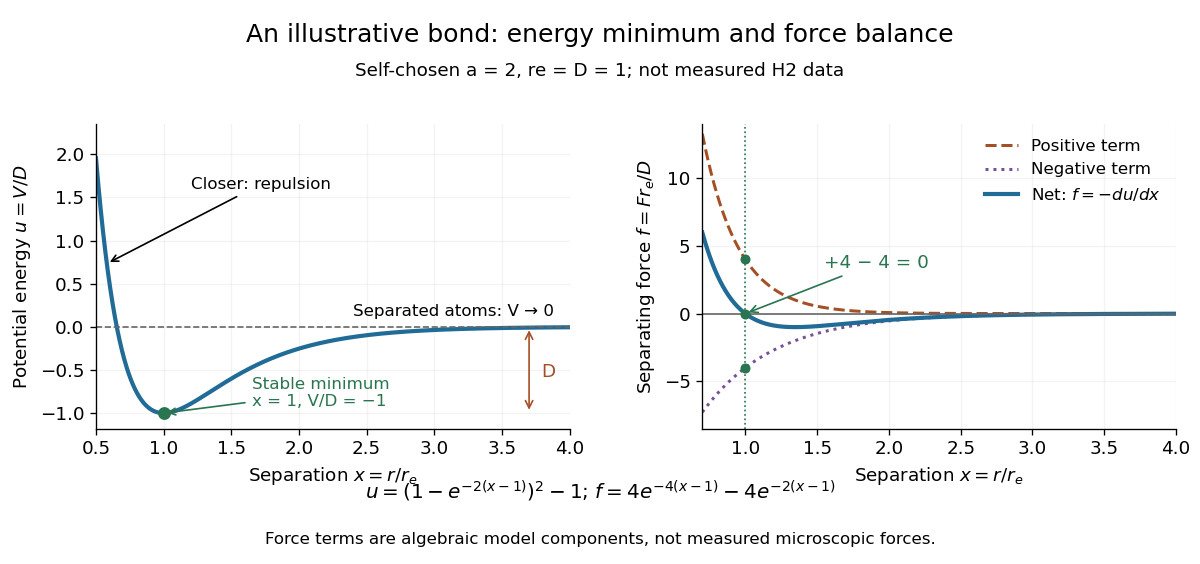
Illustrative dimensionless Morse potential and its force: a stable local minimum, short-distance repulsion, and separation toward zero potential energy
. Details. At , and . The second derivative is , confirming a local minimum. At , ; at , . As increases without bound, approaches zero from below. Thus moving from the well bottom to separated chemical atoms requires an increase of in this model's potential energy. An actual quantum mechanics dissociation threshold also depends on the initial motion of the atomic nuclei, so the well depth alone is not every measured dissociation energy.
The force panel separates into a positive term and a negative term . At they are and , cancelling exactly; nearer separations favour the positive term. These are algebraic components of the chosen Morse potential, not separately measured microscopic forces. Their usefulness is to show how a balance arises from the slope of one energy curve.
The beauty of the pair picture is its economy: a few marks summarize connectivity and constrain what a proposed molecule can contain. Its historical anchor is Gilbert N. Lewis's 1916 paper [ref]
https://doi.org/10.1021/ja02261a002. The Atom and the Molecule, Journal of the American Chemical Society 38, 762–785
, also available as an [ref]https://zenodo.org/records/1429068. archived original paper
. Lewis structures remain useful because they answer counting questions quickly; quantum mechanics supplies the richer account when energy, shape, or unpaired electrons matter.A carbonyl group contains a carbon–oxygen double covalent bond. It occurs in aldehydes and amides. [ref]
https://openstax.org/books/organic-chemistry/pages/12-7-interpreting-infrared-spectra. McMurry: carbonyl-containing groups
A hydrogen bond is an attractive association involving a hydrogen attached to another chemical atom, and an accepting atom or group. In the IUPAC 2011 definition, the atom in is more electronegative than hydrogen, and evidence of bond formation is required. The familiar strong examples use O–H or N–H groups, but restricting the concept to only nitrogen, oxygen and fluorine misses weaker cases. A short distance alone is not the entire definition.[ref]
https://publications.iupac.org/pac/pdf/2011/pdf/8308x1637.pdf. Arunan et al., Definition of the hydrogen bond, IUPAC Recommendations 2011
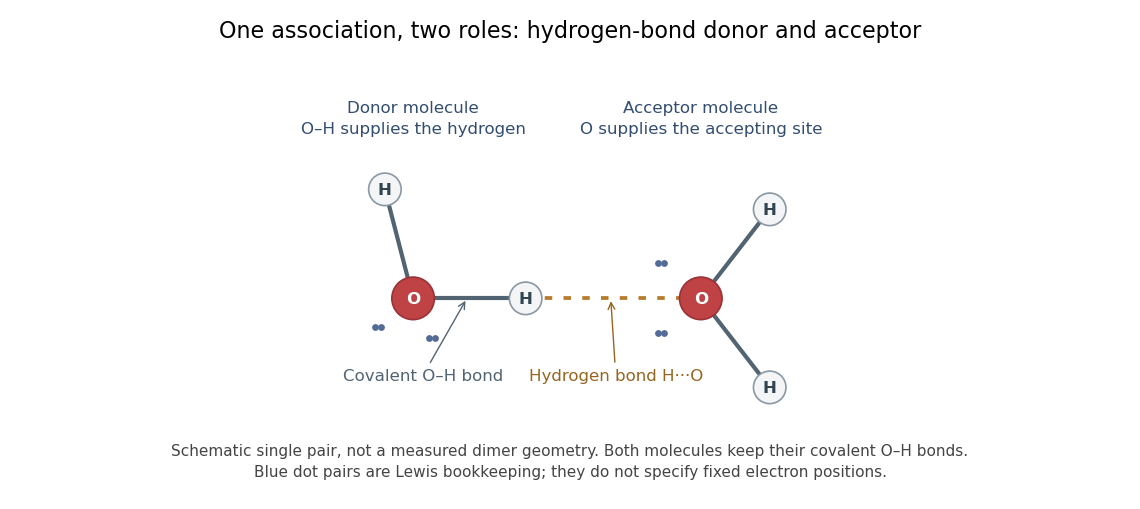
In the depicted water pair, one O–H group is the hydrogen bond donor; the other oxygen supplies the hydrogen bond acceptor. The solid O–H line denotes a covalent bond within a water molecule; the dotted H···O line denotes the hydrogen bond between them. One water molecule can play both roles in a larger arrangement because it has O–H groups and lone pairs.
This makes hydrogen bonds useful for understanding organization beyond a single molecular formula. They connect water molecules and contribute to protein folding and recognition between molecules. The same types of chemical atoms can support different associations depending on which donor and acceptor sites are exposed and how they are oriented. Alberts and colleagues discuss these noncovalent interactions in Molecular Biology of the Cell, the chemical components of a cell.
Hydrogen bonds are often directional, with an approximately straight donor–H–acceptor arrangement favourable in familiar cases; strength and preferred geometry depend on the system. The IUPAC definition uses converging experimental or theoretical evidence rather than one universal distance threshold. The author-hosted 2009 task-group draft, §§3.1–3.3 explains the definition and typical criteria leading to the recommendation.
An electron pair consists of two electrons with opposite spins sharing the same spatial part of their quantum state. The Lewis structure distinction between a bond pair and a lone pair records whether that pair is assigned to a connection between chemical atoms or to one chemical atom.
A partial atomic charge assigns an electric charge to a chemical atom by partitioning the actual electron density. The result depends on the partitioning convention and need not be an integer. It differs from formal charge, which divides bonding electrons equally in a specified Lewis structure.
A bond length describes the separation of the atomic nuclei of two bonded chemical atoms. Distinguish an equilibrium geometry from an instantaneous or experimentally averaged separation. Methods of determining molecular geometry can use different averaging conventions, so reported bond lengths need their measurement context. See the IUPAC Gold Book: bond length. Changing a bond length is one possible reaction coordinate.
Ionic bonding binds oppositely charged ions through attraction governed by electrostatics. In ordinary solid sodium chloride, each cation interacts with many anions, and also with other cations: attraction and repulsion together contribute to the binding of an extended ionic crystal. The chemical formula specifies equal numbers of the two kinds of ions; it does not divide the solid into isolated two-atom molecules.[ref]
This distinction explains a striking combination of properties: ordinary dry sodium chloride conducts electric current poorly, while its molten form or a sufficiently concentrated chemical solution in water conducts well. The ions already exist in the solid; their ability to move through the sample changes. A conductivity experiment on salt solutions tests this transport picture, rather than simply asserting that charged constituents must make every material conductive.
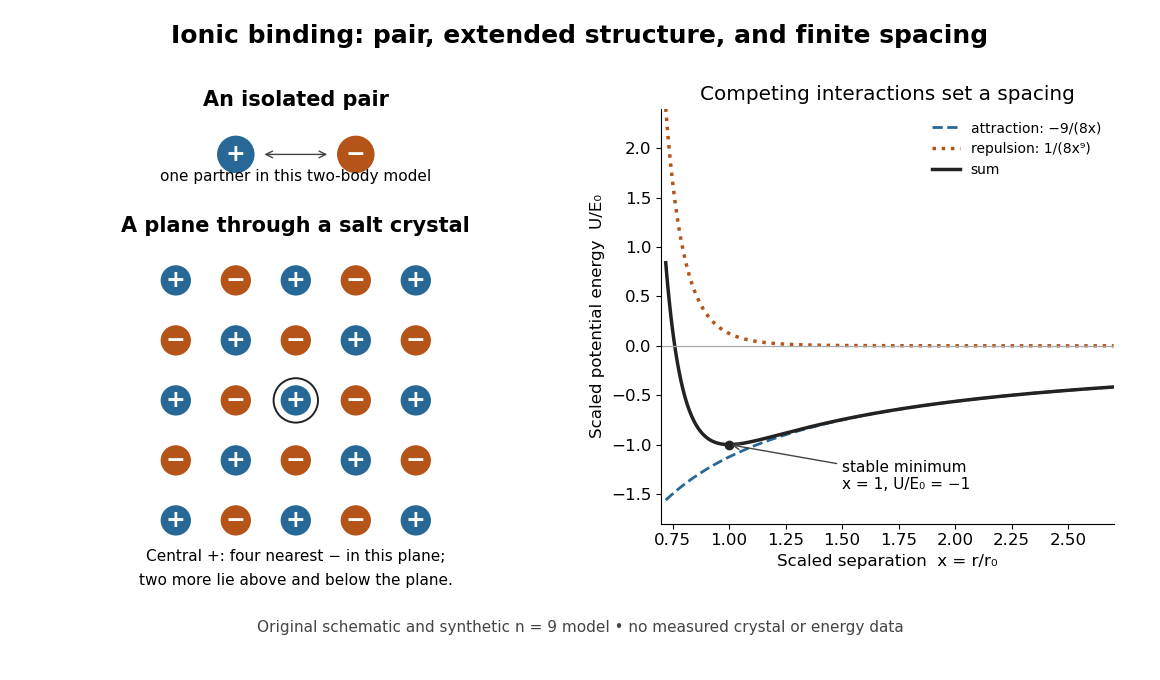
An isolated ion pair, a plane of an extended ionic crystal, and a synthetic potential energy model with a stable spacing
. Original schematic geometry and calculated model curves, not a measured electron density, diffraction pattern, or experimental lattice energy. Four nearest neighbours are visible in the plane of the rock salt structure; two more lie perpendicular to it. Disk sizes are arbitrary. The right-hand curves use the explicitly stipulated dimensionless model below. Details. Pinned article: Introduction to the OurBigBook Project
Welcome to the OurBigBook Project! Our goal is to create the perfect publishing platform for STEM subjects, and get university-level students to write the best free STEM tutorials ever.
Everyone is welcome to create an account and play with the site: ourbigbook.com/go/register. We belive that students themselves can write amazing tutorials, but teachers are welcome too. You can write about anything you want, it doesn't have to be STEM or even educational. Silly test content is very welcome and you won't be penalized in any way. Just keep it legal!
Intro to OurBigBook
. Source. We have two killer features:
- topics: topics group articles by different users with the same title, e.g. here is the topic for the "Fundamental Theorem of Calculus" ourbigbook.com/go/topic/fundamental-theorem-of-calculusArticles of different users are sorted by upvote within each article page. This feature is a bit like:
- a Wikipedia where each user can have their own version of each article
- a Q&A website like Stack Overflow, where multiple people can give their views on a given topic, and the best ones are sorted by upvote. Except you don't need to wait for someone to ask first, and any topic goes, no matter how narrow or broad
This feature makes it possible for readers to find better explanations of any topic created by other writers. And it allows writers to create an explanation in a place that readers might actually find it.
Figure 1. Screenshot of the "Derivative" topic page. View it live at: ourbigbook.com/go/topic/derivativeVideo 2. OurBigBook Web topics demo. Source. - local editing: you can store all your personal knowledge base content locally in a plaintext markup format that can be edited locally and published either:This way you can be sure that even if OurBigBook.com were to go down one day (which we have no plans to do as it is quite cheap to host!), your content will still be perfectly readable as a static site.
- to OurBigBook.com to get awesome multi-user features like topics and likes
- as HTML files to a static website, which you can host yourself for free on many external providers like GitHub Pages, and remain in full control

Figure 2. You can publish local OurBigBook lightweight markup files to either OurBigBook.com or as a static website.
Figure 3. Visual Studio Code extension installation.
Figure 5. . You can also edit articles on the Web editor without installing anything locally. Video 3. Edit locally and publish demo. Source. This shows editing OurBigBook Markup and publishing it using the Visual Studio Code extension. 
- Infinitely deep tables of contents:




All our software is open source and hosted at: github.com/ourbigbook/ourbigbook
Further documentation can be found at: docs.ourbigbook.com
Feel free to reach our to us for any help or suggestions: docs.ourbigbook.com/#contact