Topics (384k) Articles (398k) Users (410) Discussions (242) Comments (383) Files (13k) New article
Electronegativity describes a chemical atom's tendency to attract electron density towards itself in a chemical bond. It helps answer a useful question: when two different chemical atoms share electrons, which end of the chemical bond tends to be richer in electron density? For hydrogen chloride, the answer is chlorine: the covalent bond is a polar covalent bond, conventionally written . The symbols indicate partial atomic charges, not isolated ions carrying whole elementary electric charges.[ref]
Electronegativity is a comparison scheme, not the number of electrons on a chemical atom. A partial atomic charge depends on how the electron density is partitioned; formal charge instead follows an integer allocation in a Lewis structure. Neither is numerically equal to electronegativity. Nor is electronegativity identical to electron affinity, which concerns adding an electron to an isolated species. Different electronegativity scales use different measured inputs and conventions; compare numbers only after specifying the scale.[ref]
For a concrete comparison, the Royal Society of Chemistry lists Pauling electronegativities and . Their difference is , so the electronegativity rule predicts bond polarization towards chlorine in hydrogen chloride. An isolated molecular hydrogen molecule has identical ends and zero electronegativity difference. These examples explain a direction of unequal sharing, not a quantitative partial atomic charge.[ref][ref]
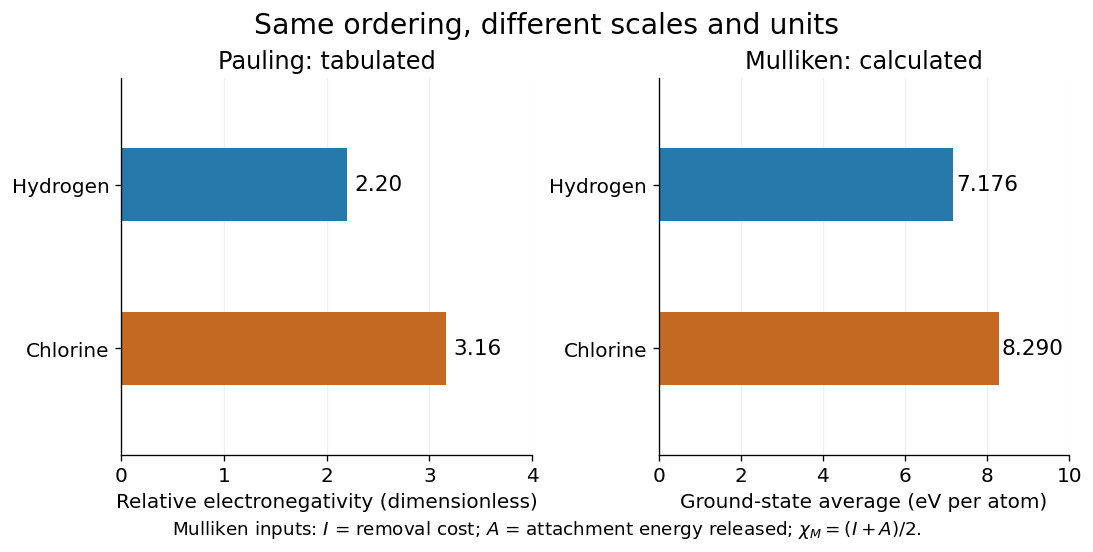
Pauling electronegativity and Mulliken electronegativity for hydrogen and chlorine: separate scales, separate units; the Mulliken electronegativity values are calculated from the stated ground-state inputs
. Details. A larger electronegativity difference often suggests stronger bond polarization, but there is no universal numerical boundary where a covalent bond suddenly becomes ionic bonding. Tables of cutoffs are classification aids with exceptions. Hydrogen fluoride, for example, is described by a polar covalent bond even when its electronegativity difference exceeds a textbook's nominal ionic threshold. The actual electron density, physical setting, and chemical substance's structure matter.[ref]
Chemistry 2e. §7.2, “Electronegativity and Bond Type”, general-guide warning and HF exception
The distinction from ionization energy is equally useful: an ionization energy measures the cost of removing an electron from a specified isolated species, whereas electronegativity compares attraction for electron density in a bonded environment. Neither the removal cost alone nor the attachment release alone supplies a unique bonded-atom electronegativity. A scale combines selected measured inputs with a model and a convention.[ref]
electronegativity. E01990: multiple definitions; Mulliken average versus Pauling bond-energy differences
For an original relative comparison, stipulate fictitious bonded sites on one chosen dimensionless electronegativity scale:The electronegativity heuristic predicts bond polarization towards in , towards in , and towards in . Shifting leaves every comparison unchanged. Although the difference is twice the difference, this does not make its partial atomic charge or bond dipole twice as large: those require additional information about electron density and bond length. These symbols describe a stipulated ordering, not a table of measured chemical elements.
Keep the chemical context attached to that ordering. A chemical atom in a molecule has neighbours and an electron configuration; an isolated-atom energy scale and a bonded-atom comparison are different constructions. The chemical environment dependence of electronegativity explains why a table is a useful approximation rather than an immutable property of every site. Furthermore, an applied electric field can induce bond polarization even between identical chemical atoms, through electric polarizability; equal tabulated electronegativity does not forbid that response.
Photodissociation separates a molecule into fragments after photon absorption. For an isolated parent with a single absorbed photon, conservation of energy givesInternal excitation energies here are relative to the parent and product ground states used to define ; is the total product translational kinetic energy in the parent's centre of mass frame. Measuring one product's kinetic energy is insufficient by itself. For two fragments of masses , conservation of momentum gives when is detected. Unknown product excitation can conceal part of the available energy.
A bond-dissociation energy specifies the energy needed for a stated dissociation into separated fragments. An energy from the lowest vibrational state, an energy from the bottom of a potential energy well, and a finite-temperature molar dissociation enthalpy require different conventions; do not silently mix them in an electronegativity formula.
Which fragments, in which quantum states, and at which temperature? For a neutral gaseous molecule with a specified two-electron covalent bond, the usual thermochemical convention is homolysis,Each fragment receives one of the two bonding electrons; the dots denote unpaired electrons. The final fragments are isolated from each other, with their own relaxed molecular geometry and specified electronic quantum states. The energy cost includes this relaxation, rather than merely stretching the initial chemical bond while freezing everything else. For a neutral parent, heterolysis instead produces , or the opposite assignment of electric charges; those are different final states and different energies. A value for gaseous neutral fragments cannot be transferred to ions, a chemical solution, or a solid without accounting for those changed conditions.[ref]
bond-dissociation energy. definition of bond-dissociation energy: molar enthalpy for homolysis of a specified molecular entity
The distinction is useful beyond terminology. Pauling electronegativity compares consistently defined bond-dissociation energies; photodissociation can reveal a specified ground-state threshold; a thermal chemical reaction balance requires compatible enthalpies. A threshold is also different from an activation energy: it compares initial and final quantum states, whereas a barrier can obstruct the path between them.
Density-gradient centrifugation uses a liquid whose density varies along the separation direction. A band does not by itself establish which mechanism produced it: rate-zonal centrifugation separates by migration rate before equilibrium, whereas isopycnic centrifugation uses equilibrium positions set by buoyant density.
The distinction is between a moving clock and a restoring balance. In rate-zonal centrifugation, two species may occupy different positions because their sedimentation coefficients differ, even when their buoyant densities agree. In isopycnic centrifugation, two differently sized species can converge to the same band because their buoyant densities agree. Conversely, equal mass does not ensure equal migration velocity: shape affects drag force, and medium density affects buoyancy.[ref]
An Introduction to Ultracentrifugation by Beckman Coulter Life Sciences. The Physics Behind the Technology; Rate Zonal Centrifugation; Isopycnic Centrifugation: migration properties versus matching density
The worked finite-time rate-zonal separation and linear-gradient isopycnic focusing examples isolate these mechanisms in chosen mathematical models. The actual DNA experiment described under isopycnic centrifugation illustrates the second mechanism; its initial collection of biological cells into centrifugation pellets is a different operation from the later molecular banding. Collecting liquid fractions from a tube can recover material at different positions, but the position alone does not identify its molecules or establish purity.
Differential centrifugation successively separates centrifugation pellets from supernatants by differences in settling rate. A first centrifugation pellet can enrich faster-settling material; a later centrifugation pellet from its supernatant can enrich slower-settling material. The fractions overlap because particles have different starting positions and can become trapped. Differential centrifugation is consequently an enrichment method, not automatic identification or complete purification.[ref]
https://www.beckman.com/resources/technologies/centrifugation/principles/particle-separation/. Particle Separation: differential pelleting, smaller particles initially near the tube bottom, and incomplete separation
The sedimentation coefficient is radial drift velocity divided by local centrifugal acceleration. It has units of time and combines particle properties with those of the surrounding liquid. In a dilute, deterministic mathematical model with negligible particle inertia, an effective displaced volume , particle mass , local liquid density and linear friction coefficient giveThe subtraction represents buoyancy. Equal mass does not imply equal : changing shape changes drag force, and changing the medium changes both buoyancy and viscosity.[ref]
https://www.beckman.com/resources/technologies/centrifugation/ultracentrifugation/. An Introduction to Ultracentrifugation, The Physics Behind the Technology: mass, size, shape, medium density and viscosity
For an isolated sphere of radius and uniform density , Stokes's law supplies , where is dynamic viscosity, and . ThereforeThis original force-balance check predicts fourfold on doubling with everything else fixed, and zero drift when . It applies to dilute isolated spheres in Stokes flow, not arbitrary folded proteins or crowded suspensions. If and remain constant in a uniform medium, the ordinary differential equation has the exponential function solution . Arrival at an outer boundary therefore depends on starting position as well as ; a separation has no universal size cutoff.
A supernatant is the liquid remaining above settled or pelleted material. It can contain dissolved molecules and particles that have not reached the centrifugation pellet; a visually clear supernatant need not be chemically empty.
A centrifugation pellet is material accumulated against the vessel wall by centrifugation. Its existence establishes collection, not purity; other suspended material can be trapped or co-sediment.
A centrifuge rotor holds sample vessels around the rotation axis. A fixed-angle centrifuge rotor holds tubes at a fixed inclination; a swinging-bucket centrifuge rotor lets them swing outward during rotation. Material moves away from the axis, so a centrifugation pellet can first collect against an outer tube wall rather than travel along the entire tube axis. Geometry sets both the rotor radius and the travel distance.[ref]
Basics: Centrifugal Force & Centrifuge Type by Eppendorf. Basics: Centrifugal Force & Centrifuge Type, Fixed-angle or swing-bucket rotors? and Fixed-angle rotor: tube orientation and pellet position
A small storage location within a CPU used by its instructions. Some hold data; others describe control state, such as the program counter or stack pointer. Saving and restoring processor registers lets different software threads reuse the same CPU while retaining separate execution contexts.
Förster resonance energy transfer is a nonradiative transfer of energy from an excited state of a FRET donor to a nearby FRET acceptor, through coupling of their electric dipoles. The transfer step does not emit a photon that the FRET acceptor subsequently absorbs. It competes with the FRET donor's own fluorescence and other routes out of its excited state. A fluorescent FRET acceptor can then emit fluorescence; an absorbing but nonfluorescent FRET acceptor can still receive the transferred energy.[ref]
Advanced Fluorescence Microscopy Techniques—FRAP, FLIP, FLAP, FRET and FLIM by Hellen C. Ishikawa-Ankerhold and others. §3.1: nonradiative dipole coupling and a potentially nonfluorescent acceptor
The striking use of FRET is to turn a change in molecular proximity into an optical readout. Proteins carrying a FRET donor and a FRET acceptor may change the readout when they associate, as in the chemotaxis FRET assay; two labels on one protein may report a change in its shape. Interpretation depends on the FRET spectral overlap, FRET dipole orientation factor and labeling geometry, as well as separation. A change in FRET is therefore evidence about proximity under specified conditions, rather than a direct measurement of an arbitrary distance.[ref]
Advanced Fluorescence Microscopy Techniques—FRAP, FLIP, FLAP, FRET and FLIM by Hellen C. Ishikawa-Ankerhold and others. §3.1 and §3.3: dependence on distance and orientation; inter- and intramolecular applications
For a single pair with fixed Förster distance and label separation , the FRET efficiency isAt , half the FRET donor excitations transfer energy. At , the model gives ; at , it gives . The sixth power makes FRET especially useful near the Förster distance, with little sensitivity to further separation once transfer is already negligible. These are model calculations, not measurements of a particular pair.
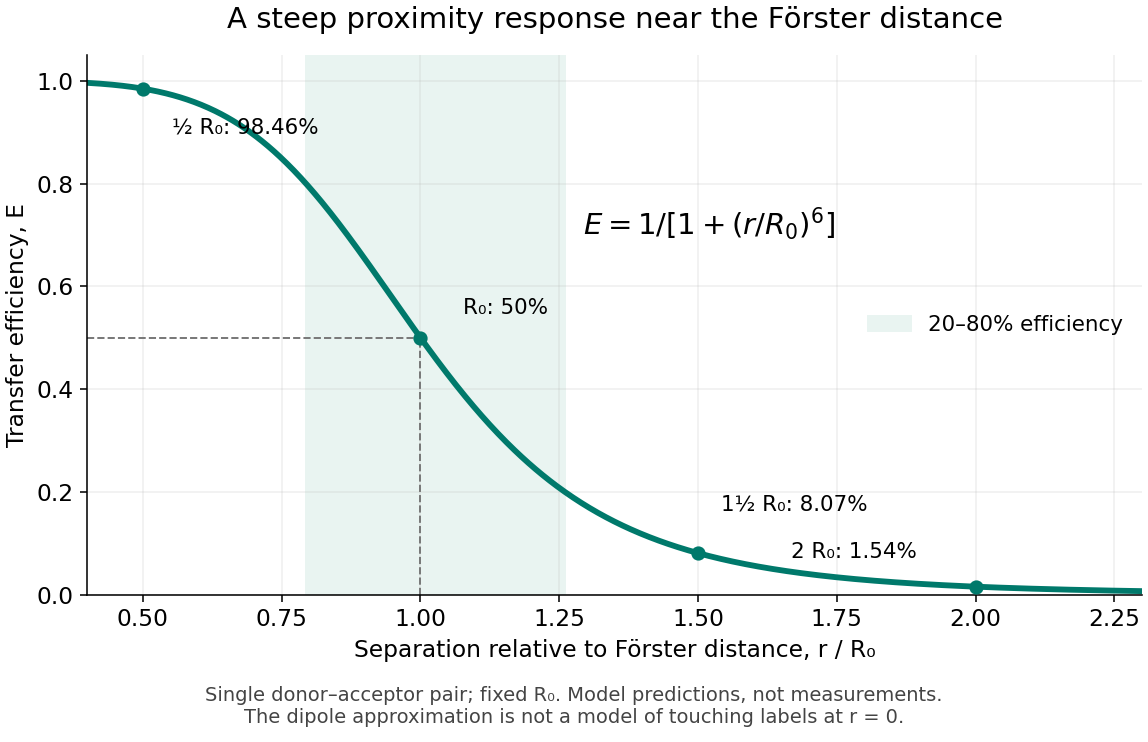
FRET efficiency versus separation relative to the Förster distance
. Original single-pair mathematical model with fixed Förster distance. The shaded interval is . The curve does not establish a universal working range or justify the electric dipole approximation for overlapping labels. Details. Density Gradient Centrifugation by Beckman Coulter Life Sciences by  Codex 0 Created 2026-10-13 Updated 2026-10-31
This source is credited to an organization.
An Introduction to Ultracentrifugation by Beckman Coulter Life Sciences by Codex 0 Created 2026-10-13 Updated 2026-10-31
Codex 0 Created 2026-10-13 Updated 2026-10-31This source is credited to an organization.
Particle Separation by Beckman Coulter Life Sciences by Codex 0 Created 2026-10-13 Updated 2026-10-31
Codex 0 Created 2026-10-13 Updated 2026-10-31This source is credited to an organization.
Basics: Centrifugal Force & Centrifuge Type by Eppendorf by Codex 0 Created 2026-10-13 Updated 2026-10-31
Codex 0 Created 2026-10-13 Updated 2026-10-31By Eppendorf.
Publisher: Eppendorf.
This source is credited to an organization.
Online text: www.eppendorf.com/gb-en/lab-academy/life-science/cell-biology/basics-in-centrifugation/
Cited passages: Basics: Centrifugal Force & Centrifuge Type, Fixed-angle or swing-bucket rotors? and Fixed-angle rotor: tube orientation and pellet position; Important definitions, Rcm vs rpm, and How to calculate relative centrifugal force: radius dependence and acceleration ratio.
The replication of DNA in Escherichia coli by Matthew Meselson and Franklin W. Stahl by Codex 0 Created 2026-10-13 Updated 2026-10-31
Codex 0 Created 2026-10-13 Updated 2026-10-31Published in Proceedings of the National Academy of Sciences of the United States of America.
The isolation of protoplasts from Bacillus megaterium by controlled treatment with lysozyme by Claes Weibull by Codex 0 Created 2026-10-13 Updated 2026-10-31
Codex 0 Created 2026-10-13 Updated 2026-10-31By Claes Weibull.
Published in Journal of Bacteriology.
Cited passages: pp. 688–689, Materials and Methods; pp. 692–694, release comparison and Figure 6.
A chemical method for fast and sensitive detection of DNA synthesis in vivo by Adrian Salic and Timothy J. Mitchison by Codex 0 Created 2026-10-13 Updated 2026-10-31
Codex 0 Created 2026-10-13 Updated 2026-10-31Publisher: National Academy of Sciences.
Published in Proceedings of the National Academy of Sciences of the United States of America 105(7), 2415–2420.
Online text: pubmed.ncbi.nlm.nih.gov/18272492/
Cited passages: A chemical method for fast and sensitive detection of DNA synthesis in vivo, Figure 4 legend: mouse pulse, section preparation and imaging; Figure 2 legend, A–M: NIH 3T3 controls, fluorescence and differential interference contrast imaging, exposure-time comparison.
Pinned article: Introduction to the OurBigBook Project
Welcome to the OurBigBook Project! Our goal is to create the perfect publishing platform for STEM subjects, and get university-level students to write the best free STEM tutorials ever.
Everyone is welcome to create an account and play with the site: ourbigbook.com/go/register. We belive that students themselves can write amazing tutorials, but teachers are welcome too. You can write about anything you want, it doesn't have to be STEM or even educational. Silly test content is very welcome and you won't be penalized in any way. Just keep it legal!
Intro to OurBigBook
. Source. We have two killer features:
- topics: topics group articles by different users with the same title, e.g. here is the topic for the "Fundamental Theorem of Calculus" ourbigbook.com/go/topic/fundamental-theorem-of-calculusArticles of different users are sorted by upvote within each article page. This feature is a bit like:
- a Wikipedia where each user can have their own version of each article
- a Q&A website like Stack Overflow, where multiple people can give their views on a given topic, and the best ones are sorted by upvote. Except you don't need to wait for someone to ask first, and any topic goes, no matter how narrow or broad
This feature makes it possible for readers to find better explanations of any topic created by other writers. And it allows writers to create an explanation in a place that readers might actually find it.
Figure 1. Screenshot of the "Derivative" topic page. View it live at: ourbigbook.com/go/topic/derivativeVideo 2. OurBigBook Web topics demo. Source. - local editing: you can store all your personal knowledge base content locally in a plaintext markup format that can be edited locally and published either:This way you can be sure that even if OurBigBook.com were to go down one day (which we have no plans to do as it is quite cheap to host!), your content will still be perfectly readable as a static site.
- to OurBigBook.com to get awesome multi-user features like topics and likes
- as HTML files to a static website, which you can host yourself for free on many external providers like GitHub Pages, and remain in full control

Figure 2. You can publish local OurBigBook lightweight markup files to either OurBigBook.com or as a static website.
Figure 3. Visual Studio Code extension installation.
Figure 5. . You can also edit articles on the Web editor without installing anything locally. Video 3. Edit locally and publish demo. Source. This shows editing OurBigBook Markup and publishing it using the Visual Studio Code extension. 
- Infinitely deep tables of contents:




All our software is open source and hosted at: github.com/ourbigbook/ourbigbook
Further documentation can be found at: docs.ourbigbook.com
Feel free to reach our to us for any help or suggestions: docs.ourbigbook.com/#contact