Topics (384k) Articles (398k) Users (410) Discussions (242) Comments (383) Files (13k) New article

A quintic equation is a one-variable polynomial equationOver the complex numbers, it has five roots of a polynomial counted with multiplicity of a root, by the fundamental theorem of algebra. Over the real numbers, at least one root is real because the leading odd-degree term makes the polynomial take opposite signs far enough in the two directions.
Some quintics are easy to solve: has roots . The Abel-Ruffini theorem says that a formula by radicals cannot solve the general quintic equation; it does not rule out special factorizations, other special-function descriptions, or numerical root finding. Thus failure of a universal radical formula does not prevent exact or approximate solutions of particular equations.
A uniform polyhedron has regular polygonal faces and a symmetry group acting transitively on its vertices. Thus every vertex has the same surrounding face pattern, but that pattern may use more than one regular polygon type. The definition includes both convex examples and, under the broader convention, star-faced or self-intersecting examples.
A cube is uniform: each vertex meets three congruent squares, and its rotational symmetries carry any vertex to any other. A cuboctahedron has triangles and squares, alternating around every vertex, and is also uniform. Uniformity does not require every pair of faces to be related by a symmetry; that stronger face condition distinguishes regular solids.
The requirement is geometric. Merely drawing a polyhedron with the same number of incident edges at every vertex does not ensure regular faces or a vertex-transitive symmetry group. Regular prisms and regular antiprisms supply infinite families of convex uniform polyhedra.
An -gonal antiprism is a polyhedron with two parallel congruent -gon bases, one rotated relative to the other, and a band of triangular side faces joining them. For the usual convex regular realization, both bases are regular and all side triangles are equilateral triangles.
Its combinatorial counts are , , and : the bases contribute edges and the zigzag side band another . Hence , agreeing with Euler characteristic. A triangular antiprism is an octahedron; a square antiprism has eight vertices, two square bases and eight triangular side faces.
A prism instead joins corresponding base vertices with a band of quadrilateral faces. The relative rotation and triangular band are the defining differences in the antiprism construction.
The AAUAAA signal is a six-nucleotide RNA sequence involved in cleavage and polyadenylation of many eukaryotic pre-mRNAs. Recognition of the signal helps organize processing downstream, after which a poly(A) tail is added. The signal itself is an encoded part of the RNA; the tail is subsequently synthesized and is not simply a copied run of genomic adenines. [ref]
Mutating the signal and comparing processing of defined RNA substrates supplied a direct functional test. The result concerns a particular processing context: other surrounding sequences and protein factors also contribute, and biological polyadenylation sites can use signal variants. Sequence recognition, cleavage position and final tail length are separate features of the mature transcript.
A saccharimeter is a polarimeter calibrated for measuring sugar concentration through optical rotation. A sample rotates the plane of polarization, and the instrument determines the angular change under specified optical conditions.
For a single optically active solute in the appropriate dilute regime,where is the optical path length and the concentration in units consistent with the stated specific rotation. Calibration, wavelength and temperature matter. Other optically active solutes, changing sugar composition or mutarotation can change the rotation, so a sugar-mixture measurement need not directly equal one compound's concentration.
A homogeneous Poisson point process on has constant intensity , with intensity measure for Lebesgue measure . Counts on disjoint measurable sets are independent, and has a Poisson distribution of mean when that volume is finite.
On the real line, an interval of length is empty with probability . Homogeneity alone is insufficient: the randomly shifted lattice , with uniform on , has translation-invariant intensity one but exactly one point in each half-open unit interval. It therefore fails the Poisson count law. Constant average density and independent random counts are different requirements.[ref]
Lectures on the Poisson Process by Günter Last and others. Chapter 3, Poisson count law and constant-intensity specialization
An orbit is a dense orbit in a topological space if its closure is all of . For a forward map orbit, this means that every nonempty open subset contains some iterate . A dense orbit visits every region distinguishable by the topology; it need not pass through every point.
An irrational rotation of the circle has dense orbits, whereas a rational rotation has finite periodic orbits. Density is a topological property and does not specify frequencies of visits. Equidistribution and ergodicity make stronger statements involving a specified measure, so neither should be inferred merely from one dense trajectory.
The esophageal balloon occlusion test checks how well changes measured by an esophageal balloon catheter track changes in pleural pressure. During an inspiratory effort against an occluded airway at end-expiration, the comparison is between the pressure change in the balloon and that at the mouth. The original study by Ahmet Baydur and colleagues tested ten subjects in sitting, supine and lateral positions. Repositioning the balloon could improve agreement when a supine measurement initially differed.[ref]
A Simple Method for Assessing the Validity of the Esophageal Balloon Technique by Ahmet Baydur and others. Abstract, end-expiratory occlusion protocol and positional findings
The mechanical rationale is a change comparison. With no external flow and approximately fixed lung volume, the change in transpulmonary pressure is small in the simple static model. Consequently,for a balloon that transmits pleural changes appropriately. The reasoning assumes communicating airways and a suitable measurement system; it does not establish equality merely because flow at one sensor is zero.
An original example uses simultaneous mouth-pressure changes cm HO and balloon changes cm HO. Their proportional response is 0.9. Repeating several efforts makes that relation more visible than interpreting one small pressure fluctuation in isolation.
Importantly, a successful change test does not determine the absolute offset. If a hypothetical sensor obeys , the ratio of changes assesses , while the constant cancels. A true pleural change from to recorded as 0 to has unit change ratio despite a 5 cm HO offset. Esophageal pressure measurement therefore needs a clear distinction between tracking respiratory swings and assigning an absolute pressure for a transpulmonary calculation. The test interrogates pressure transmission, not every possible source of measurement error.
Esophageal pressure measurement records pressure in the oesophagus, commonly with an esophageal balloon, to obtain information about respiratory mechanics and pleural pressure. The measured signal is a local surrogate. It is not a direct map of pressure everywhere in the pleural cavity.
A primary validation experiment by Ahmet Baydur and collaborators compared changes in esophageal and mouth pressure during end-expiratory airway occlusion and spontaneous efforts. Ten subjects were studied in different postures; some discrepancies changed when the balloon was repositioned.[ref]
A Simple Method for Assessing the Validity of the Esophageal Balloon Technique by Ahmet Baydur and others. Abstract: subjects, posture, occlusion and repositioning
The esophageal balloon occlusion test therefore evaluates pressure-change transmission under specified conditions, rather than proving all absolute-pressure values correct.In an ideal local model, write . If and remain fixed during an effort, thenwhen mouth and pleural pressure changes coincide under the test's assumptions. A ratio near one supports transmission gain near one, but leaves unidentified. Even perfect change agreement cannot determine that constant baseline offset.
The consequence matters when calculating transpulmonary pressure . For an illustrative alveolar pressure of 15 and true local pleural pressure of , the difference is eight. Substituting an esophageal reading of nine with an uncorrected offset of two gives six instead. The arithmetic identifies an error mechanism; it does not supply a clinical correction or assume that all pleural regions have pressure seven.
An esophageal balloon is a thin-walled pressure-sensing balloon placed in the oesophagus and connected to a pressure-measurement system. Its mechanical purpose is to couple surrounding pressure to the gas inside it. An esophageal balloon catheter supplies the pneumatic connection; esophageal pressure measurement concerns the interpretation of the resulting signal as evidence about pleural pressure.
A useful idealization separates the contributions:where balloon tension, tissue reaction and an instrumental offset can affect the reading. This additive model is bookkeeping, not a universal constitutive law for the tissue or balloon. A pressure change can be transmitted well even when the baseline has an offset.
The primary physiological study by Francesco Mojoli and collaborators changed balloon filling and compared pressure transmission with baseline contributions from the esophageal wall. Its observations demonstrate that favorable transmission of pressure swings does not by itself remove the esophageal balloon filling artifact.[ref]
In vivo calibration of esophageal pressure in the mechanically ventilated patient makes measurements reliable by Francesco Mojoli and others. Abstract and Results: filling, transmitted changes and wall-pressure contribution
For a constructed example, suppose surrounding pressure changes from 6 to while a fixed added pressure is . The balloon reads 8 and 12: it reproduces the change exactly but overestimates both absolute values by two. Consequently, agreement of a change measurement is a different validation claim from agreement of absolute pressure. Neither the balloon's name nor its presence inside the chest makes those claims automatic.
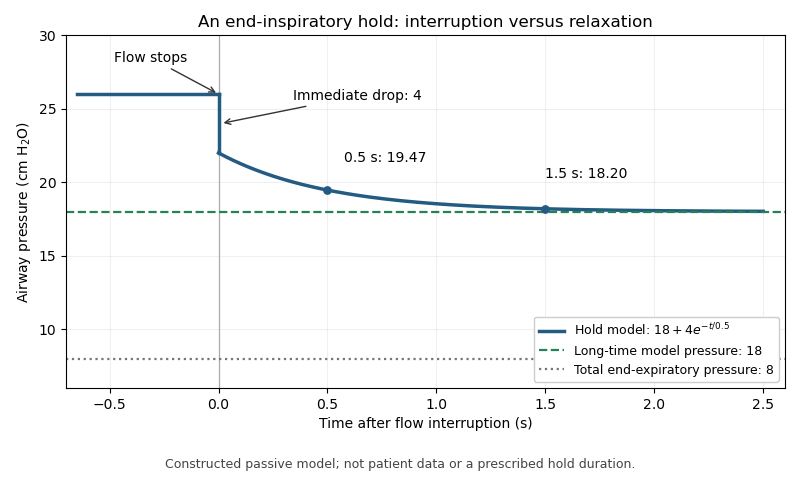
An end-inspiratory hold is a pause after inflation during which the airway is occluded and external flow is interrupted. Under passive, leak-free conditions, the resulting pressure trace helps distinguish flow-related airway resistance from the pressure remaining at approximately fixed lung volume. A stable endpoint provides a plateau airway pressure for interpreting respiratory-system compliance.[ref]
How to measure driving pressure by Hamilton Medical. End-inspiratory hold; passive and leak-free measurement conditions
Stopping flow does not imply that every compartment instantaneously reaches a common pressure. Stress relaxation, redistribution between lung regions and the apparatus response can produce a continuing pressure change after the rapid resistive drop. The measured value should therefore identify the observation interval, rather than treating the first post-interruption sample as universally equilibrated.
For an original illustrative trace, suppose flowing peak pressure is 26 cm HO and stopping flow immediately removes 4 cm HO. Let the subsequent relaxation beThe initial hold value is 22 cm HO, about 19.47 remains after 0.5 s, and about 18.20 after 1.5 s. The model's long-time value is 18. The change from 26 to 22 and the later change from 22 toward 18 represent different mechanisms in this constructed example.
With total end-expiratory pressure 8 cm HO, using the initial hold value gives a nominal respiratory driving pressure of 14, whereas using the asymptotic value gives 10 cm HO. The difference demonstrates the importance of time and model assumptions; it does not prescribe a hold duration. Continued muscle activity, leakage or airway closure can invalidate the simple static interpretation. The experimental pilot study compares static and dynamic measurement methods rather than assuming all displayed pressure estimates are interchangeable.[ref]
Static and Dynamic Measurements of Compliance and Driving Pressure: A Pilot Study by Pierre Tawfik and others. Figure 1 and Study Procedures
The plant epidermis is the outer cellular tissue covering much of the primary plant body. It separates internal tissues from the surroundings while accommodating exchange through specialized structures. In leaves, guard cells regulate openings called stomata; on aerial surfaces a plant cuticle helps restrict uncontrolled water loss. The living epidermal cells and the overlying plant cuticle are distinct structures.[ref]
The surface is an active interface. A 2001 experiment imposed different intracellular calcium oscillation patterns on Arabidopsis thaliana guard cells. The timing and amplitude of these signals affected sustained stomatal closure. This connects biochemical signaling within an epidermal cell type to a measurable opening in the organ surface.[ref]
A defined range of guard cell calcium oscillation parameters encodes stomatal movements by G. J. Allen and others. Abstract: calcium-clamp manipulation and aperture response
A leaf surface view and a cross-section answer complementary questions. The surface view can reveal the distribution of stomata; the cross-section locates the plant epidermis relative to internal tissues. Neither a shiny outer coating alone nor a single visible pore identifies every constituent cell type.
A protoplanet is a growing planetary body within a planet-forming system. It has accumulated enough mass for gravity to strongly influence subsequent collisions and accretion, while its final orbit, composition and mass may still change substantially.
Accreting a small mass onto a body of mass and radius can release energy of order . Heating, melting and chemical differentiation can therefore accompany growth. A protoplanet may continue to accumulate, merge with another body, lose material or be scattered; the name describes a stage of evolution rather than guaranteeing a particular final planet.
A velar consonant forms its main constriction between the back of the tongue and the soft palate. The label identifies a place of articulation. The soft palate's separate role in controlling the nasal airflow route means that velar place does not itself imply a nasal manner of articulation.[ref]
Essentials of Linguistics (2nd edition) by Catherine Anderson and others. §3.3, tongue dorsum and velar articulation
The sounds
[k] and [g] are velar oral stops, while [ŋ] is a velar nasal consonant. All involve a similar oral constriction region, but they differ in airflow route and usual voicing. The precise contact position can also shift with neighboring vowels. Describing a region of contact is therefore more informative than imagining one fixed point used identically in every utterance.A labiodental consonant forms its principal constriction between the lower lip and upper teeth. This is a place of articulation, distinct from the two-lip constriction of a bilabial consonant. It does not by itself specify voicing or manner of articulation.[ref]
The familiar sounds
[f] and [v] are labiodental fricatives. Comparing them keeps the constriction location similar while changing the usual voicing category. Comparing [f] with [p] instead changes both the contact surface and the airflow mechanism. A mirror can show lower-lip contact with the upper teeth, while acoustic phonetics examines the resulting noise and periodicity.A bilabial consonant uses the two lips to form its principal constriction. The term specifies place of articulation; it leaves manner of articulation and voicing to be stated separately. The lower lip approaches the upper lip rather than the upper teeth.[ref]
Essentials of Linguistics (2nd edition) by Catherine Anderson and others. §3.3, bilabial place and the lower lip as active articulator
The sounds
[p], [b] and [m] share a bilabial closure. The first two are oral stops, while [m] permits nasal airflow; their shared lip position therefore does not determine whether sustained sound is possible during closure. A mirror provides direct evidence of the lip configuration, but it cannot alone establish the state of the vocal folds or the soft palate.The visual cycle is the set of biochemical transformations that regenerates the light-sensitive retinal supply of visual pigments after illumination. In the classical rod pathway, a photon absorbed by rhodopsin converts its bound 11-cis-retinal toward all-trans-retinal. Subsequent processing involving the photoreceptor and the retinal pigment epithelium returns retinal to a form that can rebuild light-sensitive pigment. This recycling connects a rapid light-triggered molecular event to slower recovery of sensitivity.[ref]
Crystal Structure of Rhodopsin: A G Protein-Coupled Receptor by Krzysztof Palczewski and others. Page 739: photoisomerization, dissociation of photolyzed retinal and regeneration from 11-cis-retinal supplied by adjacent epithelial cells.
A useful experiment interrupted this supply rather than removing the receptor itself. T. M. Redmond and collaborators disrupted RPE65 in mice and measured retinal compounds and visual responses. The animals lacked normal rhodopsin and rod electroretinography responses even though rod opsin remained; all-trans retinyl esters accumulated, while 11-cis retinoids were absent. These results established that RPE65 is necessary for the normal production of 11-cis vitamin A derivatives in this pathway.[ref]
Rpe65 is necessary for production of 11-cis-vitamin A in the retinal visual cycle by T. M. Redmond and others. Abstract and experimental comparison of Rpe65-deficient and control mice.
The contrast supplies an illuminating example of biochemical dependence: a cell may retain a receptor protein yet lose the response because it cannot regenerate the small molecule required by that receptor. The visual cycle is the chemical recycling pathway; electroretinography measures an electrical consequence of its success or failure. The knockout establishes necessity in the tested pathway and conditions, rather than proving that every photoreceptor follows an identical regeneration route.
Electroretinography records electrical responses generated by the retina when it is stimulated with light. In full-field electroretinography, diffuse flashes stimulate a broad retinal area, and an electrode at or near the eye records a potential difference relative to a recording reference. The trace is a summed response of retinal tissue, rather than a recording of one photoreceptor or a direct report of perceived brightness.[ref]
ISCEV Standard for full-field clinical electroretinography (2022 update) by Anthony G. Robson and others. Sections on full-field stimulation, recording electrodes and standard responses.
Dark-adapted and light-adapted recordings help distinguish response systems under controlled conditions. Standardization matters because flash strength, adaptation and electrode configuration change the trace. A simple experimental comparison uses the same flash and recording arrangement before and after an intervention: differences then become evidence about which retinal processes contribute, subject to the intervention's selectivity.[ref]
ISCEV Standard for full-field clinical electroretinography (2022 update) by Anthony G. Robson and others. Dark-adapted and light-adapted standard-response protocols.
The positive b-wave illustrates how component interpretation is tested. Richard A. Stockton and Malcolm M. Slaughter measured retinal field responses together with extracellular potassium changes in amphibian preparations. A drug that suppressed ON retinal bipolar cell responses also removed the b-wave; treatments suppressing OFF-pathway responses removed the light-offset d-wave while preserving the b-wave. This supported a central role for ON retinal bipolar cell activity in generating the b-wave, rather than treating all deflections as direct rod voltages.[ref]
An independent example is the RPE65 knockout: disrupted visual cycle chemistry caused loss of normal rod responses on electroretinography, connecting pigment regeneration to a measurable tissue-level signal.[ref]
Rpe65 is necessary for production of 11-cis-vitamin A in the retinal visual cycle by T. M. Redmond and others. Rod electroretinographic phenotype and retained cone function.
Detector baseline subtraction estimates the non-signal level of a photodetector readout and subtracts it before interpreting the desired signal. The baseline can include electronic offset, dark current and background light. Subtracting its estimated mean removes a bias contribution; it does not remove the random fluctuations that occurred in the measurement.
For a current readout over a detection time gate, a constant baseline estimate givesIf the true constant baseline is , its contribution to the charge error is . An original example has and a baseline overestimate of1nanoampere. The corrected charge is then10femtocoulombs too low. A longer gate amplifies this fixed baseline-estimation error linearly.
A finite baseline record also adds uncertainty. Suppose equally spaced signal-window samples and separate baseline samples each have independent zero-mean noise of variance , and the baseline estimate is their arithmetic mean. With spacing ,The same estimated baseline is subtracted from every signal sample, so its error is shared rather than independently redrawn times. For , and , the standard uncertainty is about14.1femtocoulombs. Treating the baseline as known would give only10femtocoulombs. These are stipulated independent-noise values, not a detector specification.
Baseline drift motivates measuring the baseline near the signal in time. The SR250's active subtraction mode alternates signal-present and signal-absent triggers, reversing the baseline sample's sign before averaging.[ref]
SR250 Gated Integrator by Stanford Research Systems. PDFp2, Polarity Control and Active Baseline Subtraction
Cancellation depends on how well those samples represent the baseline during the signal; a source-correlated artifact need not cancel.In pulse energy measurement with a photodiode, charge-to-energy conversion propagates this baseline error through , where is spectral responsivity. Baseline characterization is therefore part of the energy measurement, not merely a cosmetic shift of a plotted trace.
Pinned article: Introduction to the OurBigBook Project
Welcome to the OurBigBook Project! Our goal is to create the perfect publishing platform for STEM subjects, and get university-level students to write the best free STEM tutorials ever.
Everyone is welcome to create an account and play with the site: ourbigbook.com/go/register. We belive that students themselves can write amazing tutorials, but teachers are welcome too. You can write about anything you want, it doesn't have to be STEM or even educational. Silly test content is very welcome and you won't be penalized in any way. Just keep it legal!
Intro to OurBigBook
. Source. We have two killer features:
- topics: topics group articles by different users with the same title, e.g. here is the topic for the "Fundamental Theorem of Calculus" ourbigbook.com/go/topic/fundamental-theorem-of-calculusArticles of different users are sorted by upvote within each article page. This feature is a bit like:
- a Wikipedia where each user can have their own version of each article
- a Q&A website like Stack Overflow, where multiple people can give their views on a given topic, and the best ones are sorted by upvote. Except you don't need to wait for someone to ask first, and any topic goes, no matter how narrow or broad
This feature makes it possible for readers to find better explanations of any topic created by other writers. And it allows writers to create an explanation in a place that readers might actually find it.
Figure 1. Screenshot of the "Derivative" topic page. View it live at: ourbigbook.com/go/topic/derivativeVideo 2. OurBigBook Web topics demo. Source. - local editing: you can store all your personal knowledge base content locally in a plaintext markup format that can be edited locally and published either:This way you can be sure that even if OurBigBook.com were to go down one day (which we have no plans to do as it is quite cheap to host!), your content will still be perfectly readable as a static site.
- to OurBigBook.com to get awesome multi-user features like topics and likes
- as HTML files to a static website, which you can host yourself for free on many external providers like GitHub Pages, and remain in full control

Figure 2. You can publish local OurBigBook lightweight markup files to either OurBigBook.com or as a static website.
Figure 3. Visual Studio Code extension installation.
Figure 5. . You can also edit articles on the Web editor without installing anything locally. Video 3. Edit locally and publish demo. Source. This shows editing OurBigBook Markup and publishing it using the Visual Studio Code extension. 
- Infinitely deep tables of contents:



All our software is open source and hosted at: github.com/ourbigbook/ourbigbook
Further documentation can be found at: docs.ourbigbook.com
Feel free to reach our to us for any help or suggestions: docs.ourbigbook.com/#contact