
Magnetic field and force. A steady electric current produces a magnetic field. In vacuum the Biot-Savart law givesThe Lorentz force on the charge carriers transfers force to the material carrying them. The resulting force on a current element of another circuit is , or, for a continuous current distribution, the magnetic force per unit volume is .
For two long parallel straight wires a distance apart, Ampère's law gives . ThereforeThe force is attractive for parallel currents and repulsive for opposite currents, by the cross product rule. Its units are . This approximation neglects wire thickness and end effects; a complete circuit includes its return current. Element-by-element forces need not form an isolated Newton's-third-law pair, but complete stationary circuits have balanced mutual forces when the entire system is included.
Energy description. For two linear coupled circuits the magnetic energy isHere is a mechanical coordinate and the signed mutual inductance. At prescribed currents, the generalized force is if the self-inductances do not vary. This positive derivative is obtained from magnetic coenergy, or by including the electrical sources' work; differentiating with a minus sign at fixed currents would omit that source work. At prescribed flux linkages the force instead equals the negative derivative of stored magnetic energy with those linkages fixed. The geometry thus determines both inductance and mechanical force.
The torque difference. Let now be the local angular displacement, and take and the section constant. The local twist per unit length is , so the transmitted torque is . Across a short slice,Thusto first order in slice length.
The slice's angular acceleration. The slice's axial moment of inertia is . Its net torque is the difference of the end torques, soCanceling the common geometry gives the torsional waves in a solid circular rod,For the given steel, . The radius cancels because both torsional stiffness and slice inertia contain the same . This ideal one-dimensional wave model neglects dissipation and additional elastic modes.
For the uniform solid cylinder, the axial moment of inertia isThe rotational kinetic energy at isThis includes the shaft's bulk steady rotation; the small twist does not appreciably alter its mass moment at this order.
The torque rises linearly with elastic twist, so the stored elastic energy is the work integralUsing the transmitted torque and end twist,This is energy associated with deformation, distinct from the much larger kinetic energy of the whole spinning shaft.
Power is transmitted at rate , soFor , and , the polar second moment of area is . HenceThe density does not enter this static torsional deformation.
The extra radial term. A circular Kepler orbit has . In the frame rotating with the synchronously spinning body, centrifugal acceleration increases by across a radial offset . This adds the outward differential accelerationEquivalently, in the inertial frame the farther corotating point needs an extra inward centripetal acceleration , which gravity alone does not supply. The total radial stretching relevant to the static corotating body is therefore . This is the corotating point-mass tidal field. The source's “force” expression is per unit mass.
Self-gravitational survival. Denote the asteroid radius by , distinct from the orbital radius . Its mass is and its surface self-gravitational acceleration is . Compare this restoring acceleration with radial tidal stretching :The corotating tidal-disruption estimate for a uniform sphere isThis is the requested spherical local force-balance estimate, not an exact fluid Roche figure. It neglects deformation and material cohesion.
Take a transverse offset . Its distance from the source changes only at second order, but the direction of the gravitational force changes at first order:in its first-order vector expansion. Subtracting the reference acceleration givesIt compresses the transverse separation. Together with the radial result, this is point-mass tidal stretching and squeezing, with tensor eigenvalues .
For a point mass, . Along the outward radial direction, andThus a small radial displacement has differential accelerationThe farther point falls inward less strongly, so its acceleration relative to the reference point points outward. The formula is first order in .
Both the magnitude of angular momentum and rotational kinetic energy are conserved after the impulse. At fixed , eliminate to writeThe fixed-angular-momentum energy test for principal-axis rotation makes the stability geometric. The largest moment gives a constrained energy minimum, the smallest a maximum, and the intermediate moment a saddle. Conservation of energy keeps a nearby motion near either isolated extremum, but a saddle permits departure in one direction while compensating in another. Thus both extremes are stable without dissipation; it would be incorrect to demand an energy minimum alone in this conservative problem.
Put , with . ThenRotation about the symmetry axis is stable whether that axial moment is larger or smaller than the transverse moment. In fact and are exactly constant for a torque-free axisymmetric body: the transverse components rotate into one another at the stated body-frame frequency. Stability here means bounded wobble, not relaxation back to perfect axial rotation.
For three distinct positive principal moments of inertia, the denominator of is positive. If is the largest moment, the two numerator factors have opposite signs, so . If it is the smallest, they again have opposite signs. If is intermediate, the two factors have the same sign, so . Thus the intermediate axis theorem givesFor the stable cases the body-frame wobble frequency isThe perturbation does not decay in the torque-free conservative model. For the intermediate moment, a generic small impulse excites the growing branch and eventually leaves the linear regime.
Why the shape is immaterial far away. Partition an arbitrary small planar loop into small rectangular loops with the same oriented current. Currents on internal shared edges cancel, leaving only the original boundary. Their magnetic dipole moments add to , with the enclosed area. Far enough away, the leading fields add as dipoles at the same position. The general magnetic dipole field isHigher spatial multipoles contain shape-dependent corrections. The axial and transverse results above are the special directions of this expression.
The aligned terrestrial model. Take the moment to point toward geographic south. At northern latitude , the magnetic dipole inclination versus latitude gives local northward and downward componentsUsing the specified and ,The direction is geographic north and below horizontal, with no eastward component in this ideal model. These values use the latitude printed in the paper.
At the field is perpendicular to the loop plane. Its Biot-Savart numerator isThe leading denominator variation must be kept:The integral of is zero, but its product with is not. Keeping all terms of the leading nonzero order givesFor the counterclockwise rectangle, and . HenceThis transverse field is opposite to the magnetic dipole moment. Replacing every denominator by a constant before examining the term proportional to would give the wrong answer.
Use source coordinates and observation point . The axial numerator in the Biot-Savart law isFor much larger than the loop dimensions, replace the denominator by to leading order. Transverse components cancel between opposite sides. The loop integral is twice its oriented area, soThereforeIt points along on both halves of the dipole axis, not along the signed radial unit vector.
The largest gap field is at the apex: . If the fixed breakdown threshold is , a smooth parallel-plate gap permits , whereas this small hemispherical boss permitsThus the maximum voltage is reduced by a factor of three, within the stated local-field approximation. This comparison holds the material dielectric strength and gap fixed.
On the lower plane outside the boss, write for distance from the boss centre along the plane, so . Differentiate the potential normally before putting :Thus the normal field is andThe source uses for this distance on the plane. Near the rim it tends to zero, while far from the boss it recovers the uniform parallel-plate surface charge.
At the hemispherical surface , the outward normal from the conductor into the gap is . The tangential field is zero there andThe electrostatic interface boundary conditions give surface charge density , because the interior electric field is zero. HenceIt is negative for a positive upper-plate voltage, greatest in magnitude at the apex, and zero at the equator. Its units are coulombs per square metre.
Choose a flat wall and let measure the angle from the direction towards it. Particles of speed in solid angle occupy fraction of an isotropic gas. In time , those within normal distance reach the wall. Their number per area per time is therefore .
Only the incoming hemisphere contributes. Integrating gives the one-way collision rate per unit area,Its units are . This is not : selecting the incoming half of the particles must also account for their mean normal velocity. For effusion through a thin hole whose diameter is much less than the mean free path, the same one-way rate applies because collisions within the opening can be neglected.
Denote the heated and cold vessels by subscripts . For argon, the opposing effusive particle rates are equal in the steady state:Because and ,This is thermal transpiration in the free-molecular limit. It fixes a ratio; the initial conditions determine the absolute pressures.
For the stated two identical vessels, take their fixed volume to be and the combined system sealed. Initially it contains atoms. HenceLet . Combining this inventory with gives the closed-vessel thermal transpiration resultHeating makes the hot side less dense but at higher pressure. Both expressions reduce to when . For a small imposed temperature rise , the pressure difference starts as .
If instead the cold vessel is interpreted as an externally maintained pressure reservoir with , the answer becomes . That alternative requires the fixed-pressure reservoir assumption; it does not conserve the initial particle inventory of two sealed equal-volume vessels. Merely describing the vessels as large does not keep their pressures fixed through the redistribution. The pressures in the boxed answer assume the natural closed-vessel interpretation.
Let L be the vessel initially containing argon and R the vessel initially containing helium. Both have volume and fixed temperature , and the aperture has area . The incoming and outgoing rates of each species must be considered separately. For species ,Thus its density difference relaxes exponentially with time constantThe two-vessel effusive mixing solution for the four densities isUsing atomic masses of approximately and atomic mass units gives . Helium therefore transfers faster. Each species eventually reaches in each vessel, but its transient is different. In particular, the total density temporarily rises in the initially argon vessel and falls in the initially helium vessel, before both return to .
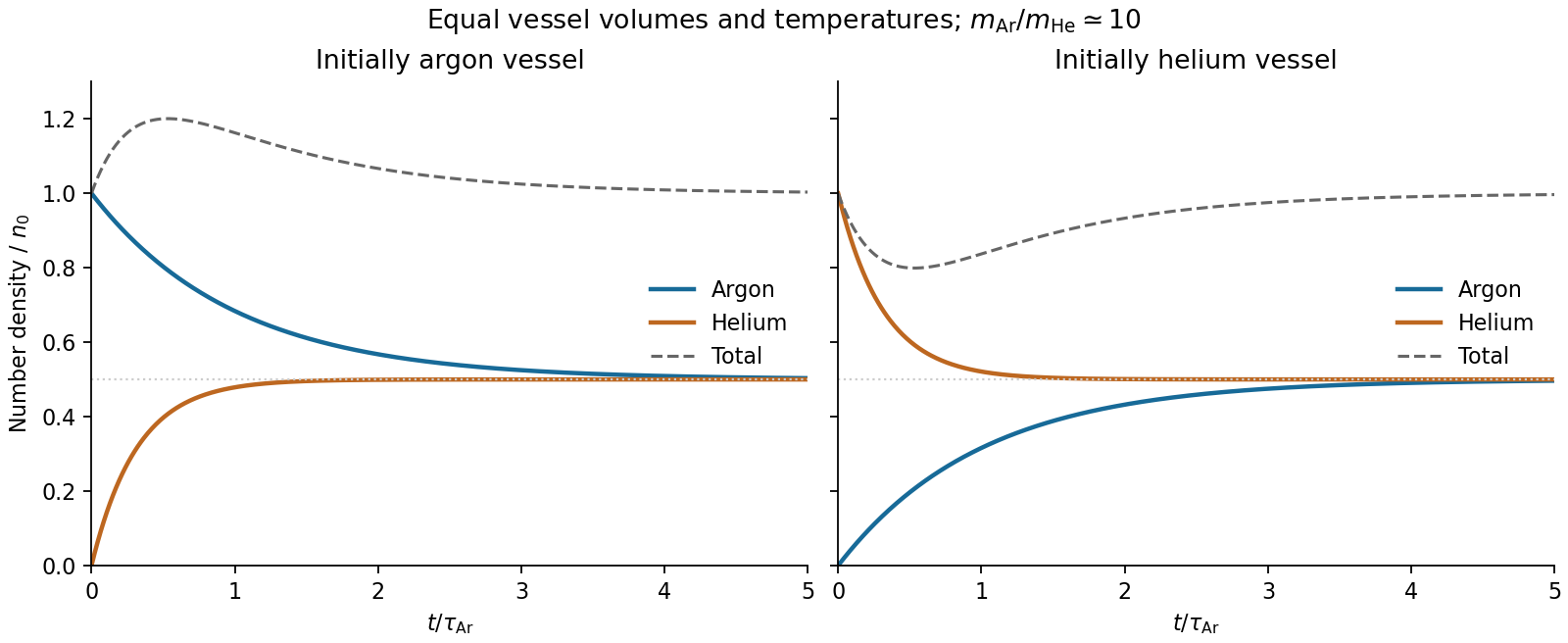

For unequal maintained temperatures , replace the rate equation byWith each species' total density sum still , its final densities and relaxation time areEvery species has the same final density ratio and partial-pressure ratio . Thus there is no permanent composition separation in this ideal steady state, although the rates remain mass dependent. A maintained hot side has lower density and higher pressure. Equal particle rates do not imply thermal equilibrium: atoms arriving from the hotter side carry more energy, so external heating and cooling are required to hold different temperatures. The model assumes thin-hole effusion, local equilibrium within each vessel and negligible aperture volume.
There are unlisted articles, also show them or only show them.