
Wall arrivals are not an unbiased sample of the gas: faster atoms arrive more frequently. The normalized speed distribution among incident atoms isThe angular factor in the arrival rate cancels when calculating the mean kinetic energy. ThusUsing givesBy contrast, an atom chosen randomly from the bulk has mean kinetic energy . The arrival weighting raises the normal-direction contribution to while each tangential direction still contributes . This is also the mean energy carried by atoms effusing through a thin aperture from an equilibrated reservoir.
At every , ,There is no constant-pressure coexistence interval, unstable loop or finite-temperature critical inflection. The isothermal compressibility is positive:Thus this equation of state predicts no liquid-gas phase transition in its physical domain. Its divergence at the excluded-volume boundary is a repulsive constraint, not a liquid-gas coexistence mechanism. This conclusion concerns the stated model and cannot rule out an ordering transition requiring additional physics or an additional thermodynamic variable. Extrapolation to absolute zero is also outside the classical gas model's reliable regime.
For the given one-mole model,At fixed positive temperature its isotherm is an ideal-gas hyperbola shifted right by : pressure diverges as and tends to zero as . Higher temperatures give higher pressure at any fixed allowed volume.
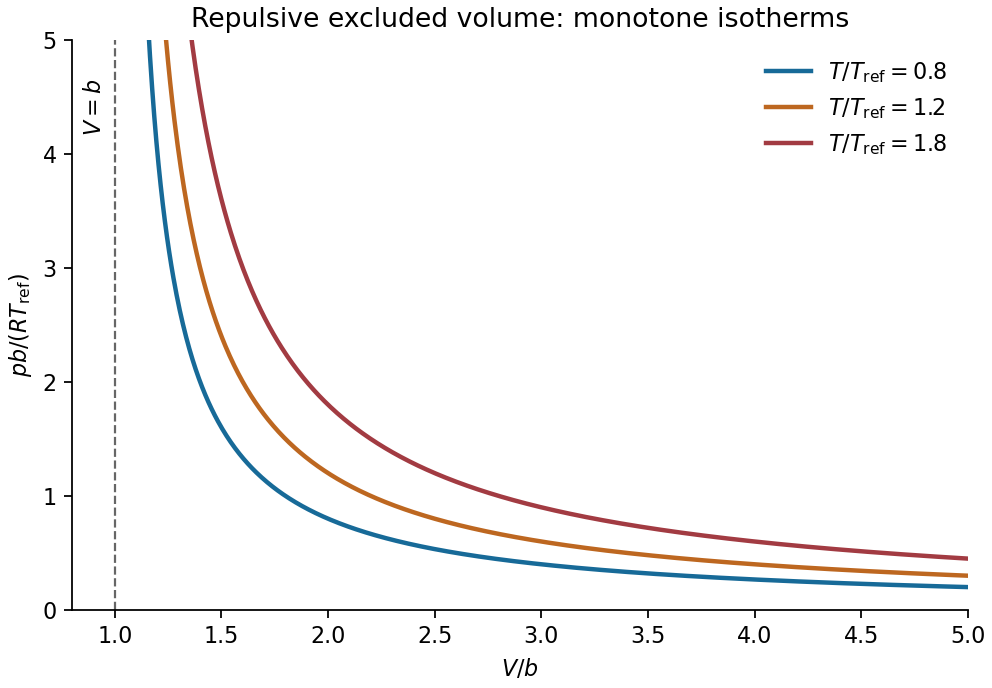

For positive , the volume is the effective volume available to molecular motion. Thus describes excluded-volume repulsion or an effective incompressible molecular core. It is a molar volume in this one-mole equation, not necessarily the literal sum of molecular geometric volume. Setting recovers the ideal gas law. No attractive-energy term is included.
An equation of state relates equilibrium state variables such as pressure, volume, temperature and material amount. At fixed composition, it reduces the number of independent thermodynamic variables. It does not by itself specify all caloric properties: information such as heat capacity or internal energy is also needed.
At a liquid-gas first-order transition, an equilibrium isotherm can contain a constant-pressure interval in which changing total volume changes the phase fractions. A metastable single-phase extrapolation can instead show a region with ; that region has negative isothermal compressibility and is mechanically unstable. Thermodynamic phase coexistence requires equal temperature, pressure and chemical potential, and a consistent free-energy description replaces the unstable region by coexistence. For an appropriate analytic fluid equation of state, a liquid-gas critical point occurs where .
These tests diagnose the phase behaviour represented by that equation of state. They do not guarantee detection of every possible transition involving an additional order parameter which the mechanical equation omits.
For a reversible adiabatic change, , equivalently . Substitute :Integration, with fixed positive reference values , givesSince and ,The relation applies to the quasistatic reversible adiabat. Adiabatic heat isolation alone does not enforce it for an irreversible process which generates entropy. The shifted volume , rather than itself, is the appropriate coordinate in this model.
Use the enthalpy . The equation of state gives , soAt fixed pressure, is constant. ThereforeSince and are constants, this ratio is independent of both temperature and pressure. Although the gas is not mechanically ideal when , its constant-pressure/constant-volume heat-capacity difference remains in this model.
Start with the fundamental relation at fixed material amount, , and expand entropy in independent variables :The last equality uses the supplied Maxwell relation. ConsequentlyFor the excluded-volume ideal gas, , so the bracket vanishes:Once depends only on temperature, cannot depend on volume either. Its stipulated temperature independence therefore makes it a constant, giving with arbitrary energy reference . Excluded volume changes the pressure without adding the volume-dependent attractive internal energy that a more general interacting-gas model might have.
For one mole, , and constant heat capacities satisfy . The specified diatomic-gas model hasA reversible adiabatic process satisfies . Constant-pressure expansion satisfies . Applying these in order givesEvery volume ratio is dimensionless, so the expressions have units of temperature. For the intended volume ordering, the minimum temperature is and the maximum is .
For , Taylor expansion gives . The vanishing-cutoff limit of the Diesel cycle isThe maximum temperature tends to , while the minimum stays at . A Carnot engine between those limiting extrema hasso the limiting efficiencies coincide. At exactly , however, both heat input and net work vanish, and the cycle retraces its compression adiabat. The efficiency there is an undefined ; the boxed value is the continuous limit for neighbouring nonzero cycles, not finite work at zero heat input.
Use heat into the gas as positive. The two adiabatic stages have . During constant-pressure heating and constant-volume cooling,The first law over a complete cycle gives , since the internal energy returns to its initial value. ThereforeSubstitute the temperatures:HenceEquivalently, define compression ratio and cutoff ratio :These formulas use the ideal constant-heat-capacity model and reversible adiabatic strokes. The heat-addition and heat-rejection strokes occur over changing gas temperatures, unlike the isothermal heat exchanges of a Carnot engine.
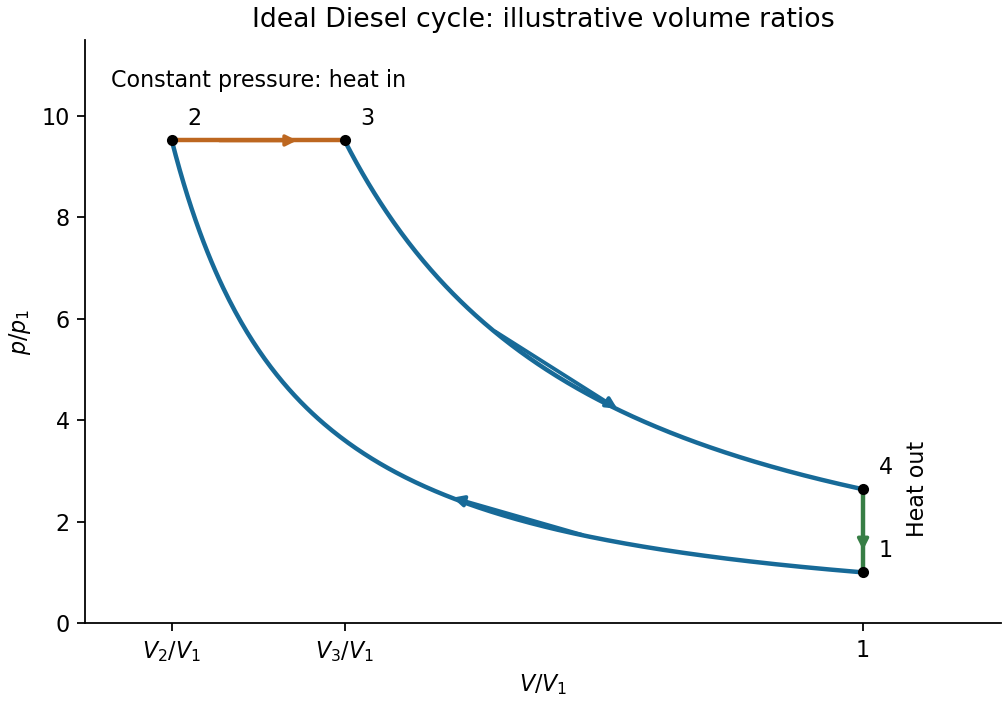
Label the initial state 1, the end of compression 2, the end of constant-pressure heating 3, and the end of adiabatic expansion 4. The volume sequence is , with . The Diesel cycle has a compression adiabat , a horizontal constant-pressure heat-input segment , an expansion adiabat , and a vertical constant-volume cooling segment .

Archimedes' principle states that the resultant hydrostatic pressure force on a body equals the weight of the fluid displaced, directed opposite to gravity. Let be the displaced fluid region, with outward normal from the body into the fluid. Since the fluid pressure force is inward,Hydrostatic balance is , with downward gravitational acceleration . Thereforefor uniform fluid density and gravity. Uniform atmospheric pressure gives no net force on a closed surface. For a floating body, the same displaced-volume construction includes the free surface; any significant air buoyancy can be included as a second displaced fluid.
A freely floating body of mass satisfies , so its displaced volume is . A homogeneous body of density floats with submerged fraction ; if , hydrostatic buoyancy alone cannot support it. The buoyant force acts through the centre of buoyancy, the centroid of the displaced volume for constant density, while weight acts through the centre of mass. Their relative positions determine rotational equilibrium and stability. For a fully submerged body, a centre of mass below the centre of buoyancy gives a restoring torque; a floating body's changing displaced shape additionally requires the metacentric height criterion. Surface tension, externally driven flow and contact forces can alter the simple force balance.
Take axes fixed in a rigid body, chosen along its principal axes, with moments of inertia . The angular momentum components are . Newton's rotational equation is , while the rotating-frame transport rule givesThus Euler's equations areThe nonlinear cross terms arise because the principal axes rotate. Even with no external torque, the body-frame components of angular momentum can vary while the angular momentum vector stays fixed in inertial space.
With zero torque, the equations conserveUniform rotation about any principal axis is a torque-free solution. If , linearization about the intermediate-axis solution givesThe positive coefficient gives exponential growth: intermediate-axis rotation is unstable, whereas rotation about the largest or smallest moment is linearly stable. For a symmetric body, Euler's equations also describe the precession of the transverse angular velocity around its symmetry axis. Torques from gravity or an applied couple enter through the right-hand sides rather than being absorbed into the inertial cross terms.
A gravitational assist changes a spacecraft's velocity relative to the Sun by scattering it in the gravitational field of a moving planet. In the planet's rest frame, ignore other forces during the encounter and take the spacecraft mass negligible. The incoming and outgoing asymptotic velocities have equal magnitude,because the encounter is conservative, but their directions differ along a hyperbolic orbit. If the planet has approximately constant heliocentric velocity , the heliocentric spacecraft velocities are . Its specific energy change isThus a flyby can increase or decrease heliocentric energy depending on its geometry. The planet exchanges momentum and orbital energy with the spacecraft; its speed change is extremely small because its mass is much greater. There is no energy creation and no increase of asymptotic speed in the planet's own frame.
For a point-mass planet, conservation of energy and angular momentum gives the hyperbolic eccentricity and deflection anglewhere is periapsis distance and the impact parameter. The velocity-vector change has magnitude , so the maximum energy-change magnitude for this fixed deflection is . A small periapsis increases the turning angle, but collision, atmosphere and tidal forces limit how close a real spacecraft may pass. Multiple encounters allow large changes without expending the propellant that equivalent direct velocity changes would require.
An Euler strut is a slender elastic column under axial compression. Let its bending stiffness about the weaker section axis be and its length be . With small lateral deflection and a dead compressive load , the quadratic total potential energy isThe first term is bending energy; the negative term is work released by the load as bending shortens the end-to-end distance. Stationarity gives . For pinned ends, at , and requires . The first instability is Euler's critical load,Below this load, the straight state has positive quadratic energy against these perturbations. At the threshold, the lowest bending mode has zero quadratic restoring energy; above it the straight state is unstable. For a rectangular section, about the appropriate bending axis, so the smaller second moment of area controls the first buckling direction.
Endpoint constraints matter. Write : for pinned-pinned, for fixed-free and for fixed-fixed conditions. This elastic instability differs from compressive material failure. Imperfections cause bending before the ideal threshold, and a short column may yield before Euler buckling occurs.
The Poynting vector is the electromagnetic energy flux density,In vacuum it equals . For a linear nondispersive medium with time-independent constitutive coefficients, Maxwell's equations and the identity give Poynting's theorem,The source term is work done by the fields on free charges; for an Ohmic conductor it is the positive local Joule heating rate . Integrating over a volume states that loss of stored field energy plus outward energy flow equals energy transferred to matter. In dispersive media, such as a plasma, material motion contributes to stored energy and the simple nondispersive expression cannot be used indiscriminately.
For a vacuum plane wave, and , and the propagation direction form a right-handed triad. With real peak field , the time-averaged wave intensity isMore generally, complex peak amplitudes give . Along a transmission line, the cross-section integral of the longitudinal Poynting vector is the transmitted electrical power . Energy flows through the electromagnetic fields in the surrounding dielectric, even though the conductors guide the currents.
Past exam of the physics B course of the University of Cambridge 2017 Paper 2 Section B B6 c Solution Created 2026-10-18 Updated 2026-10-20
For weak fields in a linear isotropic material, magnetization is , with magnetic susceptibility . Paramagnetism has , while diamagnetism has . In either case, . These weak responses generally disappear when the applied field is removed, unlike hysteretic ferromagnetism.
A paramagnet can contain permanent magnetic moments from unpaired electrons or atomic angular momentum. Alignment lowers the energy , while thermal disorder opposes it. For independent classical moments of magnitude , their weak-field average projection is , soThis is Curie's law; it assumes weak magnetization and no important interactions between moments. With quantum angular momentum , replace by . Strong-field magnetization saturates instead of growing linearly without limit. Conduction electrons also exhibit Pauli paramagnetism: only occupations near the Fermi surface readily redistribute between spin states, giving a nearly temperature-independent susceptibility when .
Diamagnetism is an induced orbital response opposing the applied magnetic field. For bound electrons, a weak field changes orbital motion and induces an opposing magnetic moment. For an isotropic collection of atoms, the elementary orbital estimate iswhere the sum runs over the electrons of one atom. It is usually small and weakly temperature dependent. Delocalized electrons also have orbital Landau diamagnetism; for an ideal three-dimensional free electron gas with a quadratic isotropic dispersion and electron spin with , . Both spin and orbital contributions must be included to determine the total response. Diamagnetism is not a consequence of permanent dipoles choosing to align against the field; that orientation would increase their energy.
Past exam of the physics B course of the University of Cambridge 2017 Paper 2 Section B B6 b Solution Created 2026-10-18 Updated 2026-10-20
For a cold, unmagnetized, collisionless plasma, take an equilibrium electron density , electrons of mass and charge , and approximately stationary ions. Use fields proportional to . The electron displacement satisfiesIts electric polarization is , hence the cold collisionless plasma dielectric responseThe negative susceptibility arises from the inertial electron response, rather than a restoring force binding an electron to a particular atom.
A transverse electromagnetic wave then obeysFor , the plasma supports propagation, with refractive index . The phase velocity is greater than , while the group velocity is ; their product is , and no superluminal signal is implied. Below the plasma frequency, the bulk wavenumber is imaginary and the field is evanescent. A sufficiently thick plasma largely reflects such radiation in the lossless model.
Including an electron momentum-relaxation rate replaces the denominator by :Its imaginary part describes absorption with the stated time convention. Finite electron temperature also produces plasma screening of slowly varying electrostatic fields, with . That spatial, longitudinal screening problem is distinct from simply taking in the cold transverse-wave formula. Magnetic bias, ion motion and kinetic resonances require more general dielectric responses.
Maxwell's displacement current is the electric-field contribution needed to make Ampère's law consistent with charge conservation. In macroscopic form,The displacement current density has units . Since , it contains the vacuum field term and, in matter, the polarization-current contribution. It need not represent free charge moving through a material.
Taking the divergence gives . Gauss's law, , then yields the continuity equation . Without the displacement term, Ampère's original law would incorrectly require every current distribution to be divergence-free even while charge accumulates.
A charging parallel-plate capacitor makes this concrete. Ignoring fringing, , so the displacement current across its dielectric gap is , equal to the conduction electric current in its wire. The integral lawtherefore gives the same answer whether the spanning surface cuts the wire or passes through the gap. Together with Faraday's law, this field term also permits self-consistent electromagnetic waves in vacuum, with speed .
To determine a crystal structure, scatter probes whose wavelength is comparable to atomic spacings, typically . X-ray diffraction, neutron diffraction and electron diffraction probe periodic order through coherent elastic scattering. With incident and outgoing wavevectors , define . Elastic scattering has and constructive interference occurs when , a reciprocal lattice vector. The equivalent Bragg's law iswhere the detector scattering angle is , not . Peak positions reveal plane spacings and the unit cell; systematic absent reflections constrain centring and the atomic basis.
For X-ray diffraction, a laboratory tube or a synchrotron supplies a collimated beam. In a monochromatic single-crystal experiment a goniometer rotates the specimen and an area detector records reflection positions and integrated wave intensities. A powder experiment uses many randomly oriented crystallites; the reflections form cones recorded as rings or peaks versus , permitting indexing and determination of lattice constants without selecting one crystallite. For a cubic cell, for example, . The white-beam Laue method is especially useful for crystal orientation.
The crystal basis structure factor isafter geometric and thermal corrections, including the Debye–Waller factor. For X-rays, describes scattering from the atomic electron density. Thus positions provide lattice geometry while relative wave intensities constrain atomic positions and species. Wave intensities do not directly give the phases of : structure refinement or other constraints must address the phase problem.
Neutron diffraction uses a reactor or spallation source, wavelength selection and a detector bank or time-of-flight detection. Neutrons interact with nuclei through nuclear scattering lengths that vary between elements and isotopes rather than simply with atomic number. This makes them useful for light atoms, isotope contrast and distinguishing some neighbours in the periodic table; their magnetic interaction also probes magnetic order. Electron diffraction in a transmission electron microscope gives strong signals from very small thin crystallites, although strong multiple scattering often complicates quantitative wave intensity analysis. These techniques complement one another.
A phonon dispersion relation requires both momentum and energy transfer, so elastic diffraction alone is insufficient. In coherent inelastic neutron scattering, the measured transfers for phonon creation areHere is the phonon wavevector reduced into a Brillouin zone, and labels an acoustic phonon branch or optical phonon branch. Negative energy transfer corresponds to annihilating an already occupied phonon. For neutrons , so wavelength and energy selection are linked. Typical thermal-neutron energies of a few to tens of millielectronvolts ( electronvolts) are well matched to many lattice vibrations.
A triple-axis spectrometer uses a monochromator crystal to select , the sample as the second scattering axis, and an analyser crystal to select before detection. Rotate these elements and the specimen to hold fixed while scanning ; inelastic peaks locate . Repeat at different along symmetry directions to map the phonon dispersion relation. The dynamic structure factor governs peak weights, including the selection of phonon polarization by the scattering geometry. A time-of-flight spectrometer instead infers outgoing neutron energy from travel time over a known flight path and records many directions simultaneously.
Inelastic X-ray scattering can also resolve phonons when very high energy resolution is available. Optical Raman scattering and Brillouin scattering measure vibrations near the zone centre because photon momentum transfers are small compared with a typical reciprocal lattice spacing; they complement, rather than generally map the entire zone like, momentum-resolved neutron measurements. Ultrasound measurements give the long-wavelength sound speed, the initial slope of an acoustic phonon branch.
There are unlisted articles, also show them or only show them.