
Joel B. Fowler Created 2026-10-18 Updated 2026-11-05
Joel B. Fowler is an electrical engineer whose work at NIST included the design and characterization of a water-bath blackbody source for radiometry. His 1995 paper describes a cavity whose temperature and effective emissivity could be controlled and measured accurately.[ref]
A Third Generation Water Bath Based Blackbody Source by Joel B. Fowler. Introduction and About the author
The apparatus placed a shaped copper cavity in a stirred, temperature-controlled water bath. The cavity geometry increases the number of internal specular reflections, raising its effective emissivity toward one, while the bath reduces temperature variation. The paper reports operation from 278 K to 353 K and calculated emissivity 0.9997, increased to 0.99997 with a restricted aperture. Geometry, thermal control and measurement uncertainty accounting therefore work together to create a useful measurement calibration source.[ref]
Changhuei Yang 2026-10-18
An electrical engineer and coauthor of the digital optical phase conjugation experiment described there.[ref]
https://www.ee.caltech.edu/people/chyang. Institutional profile: electrical engineering, bioengineering and optical phase conjugation

Portrait of Changhuei Yang
. Institutional portrait identified on the Caltech electrical engineering profile. Emmett Leith Created 2026-10-18 Updated 2026-11-05
Emmett Leith was an electrical engineer whose work with Juris Upatnieks developed wavefront reconstruction through a communication-theory treatment of holography. Their 1962 paper analyzed recording and reconstruction as a sequence of modulation, propagation and intensity detection, and tested methods for improving the reconstructed signal.[ref]
Reconstructed Wavefronts and Communication Theory by Emmett Leith and Juris Upatnieks. Abstract and experimental account
The connection is useful because an intensity recording can contain information about an optical wave's phase through interference with a reference wave. Changing the recording geometry can separate the desired reconstruction from unwanted terms. Their work helped make clear three-dimensional holographic images practical while linking optical processing with spatial frequency analysis.[ref]
Reconstructed Wavefronts and Communication Theory by Emmett Leith and Juris Upatnieks. Communication-theory formulation and generalized holograms

Portrait of Emmett Leith
. Source. Simon van der Meer Created 2026-10-18 Updated 2026-11-05
Simon van der Meer was an electrical engineer whose development of stochastic cooling made dense antiproton beams available for collider experiments. The method reduces the spread of particle motion in phase space, allowing beams produced over many cycles to be accumulated.[ref]
A pickup senses an electrical signal from particles passing through a storage ring. After amplification and an appropriate delay, a downstream kicker applies a corrective force. The timing connects the measured deviation with the returning particles; the signal from each particle is mixed with contributions from others, so gain and noise determine the net cooling. This turns high-speed feedback electronics into a tool for controlling a particle distribution.[ref]
Stochastic Cooling and the Accumulation of Antiprotons by Simon van der Meer. Sections 2–3, figures 2–3

Portrait of Simon van der Meer
. CERN. CC BY 4.0, via Wikimedia Commons. Source. Mario Dagenais Created 2026-10-18 Updated 2026-10-24
An electrical engineer researching semiconductor lasers and optical fibers.[ref]
Professional profile of Mario Dagenais. Independent professional identity
George Alfred Hockham Created 2026-10-18 Updated 2026-11-05
George Alfred Hockham was an electrical engineer whose work with Charles K. Kao examined optical fibers as communication waveguides. Their 1966 paper analyzed how a dielectric core with a higher refractive index than its surroundings can guide an electromagnetic wave.[ref]
Dielectric-fibre surface waveguides for optical frequencies by Charles Kuen Kao and George Alfred Hockham. Synopsis and introduction
The work treated guidance together with practical losses, bending and dispersion. A guided field alone does not specify a useful communication link: the signal must survive propagation, and different components must remain distinguishable at the receiver. Their combination of optical and microwave investigations connected the field calculation with the engineering feasibility of the transmission medium.[ref]
Dielectric-fibre surface waveguides for optical frequencies by Charles Kuen Kao and George Alfred Hockham. Synopsis and loss/dispersion analysis
Isamu Akasaki Created 2026-10-18 Updated 2026-11-05
Isamu Akasaki was an electrical engineer whose research helped establish gallium nitride as a material for blue and ultraviolet light-emitting diodes. Working with Hiroshi Amano and other collaborators, he pursued improvements in crystal quality and in the control of p-type and n-type semiconductor.[ref]
Fascinated Journeys into Blue Light by Isamu Akasaki. Introduction; crystal-growth and p-type-conduction sections
The scientific motivation follows from photon energy: shorter visible wavelengths require larger transition energies. A sufficiently wide band gap is therefore necessary for blue emission, but it does not by itself produce a useful device. The material must also support carrier injection and efficient light emission. High-quality growth and an operating p-n junction turned those physical requirements into an engineering platform for full-colour displays and lighting.[ref]
Fascinated Journeys into Blue Light by Isamu Akasaki. Sections 1–2 and account of the 1989 p-n-junction LED

Portrait of Isamu Akasaki
. 大臣官房人事課; attribution: 文部科学省ホームページ. CC BY 4.0, via Wikimedia Commons. Source. Hiroshi Amano Created 2026-10-18 Updated 2026-11-05
Hiroshi Amano is an electrical engineer whose work with Isamu Akasaki helped overcome two obstacles to blue light-emitting diodes: growing high-quality gallium nitride and obtaining controllable p-type semiconductor.[ref]
A low-temperature-deposited aluminium nitride buffer layer improved subsequent gallium nitride growth on sapphire. His lecture compares the resulting surfaces using scanning electron microscopy. The research also showed that low-energy electron irradiation of magnesium-doped gallium nitride could activate p-type semiconductor, enabling a p-n junction. The two results address different requirements: structural quality and the electrical activity of the semiconductor doping.[ref]

Portrait of Hiroshi Amano
. 研究振興局振興企画課; attribution: 文部科学省ホームページ. CC BY 4.0, via Wikimedia Commons. Source. Shuji Nakamura Created 2026-10-18 Updated 2026-11-05
Shuji Nakamura is an electrical engineer whose work helped make efficient blue light-emitting diodes possible using gallium nitride and indium gallium nitride. His work combined improved material growth, activation of p-type semiconductor and the design of an emitting active layer.[ref]
One crucial result concerned hydrogen binding to magnesium acceptor impurities in gallium nitride. The resulting complexes suppress their electrical activity; thermal treatment can remove that passivation. In an emitting semiconductor heterostructure, injected electrons and holes recombine in an active layer with a smaller band gap than the surrounding material, helping confine the carriers where light is produced. This connects material chemistry with an operating electronic device.[ref]
Background story of the invention of efficient blue InGaN light emitting diodes by Shuji Nakamura. Introduction, figure 1; section III, Mg-H passivation

Portrait of Shuji Nakamura
. Glenn Beltz. CC BY 2.0, via Wikimedia Commons. Source. Kazumasa Hiramatsu 2026-10-18
An electrical engineer researching semiconductor crystal growth and optoelectronics.[ref]
Professional profile of Kazumasa Hiramatsu (www2.elec.mie-u.ac.jp). Independent professional identity
Takashi Mukai 2026-10-18
An electrical engineer who developed semiconductor light-emitting devices at Nichia.[ref]
High-Power Pure Blue InGaN Laser Diodes by Atsuo Michiue and others. Independent professional identity
Marcel Bouvier 2026-10-18
A physicist researching condensed matter physics.[ref]
Gérard Mourou – Biographical by Gérard Mourou. Independent professional identity
Marissa Giustina Created 2026-10-18 Updated 2026-10-24
An electrical engineer who develops quantum-computing hardware.[ref]
Professional profile of Marissa Giustina (mcqst.de). Opening professional description; Vienna research paragraph.

Portrait of Marissa Giustina
. Google. CC BY 3.0, via Wikimedia Commons. Source. Paul E. McKenney Created 2026-10-18 Updated 2026-11-05
Paul E. McKenney is a computer scientist known for work on concurrent computing and operating-system kernels. His contributions include read-copy-update, developed for systems in which reads are frequent and updates must coexist with them.[ref]
The key read-copy-update distinction is between removing an object from a shared data structure and reclaiming its storage. An earlier reader may still hold a reference after removal; reclamation waits until the relevant readers have finished. That separation permits lighter synchronization on the read path. It is an example of how the lifetime of a shared object becomes part of a concurrent algorithm.[ref]
What is RCU? in the Linux Kernel documentation. Section 1, RCU Overview
With David Howells, he also authored the kernel guide to circular buffers and their memory barriers.[ref]
Tony Hoare Created 2026-10-18 Updated 2026-11-05
Tony Hoare is a computer scientist whose contributions include quicksort, Hoare logic and communicating sequential processes. His industrial work included an early ALGOL 60 compiler; his institutional biography also describes an unsuccessful operating system project, giving concrete context for the difficulty of reliable systems engineering.[ref]
https://www.microsoft.com/en-us/research/people/thoare/. Institutional biography, early Elliott Brothers projects and research achievements
In his 1969 paper An Axiomatic Basis for Computer Programming by Tony Hoare, he set out assignment, composition and iteration rules for reasoning directly about program text. The assignment rule reasons backward from the required result, while a loop invariant compresses arbitrarily many iterations into a preservation obligation. The paper explicitly distinguishes these partial correctness results from successful termination and discusses how arithmetic and side effects affect the model.[ref]

Portrait of Tony Hoare
. Dennis Hamilton (orcmid), Flickr; File caption identifies FLoC 2006, 18 August 2006. Creative Commons Attribution 2.0 Generic., via Wikimedia Commons. Source. Scott Kirkpatrick Created 2026-10-18 Updated 2026-11-05
Scott Kirkpatrick is a computer scientist whose work connects statistical physics with computational complexity theory and optimization. With Charles Daniel Gelatt Jr. and Mario P. Vecchi, he developed simulated annealing as a method for combinatorial optimization.[ref]
Optimization by Simulated Annealing by Scott Kirkpatrick and others. 1983, introduction and pages 672–673
The method borrows a rule from the Metropolis algorithm: a proposed increase in cost can be accepted with probability , where is an adjustable control parameter in the same units as the cost. Allowing occasional uphill changes can escape a local minimum; reducing progressively makes them less likely. The original work applied this physical analogy to electronic component placement and wiring.[ref]
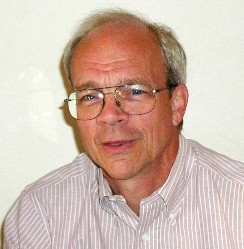
Portrait of Scott Kirkpatrick
. Photograph from Hebrew University of Jerusalem's official researcher profile. Source. Robert Tarjan Created 2026-10-18 Updated 2026-11-05
Robert Tarjan is a computer scientist whose work connects efficient graph algorithms, data structures and rigorous analysis. His contributions include algorithms for lowest common ancestors and, with collaborators, splay trees and Fibonacci heaps.[ref]
His work on amortized analysis explains why an individual operation can be expensive while a whole sequence remains efficient. The accounting assigns the cost of occasional restructuring across the sequence instead of assuming each operation has the same worst-case cost. Splay trees make this distinction particularly concrete: moving recently accessed nodes changes the tree while supporting strong bounds over a sequence of accesses.[ref]
Amortized Computational Complexity by Robert Endre Tarjan. Sections 1–2, total sequence cost and amortization
Homepage: www.cs.princeton.edu/~ret/
Institutional profile: www.hertzfoundation.org/people/robert-tarjan/


Gerald Jay Sussman Created 2026-10-18 Updated 2026-11-05
Gerald Jay Sussman is a computer scientist whose work includes the design and explanation of systems expressed as programs. With Hal Abelson and Julie Sussman, he authored Structure and Interpretation of Computer Programs by Harold Abelson and others, a text that develops programming abstraction, recursion and models of program execution through Scheme.[ref]
Structure and Interpretation of Computer Programs by Harold Abelson and others. Second-edition byline and section 1.2
One useful distinction in the text is between the shape of a procedure's source and the computation it generates. A syntactically recursive procedure can produce an iterative process when no deferred operations accumulate. That makes the execution model, rather than the presence of a self-call alone, central to reasoning about storage.[ref]

Portrait of Gerald Jay Sussman
. Phoebe, own photograph at MIT, 29 January 2024; existing Commons crop. Creative Commons Attribution-Share Alike 4.0 International., via Wikimedia Commons. Source.
Jeff Erickson Created 2026-10-18 Updated 2026-11-05
Jeff Erickson is a computer scientist whose work concerns computational geometry, computational topology, graph algorithms and data structures. His research also examines how students learn to design algorithms.[ref]
His open textbook Algorithms by Jeff Erickson develops algorithm design through explicit examples, proofs and analysis. Its treatments of dynamic programming and depth-first search show complementary organizing ideas: reuse results of smaller subproblems, or explore the structure of a graph. The explanations connect the procedure with the invariant or recurrence that justifies it.[ref]
Homepage: jeffe.cs.illinois.edu/

Portrait drawing of Jeff Erickson
. Drawing by Damien Erickson (2018), from University of Illinois Urbana-Champaign's official researcher profile. Source. Venkatesan Guruswami Created 2026-10-18 Updated 2026-11-05
Venkatesan Guruswami is a computer scientist whose research includes coding theory, computational complexity theory, pseudorandomness and the complexity of approximate optimization. A major focus is list decoding of error-correcting codes.[ref]
Ordinary unique decoding aims to recover one transmitted message; list decoding permits a bounded list of candidate messages when the received word has too many errors for uniqueness. The resulting questions connect the amount of redundancy in a error-correcting code with how much corruption can be handled efficiently. His research profile also describes work on approximate solutions to problems with NP-hardness.[ref]
Venkatesan Guruswami's Berkeley research homepage. Research, list decoding with optimal redundancy and approximate solutions to NP-hard problems
Identity source: theory.cs.berkeley.edu/

Portrait of Venkatesan Guruswami
. Photograph from University of California, Berkeley's official researcher profile. Source. There are unlisted articles, also show them or only show them.