
John Joseph O'Connor 2026-10-18
John Joseph O'Connor is a mathematician and a creator of the MacTutor history archive.[ref]
John Joseph O'Connor by John Joseph O'Connor and Edmund Frederick Robertson. MacTutor biography: quick information and mathematical work

François Viète Created 2026-10-18 Updated 2026-10-24
François Viète worked on algebraic notation and relations between polynomial roots and coefficients.[ref]
François Viète by John Joseph O'Connor and Edmund Frederick Robertson. MacTutor biography: quick information and mathematical work

Portrait of François Viète
. Charles Méryon (1821–1868), posthumous etching of François Viète; Art Institute of Chicago, accession 1909.159. PD-Art reproduction: Commons claims origin-country/life-plus-70-or-shorter public domain and treats the faithful two-dimensional reproduction as public domain in the United States. Source usage terms, via Wikimedia Commons. Source.
Ilya Piatetski-Shapiro Created 2026-10-18 Updated 2026-11-05
Ilya Piatetski-Shapiro was a mathematician whose research linked analytic number theory, representation theory and algebraic geometry. His early work included the distribution of prime numbers in special sequences and uniqueness questions for trigonometric series. His later work on automorphic forms and representations of Lie groups helped connect arithmetic questions with harmonic analysis.[ref]
https://mathshistory.st-andrews.ac.uk/Biographies/Piatetski-Shapiro/. Biography, early work and Wolf Prize citation
These connections are powerful because the same object can carry both arithmetic information and a rich set of symmetries: methods for studying its transformations can then reveal properties of its arithmetic coefficients.Identity and discipline: en-exact-sciences.tau.ac.il/math/in-memoriam

Portrait of Ilya Piatetski-Shapiro
. Externally hosted portrait identified at mathshistory.st-andrews.ac.uk/Biographies/Piatetski-Shapiro/pictdisplay/. Israel Gohberg Created 2026-10-18 Updated 2026-11-05
Israel Gohberg was a mathematician working in functional analysis, operator theory and matrix methods. His research and collaborations linked abstract properties of linear operators with concrete integral equations and matrices. He also founded the journal Integral Equations and Operator Theory, providing a meeting point for these subjects.[ref]
https://mathshistory.st-andrews.ac.uk/Biographies/Gohberg/. Biography, operator theory, matrix methods and founding of the journal
The relationship is useful in applications: an integral equation can encode a boundary-value problem, while a finite-dimensional approximation produces a linear system. Understanding invertible linear maps, the spectrum and perturbations helps explain when such approximations are meaningful and when small errors can have large consequences.Identity and discipline: en-exact-sciences.tau.ac.il/math/in-memoriam

Portrait of Israel Gohberg
. Externally hosted portrait identified at mathshistory.st-andrews.ac.uk/Biographies/Gohberg/pictdisplay/. David Milman Created 2026-10-18 Updated 2026-11-05
David Milman was a mathematician who helped develop the geometry of Banach spaces and the use of extreme points in functional analysis. He studied with Mark Krein in Odessa and later worked at Tel Aviv University. Their Krein-Milman theorem describes a compact convex set through the closed convex hull of its extreme points.[ref]
https://temnyjles.ru/Milman/biogr.shtml. I. Gohberg, M. S. Livsic and I. Piatetski-Shapiro, David Milman (1912–1982), Integral Equations and Operator Theory 9 (1986), biography and mathematical contributions
He also proved that a uniformly convex Banach space is a reflexive Banach space. This connection makes a geometric property of the norm control a duality property of the entire space. Mark Krein Created 2026-10-18 Updated 2026-11-05
Mark Krein was a mathematician whose research joined functional analysis, operator theory, harmonic analysis and mathematical physics. He worked on the moment problem, integral equations and the spectral theory of linear operators, building an influential research school despite severe institutional discrimination.[ref]
https://mathshistory.st-andrews.ac.uk/Biographies/Krein/. Biography, research on moments and operators, Odessa school and dismissals
The Krein-Milman theorem, proved with David Milman, gives a geometric expression of this work: a nonempty compact convex set in a locally convex Hausdorff space is the closed convex hull of its extreme points. In finite dimensions, the corresponding picture is a convex polygon reconstructed from its vertices.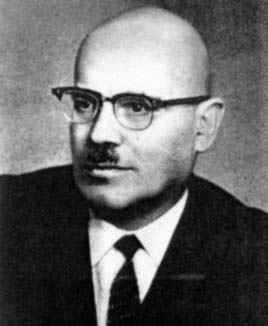
Portrait of Mark Krein
. Nicholas J. Williams Created 2026-10-18 Updated 2026-11-05
Nicholas J. Williams studies representation theory for finite-dimensional associative algebras and its connections to combinatorics. His research connects partially ordered sets and triangulations of convex polytopes with the structure of finite-dimensional algebras, including quivers and homological algebra. This interaction allows combinatorial order and geometric decomposition to encode relationships between algebraic objects.[ref]
https://nchlswllms.github.io/. Author homepage, research statement and publications on representation theory, higher orders and polytope triangulations
Identity source: nchlswllms.github.io/
Constantin Carathéodory Created 2026-10-18 Updated 2026-11-05
Constantin Carathéodory was a mathematician whose work connected measure theory, complex analysis and the calculus of variations. He began his career as an engineer and studied mathematics while working on a dam in Egypt, before entering mathematical research. His later contributions included links between the calculus of variations and partial differential equations, as well as conformal maps and their boundary behavior.[ref]
https://mathshistory.st-andrews.ac.uk/Biographies/Caratheodory/. Biography, engineering work and principal mathematical contributions
His Caratheodory measurability criterion is a basic construction principle for measures: it selects those sets that split the outer measure of every test set additively, producing a domain on which countable additivity holds.
Portrait of Constantin Carathéodory
. Caratheodory family; photographer and date unknown, as stated in the Commons File. File records family permission as public domain and an origin-country/life-plus-70-or-shorter public-domain tag. Source usage terms, via Wikimedia Commons. Source.

Paul Garrett Created 2026-10-18 Updated 2026-11-05
Paul Garrett works on automorphic forms, L-functions, representation theory, harmonic analysis and number theory.[ref] These subjects bring together functions constrained by symmetry, linear actions of groups and analytic descriptions of arithmetic. His research and expository materials explore the interaction of those viewpoints.
Identity source: cse.umn.edu/math/paul-garrett

Portrait of Paul Garrett
. James Joseph Sylvester Created 2026-10-18 Updated 2026-11-05
James Joseph Sylvester was a mathematician whose work with Arthur Cayley helped develop linear algebra and invariant theory. He studied algebraic forms, their relations and quantities that detect special behavior of polynomials; his terminology included the discriminant.[ref]
https://mathshistory.st-andrews.ac.uk/Biographies/Sylvester/. Biography, collaboration with Cayley and algebraic work of 1851–1853
His Sylvester's law of inertia explains why the numbers of positive and negative squares in a real quadratic form are unchanged by an invertible linear change of variables. Thus matrices that look different can describe the same underlying geometry, and the signs provide invariants that survive a change of coordinates.Identity source: mathshistory.st-andrews.ac.uk/Biographies/Sylvester/

Portrait of James Joseph Sylvester
. Alfred Edward Emslie (1848–1918), painted portrait dated 1889; reproduction sourced to Oxford Dictionary of National Biography, article 26872. PD-Art: original public domain in origin/life-plus-100-or-shorter jurisdictions; File also states pre-1931 United States publication. Source usage terms, via Wikimedia Commons. Source.
Claude Brezinski Created 2026-10-18 Updated 2026-11-05
Claude Brezinski works in numerical analysis, particularly extrapolation, Padé approximation, continued fractions, orthogonal polynomials and numerical linear algebra. His research also treats systems of nonlinear equations. These subjects connect different representations of an approximation with ways to accelerate or stabilize a numerical computation.[ref]
Identity source: claude-brezinski.fr/

Portrait of Claude Brezinski
. André-Louis Cholesky Created 2026-10-18 Updated 2026-11-05
André-Louis Cholesky was a mathematician and military surveyor whose computational work grew out of geodesy. During the revision of French triangulation surveys, he developed the method now known as the Cholesky decomposition.[ref]
https://www.polytechnique.edu/bibliotheque/actualites/cholesky-andre-x1895. École polytechnique historical archive, A la section géodésique de l'armée
For a real symmetric positive-definite matrix , the Cholesky decomposition writes with lower triangular matrix and positive diagonal entries. A linear system can then be solved by two triangular substitutions. The link with surveying is natural: reconciling redundant, imperfect measurements by least squares leads to such systems when the design matrix has full column rank.Identity source: www.polytechnique.edu/bibliotheque/actualites/cholesky-andre-x1895

Portrait of André-Louis Cholesky
. Unknown photographer (Commons field: no conegut). Public domain (PD-old as declared on Commons). Source and usage information on the linked Wikimedia file page. Source.
Haynes Miller Created 2026-10-18 Updated 2026-11-05
Haynes Miller works in algebraic topology, homotopy theory and homological algebra. His early research helped develop chromatic homotopy theory, and his solution of the Sullivan conjecture connected questions about maps of spaces with the structure of Lie groups. His lecture notes and expository writing develop the algebraic topology used to turn geometric questions into calculations with algebraic invariants.[ref]
https://math.mit.edu/directory/profile.html?pid=186. MIT profile, Research and Bio, chromatic research and Sullivan conjecture
Identity source: math.mit.edu/directory/profile.html?pid=186

Portrait of Haynes Miller
. Dan Romik Created 2026-10-18 Updated 2026-11-05
Dan Romik works in number theory, combinatorics and probability theory.[ref] His Complex Analysis Lecture Notes by Dan Romik also develops holomorphic functions, contour integrals and the geometry of the Riemann sphere, providing an expository connection between complex analysis and geometry.
Identity source: www.math.ucdavis.edu/people/general-profile?fac_id=romik
Daniel Reem Created 2026-10-18 Updated 2026-11-05
Daniel Reem is a mathematician whose research includes functional equations. His work on the Cauchy functional equation examines existence, regularity and stability on subsets of Euclidean spaces and tori. It also studies variants such as the Jensen functional equation and multiplicative forms of the Cauchy functional equation.[ref]
https://arxiv.org/abs/1002.3721. Remarks on the Cauchy functional equation and variations of it, author and abstract, version 7
The central issue is that the algebraic identity alone permits pathological solutions on the real numbers. A suitable regularity assumption forces the familiar form , so this subject clarifies how analytic hypotheses constrain algebraic identities.Identity source: arxiv.org/pdf/1002.3721v7
Alwin Korselt Created 2026-10-18 Updated 2026-11-05
Alwin Korselt is associated with Korselt criterion for Carmichael numbers. The criterion characterizes a composite positive integer by squarefreeness and the divisibilities for every prime divisor of .
It turns a universal modular-exponent condition into a finite collection of arithmetic tests on prime factors. For example, is squarefree, and all divide , giving the standard example of a Carmichael number.[ref]
Carmichael Numbers and Korselt's Criterion by Keith Conrad. criterion and 561 example
Robert Daniel Carmichael Created 2026-10-18 Updated 2026-10-24

Portrait of Robert Daniel Carmichael
. Unknown photographer (Commons field: no coneguts); file uploaded by Ferran Mir. CC BY-SA 4.0, via Wikimedia Commons. Source.
Václav Šimerka Created 2026-10-18 Updated 2026-10-24
A mathematician whose 1885 numerical list is discussed in Carmichael number.[ref]
https://biografie.math.muni.cz/doku.php?id=s:vaclav_simerka. Masaryk University mathematics biography: lifetime 20 December 1819 to 26 December 1887

Portrait of Václav Šimerka
. Jan Vilímek (1860–1938). Public domain (PD-old as declared on Commons). Source and usage information on the linked Wikimedia file page. Source.
Jay Abramson 2026-10-18
A mathematics educator and lead author of Precalculus 2e by Jay Abramson.[ref]
https://openstax.org/books/precalculus-2e/pages/preface. About the Authors: senior contributing author Jay Abramson; Development Overview: lead author
Institutional profile: search.asu.edu/profile/230861
Johann Jakob Balmer Created 2026-10-18 Updated 2026-11-05
A Swiss mathematician and teacher remembered for finding an empirical pattern in the hydrogen emission spectrum. In 1885 he expressed the wavelengths of its visible spectral lines through a simple formula in integer parameters. The resulting Balmer series connected measured wavelengths that had previously looked like separate experimental numbers.
Balmer's result was a numerical regularity, rather than a physical explanation of atomic structure. Its success included a further predicted line consistent with observation. The later Bohr model explained why transitions between discrete energy levels produce such a series. The episode shows how a mathematical pattern can become evidence guiding a later physical theory. [ref]
https://mathshistory.st-andrews.ac.uk/Biographies/Balmer/. University of St Andrews historical biography, mathematical work and career
A mathematician.[ref]
https://mathshistory.st-andrews.ac.uk/Biographies/Balmer/. Independent professional profile

Portrait of Johann Jakob Balmer
. F. Brandseph, photograph circa 1865; Basel University Library, UBH Portr BS Balmer JJ 1825, 2c/2b/2a; contributed with Wikimedia CH. Public domain in Switzerland under expired-term rule and in life-plus-70 jurisdictions; library declares document public domain. Source usage terms, via Wikimedia Commons. Source.
There are unlisted articles, also show them or only show them.