
For a closed connected orientable surface of genus , the Künneth theorem gives the Betti numbers of as . The weak Morse inequalities give the displayed lower bound. A surface Morse function with one minimum, saddles and one maximum exists from its standard handle decomposition. Adding a positive multiple of the cosine Morse function on the circle makes a product of Morse functions, whose critical counts are precisely these four Betti numbers. The lower bound is attained.
High-energy obstruction for a hard vector mass Created 2026-10-14 Updated 2026-10-25
A free Proca field is consistent and has three physical particle polarizations. The difficulty for generic interactions is the ultraviolet behavior of its Proca propagator: the longitudinal numerator makes part of it approach order , rather than decay as . Longitudinal external polarization vectors also behave as . Without suitable identities and cancellations, amplitudes grow with energy and perturbative counterterms of increasing dimension are needed. Conserved-current Abelian models and the Stueckelberg mechanism are important exceptions; a massive interacting vector is not intrinsically inconsistent as an effective field theory.
Continuity of probability 2026-10-14
Continuity of probability says that nested events can be approximated by their finite stages without losing probability in the limit of a sequence. In a probability space , let . ThenThe sigma-algebra ensures that both limiting events belong to . These are continuity from below of a measure and continuity from above of a measure. The first holds even for an infinite measure; the second requires finite measure of the first set, which is automatic for a probability measure because .[ref]
For a concrete model, toss a fair coin through a sequence of independent Bernoulli trials, and let be the event of at least one head in the first tosses. Its complement is the event of initial tails. On the sample space of infinite head-or-tail sequences,Every finite waiting horizon has positive tail probability, yet the event of waiting forever has probability zero. That intersection is not empty: it contains the all-tails sequence. Thus a zero-probability event need not be impossible as an outcome, and eventual success almost surely does not supply a deterministic deadline. The waiting time for the first head has a geometric distribution with success probability . After ten tosses, the remaining tail probability is exactly ; nine tosses leave .
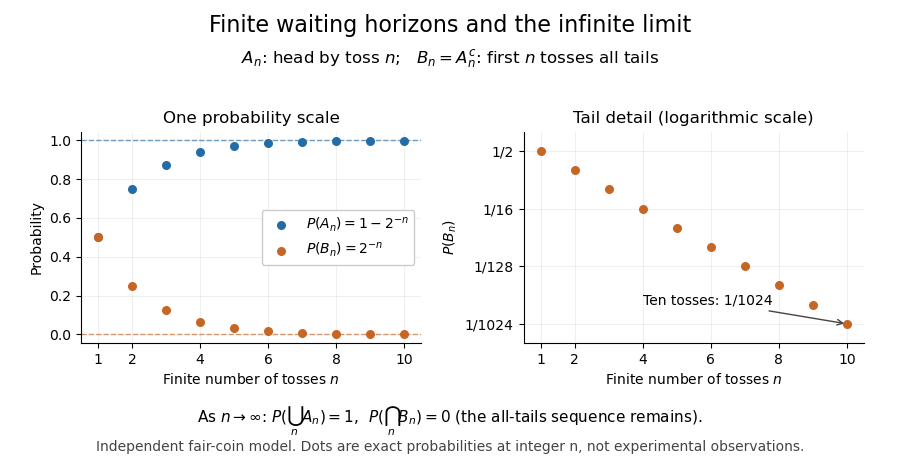
Exact fair-coin model: success by toss n increases to probability one, while the all-tails prefix probability decreases to zero
. Details. 
A proof outline exposes what makes countable additivity stronger than finite additivity of a set function. For increasing events, put and for . These set differences are pairwise disjoint events, their union is , and the first pieces have union . ConsequentlyFor decreasing events, their complements increase to ; applying the increasing result and the complement rule of probability gives . The finite-total-mass condition is essential for this subtraction. For comparison, the counting measure of each set of natural numbers is infinite, although their intersection is empty and has measure zero.
Conversely, on a sigma-algebra, a nonnegative normalized set function satisfying finite additivity of a set function and satisfies countable additivity. For pairwise disjoint events with , the remainders decrease to the empty set, andTaking the limit of a sequence recovers the infinite sum. This equivalence explains why continuity of probability is part of the foundations rather than a separate assumption about smooth curves.
One useful application controls infinitely many possible errors. If events satisfy , then the events decrease, and the union bound gives . Continuity of probability therefore makes : errors occur infinitely often with probability zero. This is the Borel-Cantelli first lemma, and it requires no independence. For the illustrative bounds , the probability of any error at index or later is at most , an explicit truncation guarantee.
The word continuity here concerns nested sets, not the absence of atoms in a probability distribution. For any real-valued random variable , the events decrease to . Hence its cumulative distribution function is right-continuous even when it has jumps, as for a geometric distribution. The nesting hypothesis matters: an arbitrary sequence of events need not admit either displayed interchange of limit and probability.
Dirichlet probability generating function Created 2026-10-14 Updated 2026-11-05
For a positive integer-valued random variable of finite support, this transform is a finite Dirichlet series. Its values encode ordinary moments, , and its derivatives at zero encode logarithmic moments: . Positive support is essential to these definitions; the transform is distinct from the ordinary probability generating function .
Redistribution of polynomial factors for dice Created 2026-10-14 Updated 2026-11-05
Encode a fair die with face labels by . Its probability generating function is . Two independent dice with polynomials have the same sum probability distribution as another pair if and all four dice have faces. Redistributing polynomial factors can construct unexpected examples, but each resulting polynomial must have nonnegative integer coefficients, no constant term if labels must be positive, and value at . For example, reallocating from one copy of to the other gives face labels and .
Triangle deletion in the alteration method 2026-10-14
If a graph has edges and triangles, successively delete one edge from a remaining triangle. No new triangle is created and at most deletions are needed, so a triangle-free subgraph has at least edges. A random-graph expectation lower bound on therefore proves existence of a large triangle-free graph. With edge probability , the expectation is ; this is a useful existence bound but is not within a constant factor of the sharp quadratic Mantel theorem bound.
Prior odds 2026-10-14
For two exhaustive mutually exclusive models of positive prior probability, prior odds compare their probabilities before observing the data. They must be distinguished from the parameter prior distributions within those models. A Bayes factor multiplies these prior odds to produce posterior odds.
Prior elicitation Created 2026-10-14 Updated 2026-10-20
Translate external information into a prior distribution by asking for representative values, uncertainty intervals and tail probabilities. Fit parameters of a suitable distribution to those judgments and inspect the resulting prior predictive distribution. For a probability believed near , a beta distribution with parameters has the desired mean; its concentration can be chosen to match a stated probability of exceeding . The words “near” and “unlikely” alone do not specify one unique prior.
Nonprincipal coordinate ideal in two variables Created 2026-10-14 Updated 2026-11-05
Over a field , the ideal in a two-variable polynomial ring is not principal. A proposed generator would divide both and . Any nonconstant divisor of the degree-one polynomial is a scalar multiple of , which does not divide ; therefore the generator would have to be a unit. But every element of vanishes at , so the ideal cannot contain one. This contrasts with , where the division algorithm makes every ideal principal.
For , integrate the logarithmic derivative of an elliptic function and its product with around a fundamental cell. The first integral forces total degree zero; the second forces the weighted point sum to lie in the lattice. Conversely choose lifts of the points with equal zero and pole sums, and form the balanced ratio of translated Weierstrass sigma functions. Their quasi-period factors cancel, giving an elliptic function with exactly the prescribed divisor. Separate zero and pole divisors require disjoint support; common terms cancel when only their difference is prescribed.
Bounds for the principal logarithm near one 2026-10-14
The power series proves this estimate. There is no global bound , since the logarithm diverges as . The different estimate is valid wherever , and is sufficient for growth bounds on canonical products.
Connection (principal bundle) 2026-10-14
A principal connection can be specified by a -equivariant horizontal distribution complementary to the vertical bundle, or equivalently by a Lie-algebra-valued connection form that reproduces infinitesimal generators and has .
A principal bundle is trivial exactly when it has a global section of a fiber bundle. Given such a section, the displayed map is a smooth equivariant isomorphism: the free transitive action on each fiber gives the unique inverse group coordinate, and local trivializations make it smooth. Conversely, a product trivialization has the section .
Associated bundle 2026-10-14
For a principal bundle and a left action of its structure group on a manifold , the associated bundle is , where . Local sections identify it with ; principal transition functions act on . Linear actions give associated vector bundles.
Orthonormal frame bundle 2026-10-14
For a metric of signature , the orthonormal frame bundle consists of all linear isometries . Right composition by makes it a principal bundle. Its standard associated vector bundle is the tangent bundle, via . A global orthonormal frame is a global section and therefore trivializes this principal bundle. A Lie group with a left-invariant metric has such a frame by left translating an orthonormal basis at the identity.
Frame bundle 2026-10-14
The frame bundle of an -dimensional smooth manifold has fiber over consisting of linear isomorphisms . Right composition by makes it a principal bundle. A global frame of a vector bundle is a global section of a fiber bundle and trivializes the tangent bundle. A metric restricts the allowed frames to the orthonormal frame bundle.
Transition function of a principal bundle 2026-10-14
For equivariant local trivializations of a right principal bundle, the change of coordinates is left multiplication in the group coordinate. Indeed an equivariant change satisfies , so evaluating at the identity gives . Its inverse shows that takes values in the Lie group, and restriction to makes it smooth. Composition on triple overlaps gives .
Write a point of Real projective space as a nonzero vector modulo real nonzero scaling. The map to Complex projective space sends its class to the complex line through that vector. A free right action of the circle group is where ; the two possible roots differ by a real sign and therefore give the same projective point. Local smooth square-root branches prove smoothness. Over , the fibre coordinate is ; over , it is . On the overlap , the transition function of a principal bundle is . Its phase winds twice. Ordinary scalar multiplication by instead has a kernel of order two and is not a free action of a group.
Primitive three-cycle criterion 2026-10-14
Conjugate the three-cycle throughout the group. Connected components of the support hypergraph form an invariant block system. Primitivity makes it connected, and connected triple supports generate an alternating group gives the conclusion.
O'Nan–Scott theorem 2026-10-14
The theorem classifies finite primitive permutation groups by their minimal normal subgroups and the action of their socle. The modern types are affine (HA), almost simple (AS), simple diagonal (SD), compound diagonal (CD), product action (PA), holomorph simple (HS), holomorph compound (HC), and twisted wreath (TW). A coarser version describes primitive maximal subgroups of symmetric groups by affine, almost-simple, diagonal and full product-action overgroups. Intransitive and imprimitive maxima are respectively unequal-part subset stabilizers and block-system stabilizers. Primitivity alone is not maximality in the symmetric group; parity can put an otherwise natural candidate entirely inside the alternating group.
There are unlisted articles, also show them or only show them.