
For a simply connected closed four-manifold with second Betti number one, Poincare duality and the universal coefficient theorem for cohomology make torsion-free of rank one. The integral intersection form is unimodular, so its one-by-one matrix is or . Hence the square of a generator generates , giving the displayed cohomology ring. This is a ring isomorphism; it need not preserve a preassigned orientation class.
Intersection complex 2026-10-14
The degree-zero normalized Deligne intersection complex extends the constant sheaf from the regular stratum by successive derived direct images and cohomological truncations at degree when codimension- strata are added. Its hypercohomology defines intersection cohomology. On a cone with vertex of codimension , its local cohomology is the link intersection cohomology in degrees at most and zero above.
Capped-boundary intersection cohomology 2026-10-14
Let a compact oriented -manifold have collared boundary , and cap by its closed cone. In the lower-middle Deligne convention the result has for , , and for . Excision identifies the relative intersection groups with ; the cone neighbourhood has only for , so its long exact sequence gives the formula. The cap is Witt exactly when .
t-intersecting family 2026-10-14
A set family is t-intersecting if every pair of its members has at least common elements. For -sets on an -point ground set, the whole level is t-intersecting when . Ordinary intersecting families are the case .
A maximal intersecting family is an up-set. It cannot contain both a set and its complement. If neither were present, maximality would supply a member disjoint from the first set, and upward closure would then include its complement. Thus precisely one member of each complementary pair occurs, so the family has members for .
For , the Erdős-Ko-Rado theorem bounds an intersecting family by the displayed size. The first that many rank- sets in lexicographic order all contain coordinate one. Therefore the lexicographic initial segment of the same size as any intersecting family is also intersecting. This statement concerns ordinary one-element intersection and does not extend to higher intersection requirements.
On five points, the four sets are an intersecting family. The first four two-element sets in colexicographic order are , containing the disjoint pair . Thus replacing a family by an equally large colexicographic initial segment can destroy intersection, even though it minimizes the lower shadow.
Union bound for intersecting families 2026-10-14
For intersecting families of subsets of , take each upward closure of a set family. It remains intersecting and contains at most one set in each complementary pair, so its complement as a family has density at least one half. Those complements are decreasing set families. Repeated Harris-Kleitman inequality gives intersection density at least , proving the displayed bound. For , the families of sets containing coordinate , for , attain equality.
Choose , and the positive angular frequency . Then the phase velocity is and the group velocity is . Their dot product vanishes and their sum is horizontal with magnitude . Draw the group velocity from the tip of the phase velocity: the two form the perpendicular sides of a right triangle. The horizontal hypotenuse is their sum, not the horizontal phase velocity .
For a traveling sinusoidal boundary forcing with horizontal phase speed , the pressure and horizontal velocity polarization gives the displayed relation between upward energy input and vertical wave momentum flux. A slowly established outgoing wave envelope deposits horizontal mean momentum as its front advances. In the frame moving at , the order-amplitude-squared change of mean kinetic energy is . Its loss rate equals the boundary work in the laboratory frame. The comparison uses a finite perturbation of the infinite uniform background energy.
Charged oscillator basis of a scalar doublet Created 2026-10-14 Updated 2026-11-05
For the internal rotation symmetry of two real scalar fields with and , the Noether charge is . Its commutators satisfy , so these creation operators produce charge eigenstates in the one-particle state sector. Substitution gives , converting the rotation of real components into opposite charges in a complex basis.
Homogeneous self-dual embedding of a linear program Created 2026-10-14 Updated 2026-10-25
For a linear program and its dual linear program, write , , , and . Introduce , , and a free multiplier satisfyingThe point , , is strictly positive in all constrained coordinates. Multiplying the first three equations by respectively and adding gives the displayed identity. Minimizing has value zero: primal-dual optimal solutions or certificates from Farkas' lemma give zero- solutions after selecting positive and scaling. At , gives an optimal primal-dual pair by division by , while gives a primal infeasibility or dual infeasibility certificate. A point with is not decisive; choosing a relative interior point of the optimal face of a linear program avoids that degeneracy because the face contains a point with .
Interference fringe spacing Created 2026-10-14 Updated 2026-10-20
The distance between adjacent bright interference fringes, or between adjacent dark interference fringes, measured along a specified direction. For the symmetric crossing plane waves in wave interference, measured along , . Bright-to-dark separation is . As tends to zero the spacing diverges; at the phase difference is spatially constant and there are no periodic bands.
Yield curve 2026-10-14
The maturity-indexed curve of interest rates inferred from prices of zero-coupon bonds. Continuously compounded yields average the instantaneous forward rate over . Modelling a curve requires both dependence across maturities and consistent evolution through observation time; specifying unrelated one-dimensional rate distributions is insufficient.
Interest-rate cap 2026-10-14
Interaction plot Created 2026-10-14 Updated 2026-11-05
An interaction plot displays response means against levels of one factor, with separate lines for levels of another and optional panels for further factors. In an additive linear regression, the difference between two lines is constant across the horizontal factor, so the population-mean lines are parallel. Changing line separations or crossings show a statistical interaction on that response scale. Sample means may be nonparallel through noise, so the plot describes the effect pattern rather than replacing a formal hypothesis test.
Exclusion process 2026-10-14
Particles on a countable lattice attempt jumps at the rates , and an attempt into an occupied site is suppressed. Thus each site contains at most one particle and the number of particles is conserved when finite. Here interchanges the occupations at and . Bounded nearest-neighbour rates give a well-defined Markov process. A symmetric jump kernel gives the symmetric simple exclusion process; an unequal left-right kernel gives the asymmetric simple exclusion process.
Voter model 2026-10-14
At each site, a rate-one clock rings and the site copies the state of a randomly chosen neighbor. The model is a Markov process on Ising spin configurations, interpreted through its local update infinitesimal generator. All constant configurations are absorbing state. Tracing copying arrows backwards gives the voter-model duality with coalescing random walks.
Treatment contamination Created 2026-10-14 Updated 2026-11-05
Treatment contamination occurs when participants in one arm of a randomized controlled trial receive an intervention assigned to another arm. This is distinct from contamination in robust estimation. The intention-to-treat analysis still compares randomized assignments, but intervention receipt becomes less separated between the arms, often diluting the assignment effect. Receipt-based comparisons can introduce confounding because receipt need not be randomized.
The same intensity measure can belong to very different point processes. A Poisson point process with a locally finite intensity measure adds two requirements: each finite-intensity window count has the Poisson distribution of mean , and counts in pairwise disjoint observation windows are mutually independent. These requirements determine its probability law; they do not follow from the formula for .[ref]
Lectures on the Poisson Process by Günter Last and others. Section 3.1, Definition 3.1 and Proposition 3.2, printed pp. 19-20: Poisson count laws, independence, and uniqueness
A randomly shifted lattice point process, a unit-rate Poisson point process, and the shared random rate gives dependent point counts construction all satisfy on the real line. Nevertheless, their counts in have respectively variance zero, one, and two. Counts in the disjoint observation windows and have respectively covariance , zero, and . These exact calculations show why measuring mean density cannot identify a spacing or statistical dependence model.
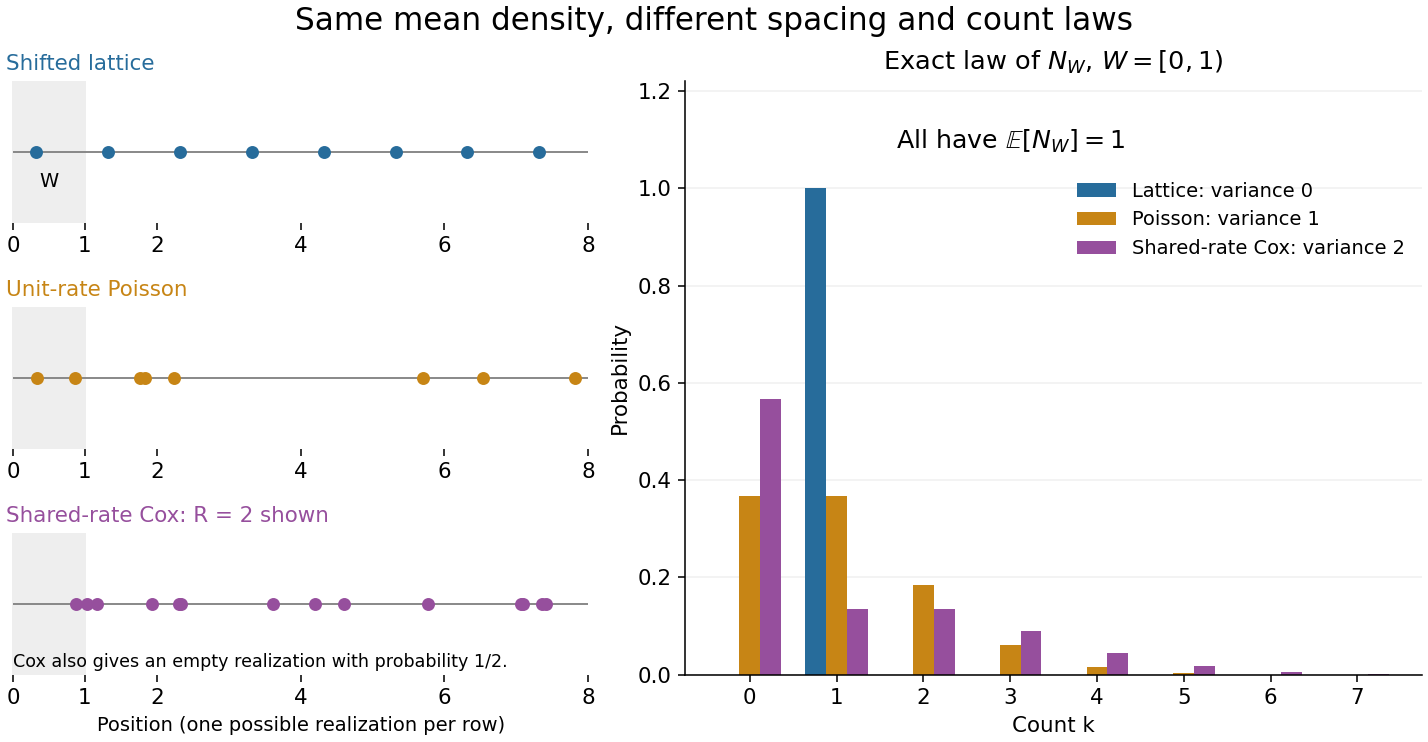
Equal intensity permits regular spacing, Poisson counts, and shared-rate dependence
. All three laws have intensity measure . Left: illustrative realizations of a randomly shifted lattice point process, a unit-rate Poisson point process, and the shared random rate gives dependent point counts construction conditional on rate two; the latter also has a completely empty outcome with probability . Right: exact probability mass functions of the count in , with the axis displayed through seven. Equal expected values of one coexist with variances zero, one, and two. Realizations illustrate spacing; the bars describe laws, not frequencies estimated from those realizations. Details.
There are unlisted articles, also show them or only show them.