
Inertial modes in a rigid rotating sphere Created 2026-10-14 Updated 2026-11-05
In a uniform-density incompressible flow inside a smooth rigid sphere rotating at angular speed , a normal mode with phase has intrinsic frequency . For , eliminating velocity from the linearized Euler equations gives the displayed pressure equation, with . Impermeability gives on the sphere. There is no condition : the rigid wall supplies variable normal pressure. These inertial waves are restored by Coriolis acceleration, and their pressure equation is hyperbolic for .
Poinsot's ellipsoid 2026-10-14
For torque-free rigid-body motion, the kinetic-energy ellipsoid fixed in the body rolls without slipping on the invariable plane perpendicular to the conserved angular momentum. Its point of contact is the angular-velocity vector.
Tensor parallel-axis theorem 2026-10-14
If is the center of mass and , expanding the defining inertia tensor about gives the displayed formula. The cross terms vanish because in coordinates centred at . Contracting with a unit axis gives the parallel axis theorem, with the squared distance between the parallel axes equal to .
PASCO's PASPORT Rotary Motion Sensor Experiment Guide, Experiment 1, specifies a PS-2120A sensor, a rod carrying two equal-radius weights, a three-step drive wheel, a thread and hanging mass, a clamp-on guide wheel, a support, a balance and calipers. The thread leaves the drive wheel tangentially. The sensor records angular velocity against time; a linear regression over the accelerating interval supplies angular acceleration . The guide measures the drive radius with calipers and repeats the run with the weights removed to subtract the apparatus's own moment of inertia. Its tables are blank: it prescribes a measurement and does not report an observed numerical agreement. [ref]
With hanging mass including its hanger, effective drive radius , no thread slip and negligible guide-wheel inertia, Newton's second law gives thread tension . The axial torque is . Under negligible friction, the inference is thereforeRepeat the inference for the unloaded assembly and subtract: . Omitting the term incorrectly treats thread tension as the hanging weight. Comparing with tests the point mass approximation; finite-sized weights also have their own moments of inertia about their centres of mass. [ref]
Useful proposed checks go beyond that ideal inference. Verify the rotary encoder's angle scale by turning the shaft through a marked full revolution; check the recorded time against an independent clock and the balance against a known mass. Measure at the thread's running surface, including thread thickness; avoid overlapping wraps that change . Release without a push, inspect the angular velocity record for a straight interval, and stop before the hanger lands or the thread runs out. Repeat with several hanging masses, weight radii and rotation directions. A consistent inferred moment of inertia across drive torques supports the model; curvature, direction dependence or drift indicates a limitation rather than a new principal moment of inertia.
For approximately constant resisting torque in one rotation direction, an original calibration model isFit the left-hand quantity against across several drives: the slope estimates the axial moment of inertia and the intercept estimates . This calibration is conditional on friction remaining constant over the fitted angular speeds; a freely slowing run can expose speed dependence. Sensor differentiation noise, guide-wheel moment of inertia, thread slip, flexing connectors and uncertain weight radii limit the inference. Removing weights can also change bearing loads, so empty-apparatus subtraction does not automatically cancel friction. These are proposed controls and a model extension, not results claimed by PASCO.
A fixed-axis readout measures , not the full inertia tensor. In a proposed generalization, repeat about , , and the three diagonal directions , , , all through the same . For example,Six independent scalar readings then determine the six entries of a symmetric matrix. Each mounting needs its own apparatus correction, and different reference points require the tensor parallel-axis theorem before the readings can be combined.
Inertia tensor of paired point masses Created 2026-10-14 Updated 2026-10-18
An exact planar example makes the off-diagonal entries tangible. Join four equal point masses with negligible-mass rigid connectors at , , and , where is a length. Their centre of mass is . Summing , and gives , and , respectively, soThe axis is a principal axis, and illustrates the perpendicular axis theorem. The axis is not a principal axis: angular velocity gives angular momentum , which points in a different direction. A bearing can enforce fixed-axis rotation despite this difference, supplying the necessary transverse torque.
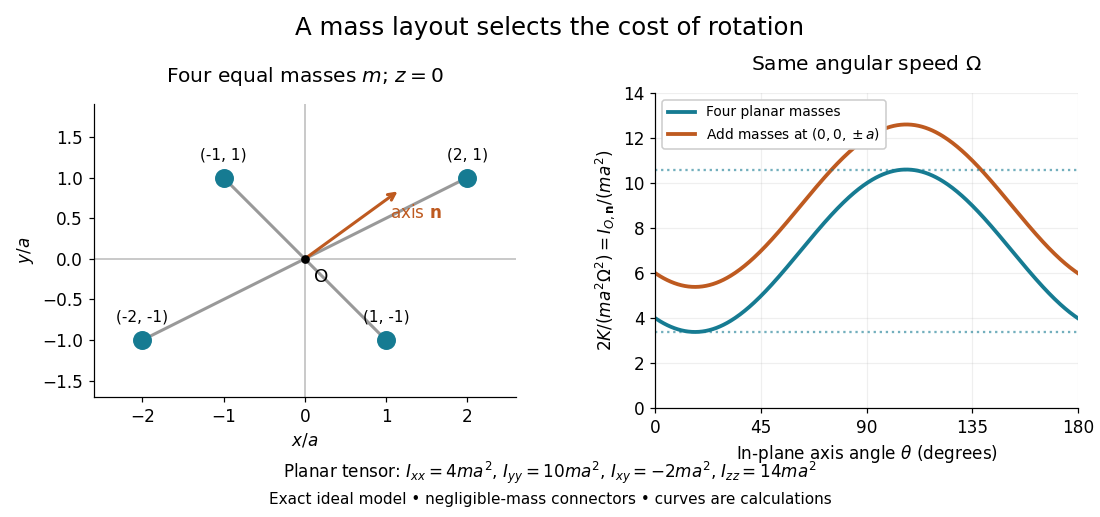
Paired point masses and direction-dependent rotational kinetic energy
. Original exact model. Four equal point masses lie in the plane with negligible-mass connectors. The curves use angular velocity and plot . Adding two more equal point masses at raises this curve by two. Markers depict ideal point masses, not finite-sized weights; no experimental data are plotted. Details.
For an in-plane unit vector , the planar model hasIts extrema are the principal moments of inertia and ; the remaining principal moment of inertia is . These values follow from the two-by-two characteristic polynomial , so they can be checked without trusting a numerical eigenvalue routine. At a stipulated angular speed , with and , rotation about , or has rotational kinetic energy , or , respectively.
A truly three-dimensional example adds two more equal point masses at and . Each contributes to the inertia tensor, givingThe in-plane principal axes stay the same while their principal moments of inertia each increase by . The moment of inertia stays unchanged because the added point masses lie on that axis. This comparison changes the total mass from to ; it holds the original four point masses fixed rather than redistributing a fixed total mass.
Perfectly inelastic collision Created 2026-10-14 Updated 2026-11-05
For two point masses, a perfectly inelastic collision is an inelastic collision in which they stick and share one outgoing velocity. In the absence of appreciable external impulse, momentum conservation givesThe centre of mass decomposition of kinetic energy shows exactly how much translational energy is lost:At fixed total momentum, the common outgoing velocity minimizes translational kinetic energy. Thus sticking removes all relative translational motion for these two point masses; the energy can become deformation, heat or other internal motion.
Extended rigid bodies may remain joined while the combined object rotates. Their different material points then need not share one velocity, and angular momentum and rotational kinetic energy must also be included. Zero normal coefficient of restitution alone likewise does not assert sticking in every tangential direction.
An index-two subgroup is normal. Conjugation by an outside element gives an involution on its irreducible characters. If , the squared norm of induction is one, so induction is irreducible of twice the degree and restriction is . If , the squared norm is two, so induction has exactly two distinct constituents, each once. Each restricts to a representation containing , and their total degree is twice that of , forcing both degrees to equal that of . This proves the fixed-orbit versus two-element-orbit classification without assuming extension of in advance.
Character induction norm bound Created 2026-10-14 Updated 2026-11-05
Extend a class function on by zero outside . For coset representatives of , . Each summand has squared normalized -norm . Pointwise Cauchy-Schwarz inequality and summation give . If is an irreducible character, its norm is one, and the sum of squared induction multiplicities is at most the subgroup index.
Monomial character Created 2026-10-14 Updated 2026-11-05
A monomial character is a character induced from a linear character of a subgroup. When discussing monomial finite groups, this property is required for every irreducible character.
Conjugate index vector Created 2026-10-14 Updated 2026-11-05
Fix paired orthonormal bases and let . Its conjugate index vector in the other Hilbert space uses the conjugated coefficients. For the unnormalized maximally entangled state , the partial inner product is . Both the conjugation and the lack of normalization of matter. Applying a linear operator on the first subsystem gives the corresponding relative state of the operated vector.
Independent record indicators 2026-10-14
The indicators of successively smaller records are independent and have Bernoulli distributions of parameters . Successively larger records use and have the same laws. For , expectation and variance additivity for independent random variables give and .
Moments of a marked Poisson integral 2026-10-14
Attach conditionally independent nonnegative marks to a Poisson point process, with a measurable mark law depending only on location. If a mark at has mean and variance , and the displayed integrals are finite, their total is finite almost surely and has the displayed moments. The Campbell first-moment formula gives the first moment and finiteness. The Poisson factorial moment measure formula gives the square of that first moment for distinct pairs; the diagonal contributes . Their difference is the variance. Signed marks require absolute first-moment integrability.
Pairwise-independent three-event avoidance Created 2026-10-14 Updated 2026-11-05
For three pairwise independent events of common probability , write . Inclusion-exclusion principle gives avoidance probability , and gives the displayed lower bound. It is strictly positive for . For , a symmetric atomic law with no zero-success atom has mass on each singleton success pattern, on each doubleton, and on the tripleton. These masses sum to one, have marginal , and have pair intersections .
Suppose the recorded durations retain an exponential distribution of rate , but an independent fraction are relabelled as failures and the rest as right-censored. Applying the ordinary survival likelihood gives , rather than . A censoring flag chosen independently of the recorded duration does not establish independent censoring of a latent failure time. Genuine simulation instead draws an event time and an independent censoring time and records their minimum.
A nonconstant smooth periodic roll obeys . The orthogonal-roll perturbation raises the increasing-gradient functional for poorly conducting convection by the displayed amount. The variance is strictly positive: a nonconstant periodic function has a derivative that vanishes somewhere and is nonzero somewhere. The Hessian of therefore has a positive direction. Its self-adjoint linearized evolution operator has a positive Rayleigh quotient and hence a positive eigenvalue, proving transverse linear instability wherever a nonconstant roll exists.
With exponentially decreasing injection, the advective approximation and inlet condition give and the displayed solution along characteristic curves. It applies behind the advective nose . The relative size of the discarded nonlinear spreading term for this profile is . Smallness of that quantity, and matching through a narrow leading layer, are necessary qualifications: elapsed time alone does not make the approximation uniform at the nose. In a translating frame the full equation remains a porous medium equation with coefficient .
For porosity and permeability of a porous medium above an inclined impermeable plane, stored liquid volume per area is . The depth-integrated Darcy flux is . Conservation of mass yields the displayed equation with , and .
Impulse-momentum theorem Created 2026-10-14 Updated 2026-10-25
Integrating the closed-collection balance in momentum conservation and applying the fundamental theorem of calculus givesFor one fixed-mass point mass, this becomes . Zero external impulse implies equal initial and final total momenta; momentum conservation throughout the interval requires zero net external force throughout it.
For stages and with update , the method has order two for every fixed real . The third-order coefficient of is always , not , so no parameter gives third order on general nonlinear equations. The displayed stability function is bounded throughout the left half-plane only when , when it is the A-stable trapezoidal function . It is not L-stable.
There are unlisted articles, also show them or only show them.