
Pair immigration with linear deaths Created 2026-10-14 Updated 2026-11-05
A population jumps from to at a constant immigration rate and from to at rate . Applying its Markov jump-process generator to and gives the displayed mean and variance equations. For and finite initial second moment, the stationary mean and variance are and . Interpreting the pair-arrival rate as proportional to population instead would produce a different branching process.
Fall time of a charge toward a grounded plane Created 2026-10-14 Updated 2026-11-05
The image of a charge at height is at height . Their separation is , giving force . Starting at rest at height , energy conservation gives . Integrating the reciprocal speed to the plane yields the stated finite time in the electrostatic Newtonian model. The induced-conductor potential energy is ; using the full image-pair energy would double the force incorrectly.
Reduced magnetohydrodynamics 2026-10-14
Reduced magnetohydrodynamics is the leading ideal-fluid description of small, anisotropic fluctuations about a strong uniform guide field, with . Its solenoidal perpendicular Elsässer variables obeyThe parallel magnetic derivative includes bending of field lines: . Slow compressive and entropy mode fluctuations are passively transported at this order. The system excludes the rapidly propagating fast magnetosonic wave sector rather than describing all possible MHD perturbations.
Grad-Shafranov equation Created 2026-10-14 Updated 2026-11-05
The Grad-Shafranov equation governs the poloidal magnetic flux of an axisymmetric magnetohydrostatic equilibrium. Pressure and toroidal-field contributions depend on the flux function. The Grad-Shafranov equation for a force-free magnetic field is its zero-pressure-gradient reduction.
Steady planar ideal-MHD field-line invariants Created 2026-10-14 Updated 2026-11-05
For a stationary, -independent ideal magnetohydrodynamics flow with , nonzero horizontal magnetic field and nonzero magnetohydrodynamic mass loading , the displayed decomposition has . The continuity equation gives the first invariant, and the ideal magnetohydrodynamic induction equation gives the second. Entropy and are also constant on each magnetic field line. Stationarity alone permits constant nonzero , so it does not imply this decomposition.
Magnetic relaxation Created 2026-10-14 Updated 2026-11-05
Magnetic relaxation converts magnetic energy into material motion through the Lorentz force density, and dissipates the resulting kinetic energy through viscosity. In a perfect conductor, magnetic flux freezing preserves field-line connectivity throughout every smooth stage. A regular limiting state has zero velocity and is a magnetostatic equilibrium, but its magnetic field can contain current sheets. Conservation of one global magnetic helicity is weaker than preservation of the complete frozen field-line structure.
Ideal gas pressure from wall collisions Created 2026-10-14 Updated 2026-10-31
Consider a particle of mass in a rigid rectangular box of length along and wall surface area , so is the volume. Choose toward the right wall. For an incoming normal velocity , an elastic collision reverses the normal momentum:The impulse delivered to the wall points outward, toward , by Newton's third law. The particle's opposite momentum change is not the wall's impulse. A tangential velocity component is unchanged by the ideal smooth-wall collision.
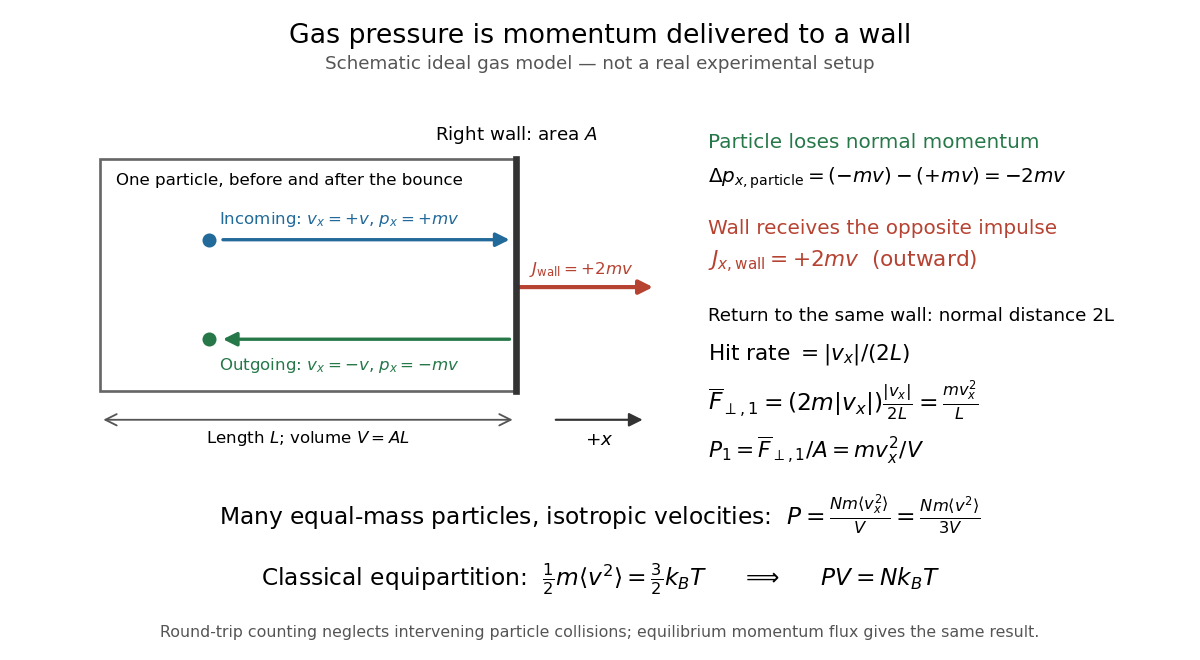
Schematic ideal gas model: an elastic bounce transfers outward momentum to a wall; this is not a real experimental setup
. Details. 
Ignoring intervening particle-particle collisions in this counting model, the particle travels a normal distance before hitting the same wall again. Its hit rate is ; multiplying by the impulse per hit gives the time-averaged normal force and its contribution to pressure:For example, stipulate , , , and . Then , the impulse per hit is , the hit rate is , and . This is one particle's tiny time-averaged contribution to one wall's pressure, not an isotropic equilibrium gas by itself.
For particles of equal mass, add their force contributions and define . In the gas's rest frame, isotropy gives , where . HenceThe final equality uses the classical equipartition theorem. The kinetic pressure of an isotropic gas therefore recovers the ideal gas law from momentum transfers. Doubling the normal speed would double both the impulse per hit and the hit rate, giving four times the pressure contribution; pressure measures a mean squared speed. Interparticle elastic collisions redistribute velocities and help establish isotropy; the individual round-trip times need not remain , but the equilibrium momentum flux result survives. [ref]
No integer solutions of the Mordell equation with constant minus twenty-one Created 2026-10-14 Updated 2026-11-05
Parity and valuations at 3 and 7 make the ideals and coprime in any hypothetical solution. Their product is a cube, so the first is an ideal cube. The ideal class group has exponent two, forcing its cube root ideal to be principal. Cubing would then give coefficient on , which cannot equal one. This proves the nonexistence of integer solutions without assuming unique element factorization.
Zero ideal 2026-10-14
The ideal consisting only of zero. It is the principal ideal generated by zero.
Pure ideal Created 2026-10-14 Updated 2026-11-05
An ideal is pure when the quotient is a flat module. Equivalently every satisfies for some . The latter condition makes vanish after localizing at primes containing it, while at primes not containing it the quotient is zero. Pure ideals need not be finitely generated. They describe flat morphisms that are closed immersions on affine charts.
Monomial ideal Created 2026-10-14 Updated 2026-11-05
An ideal in a polynomial ring generated by monomials. Its exponent vectors form an upward-closed subset of under the componentwise order. The Dickson lemma makes the minimal exponent set finite. This description permits Maclagan's theorem to compare ideals by reverse inclusion independently of the coefficient field.
Ice-shelf water 2026-10-14
Ice-shelf water has acquired characteristic properties through interaction with the underside of an ice shelf. Melting at depth can cool and freshen the water, including cooling below the surface freezing temperature because pressure lowers the freezing point. Its eventual density and contribution to deep-water formation depend on mixing with surrounding shelf and ocean waters.
Ice-shelf buttressing 2026-10-14
Ice-shelf buttressing is the restraint that a floating ice shelf, through its contact with sidewalls or pinning points, can exert on upstream grounded ice flow. Thinning or loss of the shelf can reduce this restraint and increase discharge, but the response depends on geometry and cannot be inferred from floating-ice area alone.
Sea-ice free drift 2026-10-14
Sea-ice free drift neglects internal stress transmitted from neighboring ice. An isolated floe is governed by air and water drag forces, the Coriolis force and sea-surface tilt; steady drift also neglects acceleration.
// Target: geophysics.bigb
Fano completion through three matchings 2026-10-14
If is a hyperedge and the links of on four other vertices contain the three perfect matchings of a , then those seven vertices contain a Fano plane. There is a second completion: if the link of contains three disjoint pairs, and the other six vertices contain all transversal triples through those pairs, take four triples of even parity and the three triples containing . This again gives a Fano plane. These finite templates convert forbidden Fano copies into missing cross-part triples.
Hypergraph chromatic number 2026-10-14
The hypergraph chromatic number is the minimum number of colours in a proper hypergraph colouring. If has vertices and maximum hypergraph independent set size , then , since the colour classes partition its vertex set into hypergraph independent sets.
Property B 2026-10-14
A hypergraph has Property B if its vertices of a hypergraph can be coloured with two colours so that every hypergraph edge meets both colour classes. An -uniform hypergraph with fewer than edges has Property B, by a fair independent colouring and the union bound. Conversely, for , take vertices and independently sample uniformly random -subsets. In any fixed colouring an edge is monochromatic with probability at least : convexity of binomial coefficients reduces to the balanced colouring, and . The union bound over colourings gives a probability at most of any proper colouring. Removing repeated edges leaves a hypergraph without Property B and with edges.
Hypergraph chromatic index Created 2026-10-14 Updated 2026-11-05
The chromatic index of a hypergraph is the minimum number of colours needed to colour its edges so that intersecting edges have different colours. Each colour class is a matching in a hypergraph. It is at least the maximum hypergraph vertex degree, and, when the edge set is nonempty, at most for an -uniform hypergraph of maximum degree , by greedily colouring edges: an edge meets at most others.
Strain energy density Created 2026-10-14 Updated 2026-11-05
A strain energy density measures stored elastic energy per unit volume. The volume convention must be specified. For a hyperelastic material, write per unit volume of the reference configuration, where is the deformation gradient. The total stored elastic energy iswith the first Piola-Kirchhoff stress tensor. If , the density per current volume is . At controlled temperature, the corresponding isothermal description uses a suitable free energy.
In uniform small shear strain , a linear elastic material with shear modulus stores . Differentiating with respect to gives the shear stress . Integrating over the specimen gives the work recoverable on elastic unloading. The same construction turns a local material law into a problem in the calculus of variations for a bent or stretched body, subject to its boundary conditions.
Neo-Hookean solid Created 2026-10-14 Updated 2026-11-05
For an incompressible neo-Hookean solid, a convenient strain energy density is , where is the right Cauchy-Green deformation tensor. An additive constant in does not affect the stress. The shear modulus fixes the small-strain stiffness.
There are unlisted articles, also show them or only show them.