
A nonempty linear polyhedron can have no extreme point. Intersect it with an orthant containing one feasible point, and minimize the sum of the signed coordinates there. The relevant sublevel sets are compact, so the minimum face has an extreme point, which is also extreme in the orthant intersection. The added signed-coordinate rows are integer rows with entries at most one. The integer-matrix vertex coordinate bound gives . This supplies a bounded feasibility search even when the original polyhedron contains lines.
Spheroid 2026-10-14
A spheroid is an ellipsoid of revolution obtained by rotating an ellipse about a principal axis. Rotation about the shorter axis gives an oblate spheroid; rotation about the longer axis gives a prolate spheroid. Thus the oblate form is a member of the general family.
John ellipsoid 2026-10-14
The John ellipsoid of a convex body is its inscribed ellipsoid of largest volume. For the unit ball of a -dimensional normed vector space, change coordinates so that this ellipsoid is the Euclidean unit ball. The resulting coordinates are called John position. In these coordinates the John contact decomposition implies , or .
Solid ellipsoid Created 2026-10-14 Updated 2026-11-05
A solid ellipsoid is the filled region bounded by an ellipsoid. The open version centered at the origin iswhere is a real symmetric positive-definite matrix; replacing by includes the boundary. Its semi-axis lengths are , where are the eigenvalues of . In three dimensions its volume is , by a change of variables from the unit ball.
In even-dimensional symplectic geometry, a uniform dilation , , multiplies the symplectic capacity by . This concerns one common factor in every coordinate. Independent changes in the different semi-axis lengths are not a uniform dilation and have no such common square factor.
Nearest points to the origin on a positive-definite ellipsoid Created 2026-10-14 Updated 2026-10-25
For a positive-definite symmetric matrix , the ellipsoid has nearest points to the origin exactly at , where ranges over unit vectors in the largest-eigenvalue eigenspace. Indeed, the spectral theorem for real symmetric matrices gives , with equality precisely in that eigenspace. A simple largest eigenvalue gives two opposite nearest points; multiplicity gives a scaled -sphere of nearest points.
Repeated weak-rotation bomb-test efficiency Created 2026-10-14 Updated 2026-11-05
For an Elitzur-Vaidman bomb tester using a rotation and its inverse, let be the probability of entering the absorbing path and . Conditional on a live absorber, one trial has explosion probability , successful safe identification probability , and inconclusive probability . The inconclusive projective measurement resets the input, so summing a geometric series gives the displayed success probability after at most trials. Its limit is , approaching one half as tends to zero through positive values. Exactly zero coupling produces no information.
Circle reduction splits the metric into a ten-dimensional graviton, one vector and one scalar, and the three-form into a three-form and two-form. Seven-torus reduction gives a four-dimensional graviton, vectors, direct scalars and seven two-forms. The two-form scalar duality turns the latter into seven more scalars, giving in all. A remaining four-dimensional three-form has no local polarization. These are zero-mode counts without fluxes, orbifold projections or moduli freezing.
Freund-Rubin compactification Created 2026-10-14 Updated 2026-11-05
Two-valued topos 2026-10-14
A nondegenerate elementary topos is two-valued when its terminal object has exactly the empty and whole subobjects. This is a global-truth property, distinct from being a Boolean topos, which requires complements for all subobjects of all objects.
Newton's identities 2026-10-14
Newton's identities let two different summaries of the same polynomial roots talk to each other. Elementary symmetric polynomials record products of distinct root positions; power sums record sums of individual powers, . Either can be easier to obtain in a particular problem. The identities turn one into the other, often avoiding any need to find the individual polynomial roots.
Write and for . For every positive integer , the identity isIt is a polynomial identity over the integers, so it remains true on substitution in any commutative ring. To solve it for by division, however, must have a multiplicative inverse. Over a field of characteristic zero, the first power sums recover every elementary symmetric polynomial. The same recovery works when the positive characteristic of a field is greater than ; small characteristic needs care.[ref]
The first three relations are , , and . When division by two and three is permitted, this becomesFor the three roots , their power sums are , , and . The formulas give and , recovering the polynomial from aggregate data.
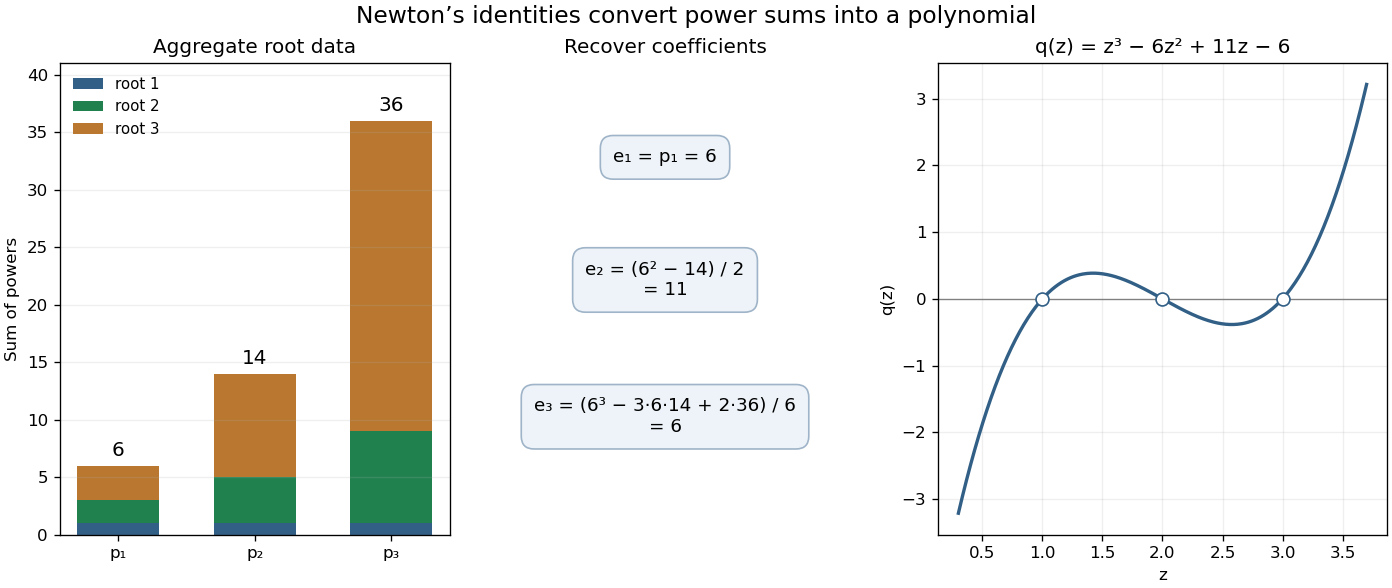

The beauty is that the summaries do not depend on the order of the polynomial roots. In symmetric polynomials, one can work with quantities that survive every relabeling; in linear algebra, traces of matrix powers give the same kind of aggregate information about eigenvalues. The identities convert those summaries into coefficients of a characteristic polynomial.
A short derivation packages the identities into a formal power series. Let . Since its constant coefficient is one, it has an inverse as a formal power series, and its formal derivative satisfiesMultiply by and compare the coefficient of . This gives Newton's identities without a convergence assumption or division by . The division issue arises only when using them to recover . The logarithmic-derivative approach is also developed in Newton's Identities (January 2019 notes) by Milan Mossé (§4, pp. 6–8).
The alternate name Newton-Girard identities recalls Albert Girard's earlier work. A modern historical account credits formulas through sixth powers to Albert Girard in 1629 and discusses their later appearance in Isaac Newton's Arithmetica universalis.[ref] This citation refers to that account; the original historical editions have not been inspected here.
Molecularity 2026-10-14
Molecularity counts the reacting entities in one elementary reaction: one for a unimolecular step, two for a bimolecular step. An entity can be a molecule, ion, or chemical atom. Solvent entities involved only through solvation are excluded. Molecularity describes a microscopic event; order of reaction describes the concentration dependence of a rate law. Assigning molecularity to a net multi-step chemical equation is therefore inappropriate.[ref]
Glossary of Terms Used in Physical Organic Chemistry (IUPAC Recommendations 1994): M entries by International Union of Pure and Applied Chemistry. Glossary of Terms Used in Physical Organic Chemistry, IUPAC Recommendations 1994, entry “molecularity”: elementary event and exclusion of solvation medium
Kunen inconsistency theorem 2026-10-14
In ZFC there is no nonidentity elementary embedding , understood as an ordinary class embedding whose set restrictions and critical sequence are available. Let be the supremum of the Kunen critical sequence, so and . Partition the ordinals of cofinality below into stationary sets indexed by the critical point. After applying , the extra stationary cell at that critical point meets the club of ordinals closed under . Such an ordinal of countable cofinality is fixed by and hence belongs both to that extra cell and an old-index cell, a contradiction.
Elementarity 2026-10-14
Preservation of all first-order formulas with parameters by an embedding. For an inclusion of structures this is the condition for an elementary substructure.
Oil drop experiment 2026-10-14
The oil drop experiment infers an oil drop's electric charge from its motion under gravity, buoyancy, drag and a calibrated electric field. Repeated changes of a single drop's electric charge reveal discrete steps; see the model, experimental procedure and limitations in elementary charge.
Electromagnetic coupling of a weak multiplet Created 2026-10-14 Updated 2026-10-18
With the plus-sign convention , let and . The coefficient of is , where . The extra minus sign in the interaction Lagrangian comes from the in . It reproduces the electric charges of every component of an Standard Model representation.
A solid sphere of radius and uniform charge density has total electric charge . Gauss law gives the radial electric field inside and outside. The electric potential vanishing at infinity is inside and outside. Integrating the electrostatic energy density over both regions gives . In a fixed-density family with and , the electrostatic energy scales as .
Electrostatic energy of a three-plate capacitor Created 2026-10-14 Updated 2026-10-25
In the parallel-plate approximation, a central plate at potential between grounded plates at forms two parallel capacitors of gaps and . Summing their field energies gives the displayed formula. At fixed voltage it is minimized at . Finite circular plates have fringe fields; the uniform-gap expression assumes those edge corrections are neglected.
Conduction band Created 2026-10-14 Updated 2026-10-20
The initially empty energy band above the band gap in the simple semiconductor description. Excited electrons in it can carry electric current; they can also bind to valence band electron holes as excitons.
Valence band 2026-10-14
In the simple semiconductor description, the highest occupied energy band of the unexcited crystal at zero temperature. A missing occupant is an electron hole.
Electron-hole recombination Created 2026-10-14 Updated 2026-10-20
An electron filling an electron hole removes both excitations relative to the filled-band background. Their electric charges cancel, consistent with charge conservation; the remaining electrons are still present. The released energy can leave through photon emission or other channels, including phonons. Formation of an exciton instead retains the excited electron and electron hole as a bound pair; recombination removes the pair. A valence band electron filling a nearby vacancy merely moves the electron hole and does not remove the total vacancy count.
There are unlisted articles, also show them or only show them.