
Past exam of the mathematics course of the University of Cambridge 2002 iii Paper 13 1 Solution Created 2026-10-03 Updated 2026-10-14
Let be a connected compact Riemann surface of genus . Choose an oriented symplectic basis of , with . For a closed complex differential form , write and . The Riemann bilinear relations begin with the identityTo prove it, cut along the chosen cycles to obtain a fundamental polygon . On this simply connected polygon, a closed differential form has a primitive , with . Stokes theorem gives . The two copies of each edge have opposite orientations, and their values of differ by the period acquired in passing between them. Pairing the copies of the and edges gives, respectively, and . Summing proves the identity; the convention fixes its sign.
For holomorphic one-forms , their wedge product is zero because locally both are multiples of . Thus the first holomorphic Riemann bilinear relations isFor a nonzero holomorphic one-form , the second relation follows by applying the bilinear identity to :In particular, a holomorphic one-form with all -periods zero must vanish. Since , the map taking a holomorphic one-form to its -periods is an isomorphism. We can therefore choose normalized holomorphic one-forms with . Put . The first relation applied to gives , and the second applied to gives for . ConsequentlyThese conclusions make the construction of the Jacobian variety work. Integration identifies the image of in with the period lattice . The real-linear map is invertible: its imaginary part is , and is invertible. Hence is a discrete lattice of full real rank , andis a compact complex torus, rather than a non-Hausdorff quotient. Changing the symplectic basis changes the displayed coordinates but not this intrinsic quotient.
The Riemann bilinear relations also supply its polarization of a complex torus. Use the Hermitian form , linear in the first argument, and set . Symmetry of givesThus is an integral positive Riemann form on a complex torus. Its matrix on the displayed lattice basis is the unimodular symplectic matrix. The corresponding positive holomorphic line bundle, equivalently the one constructed from theta automorphy in Solution 4, gives a principal polarization of a complex torus. By the Kodaira embedding theorem this makes the complex torus projective, hence an abelian variety. The normalization here is important because was chosen linear in its first argument. If , the spaces of holomorphic one-forms and periods are zero and the Jacobian variety is a point.
Past exam of the mathematics course of the University of Cambridge 2002 iii Paper 12 4 Solution Created 2026-10-03 Updated 2026-10-14
Let be the primitive lattice generator of the ray . In the toric divisor class sequence, the first map sends a torus character exponent to its principal divisor on a toric variety:The second map sends an invariant Weil divisor to its class modulo principal divisors. Completeness makes the rays span , so the first map is injective. These are the maps in the given sequence; its exactness need not be reproved.
For , letThe torus characters with form a basis of . This works for Weil divisors, not only for Cartier divisors. It is the character basis associated to the lattice polytope of a toric divisor.
For a Cartier divisor, the toric ampleness criterion is as follows. Each maximal cone has local Cartier data satisfying on its rays. The divisor is ample exactly whenEquivalently the support function is strictly concave, with these linear pieces. For a Q-Cartier Weil divisor use rational and clear their denominators; the criterion means that a positive multiple is ample Cartier. An arbitrary Weil divisor need not be Q-Cartier, so this qualification cannot be omitted.
Take positive weights , reduced so their common greatest common divisor is one. A toric definition of weighted projective space usesIf the weights are well-formed, meaning for every , the are primitive: the quotient has torsion of order that omitted-weight greatest common divisor. The lattice itself is free because is primitive. The positive relation implies that proper subsets generate pointed cones and that they meet along common faces. Completeness can be seen directly: represent a vector by real coordinates and subtract times . The resulting coordinates are nonnegative and at least one is zero, placing the vector in one of the displayed cones. Their common-face property follows from this unique normalization of each class modulo . This gives the fan of the well-formed weighted projective space.
The dual lattice isIts map in the divisor sequence is simply inclusion in , so the homomorphism identifies the cokernel with . It is onto by coprimality of all the weights. ThusChoose integers by the Bezout identity . Then explicitly represents the positive generator .
To verify ampleness in the Weil/Q-Cartier sense, put . On the maximal cone omitting ray , defineThis is integral and has . Its pairings with the included rays are , while on the omitted ray they equal . Consequently is Cartier and ample by the numerical criterion. This is an explicit class-group generator of a well-formed weighted projective space.
The generator is generally ample Weil, not Cartier. If the source's word “ample” is interpreted as requiring a Cartier divisor, its generator request is false in general: on , take . On the chart omitting the weight-two ray, the Cartier equations force , which is not in the integral dual lattice. Twice this datum is integral, so the class-one divisor has Cartier index two and no Cartier divisor generates its class group. With the usual ample-Q-Cartier-Weil interpretation, the construction above proves exactly the requested result. This distinction also explains the use of the divisorial spaces rather than assuming an invertible sheaf .
Finally let an ample divisor represent the class-group generator. Its class is the positive generator; the negative generator cannot be ample because a positive Cartier multiple has negative degree on the curves where the positive generator has positive degree. After replacing by a linearly equivalent invariant divisor, write it as with . A character basis element of has exponent with . Set . Then and . Conversely every nonnegative exponent vector of weighted degree gives the unique . Thereforeis a bijection of bases in each degree. Adding and under multiplication adds these nonnegative exponent vectors, so it preserves products and the unit. A different linearly equivalent representative changes the basis by the corresponding rational-function power and gives the same graded-ring isomorphism. Hence the divisorial section ring is the weighted polynomial ring:The character construction is defined over the ground field , so this is an isomorphism of graded -algebras. It proves the divisorial section ring of a well-formed weighted projective space assertion even when its ample generator is not Cartier.
Past exam of the mathematics course of the University of Cambridge 2002 iii Paper 12 3 Solution Created 2026-10-03 Updated 2026-10-14
A singular two-dimensional affine toric variety in the normal fan construction must come from a full-dimensional pointed cone; cones of smaller dimension give smooth charts with a torus factor. Let its primitive boundary generators be . Choose an oriented lattice basis with , and write the other generator as , . Primitivity gives . Changing the second basis vector by a multiple of the first lets us write the cone asHere because determinant one would give a smooth chart. The sublattice has index , and its affine chart is . The quotient is cyclic, generated by , whose coordinates in the two boundary generators are . Thus the kernel of the corresponding finite map of tori acts on the two affine coordinates as . More explicitly, invariant monomials are exactly those with , which are the elements of the original dual lattice in the first quadrant. Their ring is . Hence the singularity is the cyclic quotientThe choice of the two boundary axes is unordered; exchanging them replaces by its inverse modulo .
The Hirzebruch–Jung resolution is computed by the negative Euclidean algorithm. Put , and recursively setThe nonzero remainders strictly decrease, , and their greatest common divisor stays one; the process terminates with , . All , and unwinding the recursion gives the negative continued fractionStart with and and define . The determinant of every consecutive pair is one, by induction. Moreoveragain by the same recursion and the initial values . Each intermediate ray is therefore inside . To check the ordering explicitly, the first coordinates after are negative, the second coordinates positive, and successive determinants are positive. At the last step the determinant with the endpoint is zero. The vector is primitive, points in the same direction as , and hence equals it. Subdivide by all the intermediate rays . Every new cone is regular, and the subdivision has the same support, so it gives a proper smooth resolution.
Each internal ray has a compact invariant curve , because the quotient fan at it has the two opposite primitive rays. The relation gives its self-intersection . This can also be checked directly: on the chart for use coordinates with ; on the next chart the coordinates are , with . The normal-coordinate transition is that of , proving the self-intersection. Neighboring exceptional curves meet transversely once and nonneighbors do not meet.
Since , there is no exceptional minus-one curve. Combinatorially, deleting gives a cone of determinant . Deleting a longer consecutive block cannot give a regular cone either: determinants of successively more distant rays satisfy the same recursion with coefficients at least two and grow from to integers at least two. Thus no proper smooth coarsening of this subdivision exists. This proves the minimality of the minimal resolution of a cyclic quotient surface singularity; equivalently its exceptional chain has no curve that can be blown down to a smooth point. The number of exceptional curves is the length of the negative continued fraction.
If , then is an integer, so coprimality gives . Conversely gives the single coefficient and one curve. If , thenThe numerator and denominator on the right are coprime, so and . Therefore and . Conversely, if these conditions hold, then , give exactly this two-term expansion. Hence the requested equivalences are
Now consider a complete fan in dimension two with three rays and at most one singularity. Its three two-dimensional cones are the consecutive ray pairs. At least two cones are regular, and they share a ray. After an oriented lattice change, take their consecutive generators to be , and : the first cone is a basis, and forces the first coordinate . Completeness forces , because the third pair must span the missing sector with positive determinant . Write , . The unique positive primitive relation is , so the fan is that of the weighted projective plane , or after permuting weights. For this is ; for its remaining cone has type . This proves the full three-ray classificationThese are the complete three-ray toric surfaces with at most one singular point, including the smooth case.
For four rays and exactly the specified singularity, place the three regular cones consecutively. Normalize the middle one to have generators . Its neighboring regular cones then force the cyclic ray listThe remaining cone has determinant , so . Thus have opposite signs, and is a positive divisor of . In the oriented lattice basis ,so the singular cone has quotient parameter . It follows that its parameter is congruent to . If identification with the specified singularity exchanges the two boundary rays, the parameter is inverted; this does not change the criterion, since for we have , and is the complementary positive factor. The same identity with a minus sign handles .
Conversely suppose and , . Choose and in the displayed four rays. They are primitive and cyclically ordered, with all four gaps less than a half-plane; the opposite signs of ensure completeness. Three consecutive determinants are one, and the fourth is . Its quotient parameter is , so the only singular point has the required type. We have proved the four-ray completion criterion for a cyclic quotient surface singularity:
Past exam of the mathematics course of the University of Cambridge 2002 iii Paper 12 2 Solution Created 2026-10-03 Updated 2026-10-14
The smoothness criterion for a toric variety says that every cone must be regular: its primitive ray generators must be part of a lattice basis of . Such a -dimensional cone gives the chart ; all charts are smooth precisely under this criterion.
Here is a terminating construction of a smooth fan subdivision. First subdivide compatibly into simplicial polyhedral cones. One method is the barycentric subdivision: choose a rational interior ray in each nonzero cone and perform the star subdivisions in decreasing dimension. Its cones correspond to chains of faces, hence are simplicial. For a simplicial cone with primitive generators , let its multiplicity be the index of their integer span in the saturated lattice .
If a cone is not regular, choose a nonregular face minimal under inclusion. Its half-open fundamental parallelepiped contains a nonzero point of the toric lattice , . Every coefficient is positive: otherwise lies in the span of a regular proper face, whose generators extend to a lattice basis, forcing all the remaining coefficients to be integers and hence zero. Replace by the primitive vector on its ray; its coefficients still satisfy . Star-subdivide the entire fan at this ray. In each cone containing , the new maximal cones replace one of these by , so multilinearity of the determinant makes the new multiplicity times the old one. It is a positive integer strictly smaller than the old multiplicity. Other cones are unchanged. Select inside a maximal cone of largest multiplicity. The number of maximal cones having that largest multiplicity decreases, and once it reaches zero the largest multiplicity decreases. This lexicographic integer descent terminates at multiplicity one. It proves every finite rational fan has a smooth subdivision, not merely a simplicial one; this is multiplicity descent in toric desingularization.
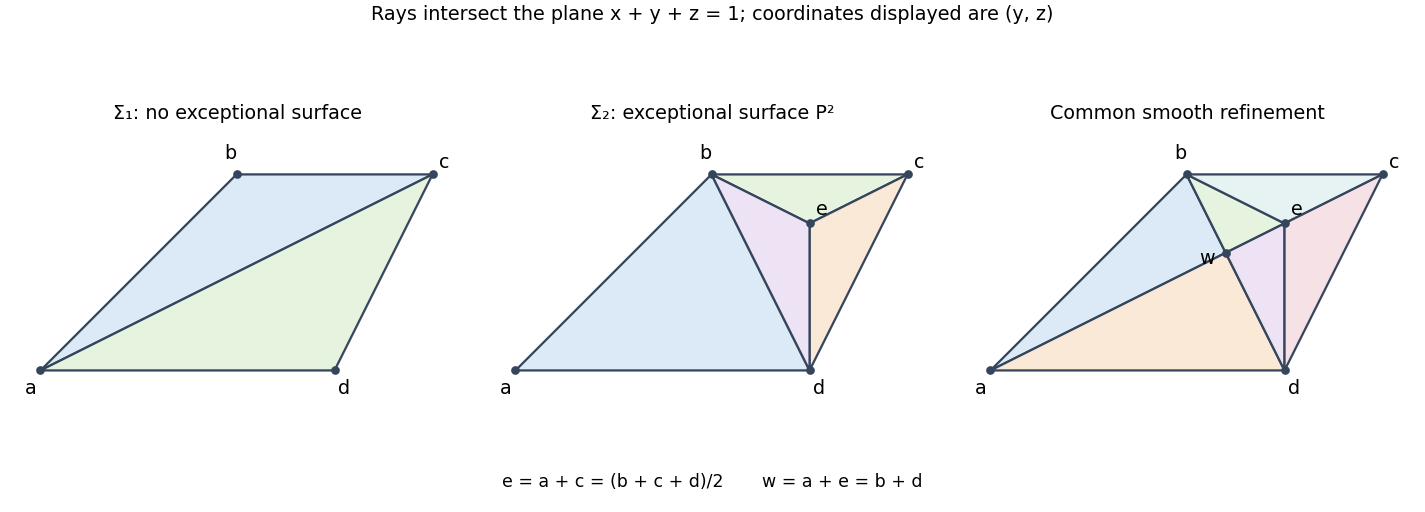
For the specified threefold, abbreviate the primitive rays byIts boundary two-dimensional faces are . For example their supporting normals, chosen inward, are ; each is zero on the named pair and positive on the other two rays. These normals are primitive. Equivalently the greatest common divisor of the two-by-two minors for each ray pair is one, so these faces are regular; the rays themselves are primitive as well. The full cone is three-dimensional with four extremal rays, hence not simplicial and not regular. The orbit-cone correspondence now shows the closed torus-fixed point is its only singular point: every other orbit belongs to the smooth chart of a proper face.
Define the first subdivision by its maximal conesHere a string of letters denotes their nonnegative span; all faces are included. This is the triangulation along diagonal of a positive cross-section. Both determinants have absolute value one, so it is smooth. The subdivision has the same support as the original cone, hence its toric morphism is proper and birational and is a resolution. No new rays were added, so it has no exceptional surfaces. Its internal wall gives a compact exceptional curve isomorphic to , by the two-ray quotient fan at that wall. The only proper coarsening is the original nonregular cone, so this resolution is minimal in the stated fan sense.
For a second resolution, setStart with the other diagonal . The cone is regular, but has determinant of absolute value two. Its primitive interior point divides it into the three regular cones shown, each with determinant of absolute value one. Therefore is again a smooth resolution and is different from .
This fan has exactly one new ray, so its only exceptional surface is . To identify it, quotient by . The three neighboring rays are , their sum is zero, and consecutive pairs are bases because are regular. Their quotient fan is the simplex fan of the projective plane. In fact its normal bundle is : the chart before subdivision is since its index-two lattice extension is generated by , and the new radial parameter is the square of the ordinary radial parameter of . It has the transition factors of .
For minimality, the ray cannot be deleted in a smooth coarsening. Deleting an interior ray in this triangulation merges all three incident cones into , which is nonregular, or merges further into the original nonsimplicial cone. If is retained, deleting a wall between its three incident cones gives a nonconvex union unless all three are merged, again giving . The remaining internal wall separates and ; their union has four extremal rays , since , and is not regular. Thus no proper coarsening is smooth. These are the two minimal toric resolutions of a four-ray threefold cone.
The factorization can be made completely explicit. Starting with , add in the wall , producing a smooth fan with maximal cones . Next addin the wall . The resulting common fan has maximal conesStarting instead with , the star subdivision at in the wall gives exactly the same six cones. Each insertion is the sum of the generators of a smooth two-dimensional cone. Such a star subdivision is the toric blowup along an orbit closure of its smooth invariant curve: in local coordinates the center has ideal , and the two blowup charts with ratios and give the two new cones. We have the zigzag of blowup morphismsThe required birational map is the composite of the inverses of the first two morphisms with the last. This supplies individual smooth toric blowups, rather than appealing to an abstract factorization theorem.

Past exam of the mathematics course of the University of Cambridge 2002 iii Paper 12 1 Solution Created 2026-10-03 Updated 2026-10-14
Write for the dual cone, , and for the affine toric variety. This is the variety denoted in the source; the subscripts there refer to the cone of exponents, whereas refers to the cone in .
For a face of a polyhedral cone , define . If is in the relative interior of , nonnegativity on shows that a functional in vanishes on exactly when it vanishes on all of . Hence is a face of . Conversely a face of gives . Every polyhedral face is exposed: the supporting functionals for its containing facets can be added, since they are nonnegative. If , then , soThe same argument applied to proves , using the closed-cone identity . That identity follows from separation of a point outside a closed convex cone. Finally, enlarging makes its annihilator smaller. Thus these maps are inverse order-reversing bijections, proving face duality for polyhedral cones even when is not full-dimensional.
For the given integral exposing functional , we claimOne inclusion is immediate since vanishes on . For the other, let be nonnegative on and test it on finitely many generating rays of . Where vanishes, those rays belong to , so is already nonnegative. On every other ray is positive, so choosing a sufficiently large integer makes nonnegative on all the rays. This proves the claim. The corresponding semigroup algebra identity isThus the face chart is an open subvariety.
For a face , the span of monomials with is an ideal: if with , the face property forces both into . Its quotient is , defining the closed subvariety . If , this subvariety lies in .
Conversely, at a point , the exponents with form a semigroup face: a product is nonzero exactly when both factors are. These exponents are precisely the point of the toric lattices of a face of . To see the geometric assertion, choose finitely many monoid generators by the Gordan lemma. The nonzero generators span a cone. If that cone were not a face, a rational nonnegative relation would express a sum of its generators using an omitted generator with a positive coefficient. Clearing denominators and evaluating the corresponding monomials would equate a nonzero product to zero. Conversely, any point of the toric lattice in their cone has a positive integral multiple expressible using them, so its monomial must also be nonzero. This proves the monomial support face of a toric point assertion. If , then and every monomial outside vanishes at , placing in . Therefore, as reduced closed subvarieties,The assertion concerns the closed set with its reduced structure; a monomial's principal zero subscheme can have multiplicities.
For the intersection assertion, choose integral exposing functionals for . Both are nonnegative on , so . Localization then givesThis uses the dual of the intersection, as printed in the PDF; the TeX's perpendicular symbol in that position is not the correct transcription.
For a general toric fan, the points with a fixed monomial support face form a torus orbit. The nonzero evaluations extend to a character of the lattice generated by that face, and restriction from the ambient algebraic torus is surjective over . Thus the affine calculation yields the orbit-cone correspondence: contains exactly the orbits for faces . The orbit associated to has character lattice , so it is the source's . The same monomial ideal calculation, chart by chart, shows that its closure isIndeed, inside a chart containing , the closure has exponent face , and its smaller support faces correspond exactly to cones containing .
Past exam of the mathematics course of the University of Cambridge 2002 iii Paper 11 3 i Created 2026-10-03 Updated 2026-10-14
Past exam of the mathematics course of the University of Cambridge 2002 iii Paper 11 2 Solution Created 2026-10-03 Updated 2026-10-14
Let be a finite undirected -regular graph on vertices, with adjacency matrix and normalized random walk matrix . Define edge expansion and normalized conductance byAn expander family has orders tending to infinity, uniformly bounded maximum degree, and a uniform positive lower bound on . For a regular graph the constant vector is an eigenvector of with eigenvalue one. Write its eigenvalues as , and let . This spectral gap measures the energetic cost of departing from a constant function.
For every mean-zero vector , the spectral theorem and the graph's energy identity giveApply this to . Its norm squared is and its energy is . ThereforeThus a uniform spectral gap gives uniform edge expansion when is fixed. This also bounds exterior vertex expansion: each exterior vertex accounts for at most boundary edges, so .
For the converse, take a mean-zero eigenvector for and choose its sign so that its positive support has at most vertices. Put , which is nonzero. Truncation decreases energy in the following precise sense: for any two real numbers ,Summing over edges yields . For the threshold sets , every nonempty set lies in that small positive support. Integrating its boundary count gives the layer-cake identityThe Cauchy-Schwarz inequality bounds the left side bybecause the first sum is at most and the second at most . Cancelling proves the Cheeger inequality in both directions:Hence bounded-degree regular families have uniform edge expansion exactly when their second-largest normalized eigenvalue stays uniformly below one.
Absolute eigenvalues give additional information. Put . Centering the indicators of and applying the operator-norm bound on the mean-zero subspace proves the expander mixing lemma:Here , so internal edges are counted as oriented incidences. A small makes edge counts resemble uniformly distributed edges. It also gives rapid random walk mixing: starting at a vertex, contracts the mean-zero component of its point mass by at most in Euclidean norm; Cauchy-Schwarz inequality then gives total variation distance at most from the uniform distribution. A bipartite graph has eigenvalue and its non-lazy walk alternates sides, even if it has good edge expansion. The lazy walk has nonconstant eigenvalues between zero and , resolving this periodicity. It is important to distinguish the gap controlling cuts from the absolute bound controlling non-lazy mixing.
Here is a fully specified deterministic construction of an infinite family. Its degree is large but fixed. SetChoose the lexicographically first ordered list satisfyingThis finite deterministic search terminates. To prove existence, choose the list uniformly and independently. For each nonzero , its signs are independent unbiased signs; the exponential-moment estimate and Markov inequality give an exceptional probability at most . A union bound gives total failure probability at mostThus at least one qualifying list exists. Fix it once and for all.
Let be the Cayley graph on whose th neighbor of is . It is an undirected -regular port-labeled graph, allowing repeated edges and loops in this intermediate construction. Its characters form an orthogonal eigenbasis, with the displayed averages as normalized eigenvalues. Therefore . Each loop counts as one transition port; degrees here mean row sums of the adjacency matrix.
We next define the zig-zag product and prove the bound used for iteration. A port labeling of a -regular undirected graph gives an involution , recording the endpoint and reverse port. If a -regular graph has vertex set , the product has vertices . For each ordered pair of small-graph ports, move from to in , follow the big edge , and move from to in . The endpoint is ; reversing the steps reverses the two small-graph port labels. The product is undirected, has vertices, and has degree .
Write and let be the permutation matrix of . The normalized product operator is . For a mean-zero unit vector, decompose into its cloud-constant part and its cloud-orthogonal part. Then , , and . The compression of to cloud-constant vectors is exactly , so . Expanding the quadratic form and applying Cauchy-Schwarz inequality givesThe operator is symmetric, so its mean-zero operator norm is bounded by this same quantity. No unproved product spectral estimate is needed.
Start with the loop-inclusive complete graph on vertices, whose normalized matrix is and whose nonconstant eigenvalues are all zero. Given a -regular , its two-step graph has degree and normalized operator . Label a two-step edge by its ordered pair of ports; reversal reverses the path and its reverse ports. These labels are the vertex set of the fixed graph . DefineIt has degree , and its number of vertices is , hence . By the proved bound,Starting from zero, induction gives , since . The cut-energy argument therefore gives multiplicity-counted edge expansion at least for every .
To obtain ordinary simple graphs, delete loops and merge parallel edges. The maximum degree is at most , and any one unordered vertex pair had multiplicity at most . Thus every cut retains at least of its multiplicity-counted boundary, givingThese simple graphs form an expander family. Every choice is deterministic: the finite base search is fixed independently of , and the recursive edge rules determine all subsequent adjacency lists. Once that base is fixed, adjacency lists can be generated successively using the previous lists, with a constant amount of work per output edge. This is squaring and zig-zag iteration yields bounded-degree expanders. The spectral argument supplies the uniform expansion guarantee and explains why squaring improves the eigenvalues while the product restores a constant degree.
Past exam of the mathematics course of the University of Cambridge 2002 iii Paper 10 4 Solution Created 2026-10-03 Updated 2026-10-14
Write for the infinite subsets of an infinite . A Ramsey set of infinite subsets is a family such that each infinite ground set has an infinite subset withThe convention asking only for one such homogeneous cone is weaker; the proof below establishes the displayed property and, in fact, the stronger completely Ramsey set property.
For a finite stem and an infinite reservoir lying above every element of , putThese sets form the basic open neighbourhoods of the Ellentuck topology, or star topology. Here is an initial segment of every member of . A star-Borel set means a member of the sigma-algebra generated by these open sets. A family is completely Ramsey if every has a homogeneous refinement with infinite and the same stem . We prove this for every star-Borel set, beginning with open sets.
Fix a star-open family and a basic neighbourhood . An infinite reservoir above a finite stem accepts if . It rejects if no infinite subset of accepts . A reservoir decides if it accepts or rejects it. Any reservoir has a refinement deciding a prescribed stem: take an accepting refinement if there is one, and otherwise the current reservoir rejects. Both kinds of decision persist under infinite thinning.
First refine to decide . If the decision is acceptance, the required homogeneous neighbourhood has already been found. Suppose it is rejection. We use deciding all finite stems by fusion to selectfrom nested infinite reservoirs. After selecting , successively thin the remaining reservoir to decide every stem with . There are only finitely many such , so every stage can be completed. Choose from that thinned reservoir and repeat. Let . For every finite , the taildecides ; for , use all of . Indeed, the stem was decided at the stage when its largest point was selected, and its final tail is a subset of the reservoir retained at that stage. The empty stem remains rejected by the initial decision.
The crucial finite-obstruction fact is that a rejected stem has only finitely many accepting one-point extensions. More precisely, suppose rejects . If infinitely many had accepting , collect those into an infinite . Any has a least point , and its remaining tail lies in . Acceptance at would then imply . Thus would accept , contradicting rejection. This proves the finitely many accepting extensions of a rejected stem assertion with the reservoirs specified.
Thin a second time. Having selected a finite prefix of , maintain that every stem with a subset of that prefix is rejected relative to its tail in . Each such stem has finitely many forbidden next points leading to acceptance. Choose the next point of above the prefix and outside the union of these finitely many finite forbidden sets. The deciding property of then makes every newly created stem rejected. Starting with the rejected empty extension gives an infinite all of whose finite extensions of are rejected.
We claim . Otherwise take . Star-openness supplies a basic neighbourhood inside containing . Extend its finite stem along until it contains ; the new stem has the form for a finite initial segment of . The remaining infinite tail of is a subset of and accepts that stem, contradicting rejection. This proves the fusion proof for open Ellentuck sets: every star-open set is completely Ramsey.
Next call completely Ramsey-null if every has a same-stem refinement disjoint from . Every star-nowhere dense set is completely Ramsey-null. Indeed, the complement of its star-closure is star-open and dense. Apply the just-proved open-set result inside . The homogeneous alternative disjoint from would be a nonempty open set contained in the closure of a nowhere-dense set, which is impossible. Hence some lies entirely in and avoids .
Countable unions of completely Ramsey-null sets are again completely Ramsey-null. Here is the full Ellentuck meagre-set fusion lemma. Given and , construct selected prefixes and nested unused infinite reservoirs. At stage , refine the reservoir, still lying above , to arrangeEach constraint can be imposed by complete Ramsey-nullness, with all earlier constraints preserved by thinning; there are finitely many constraints. Choose and retain the tail above it for the next stage. Start with and the reservoir .
Let . If and is fixed, take any and put . Every remaining point of lies in , so and . ThereforeThis construction handles all subsets of a selected prefix, not merely the full prefix: members of may skip arbitrarily many selected points. Since a meagre set is a countable union of nowhere-dense sets, every star-meagre set is completely Ramsey-null.
It remains to pass from star-open sets to star-Borel sets. Let consist of the families expressible aswhere is star-open and is star-meagre. We verify directly that is a sigma-algebra. It contains every open set. Countable unions remain in , becauseand a countable union of meagre sets is meagre. For complements, replace by the open set . The omitted part is , the boundary of the open set , which is closed and nowhere dense: a nonempty open subset of must meet , so it cannot lie in this boundary. Thusa meagre set. Subsets of meagre sets are meagre as well, since taking a subset preserves nowhere denseness. These observations prove the claimed sigma-algebra property. Hence every star-Borel set belongs to .
Finally, for and any , first use complete Ramsey-nullness to obtain avoiding . On that neighbourhood and coincide. Apply the open-set result to within to get a homogeneous . ThereforeTaking gives the requested homogeneous infinite-subset cone inside any given infinite ground set. Every closure, interior, open set and meagreness used in this proof refers to the Ellentuck topology; substituting the coarser ordinary topology at an intermediate step would change the assertion.
Past exam of the mathematics course of the University of Cambridge 2002 iii Paper 10 3 Solution Created 2026-10-03 Updated 2026-10-14
We take . An ultrafilter on is a proper filter on a set which decides every subset: it contains but not , is closed under finite intersections and passage to supersets, and contains exactly one of and for every . A principal ultrafilter has the form ; all other ultrafilters are nonprincipal ultrafilters.
To prove existence, start with the cofinite filter and order its proper filter extensions by inclusion. The union of a chain is again a proper filter on a set: the finitely many sets involved in an intersection all belong to one member of the chain, and no member contains the empty set. Thus Zorn's lemma supplies a maximal proper filter . If , adjoining must make the generated filter improper; equivalently, some has . Then , so . This proves that is an ultrafilter. It contains the complement of every finite set and hence no finite set. In particular, it contains no singleton and is nonprincipal.
The Stone-Čech compactification of the natural numbers is the set of all ultrafilters with basic open setsWe have and , so these basic sets define a topology and are clopen sets. If , choose . The disjoint basic neighbourhoods and separate them. Thus the space is Hausdorff.
For compactness, it suffices to show every basic open cover has a finite subcover, since an arbitrary open cover can be refined by basic open sets. Suppose has no finite subcover. The complements have the finite intersection property: if a finite intersection were empty, the corresponding finite family of would cover every ultrafilter. Their generated proper filter on a set extends to an ultrafilter, by the same Zorn's lemma argument. This ultrafilter contains every , and therefore belongs to none of the alleged cover members, a contradiction. We have proved that is a compact Hausdorff space. The map embeds the discrete natural numbers densely: any nonempty contains for some .
For addition on the Stone-Čech compactification of the natural numbers, defineand putThe map preserves intersections and complements, because translation does and is an ultrafilter. It also sends to and the empty set to itself. Consequently the displayed rule defines an ultrafilter . On principal points it satisfies , so it extends ordinary addition.
Write to mean that . The ultrafilter addition rule is then an iterated quantifier, with its order fixed. Expansion givesOrdinary addition is an associative operation, and the quantifiers are in the same order on both lines. Thus . This argument does not interchange ultrafilter quantifiers and does not assert that this extended addition is commutative.
For fixed , the translation hasa basic clopen set. Therefore addition is continuous in its left variable. This is the left-continuity convention used here: right translations are continuous, giving a left-topological semigroup. Continuity in both variables jointly is not part of the assertion.
Hindman's theorem says that every finite colouring of the positive integers has an increasing sequence whose finite-sums setis monochromatic. Assume, as permitted, that the addition just defined has an idempotent ultrafilter , so . This ultrafilter is nonprincipal: a principal would satisfy for positive . Hence every member of is infinite and every cofinite set belongs to .
Exactly one cell of the finite colour partition belongs to . Define its star set bySince , we have and therefore . Moreover, for each , the set belongs to . Idempotence gives , and translation of the defining formula showsThis proves the idempotent-ultrafilter star-set lemma rather than merely invoking it.
Choose . Suppose have been chosen with every nonempty finite sum in . Choose fromThis is a finite intersection of members of the ultrafilter , and so it is nonempty. The new sums are and ; all lie in by the choice. Mathematical induction yields an increasing infinite sequence withThus the assumed idempotent gives the full Hindman theorem, with distinct increasing generators and all their nonempty finite sums of one colour.
Past exam of the mathematics course of the University of Cambridge 2002 iii Paper 10 2 Solution Created 2026-10-03 Updated 2026-10-14
Van der Waerden theorem. Given positive integers , there is a finite such that every finite colouring of with at most colours has a monochromatic arithmetic progression of length and positive common difference. In particular, every finite colouring of the positive integers contains such progressions of every finite length.
Here is a colour-focusing proof of Van der Waerden theorem. We induct on , simultaneously for all numbers of colours. The assertion for is immediate. Suppose exists for every , and fix . We construct bounds , for , with this property: every colouring of either has a monochromatic progression of length , or has progressions of length , of distinct colours, which share a next point . Write those progressions aswith positive steps and all displayed points in .
For , put and . A monochromatic progression of length in has its next point in , since its step is at most ; for choose step . This establishes the initial focusing property.
Suppose has been constructed. Put and . Divide the first integers into consecutive blocks of size . Colour a block by its full colour profile, an -tuple having at most possible values. The induction hypothesis on gives block indiceswith the same colour profile. For use any one block and . Suppose that the whole interval has no monochromatic progression of length . Its repeated profile has focused length- progressions with positions and distinct colours . The colour of position differs from every , since equality would complete a length- progression in the block.
Set and . The index is at most , so this focus is in the full interval. For , the pointis in one of the chosen blocks and has colour . Also is at position in that block and has colour . We have produced focused length- progressions of distinct colours. This proves the recursive focusing property. At , the focus itself must have one of the colours, so one of the progressions extends to length . Thus is a valid bound, completing the mathematical induction and the requested proof.
To obtain the equation criterion, we first prove the small strengthening of Van der Waerden theorem that we need. For any positive integers , there is a finite bound forcing a monochromatic configurationThis is the Brauer progression theorem, and the following argument proves it from the theorem just established. Induct on . One colour is immediate. Given a bound for colours with the same , let and colour an interval at least as long as . Find a monochromatic progression in , of colour ; take if this progression has one term. If some , , has colour , its first suitably spaced terms and the point give the configuration. Otherwise the colouring of the indices obtained from uses at most colours. The induction hypothesis supplies indices of one colour. Multiplication by gives the desired configuration with step . This completes the strengthening without assuming any Rado theorem.
Multiply the rational coefficients by a common positive denominator, so that all are nonzero integers; this does not alter the equation or partition regularity. By definition, the row is partition regular when every finite colouring admits positive monochromatic satisfying . The variables need not be distinct.
For necessity, choose a prime number . Write each positive uniquely as , with , and colour by . This is a finite colouring with colours. If a monochromatic solution exists, let and . Dividing the equation by and reducing modulo giveswhere is the common colour. Thus . Its absolute value is strictly less than , so . The index set is nonempty. This proves the leading-residue obstruction to partition regularity.
Conversely, suppose for a nonempty . If is all indices, taking every variable equal to any one positive integer already gives a monochromatic solution. Otherwise fix , put , , and define integer offsetsLet and choose . The proved Brauer progression theorem gives a monochromatic configuration consisting of and a length- progression starting at . SetAll variables are positive and of one colour. Their weighted sum isThis explicitly gives a Brauer configuration for a one-row zero-sum equation. We concludeBoth directions have been proved independently of the general Rado theorem.
Past exam of the mathematics course of the University of Cambridge 2002 iii Paper 10 1 Solution Created 2026-10-03 Updated 2026-10-14
For the conclusion is immediate, so suppose and index the terms of an arithmetic progression by . There are only finitely many equivalence relations on this index set. Consequently, recording which terms have equal colours produces a finite colouring of the positive parameter pairs , even though the original colouring need not be finite.
We use the Gallai theorem for an integer lattice in this form: a finite colouring of the positive integer lattice contains a monochromatic homothetic copy of any prescribed finite integer pattern. Patterns with negative coordinates are allowed here by first translating them into the positive quadrant; the translation is absorbed into the base point of the resulting copy.
Consider the finite patternThe Gallai theorem for an integer lattice supplies integers and such that every point of lies in the positive quadrant and has the same equality equivalence relation . If has only singleton classes, any parameter pair in this copy gives an arithmetic progression whose colours are pairwise distinct, so the original colouring is injective on it.
Otherwise choose with . For every , the parameter pairhas relation . Its terms at indices and are therefore equally coloured. But these terms simplify toThus for every . Fixing proves that all have the same colour. Every is positive, because it is a term of one of the positive-parameter progressions above, and the common difference is positive. Hence is a monochromatic arithmetic progression of length .
The canonical arithmetic progression dichotomy is therefore constant or injective on an arithmetic progression of the prescribed length. The key point is that one equal-colour index pair has been made to vary independently over two complete progressions; a merely monochromatic block of parameter pairs would not by itself give this conclusion.
Past exam of the mathematics course of the University of Cambridge 2002 iii Paper 1 5 Solution Created 2026-10-03 Updated 2026-10-14
Write for and . When these are transvections, and their inverses are . Row addition by such an elementary transvection matrix preserves the determinant. It also realizes signed interchanges and compensating diagonal scalings: in any two coordinate positions,Thus elimination can reduce any invertible matrix to diagonal form using only row additions and signed interchanges, all products of transvections. For a diagonal matrix with determinant one, , use the displayed two-coordinate diagonal matrices in positions with parameter , for . Their product has diagonal entries . Hence the residual diagonal matrix is also a product of transvections, and reversing elimination provesThis proves transvections generate the special linear group, including the small fields.
For perfectness, use the convention in the following calculations. If and are distinct, direct matrix multiplication givesTaking puts every elementary generator in the commutator subgroup. Thus is perfect. When and , choose with ; such an element exists because a degree-two polynomial has at most two roots and . For ,Both coefficients are nonzero, so varying supplies every upper and lower elementary generator as a commutator. ThereforeThe exceptions really fail: has a nontrivial sign quotient, and has quotient , which has the nontrivial Abelian quotient . For the latter identification, the faithful projective action embeds the order-twelve group as an index-two subgroup of , necessarily .
The Iwasawa simplicity lemma states that, in a faithful primitive group action, if a point stabilizer has an Abelian normal subgroup whose conjugates generate the whole group, then every nontrivial normal subgroup contains the commutator subgroup. In particular a nontrivial perfect group with this property is simple. The lemma is applied here, as allowed, without assuming the desired simplicity theorem.
Let act on the one-dimensional subspaces of . This action is two-transitive: a linear map taking two specified distinct lines to two others can be made determinant one by rescaling one of the target basis vectors, without changing either target line. Its kernel consists exactly of scalar matrices. Indeed fixing all lines makes a matrix diagonal in any fixed basis, and fixing the lines through makes all its diagonal entries equal. The scalar matrices in are with . They also form its group center, since a central matrix commutes with every elementary generator, forcing all off-diagonal entries to vanish and all diagonal entries to agree. Their number is . Consequently the quotient acts faithfully and primitively.
Fix a line and considerHere is the rank-at-most-one map . These matrices have determinant one, and , so is Abelian under addition of the functionals. If , then and . Thus is normal in the line stabilizer. Its image in is a nontrivial Abelian normal subgroup of the point stabilizer. Conjugates of these groups include every elementary transvection, hence generate . Perfectness passes to a quotient. The Iwasawa simplicity lemma therefore givesIn those exceptions the projective groups are and , as above.
For , counting columns gives . Its scalar group center is trivial, so has order sixty. Its faithful action on the five points of the projective line embeds it in . Because it is perfect, its sign homomorphism is trivial and its image lies in . Equal orders then giveFor , use an explicit subgroup to obtain a five-point action. In setAll three have determinant one. Matrix multiplication gives , , and . The eight distinct matrices form a quaternion group. Moreover,Thus normalizes that quaternion group and has order three. Their generated subgroup has order and contains the scalar group center . Its image in has order twelve, hence index five since . The resulting coset action is nontrivial and, by the simplicity already proved, faithful. Perfectness again puts its image in , and equal orders implyThis is the quaternion construction of an index-five subgroup of PSL2 over F5; it avoids assuming a classification of groups of order sixty.
For the last comparison, the order of a general linear group over a finite field comes from choosing independent columns:The determinant map onto has kernel , and the scalar quotient divides by . HenceThe highest power of two dividing either order is . Their Sylow -subgroups are respectively the upper unitriangular groups of order and the image of of order . The latter image is isomorphic to because its intersection with the odd-order scalar group center is trivial.
The center of an upper unitriangular group can be computed directly here. Commuting with forces ; commuting with forces ; commuting with forces . Only can remain, and those matrices commute with the whole group. Thus has order two. In , commutation with and similarly forces , leaving the arbitrary entry . Its group center has order four. An isomorphism of the whole groups would send a Sylow subgroup to a Sylow subgroup and preserve its group center order, which is impossible. Therefore
Past exam of the mathematics course of the University of Cambridge 2002 iii Paper 1 4 Solution Created 2026-10-03 Updated 2026-10-14
For the transfer homomorphism, choose representatives of the right cosets . For and , write , where and . The permutation represents right multiplication on the cosets. DefineThe product has no order ambiguity in the abelianization . Replace each representative by , with . The new factor is . In the Abelian quotient, the extra products cancel because permutes . Thus the transfer is independent of the transversal. Moreover,Multiplying and using the same permutation of representatives gives . This proves that group transfer is a well-defined group homomorphism.
For the Burnside transfer theorem, let be a Sylow -subgroup. In particular is Abelian. We first prove the fusion fact that two elements of which are conjugate in must be equal. Suppose and . Both and centralize , and they are Sylow subgroups of : they have the maximal -order possible even in . By Sylow theorems inside this centralizer, choose with . Thus andBut centralizes by hypothesis, so .
Evaluate transfer to on . Partition the right cosets of into cycles under multiplication by . For a cycle of length beginning at , the product of its transfer factors telescopes to . It is conjugate to , so the fusion fact makes it equal to . The cycle lengths sum to . Since is Abelian, all factors commute andThe integer is prime to , and this power map is an automorphism of the finite Abelian -group : choose an inverse exponent modulo the exponent of . Therefore is surjective. Its kernel is normal and the first isomorphism theorem givesThus is the required normal p-complement; it also has trivial intersection with .
Now suppose is cyclic of order , where is the smallest prime divisor of . Conjugation embeds into , whose order is . Since and is Sylow in , the quotient has order prime to . Any remaining prime factor would divide and hence be smaller than , but would also divide , an impossibility. Thus and . The Burnside transfer theorem proves that a cyclic Sylow subgroup at the least prime divisor gives a normal complement.
Apply this to a finite nonabelian simple group. If , its Sylow -subgroup has order or . A cyclic Sylow subgroup would give a normal complement; simplicity would then force either a trivial complement and a -group, or an improper complement, neither possible for a nonabelian simple group. Groups of order are Abelian: their nontrivial group center, supplied by the class equation, is either the whole group or has cyclic quotient, which also forces the group Abelian. Thus the only remaining Sylow possibility is .
The conjugation quotient now embeds in and is still prime to . Its possible prime divisors come fromIf is odd, every prime divisor of is smaller than , and every prime divisor of the even number is at most . Since was the least prime divisor of , the quotient must be trivial. Then the Burnside transfer theorem again contradicts simplicity. If , the only nontrivial odd divisor of is three. Trivial conjugation would again give a normal complement, so three must divide ; the Sylow subgroup has order four. We have proved the least-prime divisibility constraint for a finite simple group:
For infinitely many instances of the latter alternative only, takeThese are simple, as permitted in the question (and also covered by the next solution). For , the group order is . Since , is divisible by four but not eight and by two but not four. Hence the order is divisible by four but not eight. Also , so . Their smallest prime divisor is two andTheir orders strictly increase with , so they give infinitely many distinct examples.
Past exam of the mathematics course of the University of Cambridge 2002 iii Paper 1 3 Solution Created 2026-10-03 Updated 2026-10-14
A Hall subgroup for a set of primes is a subgroup such that every prime divisor of belongs to , while no prime divisor of belongs to . Equivalently , the product of the full prime powers in belonging to .
The Hall conjugacy and embedding in finite soluble groups theorem says that, for every , a finite soluble group has a Hall -subgroup, any two such subgroups are conjugate, and every -subgroup is contained in one. We prove all three assertions together by induction, including the needed complement argument rather than assuming it.
First establish coprime splitting over an elementary abelian normal subgroup. Suppose is an elementary Abelian -group and has order prime to . Write additively. Conjugation defines a well-defined action of on because is Abelian. Choose a section , with , and let its extension cocycle be defined by . Associativity givesSum over . With this becomesMultiplication by is invertible on , so setting gives . The new section has zero cocycle and is a homomorphism. Its image is a complement to , proving .
Every other complement has the form , with . Summing this identity over and putting gives . Hence , where , and the other complement is . The same argument applies on any subgroup : a subgroup intersecting trivially is a graph of such a one-cocycle over its image , so conjugation by an element of carries it into . This proves the complement-conjugacy and embedding assertions needed below.
Now let be finite soluble, and choose a minimal normal subgroup . It is elementary Abelian of some prime characteristic , by the minimal-normal argument in the series discussion. Induction gives Hall subgroups and the embedding and conjugacy assertions in . Let be a Hall -subgroup there and its full preimage.
If , then itself is a Hall -subgroup of . Every Hall -subgroup contains , since is a -subgroup and already has the largest possible -order. Thus is the full preimage of its image in , and quotient conjugacy lifts to conjugacy in . Given any -subgroup , induction puts its quotient image into some , whose preimage contains .
If , then has order prime to . The complement construction produces of order , hence a Hall subgroup of . Any Hall subgroup has trivial intersection with and a Hall image in . Conjugating two Hall subgroups first aligns these images, after which both are complements to in the same ; the complement-conjugacy argument then conjugates them by an element of . For an arbitrary -subgroup , quotient induction puts its image into some . Then and , so the embedding argument conjugates into the chosen complement . Equivalently lies in a conjugate of . This completes the induction and all three parts of the Hall theorem for soluble groups.
For the specific general linear group over a finite field, counting ordered bases givesThere are seven lines and seven planes in . The group is transitive on each family, so line and plane stabilizers both have order and index seven. To show that these exhaust the index-seven subgroups, let have order . It contains a Sylow -subgroup of order eight, which can be conjugated toThe group orbits of on the seven nonzero vectors areof sizes . An -orbit is a union of these. The group cannot be transitive on seven points, since seven does not divide . Therefore it has an orbit of size at most three. A size-one orbit fixes . A size-two orbit must be , whose vector sum is consequently fixed. A size-three orbit must be the union of the first two -orbits, the nonzero part of the plane , so that plane is invariant. In every case lies in a line or plane stabilizer, and equality follows from their equal orders.
The two stabilizer families are not conjugate. A line stabilizer fixes its nonzero vector and is transitive on the other six nonzero vectors: extend that fixed vector and either chosen other vector to a basis, and map one such basis to the other. Thus it has no invariant three-element subset of nonzero vectors and fixes no plane. In contrast a plane stabilizer fixes its defining plane. Conjugation sends line stabilizers to line stabilizers, so cannot send one to a plane stabilizer. We obtainThey are Hall subgroups for but are not conjugate. This explicitly shows why the solubility hypothesis of the Hall theorem for soluble groups matters.
Finally, an index-three subgroup would give a nontrivial transitive coset homomorphism . Its kernel is normal; the permitted simplicity of forces that kernel to be trivial, because the action is nontrivial. But an injective map from a group of order into one of order six is impossible. Hence has no subgroup of index three.
Past exam of the mathematics course of the University of Cambridge 2002 iii Paper 1 2 Solution Created 2026-10-03 Updated 2026-10-14
A subnormal series is a finite chain , in which each term is normal in the preceding term. Its factors are the quotient groups . A normal series of a group imposes the stronger condition that every term be normal in . These conditions should not be conflated: inserting a subgroup normal in an intermediate term need not preserve normality in the whole group. A refinement inserts additional terms, and two series are equivalent when their nontrivial factors can be paired by group isomorphisms.
The basic refinement mechanism is the Zassenhaus butterfly lemma. For and , let and . Both factors of are normal in , so . The map from onto has kernel : if an element of equals with and , then . Conversely each product in is in the kernel. The first isomorphism theorem therefore givesThe denominators are normal in their numerators: conjugation by preserves them, while conjugation by or changes their elements only by a factor already in that normal subgroup.
Given two subnormal series and , refine the first by , and the second by . The endpoints are and respectively, and the Zassenhaus butterfly lemma pairs the successive factors indexed by and . This proves the Schreier refinement theorem.
A composition series is a strict subnormal series all of whose factors are simple groups. Every finite group has one: choose a maximal proper normal subgroup, repeat inside it, and use decreasing orders to terminate. A simple factor cannot admit a nontrivial refinement. Applying the preceding refinement theorem to two composition series proves the Jordan–Hölder theorem: their lengths and multisets of simple factors agree, up to group isomorphism. The factors are the Jordan–Hölder factors, and their number is the composition length. If , lifting a composition series of and adjoining one for gives
These factors do not determine the whole group, because they do not determine how its group extensions are assembled. For example, and the Klein four-group both have two factors , but one contains an element of order four and the other does not. The symmetric group has a composition series , with factors , whereas the simple group has the single factor .
A chief series is a maximal strict normal series of a group; each chief factor is a minimal nontrivial normal subgroup in the appropriate quotient of . Finite chief factors are characteristically simple. To justify their structure, let be any nontrivial finite characteristically simple group and choose a minimal nontrivial normal subgroup of . Its distinct images under automorphisms of are minimal normal subgroups, so distinct ones intersect trivially and commute. Choose a maximal family giving an internal direct product of groups. If any other image were not contained in that product, its intersection with the product would be trivial by minimality, and it could be added, a contradiction. Hence this product is characteristic and equals . Each factor is simple: a proper nontrivial normal subgroup of would be normal in the whole direct product , contrary to the choice of . Thus is a direct product of groups of isomorphic finite simple groups. This applies to chief factors by conjugation from .
Chief and composition factors need not coincide. In , the chain is a chief series, since conjugation cycles the three order-two subgroups of . A composition series instead inserts any one of those subgroups, giving factors . Its inserted order-two subgroup is normal in but not in . Chief series retain the ambient group's conjugation information that composition series discard.
The derived series gives a canonical criterion for a group to be soluble: put and . Its terms are characteristic, and each factor is Abelian. A finite group is soluble exactly when this series reaches the identity, equivalently when all its composition factors are cyclic of prime order. For one direction, the derived series supplies Abelian factors, whose simple refinements are cyclic of prime order. Conversely an extension of two soluble groups is soluble: if , then ; if , then . Induction up a composition series with cyclic prime factors proves the other direction. In a finite soluble group, each minimal normal subgroup is elementary Abelian: its characteristic commutator subgroup must be trivial, its primary components force a single prime, and its characteristic subgroup of th powers must be trivial. Thus every chief factor is a vector space over some . In a general finite group the Jordan–Hölder factors can instead be nonabelian simple groups.
The central series demand more than Abelian factors: each factor must be central in the corresponding quotient of the whole group. Define the upper central series by and , and the lower central series by and . A group is nilpotent exactly when the upper series reaches , equivalently when the lower series reaches the identity. Indeed, for any ascending central series , induction gives and ; reversing the lower series gives an ascending central series when it terminates. The least such is the nilpotency class. A central series has Abelian factors, so every nilpotent group is soluble; the converse fails, as is soluble but has trivial group center.
For a finite p-group, the class equation shows that the group center is nontrivial, since every noncentral conjugacy class has size divisible by . Applying the same argument to successive central quotients makes the upper central series reach the group. More generally a finite group is nilpotent exactly when it is the direct product of groups of its Sylow subgroups. Here is the nontrivial direction. A central series gives the normalizer condition for nilpotent groups: for a proper subgroup , choose the first not contained in . Then , so and . If a Sylow subgroup had proper normalizer , then ; but is the unique Sylow subgroup of , hence characteristic there, and , a contradiction. Thus all Sylow subgroups are normal, different ones commute because their intersection is trivial, and they form an internal direct product. Conversely each finite Sylow subgroup is nilpotent, and products of their central series give a central series for their direct product.
Composition series record simple building blocks, chief series record ambient normal structure, derived series detect solubility, and central series detect nilpotence. Their associated factors and extension data explain why the same group can have very different useful series.
Past exam of the mathematics course of the University of Cambridge 2002 iii Paper 1 1 Solution Created 2026-10-03 Updated 2026-10-14
First prove the primitive three-cycle criterion directly. The useful generation fact is that adding a three-cycle whose support meets a set , with , to the alternating group generates the alternating group on the enlarged set. If the support is with and , conjugation by and taking inverses produces every three-cycle with and two points of . For this uses two-transitivity of ; for , its cyclic action on pairs together with inversion gives both pair orientations. These cycles, together with the cycles supported inside , are all the three-cycles on and generate . Every even permutation is a product of three-cycles: pair its transpositions, and use and , with rightmost factors acting first.
If instead the new support is with just , choose and conjugate by an element of carrying to . This gives , andThe two-point-overlap case first adjoins ; the original cycle then adjoins . This proves connected triple supports generate an alternating group by successively adjoining intersecting supports.
Now take the supports of every conjugate in of a given three-cycle, and make these triples the edges of a hypergraph on the permutation domain. Its connected components are permuted by , so they form a block system. Since at least one component contains three points, primitivity forces the single component to be the entire domain. Start with one triple and adjoin intersecting triples until all points have been reached. The generation argument shows that the subgroup generated by the conjugate cycles is . Hence
To classify the proper maximal subgroups containing a three-cycle, distinguish the three possible types of action. A primitive maximal subgroup contains , and thus equals , since . An intransitive maximal subgroup lies in the full stabilizer of one of its orbits, and maximality makes it that full stabilizer. When , this stabilizer lies properly inside the subgroup that can interchange the two parts, so it is not maximal. Take the smaller part to obtain . Such an unequal-part stabilizer is maximal: its transpositions connect all points within each part, and any element outside it carries at least one within-part transposition to a cross-part transposition. The resulting connected graph of transpositions generates . To see that last assertion, transpositions along a path generate the transposition of its endpoints by successive conjugations. The stabilizer contains a three-cycle exactly when .
A transitive imprimitive maximal subgroup preserves a nontrivial partition into blocks of size , with . It equals the full permutation wreath product . This full block stabilizer is maximal: any permutation not preserving the partition sends some same-block pair to a different-block pair, giving a cross-block transposition by conjugation. The block stabilizer is transitive on cross-block pairs, so all cross-block transpositions follow; together with its within-block transpositions they generate . A three-cycle in this group must act trivially on the blocks, since any nontrivial block permutation moves at least two entire blocks, and a block three-cycle moves points. Thus a single three-cycle exists exactly when . The full classification, up to conjugation, is thereforeThis is the maximal symmetric-group subgroups containing a three-cycle classification. For there are no such subgroups.
For the first family of counterexamples to extending the criterion to longer cycles, let act on the projective line . The determinant-one matricesact respectively as and . The first fixes infinity and is one -cycle on the finite points. Its translations make the infinity stabilizer transitive on the other points; the second moves infinity, so the full action is two-transitive, hence primitive. The action is faithful after quotienting by scalar matrices. Counting a nonzero first column and the second columns with determinant one gives , and the scalar group center has order two. Thussince the ratio on the right to the left is . Consequently is the required example for every prime .
For the final example take , and let the direct product of groups act on the sixty elements of byThe action is transitive and the stabilizer of the identity is the diagonal subgroup . To prove that the diagonal is a maximal subgroup, no classification theorem is needed. If , choose . Multiplying by gives with . The subgroup is normal in , by diagonal conjugation, and is nontrivial. Simplicity of gives , and then . Thus the coset action is primitive. It is also faithful: if for every , then by taking , and is central in the centerless simple group , so . Finally,The prime is odd, and its primality follows by testing the primes , the only ones below its square root. This is a faithful diagonal primitive permutation group whose order is not divisible by the degree minus one.
Past exam of the mathematics course of the University of Cambridge 2001 iii Paper 9 5 Solution Created 2026-10-03 Updated 2026-10-14
Write , , and . We first prove a constant-version spherical isoperimetric inequality directly, including regions with several boundary components.
If , the arithmetic bound already gives . If , a region with smooth boundary is empty or the whole connected sphere up to boundary-null changes, and its area product is zero. For , write the smooth boundary as finitely many disjoint simple closed curves of lengths . Fix a point on each curve. The shorter boundary arc from to any other point has length at most , so is contained in the closed geodesic ball of radius about .
The complement of that small ball is connected and lies entirely on one side of . The Jordan curve theorem therefore gives a disk bounded by contained in the ball. Its area satisfiesThe indicator function of and the sum have the same jumps modulo two across every boundary curve. Their difference modulo two is consequently constant throughout the sphere off the boundary. Thus either or its complement lies in , up to its area-zero boundary. This also handles nested curves and disconnected regions. It follows thatCombining the cases, one valid universal choice is . Sharpness is not required.
For the inclusion estimate put , and . Splitting into its portions inside and outside givesBecause and , this expression lies between and . Apply the preceding spherical isoperimetric inequality to and divide by :Thus the constant in the spherical inclusion area discrepancy is independent of the nonempty open set .
Let and be the old and new smooth Riemannian metrics. Their area forms satisfyThe determinant ratio is invariant under changes of coordinates, so is a globally defined smooth function. The layer cake representation follows from and Tonelli's theorem:Smoothness makes every open. Compactness of the sphere gives . Multiply the inclusion bound by before integrating; for empty the resulting bound is trivially zero. For , and the discrepancy is exactly zero; for , is empty. ThereforeDividing by provesThis constant depends only on the two metrics. If is constant the normalized areas agree exactly, as the bound also shows.
There are unlisted articles, also show them or only show them.