A trypsin colorimetric assay follows enzyme activity through absorbance at . Trypsin cleaves an amide bond in the synthetic arginine derivative BAPNA, releasing p-Nitroaniline.[ref]
Enzymatic Assay of APROTININ - Sigma Quality Control Test Procedure. Enzymatic Assay of APROTININ, Sigma quality-control procedure, p. 1: Principle and Conditions
The inspected Sigma procedure prepares fresh trypsin in cold hydrochloric acid and fully dissolves BAPNA. Its buffer solution stock contains triethanolamine and calcium chloride, at pH . Three cuvettes compare trypsin, trypsin plus the enzyme inhibitor aprotinin, and a blank replacing trypsin with its acid solvent. Sodium chloride solution replaces aprotinin in the uninhibited control. A thermostatted instrument for spectrophotometry holds and a light path. After equilibration, adding BAPNA starts approximately five minutes of absorbance recording. The uninhibited sample checks activity; the blank checks background; the inhibited sample tests suppression.[ref]
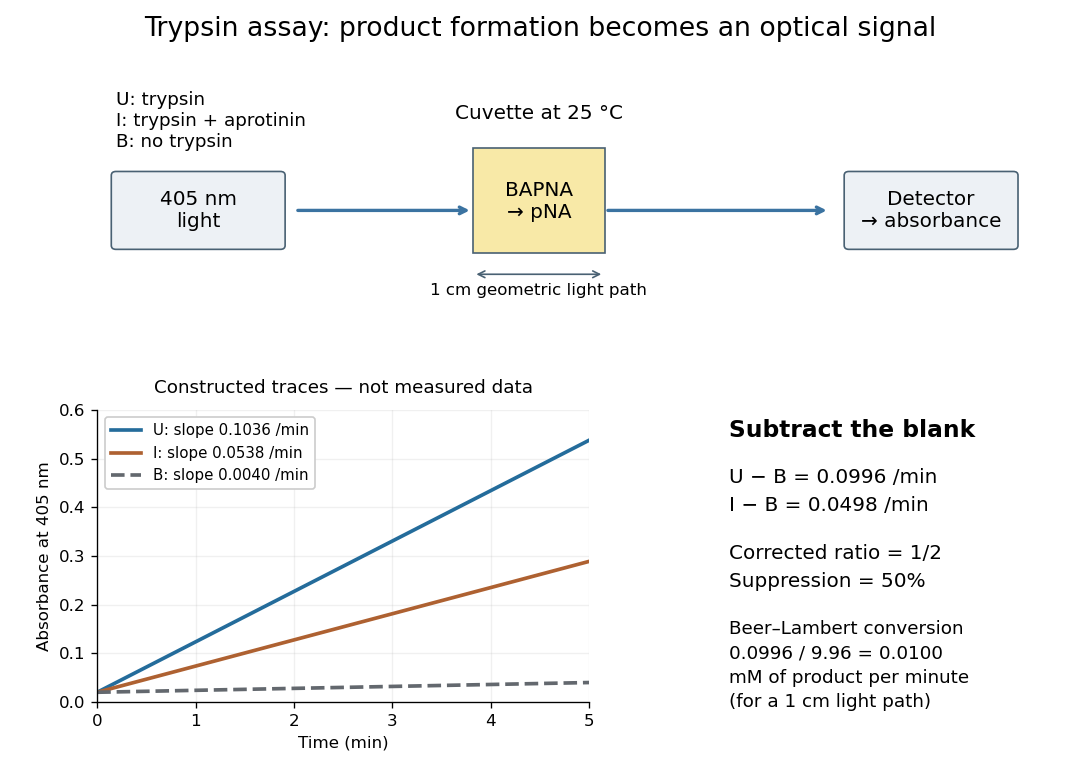

Let , and denote the measured absorbance slopes per minute over the same linear time interval. Blank subtraction gives and . If p-Nitroaniline accounts for the changing absorbance, the Beer-Lambert law givesHere is product molar concentration and is the geometric light path through the chemical solution. Sigma uses .[ref]
Enzymatic Assay of APROTININ - Sigma Quality Control Test Procedure. Enzymatic Assay of APROTININ, p. 2: Calculations, millimolar extinction coefficient at 405 nm
Choose original illustrative slopes , and . The corrected uninhibited slope is , giving at . In , the product amount of substance increases at . The corrected inhibited slope is , half as large. The relative suppression is thereforeThe background cancels in the numerator, but remains essential in the denominator. Using uncorrected slopes would instead give about . Differentiating with fixed and explains the rate conversion; dimensional analysis checks it independently, since .
The inference is a reaction rate on BAPNA under the stated conditions, rather than a direct count of trypsin molecules or proof of every cut in a protein. Cloudiness, other absorbing solutes, or different product protonation can compromise the Beer-Lambert law interpretation. A matched blank and a linear interval are therefore part of the measurement's meaning. A coloured enzyme inhibitor may require its own matched blank; a changed substrate or pH requires a fresh calibration. The constructed constant slopes above describe only that interval, not indefinite product accumulation.
Write a peptide's protein primary structure from its N-terminus toward its C-terminus. The usual simplified trypsin cleavage specificity rule places a cut immediately after K (lysine) or R (arginine), unless the next amino acid residue is P (proline). The following amino acid residue is essential: a terminal K or R has no following peptide bond to cut. The inspected institutional documentation describes proline as usually blocking cleavage, and explicitly lists sequence contexts in which that blocking is negligible. It also warns that experimental results can differ from sequence-based predictions. Thus “never before proline” is too strong.[ref]
For an original worked example, stipulate complete cleavage at all sites allowed by that simplified rule in the twelve-amino acid residue sequenceA denotes alanine, G denotes glycine, and K, R and P have the meanings above. Cuts follow positions , and . Position is R, but its following P suppresses that cut in the stipulated rule; position is terminal K. Notice that the R in ARPK is retained inside the fragment, despite being a usually favoured trypsin target.
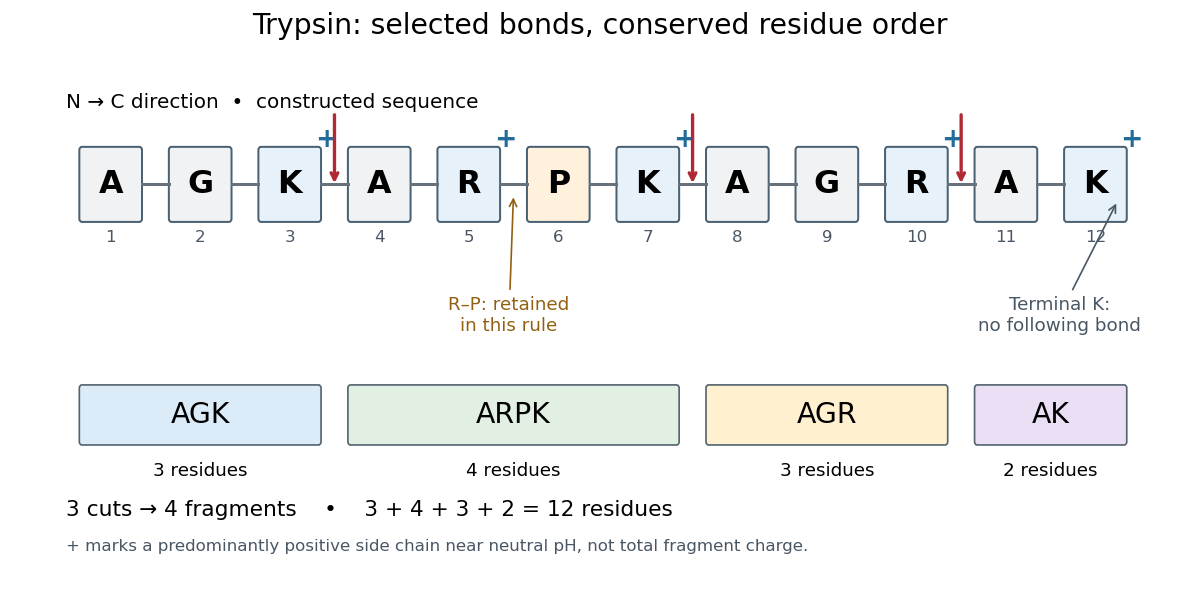
Trypsin cleavage specificity: three selected cuts make four peptide fragments
. Original sequence and prediction under the simplified K/R rule with suppression before proline. Blue plus signs identify predominantly positive lysine and arginine amino acid side chains near neutral pH, not the net electric charge of each fragment. The example is constructed, not an observed digest. Details.
Near neutral pH, the lysine and arginine amino acid side chains undergo predominant protonation and carry positive electric charge. This helps distinguish those amino acid residues from the uncharged letter symbols used to write the sequence; those symbols specify identities, not whole-fragment electric charges.[ref]
26.1 Structures of Amino Acids. Organic Chemistry by John McMurry; Table 26.1, lysine and arginine rows; concluding classification paragraph, side-chain protonation at pH 7.3
Fragment accounting checks the prediction: lengths conserve the twelve amino acid residues. The original linear chain has eleven peptide bonds; the four fragments retain , so three were hydrolysed. Three water molecules are consumed per original chain in this formal stoichiometry. More generally, cutting distinct bonds of one linear peptide makes fragments: each cut splits one connected piece into two. This argument assumes an unbranched chain without additional links joining the pieces.
A missed trypsin cleavage at position would instead give , merging two neighbouring fragments without changing their order. Even a correct cleavage preference does not guarantee complete proteolysis; predicted fragment boundaries describe a model, while actual boundaries require evidence from the digest.
Treffpunkt der Nobelpreisträger. Das Harnack-Haus in Berlin-Dahlem by Susanne Kiewitz Lise Meitner im Porträt by  Codex 0 2026-10-18
Cited passages: physicist’s career and life years; Hahn and Strassmann’s chemical findings and Meitner and Frisch’s physical interpretation; author byline and book-provenance footer.
Missing transverse momentum is the negative vector sum of reconstructed visible transverse momenta, with detector corrections specified. Under the ideal hypotheses of zero total incoming transverse momentum, complete visible reconstruction and exactly one invisible neutrino, momentum conservation givesThe neutrino is not directly seen. Even under these ideal hypotheses, its longitudinal momentum is not measured. Beam remnants can carry substantial unobserved longitudinal momentum; the colliding quarks' longitudinal momenta are also unknown event by event. Imposing an assumed parent mass can constrain , but that imports a hypothesis rather than measuring it. Finite coverage, poorly reconstructed particle jets and other invisible particles can also generate or modify missing transverse momentum.
An original teaching model exposes the roles of input loading, output loading and the supply. Choose a small-signal model with positive input electrical resistance , transconductance , and output electrical resistance . Its controlled output current source draws from the output node toward the reference node. This chosen sign gives an inverting voltage gain; it is not the historical contact circuit's sign convention.
Assume a fixed operating point, negligible reverse coupling, a frequency range where coupling capacitors pass the signal, and negligible other capacitances and transit delays. A collector resistor connects the output to a steady ideal supply ; an external electrical load is coupled through a capacitor, so it draws no direct current. The input source has series electrical resistance . All voltages below are small departures from the operating point. An ideal fixed supply has zero incremental voltage and therefore becomes the reference node in the small-signal model.
Define and , where . Input voltage division and output Kirchhoff's current law giveConsequently the port voltage gain, overall source-to-output voltage gain, and load current gain magnitudes areThis current gain uses load electric current, not all the controlled-source electric current. It is also a different port definition from the historical emitter-to-collector current gain. Larger attenuates the input; smaller attenuates the output.
For a sinusoid input signal, use root mean square voltages. The power gain from accepted input signal power to useful load power isUnlike , this tends to zero as either or . Differentiation givesThus matching the output electrical load maximizes delivered power in this unilateral resistive model. For fixed source voltage, input loading multiplies by ; the accepted-input power gain above excludes the loss in .
Choose , , , and . Then . With and root mean square, the input is and the inverted output has magnitude root mean square. Hence and : . These are calculated values of the chosen model, not historical measurements.
With the same parameters but , while . At , while . Neither current gain nor voltage gain alone establishes power gain.
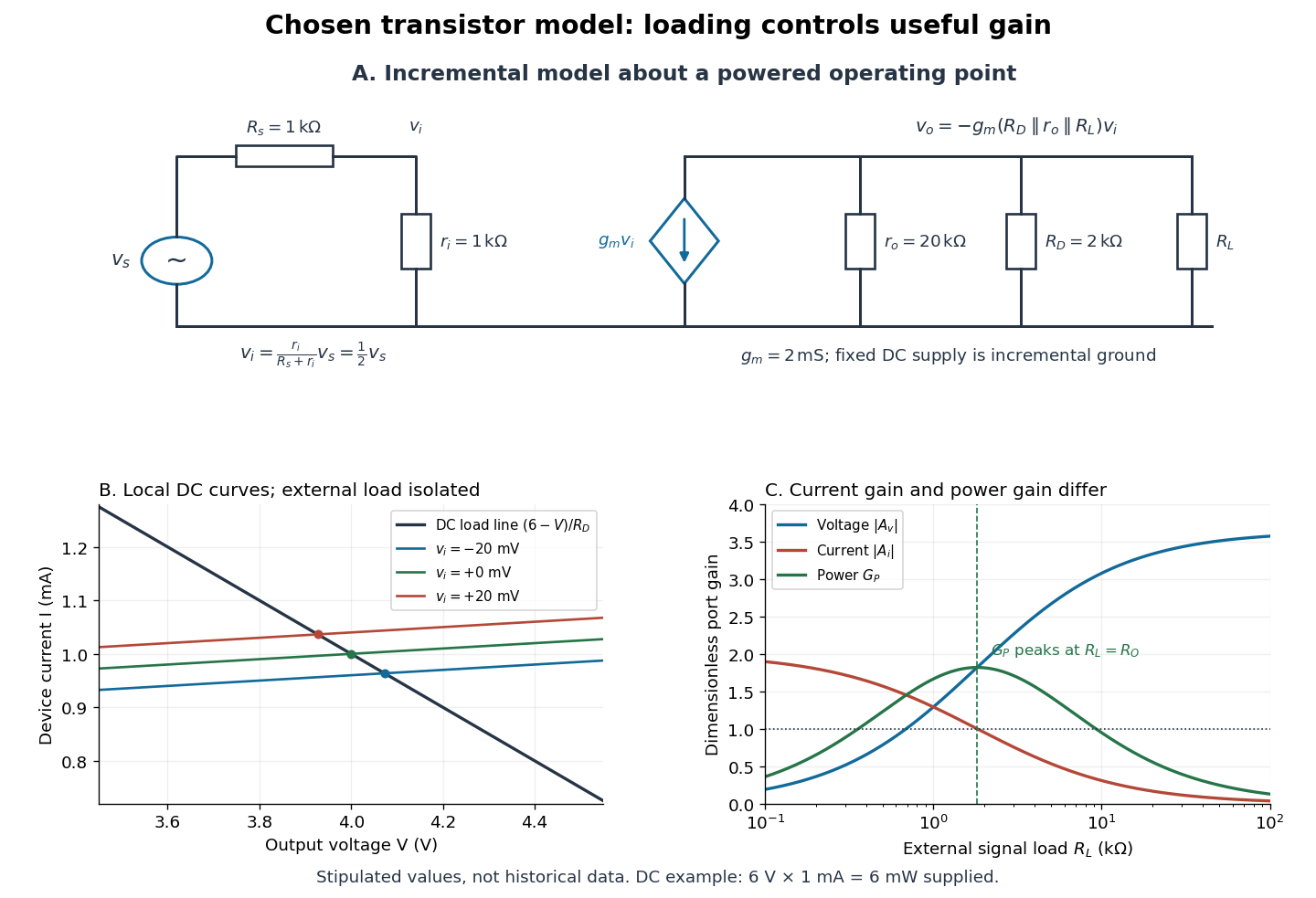

For the direct current load line in the figure, choose , and , consistent with . Locally extend the model as . With the external electrical load isolated at direct current, its intersection with is . Keeping small compared with the available voltage headroom is essential; extrapolation to arbitrarily large signals would be unphysical.
At the chosen operating point the collector supply delivers : is dissipated in and in the output device. Under a small signal, that energy flow is redistributed to provide load power. The incremental controlled current source hides the supply's steady energy flow; it does not create energy. A real complete amplifier also needs its input biasing network and has further losses. This calculation establishes neither its total efficiency nor a universal law for point-contact transistors.
A bipolar junction transistor has two p-n junctions sharing a thin base region, arranged n-p-n or p-n-p. In its forward amplification regime, the emitter junction injects minority carriers; many cross the base before electron-hole recombination and reach the reverse-biased collector junction.[ref]
Transistor technology evokes new physics by William Shockley. Printed pp. 368–370, Figs. 11–12
A point-contact transistor has two closely spaced rectifying contacts, the emitter and collector, and a third low-electrical resistance base contact to the semiconductor. The Bardeen-Brattain point-contact transistor experiment established amplification using this arrangement. It does not require two fabricated bulk p-n junctions.
A transistor whose gate controls an electric field that changes conduction through a channel between source and drain. Changing the gate's electric potential difference controls the channel electric current.
For thin-layer chromatography, define the TLC retardation factor using distances along the development direction:The origin coordinate is ; use the centre of a resolved spot and a front marked at the end of development. Both distances begin at the origin, never at the plate bottom. The ratio is dimensionless. An immobile spot has ; a spot at the front has , where separation from other fast components may be poor. This distance ratio is distinct from the chromatographic partition coefficient and from a column retention time.
For an original stylized plate, choose absolute vertical coordinates , , and above the plate bottom. The solvent distance is therefore , while the spot distances are and :Using or would wrongly include the unused centimetre below the origin. These chosen positions do not represent measured pigments or the protocol's plate dimensions.
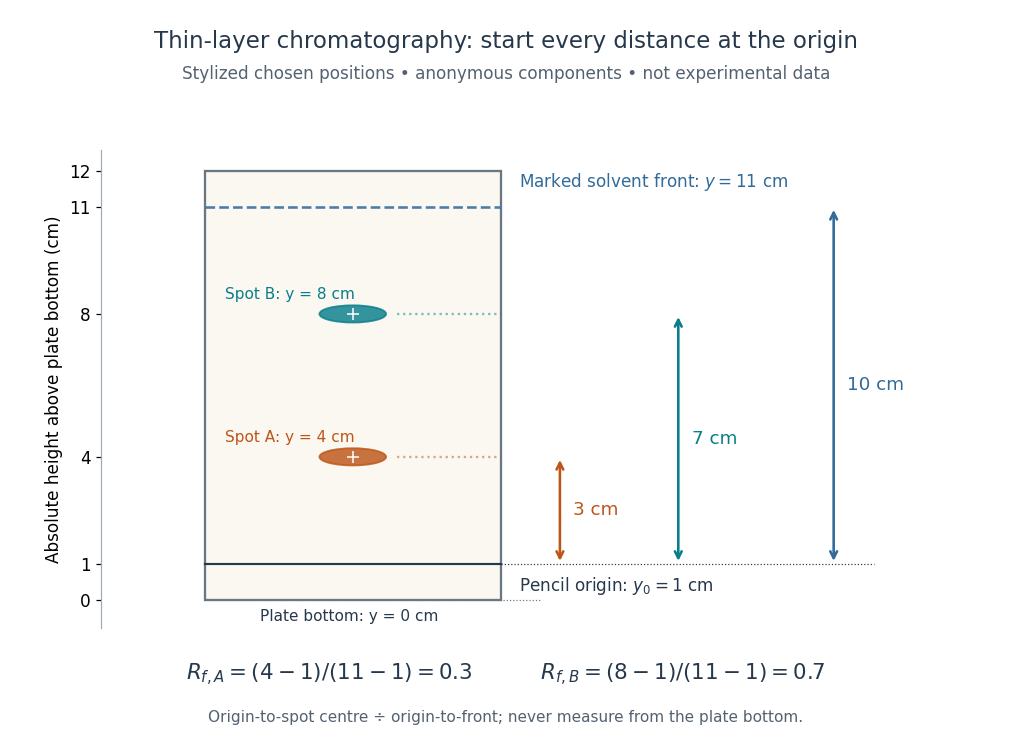
Read TLC retardation factors from the origin, not the plate bottom
. Original stylized thin-layer chromatography plate with deliberately chosen coordinates, not experimental data. The pencil origin at lies below both spots and the front at . All three measurement arrows start at the origin. The two colours label anonymous components and do not identify particular pigments. Details.
The TLC retardation factor depends on the sample, chromatographic stationary phase, eluent composition, and temperature; plate handling and development conditions must also match when comparing runs. The moving wet front and possible surface adsorption require their own transport assumptions. The equilibrium mobile fraction in the chromatographic partition coefficient model is not unconditionally equal to ; even that model depends on the phase volume ratio. Coincident TLC retardation factors alone never prove chemical identity.
There are unlisted articles, also show them or only show them.