Three-body recombination captures an electron while a second free electron carries away energy, the inverse of direct electron-impact ionization. Its rate scales as the parent-ion density times the square of electron density. It is usually negligible compared with two-body radiative recombination and dielectronic recombination in the low-density solar corona, but matters in sufficiently dense plasmas.
Many ionic crystals have high melting temperatures compared with small molecular solids, because reorganizing their strongly interacting ions costs energy. But melting leaves a dense liquid with interactions; it does not perform the complete separation defining a lattice energy. At fixed pressure, the transition occurs when the Gibbs free energies of the solid and liquid match. The relevant enthalpy and entropy differences both matter, so lattice energy alone is not a universal ordering of melting temperatures. Strong covalent bonds in extended networks can also give high melting temperatures.[ref]
Chemistry 2e. §10.5, “Ionic Solids” and “Covalent Network Solid”; §16.4, equations defining Gibbs free energy and its change
A lattice energy needs a reaction, a sign convention, and a stated amount. Using the lattice-dissociation enthalpy convention for sodium chloride,The reverse lattice-formation enthalpy is negative with the same magnitude when initial and final states match. Chemistry 2e gives for this separation, per mole of sodium chloride formula units. This is about electronvolts per formula unit, not per individual ion. It concerns separated gaseous ions, rather than neutral chemical atoms, molten salt, or hydrated ions in water.[ref]
Chemistry 2e. §7.5, “Ionic Bond Strength and Lattice Energy”, positive convention, reverse convention and NaCl value
Also distinguish an internal energy change from an enthalpy change: . A static point-charge calculation omits motion and thermal contributions. Reversing a reaction reverses its energy change; replacing internal energy with enthalpy additionally changes the defined quantity. The Born-Haber cycle infers a lattice-formation enthalpy by combining other enthalpies, ionization energies, and electron affinities. These imagined stages are a thermodynamic accounting path, not a claim about the actual sequence of a chemical reaction.[ref]
For two point electric charges in vacuum, Coulomb's law gives the interaction potential energywith zero at infinite separation. Here is the distance between them and is the vacuum permittivity. Opposite signs give negative potential energy and attraction; equal signs give positive potential energy and repulsion. For a finite collection of distinct point electric charges, sum over to count each pair once. A bulk ionic crystal requires the extended lattice sum, including both signs, rather than multiplying one attractive pair by the coordination number.[ref]
The Feynman Lectures on Physics, Volume II by Richard Feynman and others. §8–1, equations (8.1)–(8.3); §8–3, many-neighbour lattice sum
At short distances, overlapping electron density makes the simple point-charge picture inadequate. Quantum mechanics, including the Pauli exclusion principle, matters to the steep repulsive contribution. Pure attraction proportional to would collapse as ; it cannot set an equilibrium spacing on its own. A useful illustrative model isHere scales an assumed fixed arrangement, packages its attractive contribution, and represents short-range repulsion. The constants have units energy times length and energy times length to the power , respectively. This is a model, not a fitted description of a named salt.[ref]
The Feynman Lectures on Physics, Volume II by Richard Feynman and others. §8–3, close-distance repulsion and limits of a purely electrostatic lattice calculation
Differentiating gives and , so the stationary spacing is a stable minimum. For the diagram's stipulated , put and . ThenThe dimensionless curves show how competing interactions select a spacing. Their energy scale and exponent are synthetic; neither is a measured lattice energy or a melting prediction.
The bookkeeping steps and conserve electric charge and describe the electron inventories of separated species. They do not establish a chronological mechanism in which a labeled electron jumps between two pre-existing chemical atoms and becomes a classical object owned exclusively by one of them. In a bound material, quantum mechanics determines the electron density and the total energy.
Ionic bonding and a covalent bond are useful limiting descriptions with a continuum between them. Electronegativity helps anticipate unequal sharing of electron density, but a numerical cutoff does not measure a universal fraction of ionic bonding. A partial atomic charge depends on how the electron density is partitioned; integer formal charges are a bookkeeping convention. Using in a point-charge model therefore does not claim that every partition of the actual electron density assigns exactly those values.[ref]
The Feynman Lectures on Physics, Volume II by Richard Feynman and others. §30–2, “Chemical bonds in crystals”: gradations between covalent and ionic bonding
[ref]Chemistry 2e. §7.2, “Electronegativity and Bond Type”: general guide and exceptions
An ion pair is an associated cation and anion. An isolated ion pair lacks the extended neighbourhood of an ionic crystal. In a chemical solution, ion pairs can coexist with more widely separated ions; their abundance depends on conditions. A neutral gas-phase sodium chloride molecule can be treated as a discrete entity, with its own quantum mechanics and dissociation products. That use of molecule does not describe the constituents of ordinary solid sodium chloride.[ref]
The Feynman Lectures on Physics, Volume II by Richard Feynman and others. §8–3, distinction between vaporized NaCl pairs and separated gaseous ions
[ref]An ionic crystal repeats an arrangement of ions in three dimensions. A unit cell describes that repetition, whereas a formula unit describes composition. The two accounting devices answer different questions. Coulomb's law is not restricted to an arbitrarily drawn line connecting one cation to one anion: every ion contributes to the electric field experienced by the others.
A salt is an assembly of cations and anions with zero total electric charge. Its constituents can be single chemical atoms or groups joined internally by covalent bonds. Thus ionic bonding and covalent bonds can occur in the same chemical substance, at different structural levels.[ref]
Ion solvation in water: femtosecond spectroscopy of hydrogen-bond dynamics by Michel F. Kropman 8 The influence of ions on the hydrogen-bond structure of water by  Codex 0 2026-10-13
 Investigations in Molecular Cell Biology by Clare M. O’Connor 12.6: Exercise 2 - Replica plating and complementation by Codex 0 2026-10-13
Codex 0 2026-10-13Cited passages: O’Connor, Investigations in Molecular Cell Biology, §12.6, introductory paragraphs and steps 1–3: velveteen block, orientation marks and three replica media.
Introduction to Probability, Statistics, and Random Processes by Hossein Pishro-Nik 6.2.1 The Union Bound and Extension by Codex 0 2026-10-13
Codex 0 2026-10-13Disabling selected asynchronous interrupt delivery, normally under privileged control. It does not necessarily disable processor exceptions, nonmaskable interrupts or activity on other processors.
// Target: computer-science.bigb
Hardware managing and routing interrupt requests to a CPU, with architecture-dependent masking and priority rules. The Linux kernel encapsulates its operations separately from generic flow handlers. [ref]
https://docs.kernel.org/core-api/genericirq.html. Linux kernel documentation, generic IRQ handling: chip-level hardware encapsulation
// Destination: computer-science.bigb
Code entered to handle an interrupt. It identifies and acknowledges relevant device state and arranges service, possibly deferring work. The Linux kernel's generic flow layer and device driver callback have distinct responsibilities. [ref]
https://docs.kernel.org/core-api/genericirq.html. Linux kernel documentation, generic IRQ handling: interrupt control flow and default flow implementations
In interrupt-driven input-output, a device signals an interrupt when attention is needed, letting the CPU avoid repeatedly checking an idle device. The interrupt handler determines what happened and arranges the required work; notification itself does not move the payload. DMA can supply that separate data-transfer mechanism.
For a toy comparison, let events occur at times . Ideal interrupt notification happens at those same times, while polled input-output at detects them at . The polling delays are ; ideal notification delays are all zero. Events are assumed to remain pending, with a simultaneous event visible to a poll. The chart is a model, not a measurement: it excludes interrupt delivery and dispatch latency, interrupt handler service time, and polling overhead. Its zero-delay row is not a real-hardware guarantee.
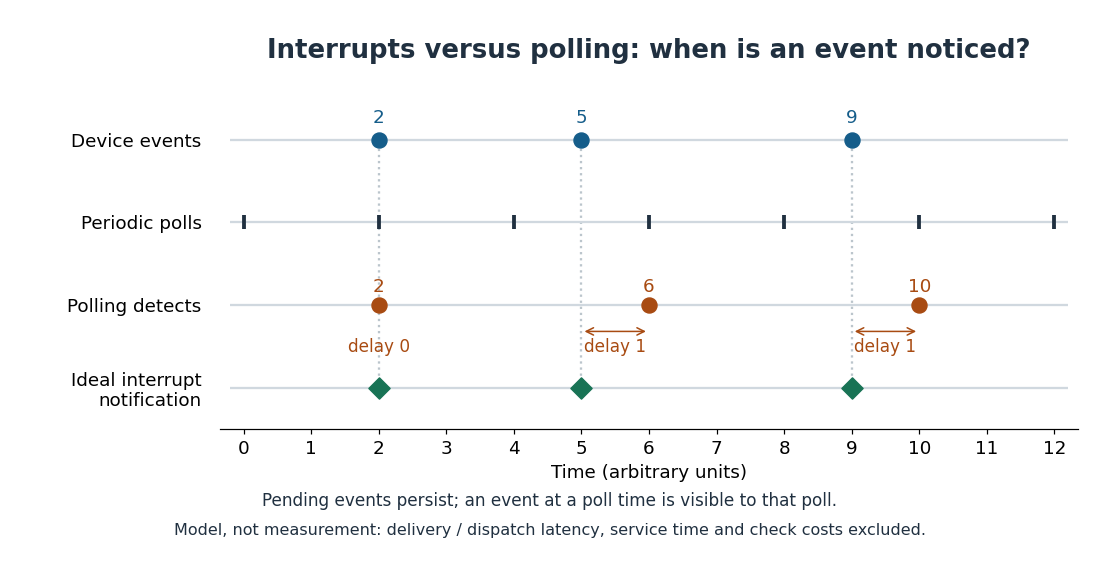

The useful idea is to spend attention when something changes. Sparse events can leave long stretches for useful CPU work instead of busy checks. At high event rates, repeated entry and service overhead can consume that saving. Batching notifications can reduce their frequency while delaying some events; switching to polled input-output during active periods is another option. No strategy is universally faster. [ref]
https://pages.cs.wisc.edu/~remzi/OSTEP/file-devices.pdf. Arpaci-Dusseau and Arpaci-Dusseau, OSTEP chapter 36, section 36.4: interrupt costs and coalescing
The Linux kernel's NAPI mechanism is a concrete combination: an interrupt normally schedules event processing, which polls for work with a receive budget. Further interrupts remain masked during that polling, and are enabled again when polling finishes. NAPI also supports busy polling; the exact processing context and configuration vary. This is a documented Linux kernel design, not a requirement on every operating system. [ref]
https://docs.kernel.org/networking/napi.html. Linux kernel documentation, NAPI: basic operation, datapath API, scheduling and IRQ masking
The volt is the SI unit of electric potential and electric potential difference: , one joule per coulomb. A positive electric charge of moved through a potential increase of gains of potential energy; the electric field does of work. [ref].
The coulomb is the SI unit of electric charge. A constant electric current of transports in a time of ; a constant current of for transports . The prefix in explains the much smaller charge scale used in the worked Coulomb's law example. [ref]
There are unlisted articles, also show them or only show them.