
A second-order operator with coefficient matrix is uniformly elliptic when some satisfies everywhere.
The focal line of an ellipse is the straight line through its two foci.
A nondegenerate ellipse has two positive semiaxis lengths. It is a smooth closed curve rather than a point or line segment.
Every symmetric polynomial over a commutative ring has a unique expression as a polynomial in the elementary symmetric polynomials.
The complete type of a tuple over parameters records every formula over those parameters that the tuple satisfies.
The Standard Model Higgs field is a complex doublet of hypercharge . Its nonzero vacuum expectation value triggers the Higgs mechanism.
The Higgs field is a scalar field: its components carry internal weak isospin and hypercharge, but no spacetime spin. A complex Higgs doublet contains four real field components. The vacuum expectation value is a property of the lowest-energy state, not a gas of Higgs bosons. A Higgs boson is an excitation about that state.
Why introduce this field? A bare mass term for a gauge field generally fails to respect the local gauge symmetry. A bare Dirac mass term for a charged Standard Model fermion also joins left- and right-handed fields with different Standard Model representations. A Higgs doublet permits gauge-invariant interactions whose expansion about a nonzero vacuum expectation value supplies both masses and definite Higgs boson interactions. The field therefore links the mass problem to experimentally testable coupling relations, as illustrated by the Higgs boson coupling to Z bosons.
The electromagnetic field tensor isIt packages the electric and magnetic fields into an antisymmetric rank-two Lorentz tensor and transforms as
An electromagnetic multipole expansion expresses the potentials or fields of a localized source as successively smaller monopole, dipole, quadrupole, and higher moments in the ratio of source size to observation distance.
An equipotential is a level set of the electric potential. The electric field is normal to every smooth equipotential.
An electric quadrupole is a charge distribution whose total charge and electric dipole moment vanish while its second charge moment does not. Its potential decays as .
The even, spherically symmetric hydrogen atom ground state has no permanent electric dipole, so a uniform electric field gives no first-order energy shift. The electric-dipole selection rules for hydrogen allow odd-parity excited states to mix in at second order, yielding a negative shift quadratic in the field.
Here there is a nondegenerate energy eigenvalue, so second-order nondegenerate perturbation theory applies. With , it givesThe notation includes integration over the continuous spectrum, as well as a sum over discrete energy eigenstates. All denominators are negative because is the ground state. The positive electric polarizability therefore lowers its energy.[ref]
Quadratic Stark Effect. Quantum Mechanics by Richard Fitzpatrick; Fitzpatrick, Quadratic Stark Effect, equations (7.57) and (7.65): quadratic convention and exact polarizability
An independent way to see the coefficient avoids truncating that sum. Define and . In coordinates , the dimensionless unperturbed Hamiltonian operator and normalized wavefunction are and , with energy eigenvalue . Writing the first-order wavefunction correction as , substitution into the Time-independent Schrödinger equation givesThe second equality can be checked by differentiation. Its parity makes orthogonal to . The resulting integral issince the normalized radial probability density is , giving and . Converting back to SI units gives the stated electric polarizability. The induced electric dipole moment is and tends to zero with the electric field, unlike the selected degenerate branches' leading dipoles. Both calculations describe weak-field level shifts; a spatially uniform static electric field also allows eventual quantum tunnelling and ionization, which these real energy corrections do not calculate.
A finite electric dipole consists of equal and opposite electric charges separated by a nonzero displacement. It has charge neutrality but a nonzero electric dipole moment . An ideal point electric dipole is the mathematical limit with fixed, so must increase as . Shrinking the separation while holding fixed instead makes the electric dipole moment vanish. The ideal electric dipole describes an exterior electric field; it does not reproduce the two near-charge singularities or the internal structure of a molecule. [ref]
https://farside.ph.utexas.edu/teaching/jk1/lectures/node20.html. Richard Fitzpatrick, Electric Dipoles: the fixed-moment point limit
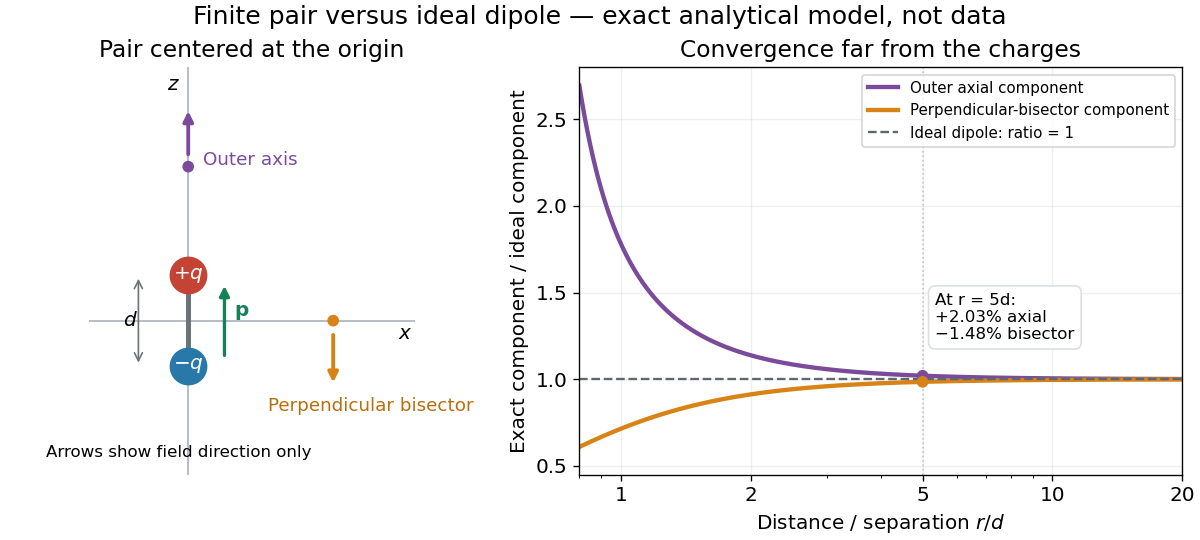
.Place the pair's midpoint at the origin and write , where is vacuum permittivity. By superposition principle and Coulomb's law, its exact electric potential away from the two point charges isFor , retain the first nonzero term of a Taylor series. The electric potential and its negative gradient becomeHere and the products in parentheses are dot products. These are exact exterior formulas for the ideal electric dipole and distant approximations for a finite pair. The electric field on the outer axis points along with magnitude ; on the perpendicular bisector it points opposite with magnitude . This directional structure is what a scalar total electric charge misses. [ref]
https://www.feynmanlectures.caltech.edu/II_06.html#Ch6-S2. Feynman, Leighton and Sands, II.6.2: exact pair potential and dipole expansion
.In a prescribed uniform external electric field , a rigid pair has opposite forces . Its net force is zero, but summing their moments about the midpoint gives the torqueThe cross product makes the torque perpendicular to both the electric dipole moment and the external electric field. If is the angle from to in their plane, the signed turning torque is . It tends to reduce a small positive . [ref]
https://openstax.org/books/university-physics-volume-2/pages/5-7-electric-dipoles. Ling, Moebs and Sanny, University Physics 2, 5.7: forces and torque on a dipole
.The external interaction potential energy, with zero chosen at , isParallel alignment minimizes this potential energy; antiparallel alignment maximizes it even though the torque is zero in both positions. This omits the pair's constant internal binding potential energy and assumes a fixed permanent electric dipole moment. [ref].
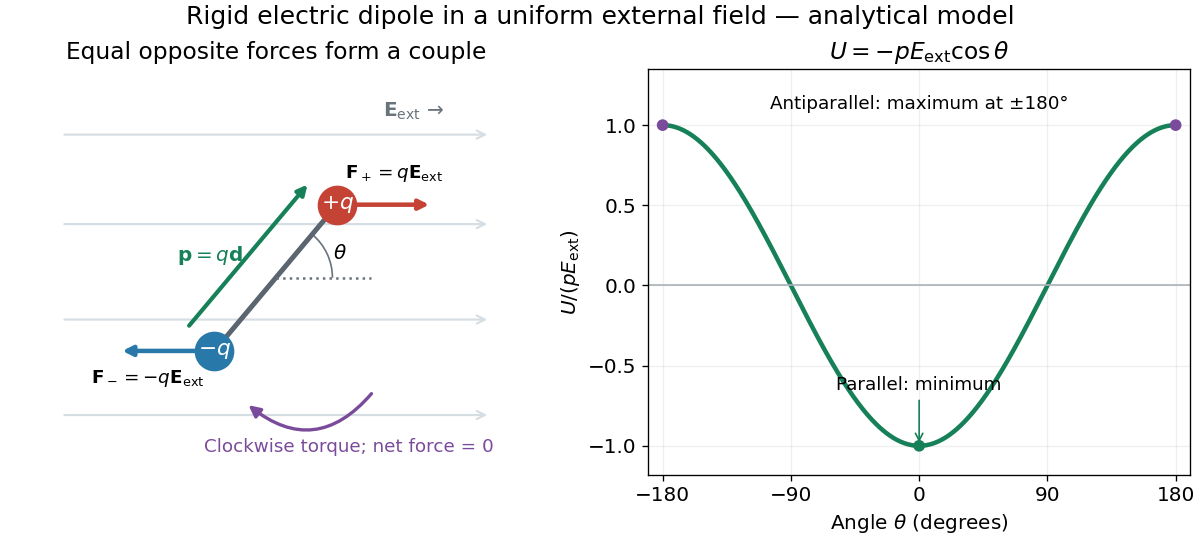

A nonuniform external electric field can exert a net force on a neutral electric dipole. Before taking the small-pair approximation, the exact external force is , where is the midpoint. A first-order Taylor series gives, for a fixed electric dipole moment and an external electric field varying slowly across ,in electrostatics. The last equality uses the vanishing curl of the external electric field, with held fixed while differentiating. Thus uniform external electric fields turn a misaligned electric dipole, whereas gradients can also move its midpoint. For example, the local source-free electric field gives , so reversing the electric dipole moment reverses the net force. This stipulated local model has zero divergence and zero curl.
A motivating experiment is Filsinger and colleagues' study of electrostatic deflection of polar molecules. Benzonitrile () in helium expanded from a pulsed valve into vacuum; two 1-mm skimmers narrowed the beam before a 15-cm deflector. A grounded trough and a high-voltage rod produced a vertical electric field gradient. Scanning a focused laser vertically downstream and recording benzonitrile ions from photoionization measured the beam's relative density. With voltage off, the profile spanned about 2 mm; applying voltage shifted and broadened it upwards. At 10 kV, many molecules lay outside the original profile. [ref]
https://pure.mpg.de/pubman/item/item_736019_2/component/file_736018/433451%28filsinger%29.pdf. Filsinger et al., Quantum state selection, alignment, and orientation of large molecules using static electric and laser fields, sections II and III A, figure 3
.Interpretation uses a quantum state's Stark effect energy : gives . States whose energy falls with increasing electric field seek stronger fields. The voltage-off profile controls the mechanical aperture. Inferring state populations needs calculated trajectories, speed distributions and a rotational temperature model; profile displacement alone does not measure a permanent electric dipole moment uniquely. This is an electric Stark effect experiment, with photoionization occurring after deflection. [ref]
https://pure.mpg.de/pubman/item/item_736019_2/component/file_736018/433451%28filsinger%29.pdf. Filsinger et al., section III A: Stark slopes, trajectory modelling and state selection
.For the symmetric finite pair, the first omitted electric multipole expansion term after the electric dipole is third order, so typical relative errors scale as . This stronger error estimate need not hold for an arbitrary neutral molecule with a nonzero electric quadrupole moment. A concrete check for a pair on the axis compares the exact and ideal electric fields at on the positive axis and at on the perpendicular bisector:Both perpendicular-bisector components are negative. At , the ratios are approximately and : errors of and relative to the ideal electric field. The condition concerns observing the pair's own electric field; the separate condition for its external force approximation concerns variation of the applied electric field across the pair.

For a localized charge and current distribution satisfying charge conservation from Maxwell equations,
Electrical resistance measures the electric potential difference needed to drive a given electric current through a component. For an Ohmic conductor under fixed material conditions, is constant and Ohm's law gives . The SI unit is the ohm, . At a fixed positive electric potential difference, increasing electrical resistance reduces electric current. Electrical conductance expresses the same response reciprocally. [ref]
https://openstax.org/books/university-physics-volume-2/pages/9-3-resistivity-and-resistance. Ling, Sanny and Moebs, §9.3: resistance and its unit
.For a straight uniform wire at rest, with constant electrical conductivity , length and wire cross-sectional area , the uniform Ohmic conductor model givesThe electrical resistivity characterizes the material; electrical resistance also includes geometry. Doubling length doubles , while doubling wire cross-sectional area halves , with material and temperature fixed. The uniform-field assumption includes insulated sides and equipotential end faces, as explained in uniform current in a straight homogeneous wire. [ref]
https://openstax.org/books/university-physics-volume-2/pages/9-3-resistivity-and-resistance. Ling, Sanny and Moebs, §9.3: wire geometry and resistivity
.As a defined wire example, take , and . Then ; applying electric potential difference drives electric current . With the same length and material, a second wire of wire cross-sectional area has and carries at that same electric potential difference. Fixing electric potential difference here differs from fixing electric current in the current density comparison: stating what is held fixed is essential.
Electromotive force is the driving work per unit electric charge around an electrical circuit, measured in volts, despite its name containing "force". For a stationary loop its electromagnetic contribution is ; for a moving electrical conductor, include the motional electromotive force. A nonzero closed-loop line integral of the electric field cannot be represented by a single-valued electric potential alone. An electromotive force specifies the drive; the resulting electric current also depends on the electrical resistance and self-inductance. [ref]
https://www.feynmanlectures.caltech.edu/II_17.html#Ch17-S1. Feynman lectures, II.17.1: emf as a circuit integral
. There are unlisted articles, also show them or only show them.