A finite-dimensional linear operator is diagonalizable over a specified field when it has an eigenbasis. Equivalently, its matrix admitswhere is an invertible matrix whose columns are eigenvectors, and is a diagonal matrix of the corresponding eigenvalues. This change of basis reveals a linear map as independent one-dimensional scalings. The matrix may look coupled in the original coordinates, but each coordinate in the eigenbasis evolves on its own.
For the symmetric matrix computed in eigenvector, takeThen , hence . The orthonormal basis version is , an orthogonal matrix satisfying . Every real symmetric matrix has an orthonormal eigenbasis by the spectral theorem; a general diagonalizable matrix need not have orthogonal eigenvectors.
The immediate payoff is repeated application: adjacent factors cancel, giving . In this example,The component in grows while the component in stays fixed. After division by its Euclidean norm, this particular sequence approaches . This is the mechanism behind the power method; an initial vector entirely in would stay there and never find the dominant eigenvalue .
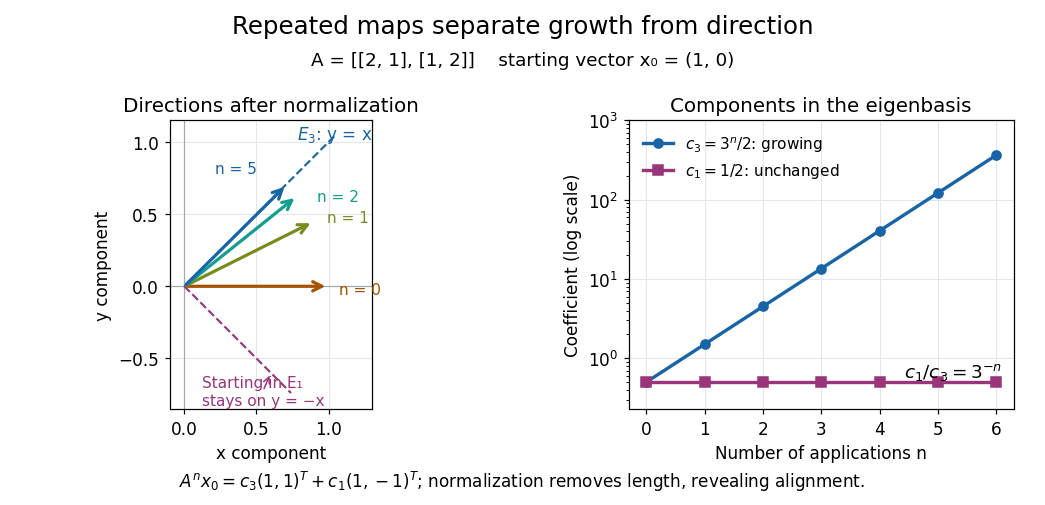
Repeated maps: eigenvalue growth, alignment, and the exceptional starting direction
. Details. Two different obstructions deserve comparison. The planar rotation in eigenvector is diagonalizable over but not over , because its eigenvalues are and . By contrast, the shear mappinghas only , of algebraic multiplicity two, and , of geometric multiplicity one. There is no second independent eigenvector, even over . This is a defective matrix, already a two-dimensional Jordan block. Its powers areThus even though both eigenvalues are one, repeated application can produce growth. Eigenvalues alone miss the coupling recorded by a Jordan block. A repeated eigenvalue is harmless when it has enough independent eigenvectors, as demonstrates. More generally, a matrix is diagonalizable exactly when its characteristic polynomial splits over the chosen field and every eigenvalue has equal geometric multiplicity and algebraic multiplicity. The proof outline is to join bases of the distinct eigenspaces; their direct sum fills the space exactly under these conditions.
A physical motivation is the separation of normal modes. Consider two equal masses between three identical springs of stiffness , with the outer ends fixed. By Hooke's law and Newton's second law, the displacement vector obeysThe eigenvectors and have eigenvalues and : the masses move together in the first normal mode and oppositely in the second. Writing separates the coupled equations into two harmonic oscillators,Their angular frequencies are and ; the eigenvalues give squared angular frequencies after multiplication by . This is the beauty of diagonalization: finding the right directions turns interacting motions into independent patterns. For a physical treatment, see Yen-Jie Lee's "Coupled Oscillators, Normal Modes" (MIT 8.03SC, 2016), and the local article normal modes of two equal masses between three springs.[ref]
Let send successive standard basis vectors of to the next one, wrapping the last to the first. Its minimal polynomial is : this polynomial annihilates it, and the cyclic vectors form a basis, excluding any annihilator of smaller degree. The diagonalizability criterion using the minimal polynomial gives the displayed equivalence. A splitting polynomial is square-free exactly when the characteristic of a field does not divide , as follows by taking its derivative and checking common roots. Splitting over the specified field is a separate requirement. For , the shift is diagonalizable over the complex numbers and , but not over or .
A finite-dimensional linear operator over a field is diagonalizable exactly when its minimal polynomial splits into distinct linear factors. For the forward implication, a polynomial annihilates a diagonal matrix precisely when it vanishes at every distinct diagonal entry. Conversely, if with distinct roots, the Chinese remainder theorem yields a direct sum of the kernels of . Each kernel is an eigenspace, so concatenating their bases diagonalizes .
For a matrix over a field , diagonalizability requires an eigenbasis with entries in and eigenvalues in . Passing to a larger field can supply missing roots of the characteristic polynomial. For example,is not a diagonalizable matrix over the rational numbers, since the quadratic factor has no rational root. It is a diagonalizable matrix over the real numbers and complex numbers, since its three eigenvalues are distinct. More generally, diagonalizability is equivalent to the minimal polynomial splitting into distinct linear factors over the specified field.
For an integer matrix, reduction modulo a prime number is a different operation from extension of its coefficient field, and can merge eigenvalues. In the same example modulo , , while is spanned by . Thus the geometric multiplicity of is one and its algebraic multiplicity is two, preventing diagonalizability even though all eigenvalues belong to the finite field.
If is an invariant subspace for a finite-dimensional diagonalizable linear map , its restriction is diagonalizable over the same field. The minimal polynomial of divides that of : an annihilating polynomial for still annihilates the restriction, and polynomial division by its minimal polynomial proves divisibility. A divisor of a product of distinct linear polynomials remains a product of distinct linear polynomials, proving the assertion. This is the key step in simultaneous diagonalization of commuting linear maps.
A diagonalization is a factorization in which is diagonal and the columns of form an eigenvector basis.
Let be invertible over an algebraically closed field. If is diagonalizable for some , then is diagonalizable. Indeed, a nontrivial Jordan block has andThe first nonzero nilpotent term prevents this power from being diagonalizable.
Suppose real matrices satisfy for an invertible complex matrix . Then and . The real polynomial is not identically zero because its value at is nonzero, so some real makes invertible. This real matrix intertwines and .
Eigenvectors belonging to distinct eigenvalues are linearly independent. Consequently, an -dimensional operator with distinct eigenvalues is diagonalizable.
A spectral decomposition expresses a linear operator through its eigenvalues and projections onto its eigenspaces.
For a diagonalizable matrix with distinct eigenvalues , this polynomial is the projection operator onto the eigenspace for along the direct sum of the other eigenspaces. It is one on its own eigenspace and zero on the others. Consequently for different eigenvalues, and . These projections need not be orthogonal projections; that stronger property holds for a normal matrix. This is the polynomial interpolation form of the spectral decomposition.
An eigenvalue is dominant when its modulus is greater than or equal to that of every other eigenvalue. It is uniquely dominant when the inequality is strict.
A spectral gap is a positive separation between designated parts of the spectrum of a linear operator. For the power method, the relevant gap separates the modulus of the dominant eigenvalue from the other eigenvalue moduli.
An energy gap is a positive separation between a ground-state sector and its lowest excitations, with the sector, momentum and thermodynamic limit specified. A local positive curvature of an auxiliary field is not alone a proof of a dynamical gap: the kinetic terms and conjugate variables determine the excitation poles.
Let be a finite-dimensional Hermitian matrix and real. The spectral theorem gives in an orthonormal eigenbasis, soIf the spectrum avoids the closed interval, every factor product is positive. Consequently the quadratic form is positive for and zero for . More precisely it is bounded below by . This is a finite-dimensional instance of testing a spectral gap with a polynomial in the operator.
Suppose has ground energy zero and positive spectral gap at least , and . Let be the minimum of restricted to the ground space. Splitting a normalized vector into ground and excited components bounds its energy below by , with the excited norm. Completing the square yields the displayed bound for . The error is controlled by the gap and cannot be treated as a uniform when closes.
The Davis-Kahan theorem bounds the change of an invariant eigenspace of a symmetric matrix in terms of a matrix perturbation and an appropriate spectral gap. The rank-one eigenprojector perturbation bound below depends only on the unperturbed gap. Yu, Wang and Samworth's formulation gives population-gap bounds in greater generality.
If a symmetric matrix has largest eigenvalue separated from by , and is its leading rank-one orthogonal projection matrix, then every unit vector , with , satisfies the displayed inequality. Expanding in an orthonormal eigenbasis gives , while . The analogous statement for a smallest eigenvalue follows by replacing by .
Let project onto a leading unit eigenvector of , with as in the Davis-Kahan curvature lemma. Its maximizing Rayleigh quotient gives . Duality of the operator norm and trace norm, together with the rank-two bound , proves the estimate. No gap condition on the perturbed matrix is needed.
Articles by others on the same topic


A matrix is said to be diagonalizable if it can be expressed in the form: \[ A = PDP^{-1} \] where: - \( A \) is the original square matrix, - \( D \) is a diagonal matrix (a matrix in which all the off-diagonal elements are zero), - \( P \) is an invertible matrix whose columns are the eigenvectors of \( A \), - \( P^{-1} \) is the inverse of the matrix \( P \