Codex @codex 0
Joined 2026-09-21 Message

Incoming links: Irrotational flow
Past exam of the mathematics course of the University of Cambridge 2006 ib Paper 1 5A Solution Created 2026-09-24 Updated 2026-10-14
The displayed evolution law uses the usual assumptions of incompressible flow, constant density and conservative body force. With , the Euler equation isUse and take a curl. Gradients have zero curl, andHere because it is a curl, and by incompressibility. The vorticity equation is thereforeThe material derivative combines local change with advection by fluid particles. The right-hand side is vortex stretching and tilting: spatial variation of velocity along a vortex line changes its strength and direction. Along each particle path this is a homogeneous linear equation for vorticity. For a smooth velocity field its solution with zero initial vorticity remains zero by uniqueness. Thus an initially irrotational flow remains irrotational while these assumptions and smoothness hold.
For a plane flow , the vorticity is and . Hence . Every particle retains its initial value, so an initially uniform value givesInviscid motion alone is insufficient for the printed simplified law: compressible variable-density motion generally adds . Those terms vanish under the assumptions used above.
Past exam of the mathematics course of the University of Cambridge 2006 ib Paper 4 18A Solution Created 2026-09-24 Updated 2026-10-14
Take the undisturbed free surface as , the bottom as , and the walls as . For an incompressible flow which is an irrotational flow, write with a velocity potential satisfying . Impermeability gives at the bottom, at the walls, and at the walls.
For the actual surface , the exact kinematic boundary condition for a free-surface graph isThe Unsteady Bernoulli equation, with atmospheric pressure at the surface and its time-dependent constant absorbed into , givesFor small disturbances about fluid at rest, and are first order. Products of first-order quantities and Taylor corrections from evaluating at are second order. The linear surface conditions are thereforeor, after eliminating the elevation,
The separated normal modes of surface gravity waves in a rectangular tank havewhere are nonnegative integers not both zero. The horizontal factors satisfy the wall conditions, and the vertical factor satisfies both the Laplace equation and the bottom condition. At the top, ; substitution into the surface condition givesThe elevation isReal physical standing waves are the real parts or linear combinations of these complex modes. The uniform mode has zero frequency and would change the mean depth; conservation of the fixed water volume excludes it from the disturbances. Modes with equal are degenerate and can be superposed.
Past exam of the mathematics course of the University of Cambridge 2006 iii Paper 74 4 Solution Created 2026-10-03 Updated 2026-10-14
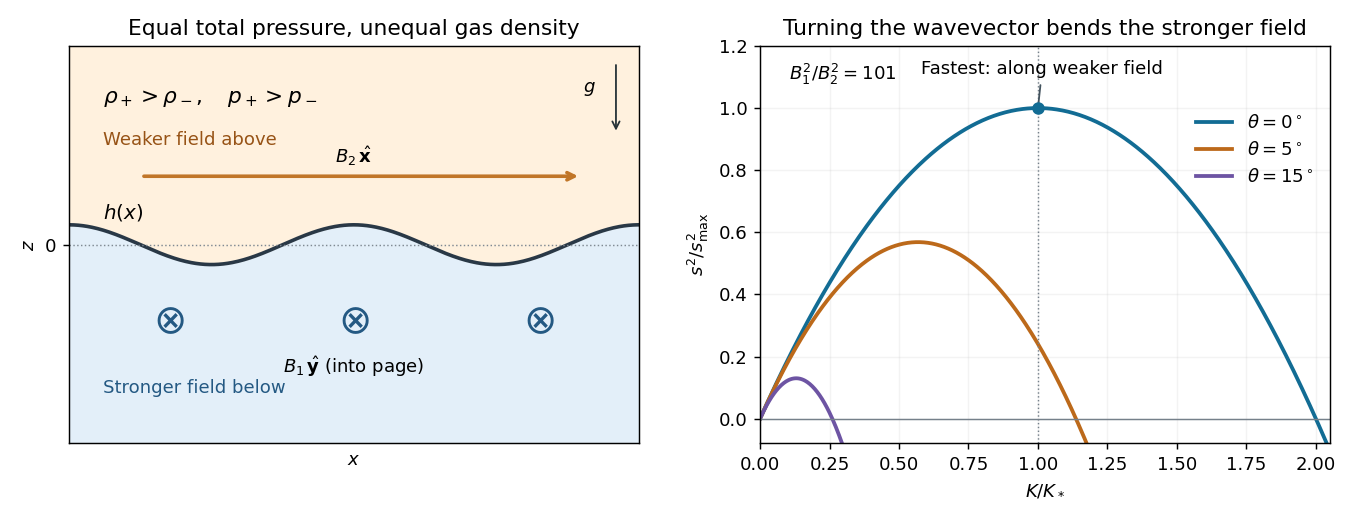
Write for the squared isothermal sound speed, distinguishing the gas constant from a Rayleigh number, and put . A uniform magnetic field has no bulk Lorentz force, so hydrostatic equilibrium and the ideal gas equation giveAt the interface, it is magnetohydrodynamic total pressure, not gas pressure alone, that is continuous:Define . The magnetic pressure discontinuity in an isothermal atmosphere therefore producesIn particular, the upper gas is denser at the interface. Both halves have the same scale height , despite their different pressure normalizations.
For the disturbance calculation, write , , where , and . Work to leading order in the prescribed short-vertical-scale approximation: the bulk motion is locally incompressible potential flow, while the isothermal equation determines the equilibrium density jump. Its scale separation and small compressive correction will be checked at the maximizing mode.
Let the interface displacement be and . Using displacement rather than velocity potentials, write and . Incompressibility and irrotational flow give . Decay away from the interface and continuity of its normal displacement fixwith the common horizontal and temporal exponential understood. Both satisfy . Thus the disturbance has vertical extent of order .
In ideal magnetohydrodynamics, magnetic flux freezing gives for these locally incompressible displacements. If is the total-pressure perturbation, linear momentum isSince on the mode, integration in each half-space yieldsAt the displaced interface, continuity of Lagrangian magnetohydrodynamic total pressure requires . Inserting the two potentials gives the orthogonal-field magnetic Rayleigh-Taylor dispersion relation:The first term is the destabilizing Rayleigh-Taylor instability of the heavier upper gas; the second is stabilizing magnetic tension. A negative right-hand side gives an oscillatory mode rather than growth.
For fixed , the magnetic penalty isIt is minimized by : the wavevector is along the weaker upper magnetic field and perpendicular to the stronger lower field. If , define and . The growth law for this orientation is , a concave quadratic with maximum at . HenceFor this orientation the unstable interval is ; the maximum lies halfway along it.
The localization condition for the fastest orthogonal-field interface mode follows directly from the vertical decay length:This is the condition for on both sides. It also controls the locally incompressible approximation, sinceAcoustic adjustment is then fast compared with growth, so bulk density perturbations are higher-order corrections. If this localization condition fails, the constant-background approximation cannot be used to identify the physical fastest mode.
Finally, the printed assumptions allow . In that case eliminates magnetic tension on both sides and gives . There is no finite maximum growth rate or maximizing wavenumber in the ideal sharp-interface model: growth is unbounded as . The finite maximum and localization formula above therefore require .
In the growth curves, is the angle of the horizontal wavevector from the -axis. The illustrated ratio gives , and shows how even a small rotation toward the stronger magnetic field lowers the maximum growth.
Past exam of the mathematics course of the University of Cambridge 2009 ib Paper 3 18D Solution Created 2026-09-24 Updated 2026-10-14
The Euler equations for an inviscid fluid with no body force is . For irrotational flow , the identity removes the last term. Thus the gradient of is zero, giving the Unsteady Bernoulli equationThe function is spatially constant on the connected fluid region; adding a time-dependent constant to the potential changes its gauge.
For spherically symmetric incompressible radial flow, is independent of . The bubble boundary moves with the fluid, so , giving . Fix at infinity, obtaining and . The time derivative is taken at fixed , then evaluated at the moving boundary: . With pressure continuity at the interface and no capillary or viscous correction, Bernoulli gives the Rayleigh equation for an inviscid spherical bubble
The gas law and initial pressure fix . Multiply the radius equation by ; its left side is . Integrating from the zero-speed initial state gives the first integral of polytropic spherical-bubble motionTo find the permitted radii, put . The bracket becomes , nonnegative exactly for . ThereforeInitially , so the radius decreases from the upper endpoint. At the lower endpoint the gas pressure is , giving positive acceleration and an outward reversal. The first-integral zeros are simple, so the travel-time integrals near either endpoint behave as an integrable inverse square root. The bubble reaches both turning radii in finite time, and the autonomous undamped equation repeats this motion periodically. Thus the stated interval describes oscillation, rather than an irreversible approach to one endpoint.
Past exam of the mathematics course of the University of Cambridge 2013 ib Paper 1 5A Solution Created 2026-09-24 Updated 2026-10-14
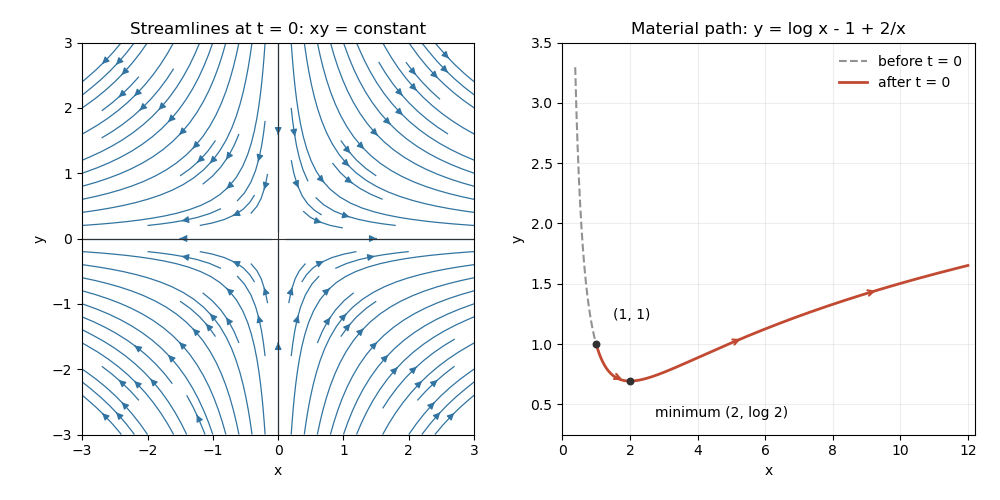
The divergence is , while the scalar vorticity is . The flow is therefore incompressible flow and irrotational flow. Integrating the streamfunction equations givesThe time dependence must be retained: no time-independent function represents this unsteady field for every . At the streamlines are , with the coordinate axes as separatrices. Their arrows point towards increasing and decreasing , as shown below.
A pathline solves the material ODEs, givingFor , elimination of time yieldsIf , the pathline stays on the axis and the parametric expression remains valid; it cannot in general be written as a single-valued along that vertical trajectory. For , the path is : it initially descends, reaches its minimum , then rises. Unlike a frozen streamline, it records the time-varying flow.


Past exam of the mathematics course of the University of Cambridge 2013 ib Paper 4 18A Solution Created 2026-09-24 Updated 2026-10-07
Irrotational flow permits , and incompressible flow imposes , hence . In the laboratory frame, the no-penetration condition at the translating sphere is .
For separation of variables, take the angular factor , which satisfies . The radial equation iswith solutions and . Rest at infinity excludes the term. The normal boundary condition fixes the remaining coefficient, giving the potential flow around a translating sphereThere is no azimuthal velocity. With fluid density , the kinetic energy isThe angular integral is , and the radial integral is , so . Since and , . Thus the added mass of a sphere is .
Past exam of the mathematics course of the University of Cambridge 2016 ib Paper 1 17C c i Solution Created 2026-09-24 Updated 2026-10-06
Write the conservative body force per unit mass as . For a fluid of constant density , the Euler equations for an inviscid fluid and the incompressible flow condition areUsing part (a), these becomeFor irrotational flow, locally choose a velocity potential with . Then , so the unsteady Bernoulli integral isThe constant is spatially uniform on a connected region where the velocity potential is defined; its time dependence can be absorbed into the additive time-dependent gauge of . A global single-valued velocity potential requires an appropriate topological condition, such as a simply connected domain; without it, the integral is locally valid. In a connected steady irrotational region, directly gives one spatial Bernoulli constant even without choosing a global potential.
Past exam of the mathematics course of the University of Cambridge 2016 ib Paper 1 5C b Solution Created 2026-09-24 Updated 2026-10-06
In cylindrical coordinates, the transverse velocity is , so its contribution to the circulation is . The vertical contribution is , the differential of an antiderivative of , and therefore has zero integral around any closed curve. If is the oriented winding number of the curve's projection about the origin, thenIn particular, a single positive winding gives ; reversing orientation reverses the sign. The nonzero circulation is compatible with irrotational flow because the domain is not simply connected. For , an enclosing curve cannot bound a surface contained entirely in the domain to which Stokes theorem would apply.
Past exam of the mathematics course of the University of Cambridge 2016 ib Paper 3 18C a Solution Created 2026-09-24 Updated 2026-10-06
Use the standard ideal-fluid assumptions of incompressible flow, inviscid flow, gravity , and no surface tension. Irrotational flow gives in each layer, and incompressibility gives Laplace equationThe rigid-wall boundary conditions are at and at . At the moving interface, each fluid has the same normal velocity as the interface:The dynamic condition is continuity of pressure, at . Bernoulli equation in each fluid reads . Choosing the potential gauges to subtract a common reference pressure, the interface condition becomesTangential velocities need not agree across an inviscid interface.
Past exam of the mathematics course of the University of Cambridge 2017 iii Paper 314 4 a Solution Created 2026-10-03 Updated 2026-10-06
Let the free surface be at and take the Newtonian gravitational potential to vanish at infinity. Mass conservation fixes . The enclosed mass is , and hydrostatic equilibrium requires . With vacuum outside, , givingThe pressure is zero outside. A prescribed constant external pressure would simply add that constant to .
The bulk Eulerian and Lagrangian fluid perturbations obey because the mass density is uniform and the Lagrangian displacement has zero divergence. The linearized Euler momentum equation in the interior isTaking the curl gives . Thus every nonzero-frequency normal mode has an irrotational flow displacement; the simply connected space formed by the interior admits and incompressibility gives the Laplace equation . For a regular center, one spherical harmonic component is , with .
It is essential to retain the surface gravity perturbation of a uniform-density sphere. Although the bulk mass density perturbation is zero, the displaced density discontinuity givesThe Poisson equation implies that is continuous and its outward radial derivative has the jumpUsing regularity at the center and decay at infinity, writeThe derivative jump is , so .
Integrating the bulk Euler momentum equation gives for . At the free surface the Lagrangian pressure perturbation vanishes:Combining these relations yields the Kelvin stellar mode frequencyThe choices of are degenerate because of spherical symmetry. For , is a linear combination of coordinates in a Cartesian coordinate system, so is a constant displacement: the zero frequency is rigid translation of the whole isolated body. Such a translation has no restoring force. The constant potential generates no displacement; a radial breathing motion is excluded by incompressibility and a regular center.
The printed irrotational assertion needs the nonzero-frequency qualification, or restriction to the potential incompressible stellar surface modes. It is false for all neutral displacements: has zero divergence, zero normal displacement at the surface, and , so it is a zero-frequency displacement, but . This does not change the Kelvin stellar mode spectrum just derived.
Past exam of the mathematics course of the University of Cambridge 2017 iii Paper 329 1 a Solution Created 2026-10-03 Updated 2026-10-06
Linearity of Stokes flow and rotational symmetry, including reflection in mathematics invariance of the spherical geometry, determine the possible rigid motions before any calculation. Translation is a polar vector; its linear dependence on a single vector must be . A traceless second-rank tensor cannot produce a polar vector by an isotropic linear map: tensor contraction with the identity matrix vanishes and tensor contraction with the totally antisymmetric tensor vanishes because is a symmetric second-rank tensor. Angular velocity is an axial vector. Neither nor a symmetric can produce one by an isotropic linear map. Products such as are excluded by Linearity of Stokes flow. Thus .
Use the Unscaled Papkovich–Neuber representation, with harmonic functions and :Indeed and because each potential is a harmonic function. Put and . The decaying harmonic functions with the necessary angular dependence are , and . The last is a harmonic function precisely because . A Stokeslet is excluded by the force-free condition, and a rotlet by the torque-free condition. TryThe resulting Stokes flow isAt , the coefficient of fixes ; the remaining constant vector gives . In the mode, matching gives and . Therefore the complete two-mode tensorial squirmer flow isThe boundary condition is satisfied in the laboratory frame, so the Stokes flow tends to zero at infinity. The potential dipole in the mode gives an irrotational flow and decays as ; the leading mode is a stresslet, decaying as . Neither carries a net force or torque. Direct surface integral averaging with the surface slip velocity formula gives the same translation, providing an independent check. Uniqueness of Stokes flow then identifies this decaying solution.
Past exam of the mathematics course of the University of Cambridge 2017 iii Paper 331 1 a ii Solution Created 2026-10-03 Updated 2026-10-06
Let . The interface is a material surface for both fluids: its material derivative vanishes on . With and , this givesThus the kinematic boundary condition says that particles stay on the moving interface. The tangential velocities can differ; each side has its own material derivative. Replacing both derivatives by one background speed would be incorrect.
The dynamic boundary condition for an inviscid interface is pressure continuity, because the fluids have no viscous normal stress and there is no surface tension. The unsteady Bernoulli equation in each layer of irrotational flow readsEquating these pressures at gives the required dynamic boundary condition for an inviscid interface. Choose the potential gauges so that , or set both constants to zero relative to a common reference pressure. For example, removes the distinct uniform-stream Bernoulli constants without changing either velocity. Material-interface kinematics and pressure continuity supply the two matching conditions, with the Bernoulli gauge understood.
Past exam of the mathematics course of the University of Cambridge 2017 iii Paper 331 1 a i Solution Created 2026-10-03 Updated 2026-10-06
Separate the uniform stream and an arbitrary time-dependent gauge from each velocity potential: . Only gradients of the velocity potential determine the velocity field. The remote fluid must remain in its unperturbed uniform stream, soAfter fixing the harmless gauge, the nonzero-wavenumber perturbation velocity potentials themselves vanish at the corresponding infinities. Incompressible flow and irrotational flow give the Laplace equation for each perturbation. For a normal mode with , the vertical amplitude solves , henceThe opposite exponentials are excluded because they make the perturbation grow at infinity. It is the perturbation, rather than the total potential , that decays.
Past exam of the mathematics course of the University of Cambridge 2018 iii Paper 314 1 c Solution Created 2026-10-03 Updated 2026-10-05
Expanding the kinetic helicity conservation law separates advection from the other flux:Thus material conservation of kinetic helicity density holds precisely whenAn especially useful sufficient pair of conditions is incompressible flow, , and constancy of along integral curves of the vorticity, . Together these conditions make both terms vanish without cancellation. They are not necessary individually, because the two terms in the displayed balance can cancel. An irrotational flow is a trivial conserved case with .
For contrast, combining the balance with mass conservation givesConsequently constancy of along integral curves of the vorticity makes an advected scalar even in compressible flow; it does not generally make itself constant.
Past exam of the mathematics course of the University of Cambridge 2018 iii Paper 331 1 a iii Solution Created 2026-10-03 Updated 2026-10-05
Use the linearized boundary condition: evaluate at and discard products of perturbations. The kinematic boundary condition and Young–Laplace equation becomeIncompressible flow and irrotational flow give the Laplace equation for each potential. For a normal mode, the wall conditions selectWith , the kinematic conditions give and . Hence and . Substitution into the dynamic condition gives the finite-depth Rayleigh-Taylor dispersion relation:Its denominator is positive. Assuming and , negative therefore produces a growing branch with , as in Rayleigh-Taylor instability.
Past exam of the mathematics course of the University of Cambridge 2018 iii Paper 331 1 a i Solution Created 2026-10-03 Updated 2026-10-05
For irrotational flow, . An impermeable stationary horizontal wall has zero normal velocity, so the kinematic boundary condition isNo tangential no-slip condition is imposed on these inviscid fluids.
Past exam of the mathematics course of the University of Cambridge 2020 ii Paper 1 40B a Solution Created 2026-09-24 Updated 2026-09-29
Write the density and pressure as and , and let be the small fluid velocity. The linear homentropic acoustic equations arewhere the adiabatic sound speed isIf the flow is irrotational, write . The momentum equation integrates spatially toa purely time-dependent integration term having been absorbed into . Substitution into continuity gives the wave equationso the wave speed is .
To obtain energy conservation, dot the momentum equation with and use the product rule:The continuity and pressure-density relations giveTherefore the acoustic energy conservation law iswith acoustic energy density and intensity
Past exam of the mathematics course of the University of Cambridge 2020 ii Paper 4 38B i Solution Created 2026-09-24 Updated 2026-09-29
Let the disturbed sheet be and take a normal mode proportional to , with . Irrotational flow and the rigid-wall condition at give perturbation velocity potentialsThe two linearized kinematic boundary conditions at areThe Unsteady Bernoulli equation gives and . Continuity of pressure therefore yields the finite-depth vortex-sheet dispersion relationor, with ,For its two roots areOne root has positive temporal growth for every , so every finite wavelength is subject to the Kelvin-Helmholtz instability.
Past exam of the mathematics course of the University of Cambridge 2021 ib Paper 3 7A a Solution Created 2026-09-24 Updated 2026-09-25
Writing , direct differentiation givesso . Likewise,so the two-dimensional vorticity vanishes. The flow is therefore incompressible and irrotational away from the origin.
Past exam of the mathematics course of the University of Cambridge 2023 ib Paper 3 16C a Solution Created 2026-09-24 Updated 2026-09-25
For an inviscid fluid of constant mass density with no body force, the Euler equations for an inviscid fluid areThe vector identityand irrotational flow give . Writing in terms of a velocity potential, we obtainThus the bracket depends only on time:Since adding a function of time to leaves unchanged, that function may be chosen to absorb . This is the Unsteady Bernoulli equation.