For A=B, the first two component squares have opposite mixed terms and sum to θ˙2+ϕ˙2sin2θ. Put n=ψ˙+ϕ˙cosθ. Using the orientation-dependent potential printed in the source therefore gives the formal model
For imposed fixed tilt θ=α∈(0,π/2), conservation of n and pϕforces ϕ˙=Ω constant. Impose the fixed-height condition z=h in this formal constrained model. Its θequation is
When this condition holds the two algebraic rates are (Cn±C2n2−4AMghcosα)/(2Acosα).
There is a physical inconsistency in the printed data that must be kept distinct from this algebra. If (x,y,z) are literally Cartesian coordinates of the centre of mass in uniform gravity, the gravitational potential is Mgz, not Mgzcosθ. The printed Lagrangian consequently does not follow from that Cartesian-height interpretation. Moreover its unconstrained zequation is z¨=−gcosθ, so constant height at the indicated tilt requires a constraint reaction. The requested rate and discriminant follow from the printed orientation-dependent potential with fixed height imposed; a standard heavy-top interpretation instead usesaheight proportional to an axis distancetimes cosθ, with the reference point and corresponding inertia specified consistently. The kinetic-energy derivation is independent of this source inconsistency.
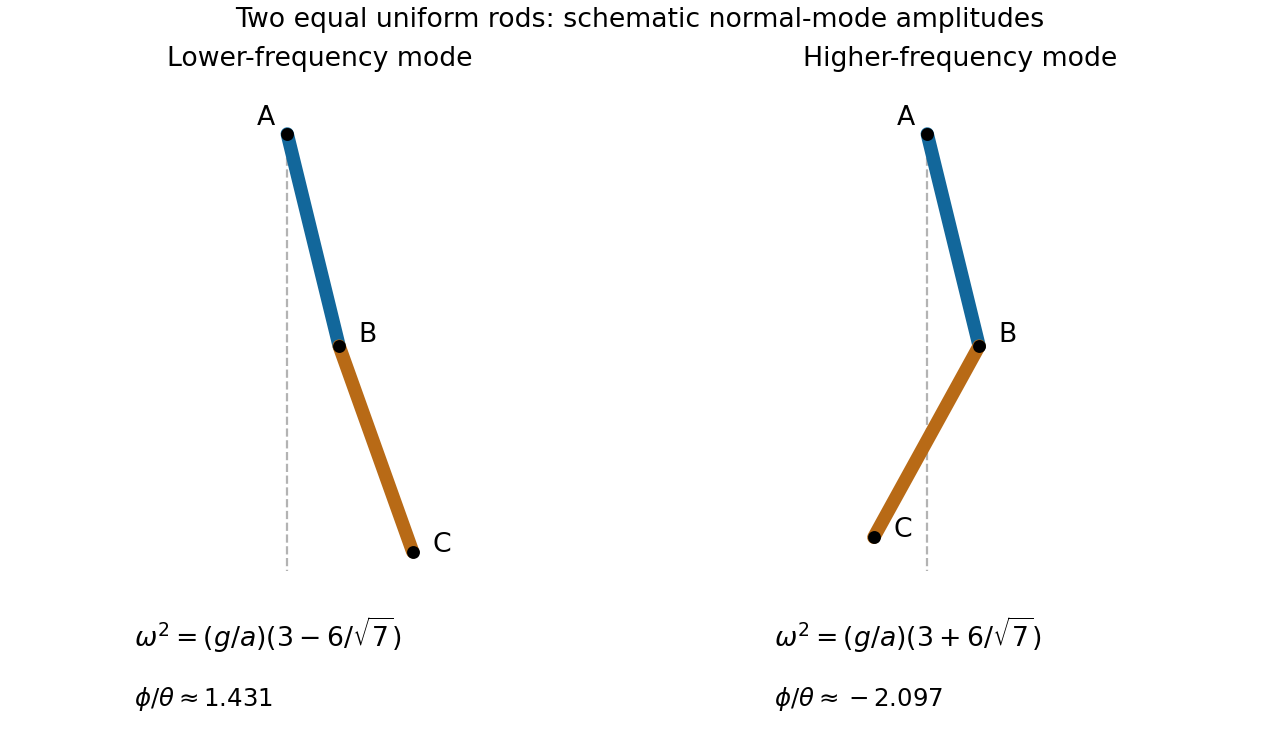
Use coordinates with the downward vertical asreference. The first rod's center is at (a/2)(sinθ,−cosθ), so its translational plus rotational kinetic energy is ma2θ˙2/6. The second center is
Both squared frequencies are positive. The amplituderatio is ϕ/θ=(9−8κ)/(3κ): it is positive in the lower-frequency mode and negative in the higher-frequency mode. The rods therefore swing in phase in the first mode and in opposite phase in the second.
For the rods let θ1,θ2 be their small inclinations from the downward vertical. To first order, θ1=x/a and θ2=(X−x)/(2a). The first rod has kinetic energymx˙2/6. The second has centre-of-mass horizontal velocity (x˙+X˙)/2 and angular velocity (X˙−x˙)/(2a), giving
It is positive for the smaller root and negative for the larger root. Thus the low-frequency mode has the rods in phase, and the high-frequency mode has them out of phase. Using the rod-angleratio is necessary because X is the displacement of the end of the second rod, not that rod's inclination.
Choose the orientation with increasing u; reversing it does not change stationarity. Invariance of length under regular reparametrization therefore gives
For a nonconstant parallel η=η0, choose constant nonzero ζ˙. The secondequation holds, and the first reduces to f(η0)f′(η0)ζ˙2=0. Since f>0, this is equivalent to
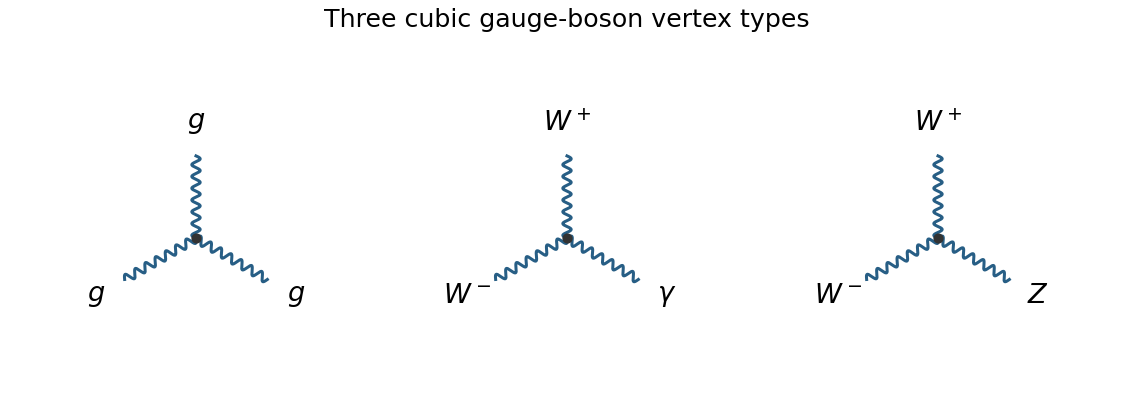
There is a convention to distinguish here: if acalculation expands around massless free fields, quadratic mW2Wμ+W−μ and mZ2ZμZμ/2 terms may be drawn as two-leg mass insertions. Those two insertion types belong to that bookkeeping convention. Similarly, two-point self-energy corrections occur in loop diagrams. Neither is an additional fundamental interaction in the standard physical-mass, tree-level rules used for the count above.
Release from rest at θ0 also gives θ˙2=3g(cosθ0−cosθ)/(2l) by conservation of energy. These results hold while both contacts persist. The idealwall reaction is normal to the wall; an unspecified tangential wallfriction would require an additional generalized force and would prevent determination from the supplied data alone.
The endpoint mass cancels in the light-rod limit. A concrete comparison shows why the finite rod cannot silently be included: the same specified endpoint m with Mr=m gives T=2π8l/(9g), distinct from the negligible-rod result. This is a physical pendulum when the rod contributes, and a simple pendulum in the light-rod limit. Both expressions require small oscillationamplitude; the full sineequation remains nonlinear.
Let the pivot's prescribed horizontal position be x(t) and measure θ from the downward vertical. The bob's coordinates are X=x+lsinθ and Y=−lcosθ. Therefore
Here x(t) is a prescribed input, not yet afree coordinate. Terms depending only on that prescribed timefunction can be dropped without changing the θequation. The moving block's own kinetic energy becomes relevant when its motion is free in part (d).
The rod is light, rigid and of fixed length; pivot friction and air drag are neglected. A rigid rod, unlike astring, may sustain either tensile or compressive constraint force.
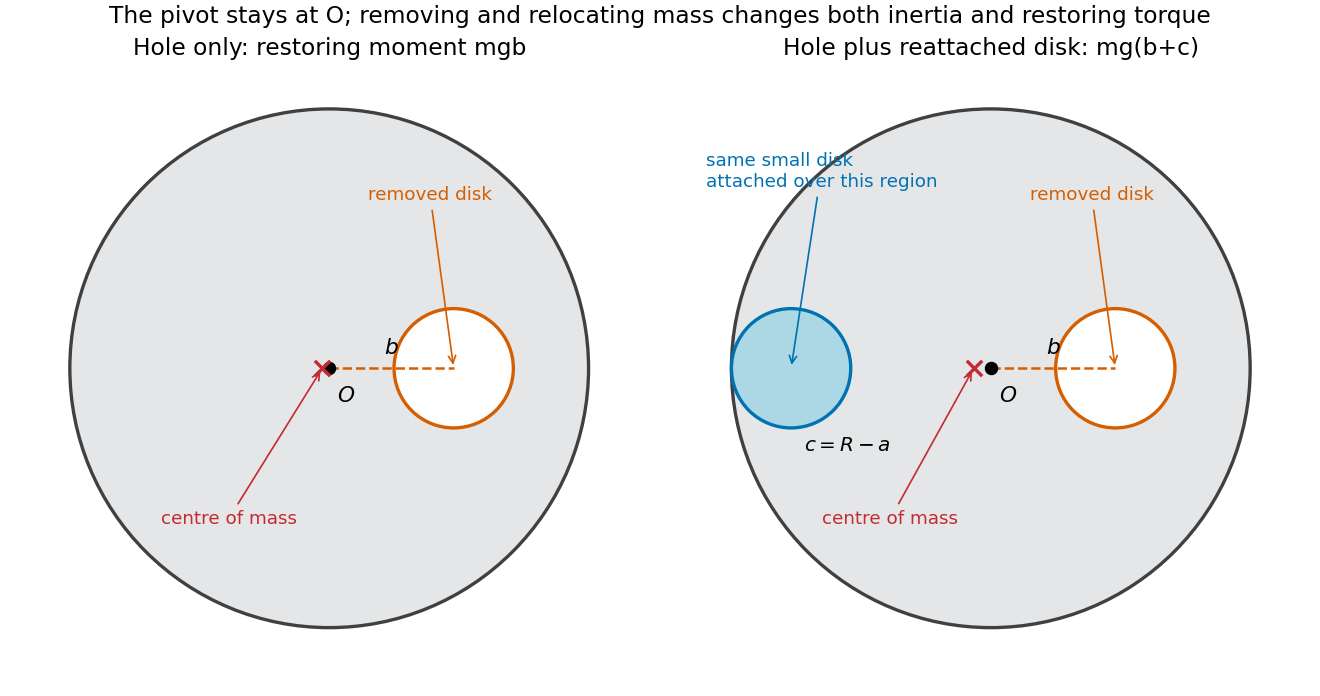
Now add the removed small disk on the opposite side, with its centre adistance c=R−a from O so that it is internally tangent to the large disk. The total mass returns to M, while its firstmoment about O is −m(b+c)x^. Thus
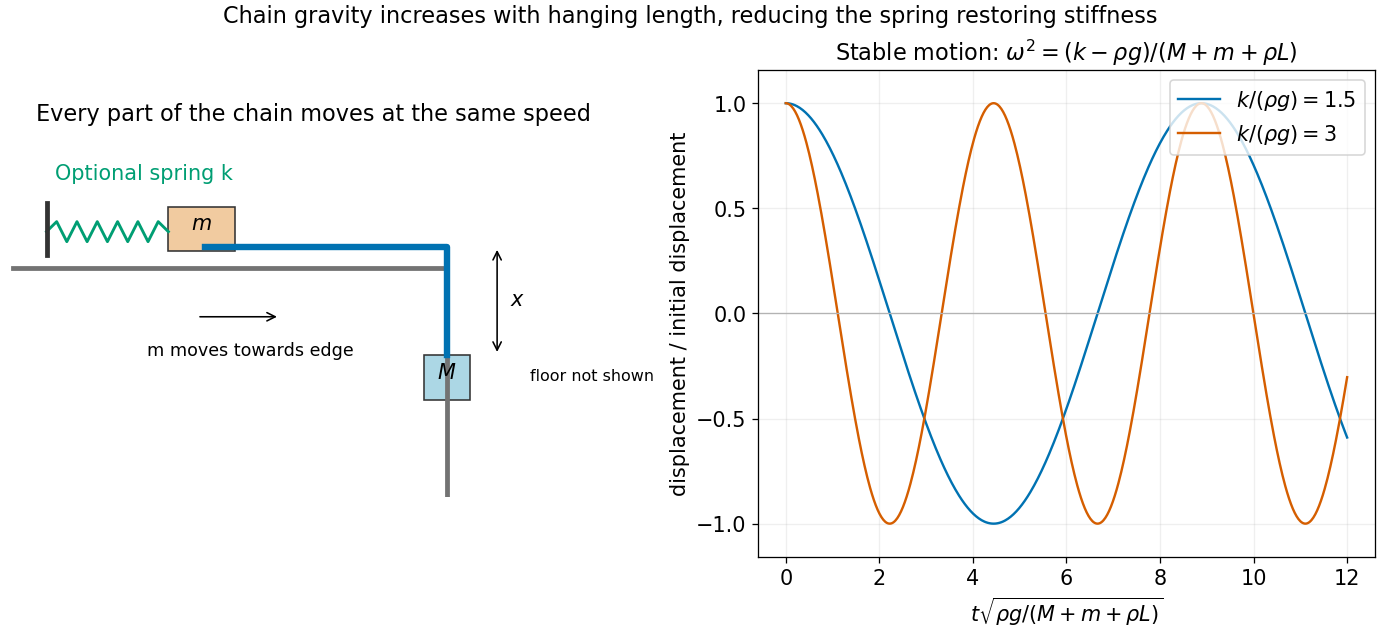
These are also the smaller mass'sdisplacement and speed towards the edge. The formula applies until M reaches the floor, at tf=Ω−1arcosh(1+ρy/M). Since y<L, the smaller mass has not yet reached the edge during this interval. As ρ→0, the result tends to x=Mgt2/[2(M+m)], as expected for a massless connector.