Separate the variables in this first-order ordinary differential equation:Integration gives , so . On the interval containing the prescribed point , we have . The initial condition therefore gives , hence . Choosing the positive square root to match that initial condition yieldsThe maximal interval containing on which this solves the explicit ordinary differential equation is . At the left endpoint , the original denominator vanishes and the derivative becomes unbounded. Directly, and , verifying the equation throughout this interval.
Recognize the left-hand side as a product rule derivative, and use :At , both and equal , so . ThereforeDividing by first obtains this solution on , the interval containing the initial condition. The explicit expression is smooth on the entire real line and satisfies the original, undivided differential equation even where .
For this homogeneous first-order differential equation, set , with . The product rule gives , and substitution simplifies the equation toThe useful further substitution is . Its chain rule derivative satisfiesThus . Replacing and gives the implicit solutionNo division by was needed, so the level is included. A direct verification also identifies the integrating factor for a differential one-form:Setting this exact differential to zero recovers precisely the original equation after multiplication by the nonzero factor . The coefficient never vanishes for real , since implies . Hence these level sets give local function graphs everywhere with .
The generalized Leibniz rule follows by mathematical induction. The case is the identity . Suppose the formula holds for and differentiate every term using the product rule:For an interior index , the coefficient of becomes by Pascal's identity. The two endpoint coefficients are one. This provesOnly finitely many derivatives are involved; it suffices that both functions are times differentiable.
For and , the derivatives of beyond order two vanish. The three surviving terms of the generalized Leibniz rule giveThe simplified expression works for every integer , including the two cases where one or more of the three terms are absent.
For and , use . Again only three terms survive. With , they areSince and , this becomesThe factors and remove the nonexistent terms when or .
The conversion from cylindrical coordinates to Cartesian coordinates isHere is the distance from the axis and is measured around that axis. A full turn describes the same point.
On the circular cylinder, is constant, so the given line element reduces to . Unroll the circular cylinder with . The line element is then , so the usual Euclidean geometry formula measures arc length in the plane.
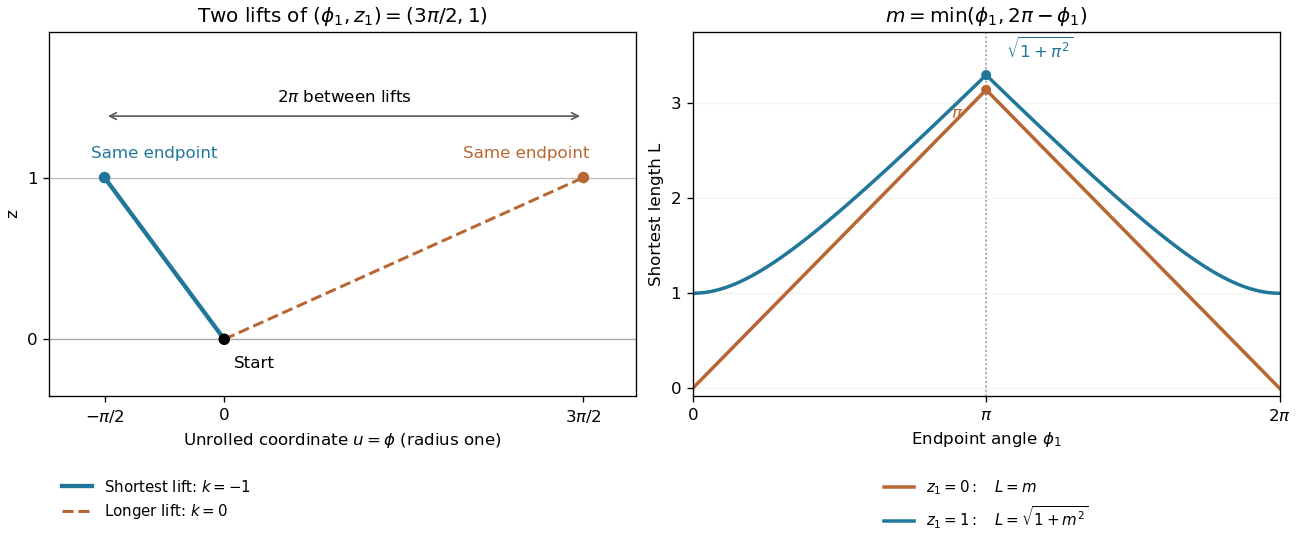
The endpoint has infinitely many lifts , with . For each lift, the straight line segment is shortest; its length is . Comparing the lifts gives the unrestricted shortest path on a circular cylinder:If is a minimizing angular increment, a shortest geodesic is parametrized by , . This is a helix when both increments are nonzero, and a circular arc or vertical generator in the limiting cases. A nonminimal lift also gives a geodesic, but it is only shortest within its fixed winding class.
For and , the shortest path on a circular cylinder has lengthIts graph is triangular, with endpoint values zero and maximum at . In particular, increasing the angle to a full turn brings the endpoint back to the starting point.
For and , the corresponding length isThis graph has endpoint values one, a maximum at , and symmetry about . Each half is smooth, with horizontal slope at the outer endpoint; at the two halves meet at a corner, because the minimizing winding direction changes.

At an ordinary point, an order- linear ordinary differential equation has arbitrary constants in its general solution. Determining them uniquely requires independent, consistent scalar conditions. Prescribing at one ordinary point gives uniqueness under the standard continuous-coefficient assumptions. Conditions at different endpoints need an additional nonsingularity check: for example, , leaves every multiple of possible. Thus counting boundary conditions alone does not guarantee uniqueness for a boundary value problem.
The characteristic equation is , giving the complementary function . For the forcing term , a linear particular solution gives , hence , .
The forcing gives resonance in a differential equation, since already appears in the complementary function. Try . Direct differentiation givesso . Combining the two particular solutions givesThe factor in the resonant exponential particular solution is required because is already a root of the characteristic equation.
Now the characteristic equation is , with a repeated root, so the complementary function is . For the polynomial forcing, substitute to obtainThus , , . For the forcing , both and already occur in the complementary function; the resonant exponential particular solution therefore starts with . The identitygives . The resulting general solution is
Parametrize the straight line by , , with . Substituting into the vector field and taking the dot product givesHence the direct line integral is
For the curved path , . The vector field along this parametric curve isIts dot product with the tangent is . Therefore the direct line integral is
Integrate with respect to , obtaining . Matching gives , so . Finally, must equal the third component, so . Thus a scalar potential isThe fundamental theorem for line integrals now gives for either path, confirming both direct computations. Since the curl of a gradient is zero for this smooth function, it also confirms the result in part (b). The potential is defined throughout , so no domain obstruction to path independence occurs.
Use a Lagrange multiplier to maximize subject to , with . The equations areThe second equation gives . Substituting into the first gives , hence . The constraint then gives , soThis is the same aspect ratio as the minimum-area closed cylinder at fixed volume. To confirm maximality directly, eliminate : on . Its only stationary point is the value above, its second derivative there is negative, and the volume tends to zero at either end of the interval.
Maximize the total surface area with the constraint . The Lagrange multiplier equations areFrom the second, . Substitute into the first and multiply by to obtain . Thus the aspect ratio satisfies . Since ,This is the maximum-area cylinder inscribed in a sphere. The dimensions and area, although not needed to specify the ratio, areThere is only one positive stationary ratio. At the degenerate boundaries and , the limiting areas are zero and , both below this value, confirming the maximum.
The homogeneous linear system has coefficient matrixNonzero solutions exist exactly when its determinant vanishes. Expanding along the first row givesThus or . The first equation always gives . For , the second then gives ; the third imposes the same relation. For , the second gives , again consistent with the third. Therefore the nonzero solutions areFor every other , the matrix is invertible and only the zero solution exists.
Here the vertical bars denote determinants. Since , taking determinants gives . The condition selects . By the multiplicative property of the determinant,The hypotheses determine this determinant, while allowing many possible matrices and .
The region of integration is , . It is the closed triangle with vertices , , and , bounded by , , and . Each horizontal slice runs from the rising left edge to the falling right edge.
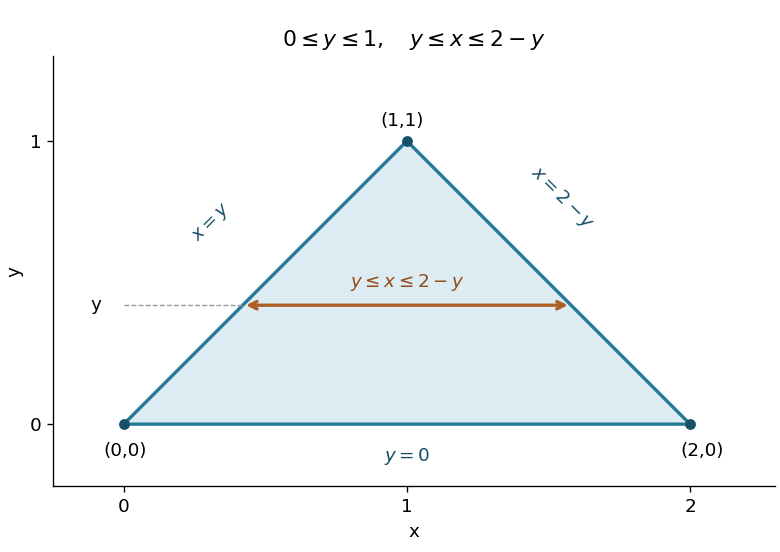
Triangular integration region and a horizontal integration slice
. Original diagram of the region , , with its three vertices, boundary equations, and an example slice at fixed . Details.
Integrate with respect to first:The triangle has area one, but the nonconstant integrand makes the double integral a weighted area.
Use the spherical polar coordinates volume element . Since throughout , the solid has radial range and full azimuthal range . Its volume isPut , so and the endpoints become and . ConsequentlyThe polar equation describes the entire three-dimensional surface, so the spherical polar coordinates volume element, rather than a two-dimensional polar area element, is required.
Solve the two algebraic constraints for the squared coordinates:On any nonsingular real branch, implicit differentiation at fixed gives and . Differentiating with the other original coordinate fixed gives and . ThereforeThis is the multivariable chain rule applied to . These formulas assume the relevant denominators are nonzero and the chosen variables are valid local coordinates.
At fixed , differentiating gives . Also, gives . At fixed , eliminate to write , giving . Finally, the previous part gave . ThusThe held-fixed subscripts matter: substituting a reciprocal partial derivative while silently changing what is held fixed would not preserve these cancellations.
Differentiate both algebraic constraints at fixed or fixed :The multivariable chain rule for therefore givesDivide the first identity by and the second by , and add. The terms cancel, leavingThe Jacobian determinant of is , so the calculation is valid on real branches with . This explicitly supplies the local independence assumption underlying the change of coordinates.
If for a twice continuously differentiable potential , then and . Equality of mixed partial derivatives gives the necessary condition for an exact differential:This condition alone does not ensure global exactness on a domain with holes.
For the Helmholtz free energy , use the stated identity for internal energy and the product rule:Thus and . Equality of mixed partial derivatives yields the Maxwell relationThe temperature and volume are the independent variables here, with composition and amount of gas fixed.
Next express and substitute its total differential into :Matching the coefficient of givesThis is the thermodynamic internal pressure identity: an equation of state determines how internal energy changes under an isothermal change of volume.
For the Dieterici equation, set while differentiating at fixed . ThenSubstitute into the thermodynamic internal pressure identity. The term proportional to cancels , leavingThe physical gas domain has and .
For the ideal gas instead, gives . Therefore is independent of volume at fixed amount of gas. Integrating the remaining condition , with constant heat capacity at constant volume, giveswhere is independent of both and and fixes the reference for internal energy.
With replacement, successive draws are independent, with red probability and green probability . The first red on draw requires greens followed by one red. HenceThis is a geometric distribution. Its total probability is one because the geometric series sums to .
Use the law of total probability according to the first draw. Without replacement, the second-draw red probability is after a red and after a green. ThusEquivalently, each counter has the same probability of occupying the second position as the first. Equal marginal probabilities do not make the two draw events independent.
After a red first draw, one red remains among six counters. The multiplication rule for conditional probability gives
By inclusion-exclusion, subtract the intersection once to correct the double counting:As a check, the complementary event is two greens, of probability .
The definition of conditional probability givesConditioning on a red in the second position leaves one red among the six counters that could occupy the first position, giving the same result directly.
Using the standard sine limit , with angles in radians,Thus the two-sided limit exists and is finite.
Although oscillates without a limit, its magnitude is at most one. Therefore . The squeeze theorem givesThe shrinking factor suppresses the oscillation from either side of zero.
The derivative of the exponential function at zero gives . Hence , andThe denominator is nonzero for every real , so this is a two-sided finite limit.
A series is a convergent series if its partial sums have a finite limit as . The number is the sum of the series. Explicitly, for every there is an integer such that whenever . The condition alone is insufficient: the harmonic series has terms tending to zero but diverges.
The series has absolute convergence if is a convergent series, meaning its nonnegative partial sums have a finite limit. Absolute convergence implies convergence of the original real or complex series. The converse fails: the alternating harmonic series converges, while its absolute-value series is the divergent harmonic series.
The summands are positive. Apply the ratio test:ThereforeFor a direct comparison interpretation, the ratio is eventually at most any fixed number between and , such as . The tail is then bounded by a convergent geometric series. Thus the exponential denominator wins over the fourth-power numerator strongly enough to make the whole series summable.
Articles by others on the same topic
There are currently no matching articles.