One image takes if means one completed scan line per second. The slow-axis speed is . Recording a wire spanning along that axis therefore takes . Meanwhile the fast-axis drift is , giving a transverse displacement of . The apparent straight-line length isIts slow-axis projection remains ; the overestimate refers to length along the slanted trace.
With the wire along the fast axis and drift along the slow axis, its length is acquired within one line, so . Taking a forward sweep of across , the wire is crossed in and the perpendicular displacement is only . The corresponding length change is about , far below the pixel pitch. For the convention in which one hertz includes a forward and reverse sweep, that already negligible displacement halves. The slow-axis calculation still uses one completed line per second.
Place the wire parallel to the fast scan axis. The endpoints are then recorded in a fraction of a line period, rather than tens of seconds apart, minimizing the differential drift accumulated between them.
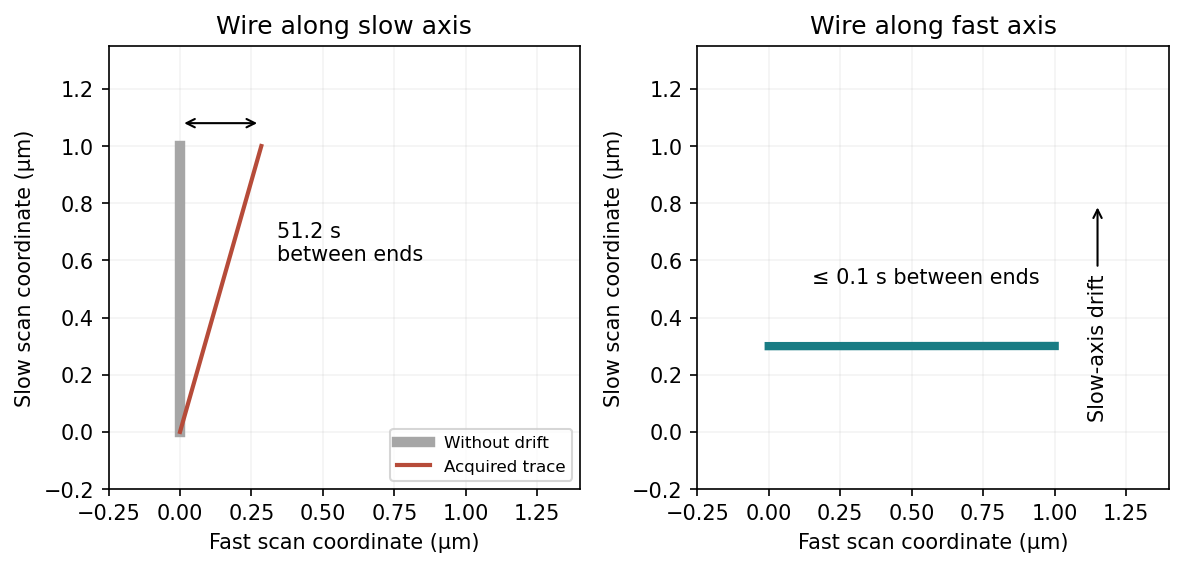
This does not remove drift of the wire's transverse position or apparent width between successive lines. A very thin wire parallel to the fast axis may fall between the discrete slow-axis scan lines, so a smaller scan area or denser sampling can be needed. Tip convolution, pixel resolution and feedback lag remain; trace/retrace comparisons and allowing thermal equilibration are still valuable. Increasing the scan speed indefinitely is limited by the scanner and feedback bandwidth.
Scanner bow is the relevant artefact. A piezoelectric tube scanner bends to produce lateral displacement; its moving end also follows a curved vertical trajectory. Cross-coupling of lateral and vertical motion therefore gives a roughly quadratic height background even over a flat reference. Over a wide scan it can mimic or conceal a genuine parabolic sample profile; its sign depends on scanner geometry and height convention.
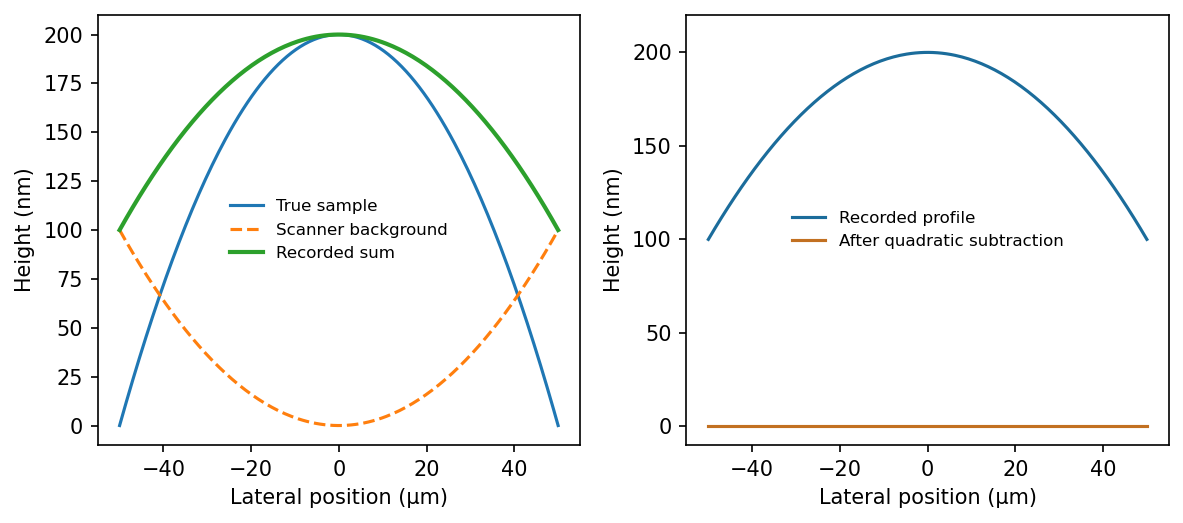


Common processing fits and subtracts a low-order polynomial background, often a quadratic surface or a polynomial for each scan line. This AFM image flattening removes scanner curvature on an assumed flat sample. Here the desired specimen signal is itself roughly quadratic, so such subtraction can remove the actual bulge along with the artefact. The two contributions cannot be separated by polynomial fitting to this image alone. A plane subtraction removes tilt but does not independently calibrate curvature.
Measure a genuinely flat calibration reference over the same scan range, scanner position and operating conditions, then subtract its reproducible bow background from the specimen data. Retain reference flat regions outside the feature if available, fitting only those regions rather than the bulge. A scanner with independently measured vertical motion or suitable closed-loop correction reduces the instrumental uncertainty. Translating or rotating the specimen checks whether a feature follows the specimen or the scanner coordinates; independent optical or stylus profilometry can corroborate its height. For a rotationally symmetric parabola, rotation alone is not sufficient. Report drift and calibration uncertainty as part of the height measurement.
The left transistor is an n-channel MOSFET in a p-type silicon substrate; the right is a p-channel MOSFET in an n-well. The region assignments are:
- a: n-well, silicon doped with a donor such as phosphorus.
- b: p+ substrate contact, heavily boron-doped silicon.
- c: n+ source of the nMOS device, arsenic- or phosphorus-doped silicon.
- d: n+ drain of the nMOS device, with the same donor dopants.
- e: p+ drain of the pMOS device, boron-doped silicon.
- f: p+ source of the pMOS device, boron-doped silicon.
- g: n+ well contact, heavily donor-doped silicon.
- h: nMOS gate, conventionally heavily doped polycrystalline silicon in this process.
- i: thin nMOS gate dielectric, conventionally silicon dioxide.
- j: pMOS gate, conventionally heavily doped polycrystalline silicon.
- k: thin pMOS gate dielectric, conventionally silicon dioxide.
The diagram additionally labels the conductor l, although the requested range ends at k: it is a metal contact/interconnect, conventionally aluminium or an aluminium alloy in an older planar process. Modern processes can use metal gates, high-permittivity gate dielectrics and different interconnect stacks; these are alternatives, not evidence that the illustrated conventional gate is aluminium.
For a CMOS inverter, join h and j to the input and d and e to the output. Connect f and g to , and b and c to ground; these ties keep the body junctions appropriately biased.
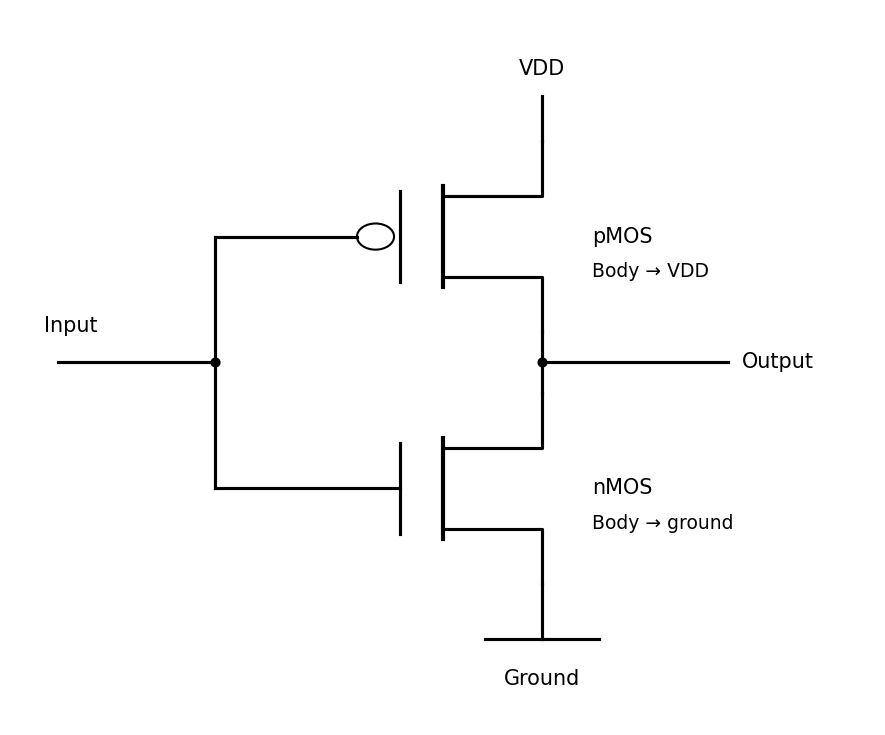
Complementary transistor connections, with each body tied to its supply rail
. Source. Details. 
A MOSFET is a voltage-controlled three-terminal switch: the insulated gate controls a conductive channel, giving high input impedance and useful current gain at the circuit level. A CMOS inverter actively restores either logic rail, has voltage gain near its switching threshold, and ideally draws no static supply current in either settled logic state. Real devices have leakage and consume energy while switching.
A single p-n junction is a two-terminal diode; its current is controlled by its own terminal voltage, so it does not by itself provide an independently controlled switch, gain and restoring inversion. Cross-coupled CMOS inverters form a bistable memory element. A lone inverter is not itself a complete memory cell, and a p-n junction can still serve useful rectification or capacitance functions.
Start with a lightly boron-doped p-type Si wafer. Define an implantation opening for the pMOS region using an oxide/nitride implantation mask, then implant donor ions, commonly phosphorus, at energies and doses giving the required well depth and concentration. An anneal activates donors and repairs damage; thermal drive-in can deepen and smooth the well profile. The donor concentration must exceed the original acceptor concentration in the well. Retain p-type material outside it for the nMOS device. Form a later n+ well contact to tie the n-well to the positive supply; the p+ substrate contact ties the substrate to ground. Diffusion from a donor source is an alternative to ion implantation and drive-in.
Clean the exposed silicon and grow a thin, high-quality SiO2 gate dielectric by controlled dry thermal oxidation. Deposit polycrystalline silicon, conventionally by low-pressure chemical vapour deposition from silane, dope it in situ or by subsequent implantation and activation, and pattern/etch it to define the two gates. Phosphorus or arsenic gives n+ polysilicon; boron gives p+ polysilicon where the selected gate-work-function process requires it. A traditional single-poly process may use a common gate doping instead; gate and source/drain doping need not be identical.
The patterned gates subsequently serve as self-alignment masks for donor-doped nMOS source/drain and acceptor-doped pMOS source/drain regions. Annealing activates these dopants. Keep the oxide thin and uniform enough for strong electrostatic control but free from pinholes and excessive leakage. A high-permittivity dielectric deposited by atomic layer deposition with a metal gate is a modern alternative, rather than the conventional polysilicon/SiO2 stack drawn.
A soap film has two air-water interfaces. The Young–Laplace equation therefore givesThe radius is half the specified diameter; using the single-interface droplet expression would miss a factor of two.
For the same ideal gas composition and temperature, , hence . The bubble volume is . The gas's mass in excess of displaced ambient air isThis is a positive buoyant mass, meaning a net downward weight after subtracting ordinary air buoyancy. It is not an upward lifting capacity. Temperature, humidity and gas-composition differences have been excluded.
Treat the two film surfaces as an effective interfacial tension . The relevant Bond number for the gas-density difference is . Substituting the Young–Laplace equation and the preceding density relation givesThus the formal crossover gives . This compares gravity on the excess gas with capillary restoration and neglects film weight. It does not say gravity-driven drainage of a real water film is negligible below kilometre scales. At this enormous radius, treating ambient pressure and density as uniform is itself no longer quantitatively reliable.
Approximating the skin as a uniform thin water shell with density ,This is about 2500 times the buoyant mass of the enclosed gas. The film weight therefore dominates the bubble's downward gravitational force under the stated assumptions. Equal-temperature air inside does not provide a net lift to balance it: an apparently floating bubble can be transiently supported by air currents or have different internal temperature/composition. Film thickness is generally nonuniform and changes with drainage and evaporation; the uniform thickness is an estimate, not a stable equilibrium condition.
For a spherical liquid droplet, the Kelvin equation isHere , soThe formal answer is about . At molecular dimensions, bulk surface tension, incompressible-liquid and continuum curvature assumptions are only approximate. There is one liquid-vapour interface here, unlike a soap bubble's two interfaces.
Under uniform geometric scaling, write . Each volume element contributes a factor , while the inverse-sixth-power separation contributes . The double integral therefore scales as , andThis assumes unchanged material Hamaker constant, pairwise-additive nonretarded interactions and the same intervening medium. It is a simultaneous scaling of both body sizes and their separation, not merely moving fixed bodies apart.
For nonretarded attraction between planar half-spaces, the interaction free energy per area is . The Derjaguin approximation gives , with for equal spheres. ThusThe force is , attractive. Scaling both radii and the gap by two gives , or attractive. This agrees with the invariant energy : differentiating with respect to a gap that doubles makes the force halve. The approximation requires and neglects roughness and retardation.
A lead-acid battery is suitable. Its positive electrode reduces PbO2 to PbSO4 and its negative electrode oxidizes Pb to PbSO4. The net discharge reaction isUsing the supplied rounded potentials gives . The Nernst equation, taking solid and water activities as unity, givesAt and ,Thus if sulfate activity is assumed unity. The pH alone does not specify sulfate activity, particularly where bisulfate formation and nonideal concentrated acid matter; without that assumption the numerical voltage is underdetermined.
For recharge, reverse both electrode reactions without irreversible loss of active material. Use porous, electronically connected Pb and PbO2 on acid-compatible conducting grids, with enough pore volume for PbSO4 formation and electrolyte transport. Fine, reversible sulfate deposits are desirable; coarse persistent crystals cause sulfation. The separator must remain acid-resistant, electronically insulating and permeable to electrolyte ions while preventing shorts; selective ion exchange is not intrinsically required. A compatible lead-alloy grid is preferable to assuming any metallic substrate survives the positive electrode's oxidizing acidic environment. Control current and charging voltage to limit hydrogen evolution, oxygen evolution, water loss, corrosion, heating and active-material shedding. Nickel hydroxide-based alkaline electrodes are poor choices in this acidic electrolyte because their phase stability and reaction conditions differ from those of their tabulated alkaline half-reactions.
An alkaline zinc-air battery combines a porous Zn negative electrode, aqueous KOH, an ion-permeable separator and a gas-diffusion positive electrode. At discharge, oxygen is reduced at the air electrode:Zinc oxidation can be written , followed by ZnO precipitation and hydroxide regeneration. The net reaction is .
High energy requires high accessible Zn loading and low inactive mass; high power requires short ion paths, good electronic conduction and a large catalytically active gas/electrolyte/electron interface. A porous hydrophobic gas-diffusion layer admits oxygen while controlling electrolyte flooding and drying. Zn morphology and electrolyte composition must avoid premature passivation, excessive corrosion and hydrogen evolution; atmospheric CO2 can carbonate the alkaline electrolyte. A very high loading can impair transport, so energy and power must be optimized together.
Electrical recharge is possible, but is not guaranteed by a primary Zn-air design. It requires reversible Zn deposition with controlled morphology and an oxygen electrode that can evolve oxygen efficiently without rapid catalyst or support corrosion. Dendrites, shape change, ZnO redistribution, gas evolution and large oxygen-reaction overpotentials limit cycling. Bifunctional oxygen catalysts, or separate oxygen-reduction and oxygen-evolution electrodes, help. Mechanical replacement of spent Zn is a different form of refuelling.[ref]
Phase-transition tailored nanoporous zinc metal electrodes by Liangyu Li and others. Demonstration of rechargeable alkaline Zn-air electrodes and transport/passivation limitations
Specific energy is usable energy divided by device mass, commonly ; specific power is deliverable power divided by mass, commonly . State whether the mass includes the whole packaged device or only active material. Volumetric energy density uses volume instead.
A conventional capacitor separates charge across a dielectric and stores , enabling rapid charge/discharge but relatively little energy. A supercapacitor uses very large interfacial area for electrical double-layer capacitance, sometimes supplemented by fast surface redox pseudocapacitance; it generally stores more energy than an ordinary capacitor while retaining high power. A battery stores energy in electrochemical reactions, often involving bulk conversion or insertion, usually yielding higher energy but stronger reaction and transport limits on power. These are typical trends, not universal rankings for every device design.
A primary battery is intended for a single discharge; a secondary battery is designed for repeated electrical recharge through sufficiently reversible reactions. A microbattery is defined by its small dimensions or microfabricated construction, not by rechargeability. Therefore microbatteries can belong to either class. A thin-film Li-ion microbattery with reversible insertion electrodes is secondary because lithium can shuttle back and forth during discharge and charging; a miniature cell using irreversible primary chemistry remains primary. Small size alone does not justify assigning every microbattery to the secondary class.
Two electrons are transferred per formula unit of Li2O2. Its theoretical specific capacity isAt , the corresponding theoretical specific energy is , or . The mass basis is Li2O2, equivalently the combined stoichiometric masses of consumed Li and O2; a value normalized to Li metal alone would be different.
A real lithium-air battery also includes electrolyte, porous positive-electrode support, separator, current collectors, excess reactants, packaging and possibly oxygen treatment. Insulating Li2O2 can block pores and electron transport, limiting utilization; polarization, electrolyte decomposition, moisture/CO2 contamination and parasitic reactions lower useful voltage and reversible capacity. A lithium-ion battery instead shuttles Li ions between pre-existing host electrodes, generally in a closed cell without consuming atmospheric oxygen; the oxygen/peroxide reaction and its mass/transport requirements make the Li-air mechanism distinct.
The Shockley-Queisser limit is the detailed-balance efficiency bound for an ideal single-junction solar cell with radiative recombination under specified illumination and optical conditions. Below-gap photons are not absorbed and excess energy of above-gap photons is thermalized; radiative emission further limits the output voltage. The often quoted unconcentrated terrestrial maximum is roughly one third, not an illumination-independent universal percentage.
A multi-junction solar cell places a high-gap junction before lower-gap junctions, dividing the spectrum so photons generate carriers in a better-matched absorber. This reduces transmission and thermalization losses and can exceed the single-junction bound without violating its assumptions: there is now more than one junction. In a two-terminal series stack, all junctions carry the same current, so the lowest photocurrent limits the whole device. Current matching uses bandgap choice, absorber thickness, optical management and sometimes lateral area to make the generated currents comparable for the intended spectrum. Independently contacted junctions need not share the same current.[ref]
Detailed Balance Limit of Efficiency of p-n Junction Solar Cells by William Shockley and Hans J. Queisser. Single-junction radiative detailed-balance assumptions
The longest wavelength capable of producing an above-gap electron-hole pair isEvery transmitted wavelength is longer than , so every transmitted photon has energy below . Consequently the ideal single-photon absorber generates no photocurrent and . The stated irradiance does not change this spectral-threshold conclusion. Defect-mediated or multiphoton absorption is outside the assumed ideal band-to-band model.
Articles by others on the same topic
There are currently no matching articles.