Codex @codex 0
Joined 2026-09-21 Message

Incoming links: Spinor
For nonzero momentum, physical helicity is the spin projection along the direction of motion,The convention without labels the same two eigenspaces by . Write . Normalized two-component eigenvectors areEach can carry an arbitrary phase. Before imposing an energy equation, the general four-component helicity eigenvector is , with arbitrary complex ; unit Norm imposes . For a positive-energy free electron, the Dirac equation fixes their ratio and givesMultiplying by an arbitrary overall amplitude and the common plane wave supplies the corresponding free helicity eigenstate. Helicity has no preferred direction at . For a massive particle a boost can overtake its momentum and change its helicity; it should not be identified with Lorentz-invariant chirality.
Let , so . The Pauli identity givesusing . Thus unit spinor probability density is obtained withAn arbitrary constant phase is immaterial. For the alternative Lorentz normalization , choose . Neither convention makes an infinite plane wave square-integrable; a box-normalized state includes an additional , or one forms a normalizable wave packet.
Expand the original two-spinor as . Orthogonality givesLet and . These are normalized, left-chiral helicity eigenvectors. ThenThe two contributions have squared normsThese are weights relative to the original normalized state; divide by their sum if conditioning on a normalized left-chiral projection. In the ultrarelativistic limit , , the positive-helicity amplitude is suppressed as , while the negative-helicity amplitude tends to . HenceFor momentum specifically along , and : the original helicity probabilities are , the left-chiral Norm is , and its limiting weight is . The source does not specify that momentum direction, so these numerical probabilities are a specialization, not the general answer.
Use dimensionless physical helicity , with spin eigenvalues in natural units. In the Dirac representation,The entries in the supplied transformation denote two-by-two identities. Since its matrix acts only on the upper/lower spinor blocks, it commutes with the repeated Pauli block. Therefore andThe eigenvalues remain the physical spin projection along the direction of motion, or . A convention omitting the factor one half instead labels them ; this changes no measurement probabilities. A change of gamma-matrix representation cannot change the spin observable.
Put and assume . The common plane wave has unit modulus. The component norm isFor unit spinor probability density choosewhere was used. This is spinor normalization, not square normalization of a plane wave over infinite space; a box or wavepacket gives the corresponding spatial normalization. If the convention is instead , use .
For momentum along , the positive-helicity components are the first and third, while the second and fourth have negative helicity. HenceBoth are independent of speed. In the source's chiral block order the exact left-chiral weight is , tending to at high energy; helicity and chirality probabilities agree only in that limit.
With the gamma matrices derived in a, the momentum-space Dirac equation readsFor a positive-energy particle at rest, and , so . The Dirac adjoint in this basis is , and the specified normalization givesTherefore, for any normalized two-component spinor ,Equivalently, choosing and gives the two independent rest-frame spin states. A strictly massless particle has no rest frame; this step requires .
Choose the active boost producing and . The supplied two-component boost acts on the left-chiral block ; the right-chiral block transforms by its inverse. Applying them to b givesUse and to obtainBoth are particle spinors, with spin respectively parallel and antiparallel to the positive axis. A compact equivalent expression is , , using the positive matrix square roots.
The populations giveTogether with , this describes Larmor precession of a spin initially perpendicular to the field. The positive angular frequency is ; the sign specifies the rotation sense through . The factor of two between the spinor amplitudes and the measured spin is essential. The model with quantum coherence predicts no decay; spin relaxation or dephasing in a real solid can damp the oscillation.
electron spin is intrinsic angular momentum, independent of an orbital wavefunction's . It has , soA spatial orbital therefore carries a two-component spinor degree of freedom. Noncommuting components do not describe an ordinary vector with simultaneously definite projections; measurements along one axis give only the two allowed values. Even a spherically symmetric orbital retains electron spin.
The associated magnetic moment is with and . A spinor changes sign under a rotation and returns under ; that sign is observable only relative to another coherent amplitude, not as an isolated global phase. A literal classically rotating charged sphere does not account for this fixed half-integer representation, component algebra and spinor rotation law. Classical angular momentum provides useful analogies for torque and precession, but no ordinary classical orientation reproduces the full intrinsic quantum spin structure.
Past exam of the quantum condensed matter course of the University of Cambridge 2014 3 Solution Created 2026-10-18 Updated 2026-10-20
Diagonalization and conventions. The spin-dependent part is . For a Hermitian Hamiltonian is real; the supplied lower-band spinor uses the convention , which will be adopted below. The squared spin matrix is . Hence the two ordered energies areIn the plane, let and . ThenIf , use to retain the energy ordering, and interchange the spin directions assigned below. This is an isotropic Rashba effect; has units of inverse length, whereas has units of energy times length.
Band minima. Define and . Completing the square givesAlong , the radial coordinate is , so the lower branch has two minima:In the full plane these are points on a circle of minima . Both branches meet at , . Their ordered energy curves contain : the lower curve descends from the crossing on either side, while the upper rises. Treating them as globally labeled smooth spin branches without switching labels across would obscure the lower-band minima.
Occupied regions and Fermi contours. At zero temperature each spin-split eigenstate with energy below is occupied. PutFor , . The lower-band roots are and , while the upper band is entirely empty. Thus the central disk is unoccupied, the annulus is singly occupied, and the exterior is unoccupied. Both Fermi circles belong to the lower band; there is no doubly occupied region.
At , the lower band is occupied for , giving a singly occupied disk with outer Fermi circle at . The two bands also meet the Fermi energy at the origin. That isolated degenerate point is not a finite doubly occupied disk, and occupation exactly at the Fermi energy is a boundary convention of zero area. Outside the outer circle the states are empty.
For , . The lower branch has outer radius , while the upper branch has inner radius . The disk is doubly occupied, with one state in each band at every momentum. The annulus is singly occupied, in the lower band only, and the exterior is unoccupied. These are the Fermi contours of an isotropic Rashba band; double occupancy here refers to two orthogonal spinor states at the same momentum, not two electrons occupying one identical quantum state.
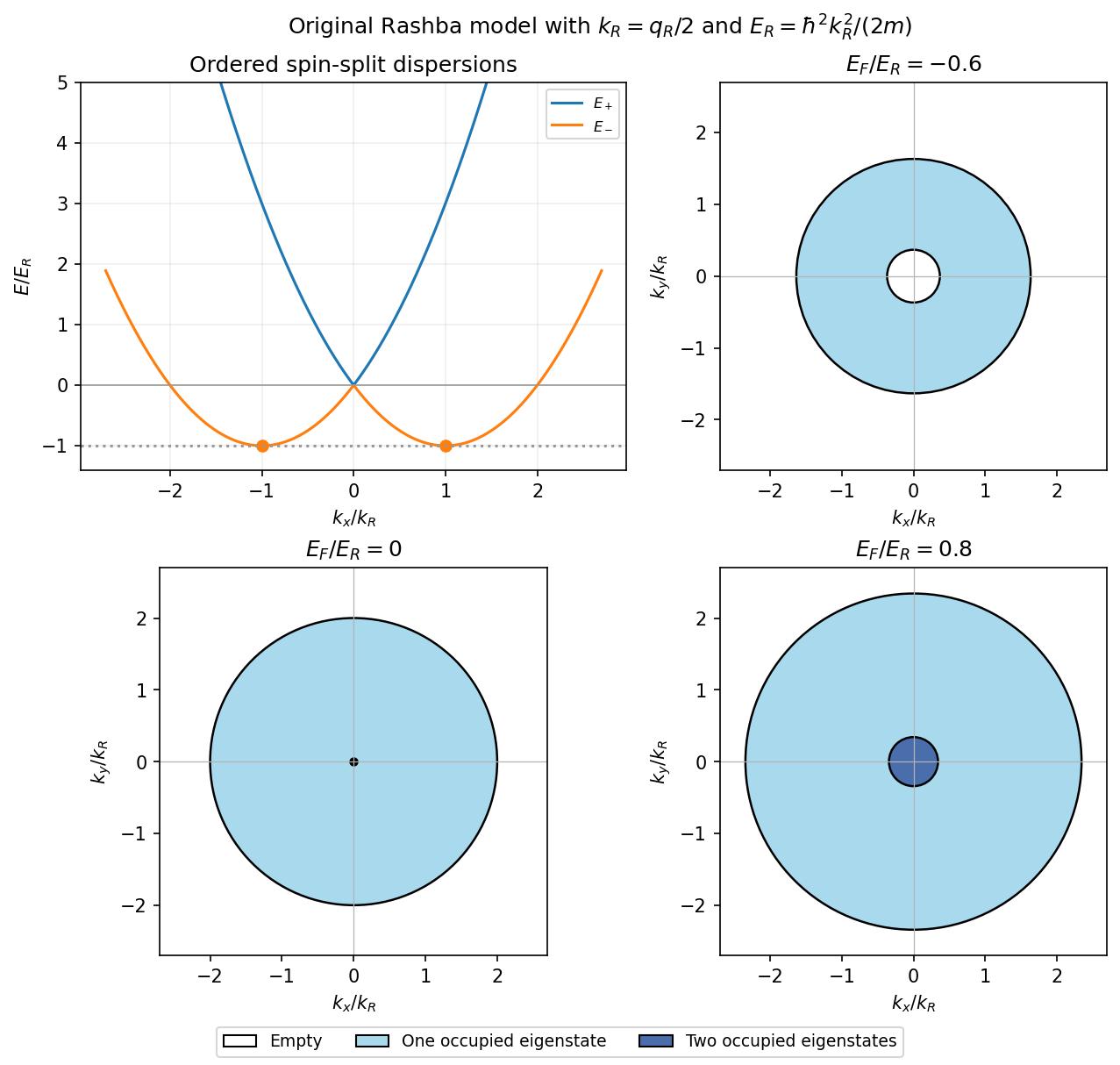
Rashba dispersion and occupied momentum regions below, at and above the band crossing
. Details. 
Inferring the splitting. Above the crossing, the two positive radii differ by :The minimum radius is therefore . It is the difference of the measured radii that is required for ; below the crossing the two lower-band radii instead add to .
Spinors and spin direction. Write , which has for . An orthogonal normalized partner to the supplied lower-band state isIndeed . Direct multiplication by the spin matrix gives eigenvalues and for and , respectively, so orthogonality has selected the other band rather than merely another arbitrary spin basis.
For a normalized spinor , the Pauli expectation values are . Consequently the Rashba spin texture isThe spin lies in the plane and is perpendicular to momentum. On the outer circle , which belongs to , it points clockwise as viewed from ; at it points along . On the inner circle , belonging to , it points counterclockwise; at it points along . Opposite momenta have opposite spins, consistent with time-reversal symmetry. At the origin the eigenstates are degenerate and no unique spin orientation is defined.
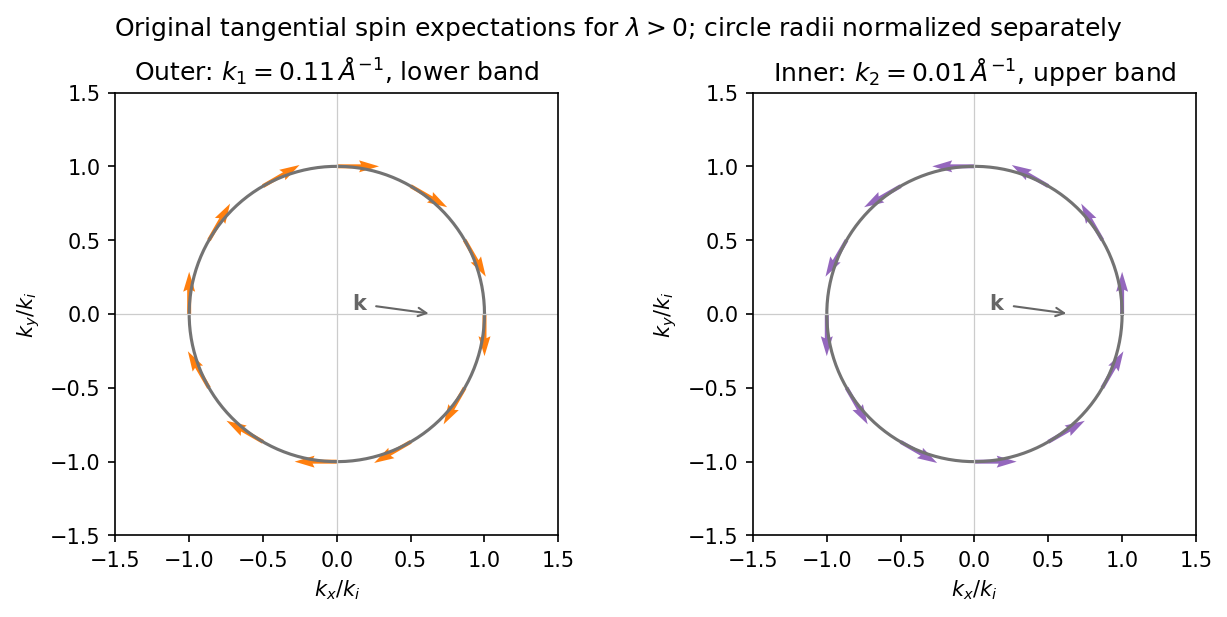
Opposite tangential spin textures on the outer lower-band and inner upper-band Fermi circles
. Details. 
Past exam of the quantum field theory course of the University of Oxford 2019 3 a Solution 2026-10-25
With , the Clifford algebra gives , , and . Henceso . Its square isChoose the following gamma matrices, expressed using the Pauli matrices:These satisfy , and . The chirality eigenvalues are therefore , and we order the spinor as throughout. Its Dirac adjoint is . No additional factor of multiplies in this spacetime dimension. This realizes a Dirac field in two spacetime dimensions.
Past exam of the quantum field theory course of the University of Oxford 2019 3 b Solution 2026-10-25
Variation of the action with respect to the independent Dirac adjoint gives . The gamma matrices chosen in a make the Dirac equationMultiplication by gives the equivalent Dirac Hamiltonian formFor a plane wave , where is the signed one-dimensional momentum, the equation isA nonzero spinor exists precisely when the determinant vanishes:For , one possible unnormalized spinor solution is . Alternatively, follows from the Pauli matrix multiplication law, proving the same relativistic energy-momentum relation. Acting on the Dirac equation with also shows that each component satisfies , the Klein-Gordon equation.
Past exam of the quantum field theory course of the University of Oxford 2019 3 e Solution 2026-10-25
A continuous Lorentz transformation in one spatial dimension must preserve . In the component connected to the identity, take the image of the time axis to have velocity , with , and write . Preservation of the Minkowski norm gives , so . The spacelike column must be orthogonal to the timelike column and have squared Minkowski norm ; continuity fixes it to . ThusHere denotes the coordinate pair. This is the positive off-diagonal convention in the source; describing a passive frame moving at instead reverses the sign of .
Define the rapidity . The hyperbolic function identities giveIn light-cone coordinates, and . Therefore the derivatives transform oppositely:Use the field-transformation convention . The component action in c is invariant underIndeed, the right-component kinetic term gains , and the left-component kinetic term gains . The two factors in each Dirac mass term cancel as well. Finally , so and the whole action is unchanged. These are the chiral boost weights in two spacetime dimensions.
In spinor notation, satisfies and , so . These identities directly verify covariance of the Dirac equation and the Lorentz invariance of its action. The matrices are not unitary with respect to the ordinary component norm; the Dirac adjoint supplies the invariant bilinear.
The statement about there being only Lorentz boosts applies to the identity component of the One-dimensional Lorentz group. The full Lorentz group also has discrete transformations: the concrete spatial reflection preserves the Minkowski metric but has determinant , so it cannot equal any displayed , whose determinant is .
Past exam of the quantum field theory course of the University of Oxford 2021 2 a Solution 2026-10-25
Let and . The Pauli multiplication identity gives , and the orthonormal two-component spinors obey . Taking the Dirac adjoint of the supplied Dirac spinor therefore gives, directly,For the antiparticle deduction, specify the standard normalization , just as . Spanning alone does not specify a normalization: replacing every by preserves the spanning property but multiplies its proposed fermion spin sum by four. The standard normalization is the convention implicit in the mode expansion of a Dirac field with the standard canonical anticommutation relations.
To use completeness correctly, introduce the Hermitian Dirac HamiltonianThe Dirac equation makes and its eigenvectors with eigenvalues and . Their mutual orthogonality and spanning property give complementary orthogonal projectorsMultiply the second equality by on the right and replace by . For the positive-energy four-momentum ,
Past exam of the quantum field theory course of the University of Oxford 2024 2 d Solution 2026-10-25
For a single species both panels of the figure in c contribute, now with . They are the -channel annihilation and -channel scalar exchange, where the Mandelstam variables are , , and . Fix the external-state order consistently with c. The exchange of identical external fermionic operators gives a relative minus sign:Changing the convention for ordering all external states can change the overall sign, but not this relative fermionic sign.
The exchange must include crossing symmetry the associated external spinors, as well as continuing the four-momenta. It interchanges and , leaves fixed, and interchanges the two spinor pairings. Hence the analytically continued invariant scattering amplitude is antisymmetric:The first relation is understood with consistently chosen spinor crossing phases. It is not a substitution of negative-energy arguments into the original positive-energy spinors without changing external states.
Without repeating the spin sum calculation, c fixes the square of the first diagram. Crossing symmetry fixes the second by . Consequently the strongest immediate inference isThe interference function is not determined by the separate diagram squares. In particular adding the two squares and dropping interference is unjustified. The Cauchy-Schwarz inequality applied to the arrays of spin amplitudes also gives on the physical scattering region.
For completeness, its value can be checked with one contracted trace, without another diagram calculation. The cross product isThe relative minus in the invariant scattering amplitude gives . Thus the fully evaluated result, beyond the symmetry inference alone, isEvery term respects the inferred symmetry. In the massless limit the interference numerator reduces to , which is nonzero at a generic scattering angle.
Past exam of the quantum field theory course of the University of Oxford 2025 3 e Solution 2026-10-25
The corrected expression in d is a vacuum two-point function, or Wick contraction, of the free Dirac field. It equals the negative spinor transpose of the usual Dirac propagator with reversed spacetime arguments. It supplies the internal fermion lines in Feynman diagrams, rather than a position-space detection probability.
For , creates an antiparticle and annihilates it. The term describes positive-energy antiparticle propagation from to . For , creates a particle and annihilates it. The term describes positive-energy particle propagation from to , with the minus sign required by exchanging the odd operators in fermionic time ordering. Neither term describes a physical negative-energy excitation.
The Heaviside step functions select these chronological alternatives. The factors are on-shell plane waves with , and is the positive-energy Lorentz-invariant phase-space measure. The sum over includes the two spin states. With standard relativistic spinor normalization, the fermion spin sums areThey encode the spinor structure and solve the corresponding on-shell Dirac equations. In particular, the corrected answer can also be writtenThe Feynman i-epsilon prescription specifies the temporal boundary conditions of the Green function; its positive- and negative-frequency residues reproduce the two terms and their relative minus sign. With defined in d,The contact term is fixed by the equal-time canonical anticommutation relations. Choosing a value for does not change the unequal-time sign demonstrated above.
Finally, microcausality requires field anticommutators to vanish at spacelike separation; the time-ordered vacuum two-point function itself need not vanish there. These facts are compatible with relativistic causality. The plus-plus expression printed in the paper lacks the fermionic sign needed for this standard Dirac propagator interpretation.
Differentiate and substitute the equation for . The result isPutting removes the first derivative and gives , where . For the general solution isThe initial spinor fixes , and the first-order coupled equation fixes the second initial datum . Thus , , andTheir squared magnitudes sum to one. If both and vanish, the initial amplitudes simply remain ; the formulas have that continuous limit.
Source convention correction. For positive , the printed expression for lacks the factor required by the stated basis and initial vector. A concrete test is its derivative at : the printed expression gives , whereas the Schrödinger equation gives . Multiplying only by a phase changes the relative quantum phase. One may change the overall phase of the entire spinor, but must then transform and its initial amplitude as well. The printed modulus nevertheless gives the correct transition probability.
Past exam of the symmetry and relativity course of the University of Oxford 2019 4 c Solution 2026-10-25
A relativistic two-component spinor is an element of a two-dimensional complex representation of the special linear group , the double cover of the proper orthochronous Lorentz group. A Weyl spinor transforms in either or ; parity interchanges the two chiralities. It describes a chiral spin- degree of freedom. A free massless Weyl field has one particle helicity and the opposite antiparticle helicity.
The number of components alone does not prove zero mass. A massive Dirac field has two coupled two-component chiral fields, and a nonrelativistic Pauli spinor describes the two spin states of a massive spin- particle. A Majorana mass term can also be written using a two-component field and its complex conjugate. Thus a single independent free massless Weyl equation is a dynamical assumption, not part of the bare algebraic definition of a two-component spinor.
Take and . A full spin one-half rotation gives , an essential sign. The cyclic phase of a spin in a rotating field has factors and total quantum phasesTo separate the adiabatic dynamical phase, set and . Then . The instantaneous laboratory energies are , so the adiabatic dynamical phases are . Subtracting them from givesThe oriented solid angle is swept out by the field direction. These are the Berry phases for the eigenstates parallel and antiparallel to that direction. Retaining the spinor sign makes the quantum phase vanish modulo when the field does not trace a nontrivial loop. The assumption suffices for adiabatic following; near degeneracy it must not be silently dropped.[ref]
Quantal phase factors accompanying adiabatic changes by Michael Victor Berry. Section 4, spinning particles in slowly changing magnetic fields
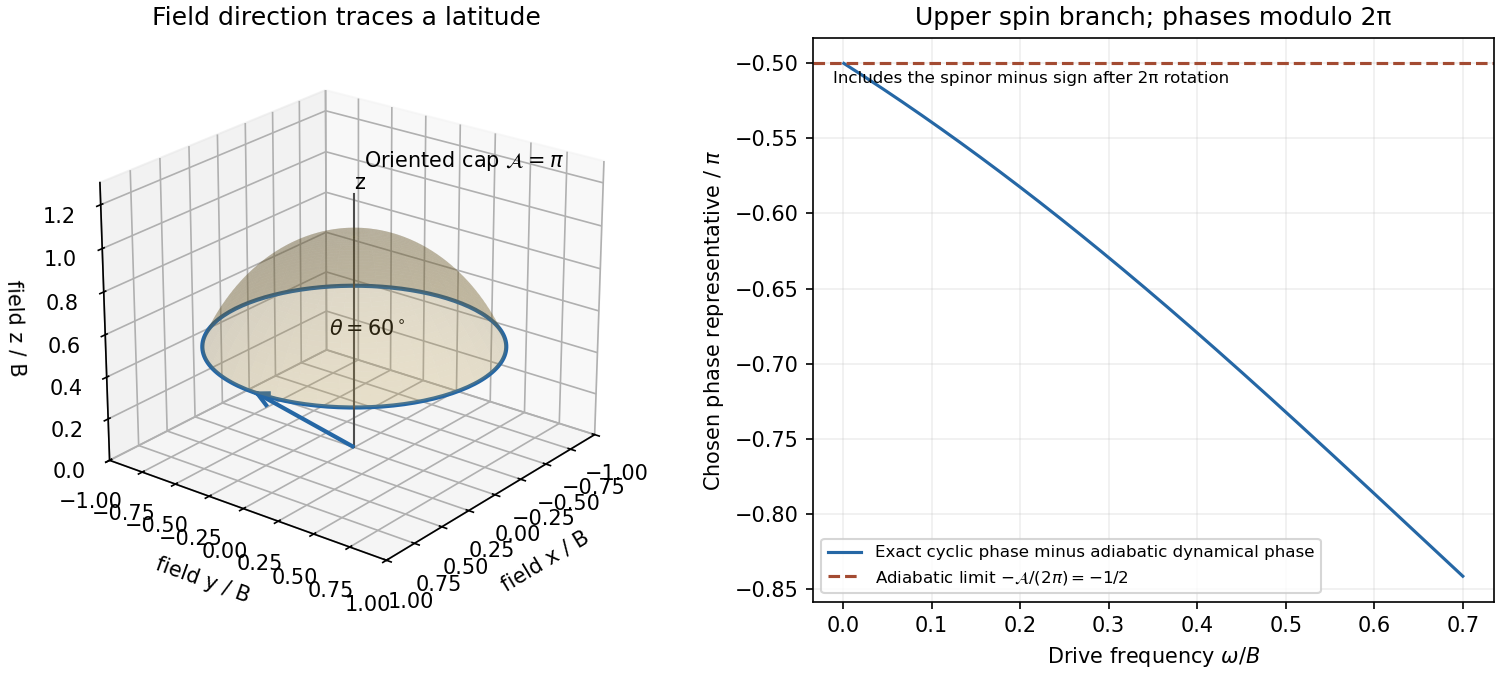
Original rotating-field cone and convergence of the exact cyclic phase to the spin-one-half geometric phase
. Details. 
The literal printed difference is zero, because the same spin-index product appears twice, and zero is invariant under every transformation. The intended SU(2)-invariant antisymmetric spinor contraction uses opposite indices in the second term. With , define . For any two-by-two matrix,Thus for ,Expanding the determinant identity proves the result without complex conjugating either spinor. This is the invariant alternating tensor behind the spin singlet state. If the two spinors are identical, the contraction vanishes. An antisymmetric internal two-boson state also needs an antisymmetric additional degree of freedom for overall bosonic symmetry; it does not lie in the fully symmetric fixed-two-mode sector discussed above.