Topics (384k) Articles (398k) Users (410) Discussions (242) Comments (383) Files (13k) New article

Igor Yashayaev authored a report on oceanographic conditions in the Labrador Sea. Such observations connect temperature and salinity profiles with deep-water formation and ocean ventilation; comparing years requires consistent sampling and measurement interpretation.[ref]
2024 and 2025 Oceanographic Conditions in the Labrador Sea by Igor Yashayaev. author list and the described study’s abstract or introductory account
Henry Stommel explained a mechanism for the western intensification of wind-driven ocean currents. His 1948 basin model combined wind stress, a latitude-dependent Coriolis parameter and linear bottom friction; the resulting circulation concentrated streamlines on the western side.
The result connects a global transport balance with a narrow boundary current. Friction is essential to closing the circulation even when it is weak in much of the interior, illustrating why a small local effect can control the structure of an entire flow.[ref]
The westward intensification of wind-driven ocean currents by Henry Stommel. Original model and westward concentration of streamlines
Lars H. Smedsrud coauthored a model of frazil ice in ice-shelf-water plumes with Adrian Jenkins. It follows buoyant water along an ice-shelf base and includes the growth of crystals of different sizes after the plume becomes supercooled.
Adrian Jenkins studies interactions between the ocean and ice shelves. With Lars H. Smedsrud, he developed a model of frazil formation in buoyant ice-shelf-water plumes. As a plume rises into lower pressure, its freezing temperature changes, allowing supercooling and growth of suspended ice crystals.
Their model couples plume flow, heat, salt and crystal populations, linking microscopic freezing with marine-ice accumulation beneath an ice shelf.[ref]
Frazil ice formation in an ice shelf water plume by Lars H. Smedsrud and Adrian Jenkins. Abstract and Sections 1–2, coupled plume and crystal-growth model
Melvin E. Stern was a physical oceanographer who developed a mathematical account of the instability now called salt fingering. His 1960 paper The Salt-Fountain and Thermohaline Convection by Melvin E. Stern explained how warm, saline water above cooler, fresher water can become unstable even when the combined density stratification is gravitationally stable.[ref]
The Salt-Fountain and Thermohaline Convection by Melvin E. Stern. Abstract, unequal molecular diffusivities and laminar instability
The decisive ingredient is that heat spreads by heat conduction much faster than salt spreads by diffusion. A displaced parcel can lose its temperature anomaly while retaining its salinity anomaly, changing the restoring or overturning density difference. Stern's paper made this into a stability problem and asked whether the resulting motions could matter for vertical ocean mixing. This connected small-scale molecular transport with a possible large-scale oceanographic consequence, while leaving its environmental importance as an observational question. He taught at Florida State University from 1987 to 2006.[ref]
https://news.fsu.edu/wp-content/uploads/2016/10/fstimes-2010-04-01.pdf#page=11. Florida State Times, April/May 2010, p. 11, institutional remembrance and portrait of Melvin Stern
The work of neurologist Robert S. Fisher includes the operational definition and classification of epilepsy. He led the international task force responsible for the 2014 practical clinical definition. [ref]
A practical clinical definition of epilepsy by Robert S. Fisher and others. 2014, ILAE official report, byline and Summary
The contribution distinguishes an enduring predisposition to seizures from a count of isolated observed events. The report set out circumstances in which recurrence risk or a recognized epilepsy syndrome can support a diagnosis after fewer than two unprovoked seizures. Defining such criteria makes clinical classification reproducible while exposing its assumptions; the diagnostic category is not itself a complete explanation of the underlying neural mechanism.
Jennifer Chu is a science writer at MIT News. MIT's staff directory identifies her as a senior writer covering subjects including mathematics, mechanical engineering and physics.[ref]
MIT News staff directory. Jennifer Chu entry
Her credited work includes the institutional account of the MIT Cheetah robot's running-jump demonstration published on 29 May 2015.[ref]MIT cheetah robot lands the running jump by Jennifer Chu. Byline and publication date
That account explains a scientific sequence rather than just reporting that a robot jumped: onboard lidar estimates an obstacle, the controller adjusts the approach and the motors provide the forces needed for takeoff. It also distinguishes treadmill experiments from indoor-track trials, where the available planning distance differs.[ref]
MIT cheetah robot lands the running jump by Jennifer Chu. See, run, jump and treadmill/indoor-track comparisons
The distinction is useful when interpreting a robotics demonstration. Detecting an obstacle and finding a mechanically feasible jump are separate tasks; a successful sensor measurement does not guarantee that a particular approaching state permits the necessary takeoff. The credited contribution here is scientific reporting of the experimental system and its conditions.
David J. Craig is the credited writer of Boston University's 14 November 2003 account of research connecting dynamical systems, biology and biomedical engineering. His article describes James J. Collins's work on noise and sensation, including vibrating gel insoles intended to improve the detection of weak pressure signals from the feet. This is a contribution to communicating the research; the article attributes the experimental work to the researchers.[ref]
Dynamic solutions to physiological problems by David J. Craig. Byline, date and “Touch sensitive” section
The scientific puzzle in that account is stochastic resonance: under suitable conditions, adding noise can improve the detection of a weak signal. A simple explanatory model is a detector that responds when , where is the signal, the noise and a threshold. If , a detector without noise never responds; a fluctuating gives a nonzero probability of crossing the threshold. The same noise can also produce a response when the signal is absent, so an increase in threshold crossings alone does not establish improved discrimination. Craig's account places this counterintuitive mechanism in the concrete setting of mechanical stimulation of the sole rather than claiming that noise always helps.[ref]
Dynamic solutions to physiological problems by David J. Craig. “Touch sensitive”: weak-signal detection and the vibrating gel insole
E. A. Carswell is the first-listed author of a 1975 paper describing a host-derived serum activity named tumor necrosis factor. The researchers investigated necrosis in transplanted tumors and distinguished the serum factor's activity from that of residual endotoxin. This supported an indirect route in which a host response could mediate an effect initially associated with the stimulating material.[ref]
An endotoxin-induced serum factor that causes necrosis of tumors by E. A. Carswell and others. Abstract, PNAS 72 (1975), pp. 3666–3670; DOI 10.1073/pnas.72.9.3666.
The paper also compared responses in cultured cells: the tested neoplastic cell lines and mouse embryo cultures differed in susceptibility. This is an illuminating experimental distinction between observing a biological effect and identifying its range. It did not establish that every tumor responds, that every other cell is unaffected, or that a therapeutic application follows automatically. A macrophage origin was proposed as an interpretation, rather than directly identified by these experiments.[ref]
An endotoxin-induced serum factor that causes necrosis of tumors by E. A. Carswell and others. Abstract: residual-endotoxin tests, cultured-cell comparison and proposed macrophage interpretation.
Tim R. Mosmann is an immunology researcher whose work includes quantitative cellular assays and analysis of T cell responses. His Rochester laboratory identifies him by this name and directly lists the 1983 colorimetric-assay paper published as T. Mosmann. This provides an institutional link between the initial-only byline and the named researcher; the R. is retained without expansion.[ref]
Tim R. Mosmann laboratory profile at Rochester. Lab Members, Principal Investigator; laboratory homepage, Selected Publications, PMID 6606682
In 1983, Tim R. Mosmann reported a tetrazolium salt-based colorimetric method for mammalian cell survival, cell proliferation and activation. The paper's abstract describes a multiwell scanning spectrophotometer readout and explicitly notes that signal depends on activation. The experimental contribution therefore includes both a convenient quantitative assay and a qualification on its biological interpretation.[ref]
An original measurement model illustrates that qualification. Suppose a background-corrected signal is , where is the number of contributing cells, their mean per-cell reducing activity under the assay conditions and an instrumental factor. Doubling at unchanged doubles the signal, but doubling at unchanged does too. The single scalar signal does not identify both quantities.
For stipulated initial and , the products for later populations and are both 200. A larger readout alone cannot distinguish proliferation from increased activity per cell. Conversely, halving cell number while doubling mean activity can leave the total unchanged. These are model examples, not data from the 1983 paper.
Controls with known cell numbers, appropriate blanks and independent biological observations help establish which interpretation applies. The general lesson is to connect cell viability and cell proliferation claims to a validated response model, rather than assigning every absorbance change to one mechanism.
The laboratory also describes computational analysis of high-dimensional flow cytometry measurements of T cells.[ref]
Tim R. Mosmann laboratory profile at Rochester. laboratory homepage, Batch effects in flow cytometry data
That scientific setting likewise requires distinguishing a measured signal pattern from the underlying populations it is intended to represent.
Tim R. Mosmann, portrait explicitly named on the Rochester Mosmann laboratory members page
. Christian Schoof developed a first-principles description of where a marine ice sheet detaches from bedrock and becomes a floating ice shelf. His 2011 analysis treated this grounding line as a contact boundary in Stokes flow, with different stress conditions on grounded and floating regions.[ref]
The analysis derives boundary conditions for ice thickness and flux from the local contact problem. Additional boundary layers make velocity and surface slope connect smoothly, showing why a depth-averaged flow model needs carefully matched grounding-line conditions rather than an arbitrarily prescribed junction.
Matthias Morzfeld is a researcher in computational and mathematical geophysics whose work combines models with observations. His Scripps Oceanography profile identifies research on data assimilation, inverse problems, Monte Carlo methods and uncertainty, and records a mechanical-engineering doctorate at UC Berkeley in2011. His author-maintained UC San Diego homepage describes a particular interest in how sampling methods behave in high-dimensional spaces.[ref]
Matthias Morzfeld profile at Scripps Oceanography. Research Interests, Education and personal research statement
His earlier work with Fai Ma and Ali Imam studied decoupling of viscously damped linear systems in oscillatory free vibration. Their2009 paper constructs a time-varying coordinate transformation by synchronizing phases of damped modes, extending classical modal analysis beyond its usual classical-damping setting.[ref]
The Decoupling of Damped Linear Systems in Oscillatory Free Vibration by Fai Ma, Ali Imam and Matthias Morzfeld. p408, Abstract; §2, coordinate coupling
This addresses how a damping matrix can keep motion coupled even when undamped normal modes have been identified.An original Bayesian inference example illustrates the model–observation combination underlying his later research interests. Suppose a scalar state has prior distribution and an independent measurement error has a Gaussian distribution , with observed . The posterior distribution has density proportional toThus . The estimate moves toward the measurement while retaining the information and uncertainty from the prior. The posterior variance is lower than either the prior variance4 or the measurement-error variance1 in this stipulated independent Gaussian model.
These chosen numbers are not a result from Morzfeld's papers. They isolate a simple update mechanism; nonlinear dynamics, sparse observations and large state spaces can make the corresponding computation much harder. His work develops and studies numerical tools for such model–data problems rather than assuming that a small Gaussian calculation suffices for an Earth-science application.[ref]
Matthias Morzfeld profile at Scripps Oceanography. numerical methods and high-dimensional sampling interests
Massimo Germano contributed a relation between unresolved stresses at different filtering scales that became a basis for the dynamic subgrid-scale model. A participant account of the 1990 Center for Turbulence Research summer program credits his identity with initiating the collaboration with Ugo Piomelli, Parviz Moin and William H. Cabot.[ref]
Thirty years of Dynamic Modeling by Ugo Piomelli and Parviz Moin. Page3: Germano's identity and the collaboration
The physical issue is that filtering a product differs from multiplying filtered quantities. In large eddy simulation, this creates subgrid-scale stress. Using a second filter exposes a relationship between stresses at two scales; an exact algebraic relation then helps constrain an approximate physical closure.[ref]
A dynamic subgrid-scale eddy viscosity model by Massimo Germano and others (1990). Section2: grid and test filters, stress identity and dynamic coefficient
For an original scalar illustration, average four equally weighted velocities . Their overall mean square is , and the square of their mean is , giving variance . Group them as and . The group means are , whose variance is ; each group's internal variance is . Thus total variance separates variation between coarse groups from variation within them. An identity among averages is exact even when a model for missing variations is approximate.
The dynamic model's success therefore does not turn every closure assumption into an identity. Separating those two ingredients makes the contribution reusable: exact relations provide constraints, while predictions still require tests against adequately resolved observations or computations.
Ugo Piomelli researches computational models of turbulence, including large eddy simulation. Queen's University's institutional account describes work aimed at predicting complicated flows with tractable computational cost and identifies his former Canada Research Chair in turbulence simulation and modeling.[ref]
Ugo Piomelli research profile by Queen’s University. Research description and former chair designation
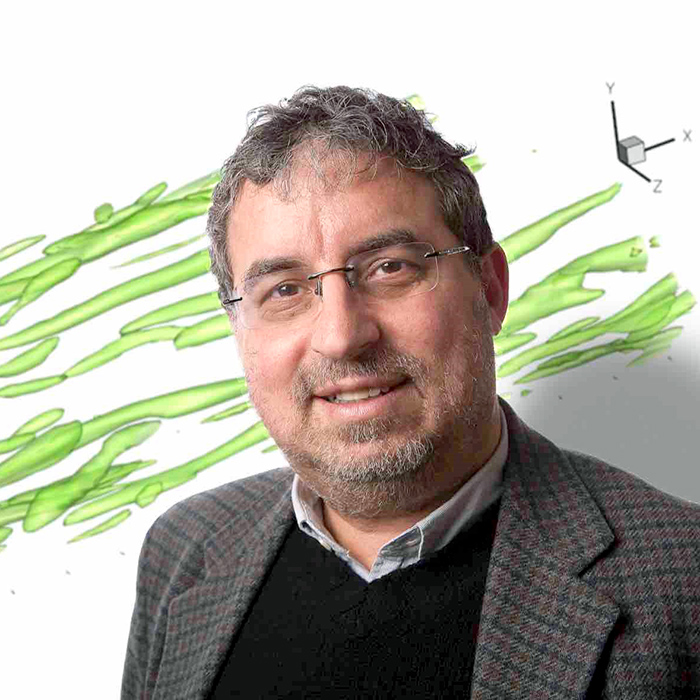
Ugo Piomelli
. Identified portrait from Ugo Piomelli research profile by Queen’s University.Piomelli coauthored the dynamic subgrid-scale model work with Massimo Germano, Parviz Moin and William H. Cabot.[ref] In a retrospective with Moin, he describes incorporating the proposed model into a channel-flow code. An initially delayed transition proved to reflect an incorrectly entered perturbation amplitude; correcting it changed the comparison with reference data.[ref]
Thirty years of Dynamic Modeling by Ugo Piomelli and Parviz Moin. Page3, implementation and initial-condition error
The episode makes a methodological point: a discrepancy can test the closure, the numerical implementation or the specified physical problem. If one simulation starts with a disturbance one hundred times smaller than intended, equal times no longer represent equal stages of its growth. Checking initial conditions therefore precedes attributing every difference to the subgrid-scale model. The numerical factor in this illustration is hypothetical; the retrospective does not quantify the mistyped factor.
Parviz Moin is a researcher in computational fluid dynamics and turbulence. Stanford's institutional profile identifies him as the founding director of the Center for Turbulence Research and describes his use of direct numerical simulation and large eddy simulation to investigate turbulent shear flows.[ref]
Parviz Moin research profile by Stanford University. Bio: founding directorship and research methods

With Massimo Germano, Ugo Piomelli and William H. Cabot, he coauthored work on the dynamic subgrid-scale model. The approach uses information at different resolved scales to determine a model coefficient during the calculation.[ref]
A dynamic subgrid-scale eddy viscosity model by Massimo Germano and others (1990). Byline and Section2
The participant account places the collaboration at the 1990 summer program and distinguishes that report from the subsequent 1991 journal paper.[ref]Thirty years of Dynamic Modeling by Ugo Piomelli and Parviz Moin. Pages3–4, development and publication chronology
A useful scientific distinction is between a numerical method's resolution and its physical accuracy. A finely detailed flow visualization can still give an inaccurate mean drag force. Conversely, a carefully tested coarse model can predict a specified average while omitting individual small eddies. Moin's computational research makes the choice of observable, reference calculation and physical question part of evaluating a simulation.
William H. Cabot coauthored the dynamic subgrid-scale model developed with Massimo Germano, Ugo Piomelli and Parviz Moin. Their 1990 report compared modeled unresolved stresses with data from direct numerical simulation and tested large eddy simulation of transitional and turbulent channel flow.[ref]
A dynamic subgrid-scale eddy viscosity model by Massimo Germano and others (1990). Author byline and Section3: numerical tests
A participant retrospective identifies Cabot as a Stanford research associate during the collaboration.[ref]Thirty years of Dynamic Modeling by Ugo Piomelli and Parviz Moin. Page3, account of the1990 summer program
The numerical comparison illustrates an important issue in turbulence research: matching the objects being compared. A coarse simulation describes resolved motion, while a finely resolved reference contains additional fluctuations. The report filtered the reference data before some comparisons, so the comparison did not automatically count intentionally omitted small scales as errors in a resolved field.[ref]
A dynamic subgrid-scale eddy viscosity model by Massimo Germano and others (1990). Section3, Figures5–8 and discussion of filtered DNS
For an original arithmetic illustration, fine-grid velocities and have mean and mean square . The square of their mean is only . Replacing both samples by the mean preserves that mean but loses a fluctuation contribution of . This elementary difference is why an averaged velocity and an averaged momentum flux contain different information, and why subgrid-scale stress requires explicit treatment.
Pinned article: Introduction to the OurBigBook Project
Welcome to the OurBigBook Project! Our goal is to create the perfect publishing platform for STEM subjects, and get university-level students to write the best free STEM tutorials ever.
Everyone is welcome to create an account and play with the site: ourbigbook.com/go/register. We belive that students themselves can write amazing tutorials, but teachers are welcome too. You can write about anything you want, it doesn't have to be STEM or even educational. Silly test content is very welcome and you won't be penalized in any way. Just keep it legal!
Intro to OurBigBook
. Source. We have two killer features:
- topics: topics group articles by different users with the same title, e.g. here is the topic for the "Fundamental Theorem of Calculus" ourbigbook.com/go/topic/fundamental-theorem-of-calculusArticles of different users are sorted by upvote within each article page. This feature is a bit like:
- a Wikipedia where each user can have their own version of each article
- a Q&A website like Stack Overflow, where multiple people can give their views on a given topic, and the best ones are sorted by upvote. Except you don't need to wait for someone to ask first, and any topic goes, no matter how narrow or broad
This feature makes it possible for readers to find better explanations of any topic created by other writers. And it allows writers to create an explanation in a place that readers might actually find it.
Figure 1. Screenshot of the "Derivative" topic page. View it live at: ourbigbook.com/go/topic/derivativeVideo 2. OurBigBook Web topics demo. Source. - local editing: you can store all your personal knowledge base content locally in a plaintext markup format that can be edited locally and published either:This way you can be sure that even if OurBigBook.com were to go down one day (which we have no plans to do as it is quite cheap to host!), your content will still be perfectly readable as a static site.
- to OurBigBook.com to get awesome multi-user features like topics and likes
- as HTML files to a static website, which you can host yourself for free on many external providers like GitHub Pages, and remain in full control

Figure 2. You can publish local OurBigBook lightweight markup files to either OurBigBook.com or as a static website.
Figure 3. Visual Studio Code extension installation.
Figure 5. . You can also edit articles on the Web editor without installing anything locally. Video 3. Edit locally and publish demo. Source. This shows editing OurBigBook Markup and publishing it using the Visual Studio Code extension. 
- Infinitely deep tables of contents:


All our software is open source and hosted at: github.com/ourbigbook/ourbigbook
Further documentation can be found at: docs.ourbigbook.com
Feel free to reach our to us for any help or suggestions: docs.ourbigbook.com/#contact