Topics (384k) Articles (398k) Users (410) Discussions (242) Comments (383) Files (13k) New article

John Cowdery Kendrew helped establish how X-ray crystallography can reveal the three-dimensional arrangement of a protein. Nobel's primary nomination archive names John Cowdery Kendrew, also identifying J. C. Kendrew in its award-sharing comment.[ref]
John Cowdery Kendrew in the Nobel nomination archive. 1962 nomination64-0,nominee2 and Comments
His team's1960 myoglobin paper presented a Fourier analysis at2-angstrom resolution. Its opening recalls how earlier phase determination compared native crystals with heavy-atom derivatives containing localized mercury or gold sites. Such comparisons supply information missing from a simple measurement of diffraction intensity.[ref]
Structure of Myoglobin: A Three-Dimensional Fourier Synthesis at 2 Å. Resolution by J. C. Kendrew and others. Page422,opening discussion of earlier phasing and the2Å analysis
An original one-dimensional example explains that phase problem. Write a periodic electron density using Fourier series coefficients . The two positive densitieshave , and , with the final sign distinguishing them. Their squared coefficient magnitudes are identical:9 for mode zero,1/4 for modes and1/16 for modes . The relative phase of the second harmonic has changed while the first harmonic is fixed. Thus equal intensities need not identify one density.
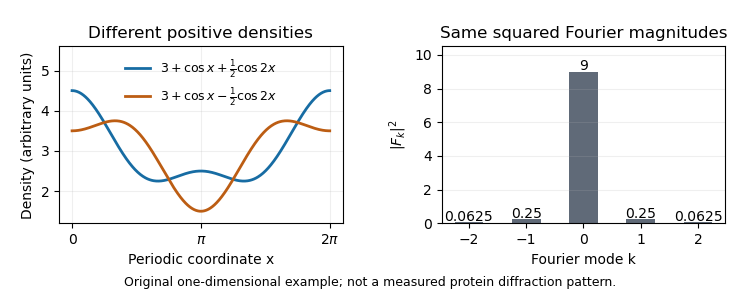
The myoglobin experiment was more demanding than this toy calculation, but the distinction motivates its chemical strategy: modifying crystals at known heavy-atom sites changes their scattering in a way that constrains phase information. Reconstructing an electron density map therefore requires both measured diffraction and a justified phase-determination method, rather than treating the recorded spots as a direct photograph of the molecule.

Margaret M. Hilferty coauthored the 1931 paper The Distribution of Chi-Square by Edwin B. Wilson and Margaret M. Hilferty. The original byline identifies her with Harvard's Department of Vital Statistics; no fuller personal name is inferred from the initials.[ref]
The Distribution of Chi-Square by Edwin B. Wilson and Margaret M. Hilferty. Original title page, p684
Their Wilson-Hilferty transformation reduces the skewness of a chi-squared distribution by taking a cube root. For , the standardized quantity is approximately standard normal. It provides a practical approximation to quantiles and tail probabilities, with accuracy depending on the statistical degrees of freedom and the probability region.[ref]
Rajen D. Shah develops statistical inference for high-dimensional data. His author publication list verifies work on regression, model checking and testing conditional independence.[ref]
With Jonas Peters, he introduced the generalized covariance measure statistic, based on the covariance of residuals after each response is regressed on the same conditioning variables. The resulting hypothesis test combines regression estimates with a calibrated covariance statistic. Their accompanying impossibility result explains why unrestricted distribution-free conditional independence testing needs additional structure; the regression-based method instead states approximation and moment assumptions explicitly.[ref]
Jonas Peters studies causal inference and the foundations of conditional independence testing. With Rajen D. Shah, he proved that a test with uniform finite-sample validity over an unrestricted continuous-data null class cannot obtain nontrivial power against alternatives in their setting.[ref]
The Hardness of Conditional Independence Testing and the Generalised Covariance Measure by Rajen D. Shah and Jonas Peters. Impossibility result and its distributional scope
Their constructive response is the generalized covariance measure statistic: regress each of two variables on the conditioning variables and examine the covariance of their residuals. Suitable regression-error rates and moment conditions yield asymptotic validity. Such a test targets conditional residual association; arbitrary forms of conditional dependence need not produce a nonzero residual covariance.[ref]
The Hardness of Conditional Independence Testing and the Generalised Covariance Measure by Rajen D. Shah and Jonas Peters. Section3.1 and asymptotic conditions
John Carlin develops biostatistics for health and medical research, including methods for missing data and causal inference. His institutional profiles describe work on multiple imputation and the need to specify the scientific purpose of an analysis before choosing a regression model.[ref]
https://www.vicbiostat.org.au/people/john-carlin. Research interests, imputation and scientific practice
[ref]https://www.mcri.edu.au/researcher-details/john-carlin. Methodological research and applications
With multiple imputation, several plausible completed datasets represent uncertainty about unobserved values. Their analyses must account both for uncertainty within a completed dataset and for variation between completed datasets. This makes the assumptions about the missing values visible in the analysis. Carlin is a coauthor of Bayesian Data Analysis by Andrew Gelman and others.[ref]
Bayesian Data Analysis by Andrew Gelman and others. Third-edition author list and missing-data methods
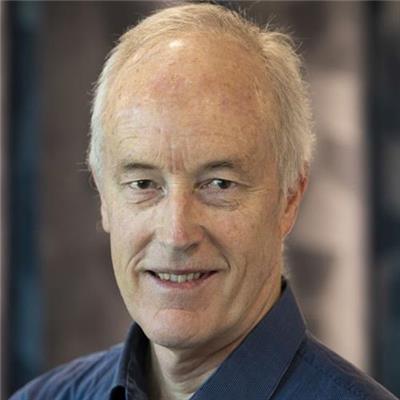
John Carlin
. Portrait identified on the linked official researcher profile; photographer and licence are not asserted. Source.David Dunson develops Bayesian inference and statistical machine learning for complex data. His research seeks lower-dimensional structure in observations such as networks, functions and biological measurements, with applications in ecology, neuroscience and environmental health.[ref]
A model may represent many dependent measurements through a smaller set of latent quantities, then carry uncertainty about those quantities into predictions. Dunson's work couples flexible modelling with algorithms for Bayesian inference and uncertainty quantification. He is also a coauthor of Bayesian Data Analysis by Andrew Gelman and others.[ref]
Bayesian Data Analysis by Andrew Gelman and others. Verified third-edition coauthor list
Aki Vehtari develops computational Bayesian statistics, including probabilistic programming, model diagnostics, model assessment and Gaussian processes. His author research page describes these as connected parts of a Bayesian workflow: specify a model, compute its implications, check the computation and examine predictive adequacy.[ref]
He coauthored Bayesian Data Analysis by Andrew Gelman and others. A posterior distribution summarizes uncertainty conditional on the model and data; checking whether that model reproduces important observations is a further task. This distinction connects Bayesian inference with posterior predictive checks, rather than treating successful computation as sufficient evidence that the model is suitable.[ref]
Bayesian Data Analysis by Andrew Gelman and others. Third-edition author list and model-checking exposition
Olivier Catoni develops methods for robust statistics. His work on the mean and variance constructs M-estimators with deviation guarantees for heavy-tailed distributions under moment assumptions.[ref]
The sample mean lets a single very large observation exert arbitrarily large influence. Catoni's construction replaces a linear estimating equation by a controlled nonlinear function of each residual. With an appropriate tuning parameter, a mean estimator can achieve Gaussian-order deviation bounds at a chosen confidence level under bounded variance, even when the observations are not normally distributed. The tuning and assumptions are part of the guarantee; the result does not assert that one fixed setting automatically works at every confidence level.[ref]
Challenging the empirical mean and empirical variance: a deviation study by Olivier Catoni. Equations2.1–2.3 and Proposition2.4
Vladimir Koltchinskii studies the mathematics of statistical learning. His joint work with Karim Lounici gives concentration inequalities and expectation bounds for sample covariance operators of centered Gaussian observations.[ref]
Their bounds separate two questions: the typical size of the operator norm error, and its fluctuations around that typical size. In finite-dimensional Euclidean space, their effective dimension is comparable to . If most covariance eigenvalues are small, this quantity can be much smaller than the ambient dimension, explaining why statistical difficulty need not track the raw number of coordinates.[ref]
Concentration Inequalities and Moment Bounds for Sample Covariance Operators by Vladimir Koltchinskii and Karim Lounici. Trace-rank discussion and Corollary2

Vladimir Koltchinskii
. Portrait identified on the linked official researcher profile; photographer and licence are not asserted. Source.Karim Lounici develops the theoretical foundations of statistical models and algorithms for structured data. His own research page identifies this focus.[ref]
With Vladimir Koltchinskii, he bounded the error of sample covariance operators in the operator norm. For a centered Gaussian vector with covariance , the expected error has scale comparable to , where . This effective dimension reflects the distribution's geometry rather than merely the number of recorded coordinates.[ref]
Concentration Inequalities and Moment Bounds for Sample Covariance Operators by Vladimir Koltchinskii and Karim Lounici. Abstract, Definition1 and expectation bounds

Karim Lounici
. Portrait identified on the linked official researcher profile; photographer and licence are not asserted. Source.Tony Cai develops methods and theory for high-dimensional statistics, statistical decision theory and statistical machine learning. His research includes functional data analysis and applications to genomics.[ref]
With Weidong Liu and Xi Luo, he introduced CLIME, estimating a sparse precision matrix through linear programming. Their results bound estimation error under sparsity and tail assumptions. The method makes a useful distinction between an optimization constraint and a theorem: positive definiteness of the final estimate is established under conditions, rather than imposed as a constraint in the columnwise programs.[ref]
A Constrained L1 Minimization Approach to Sparse Precision Matrix Estimation by Tony Cai and others. Section2 formulation and positive-definiteness result

Tony Cai
. Portrait identified on the linked official researcher profile; photographer and licence are not asserted. Source.Weidong Liu works on high-dimensional statistics. Shanghai Jiao Tong University's institutional profile identifies this researcher and his focus on high-dimensional statistical inference.[ref]
His CLIME paper with Tony Cai and Xi Luo estimates a sparse precision matrix even when direct inversion of the sample covariance matrix is unsuitable. It controls while minimizing an entrywise absolute-value objective, then uses a symmetrization rule. Statistical accuracy requires assumptions on sparsity and the distribution's tails.[ref]
Xi Luo develops biostatistics and machine learning methods for biomedical data. His institutional profile identifies applications in neuroscience, genomics and disease research.[ref]
https://sph.uth.edu/faculty/index.htm?fac=pghNVLVTa9HXjk5wwNYG3A%3D%3D. Official Xi Luo research profile
With Tony Cai and Weidong Liu, he developed CLIME for sparse precision matrix estimation. The method constrains the error of an approximate inverse of the sample covariance matrix and minimizes an entrywise absolute-value objective. Its computation separates into columnwise linear programs.[ref]
A Constrained L1 Minimization Approach to Sparse Precision Matrix Estimation by Tony Cai and others. Section2, original formulation and columnwise decomposition
Jerome H. Friedman is the statistician who coauthored the Graphical Lasso with Trevor Hastie and Robert Tibshirani. Their paper estimates a sparse inverse covariance matrix using penalized likelihood and a computationally efficient iterative algorithm.[ref]
The statistical benefit of a sparse precision matrix is an interpretable pattern of conditional relationships. In a multivariate normal distribution, an off-diagonal zero means that the corresponding variables are conditionally independent given the others. This conditional relationship can differ from their ordinary marginal correlation. The paper's repeated Lasso calculations connect that model with practical convex optimization.[ref]
Trevor Hastie develops methods in statistical learning, including generalized additive models and regularized regression. His research page describes the interaction between interpretable statistical models, flexible prediction and efficient computation.[ref]
His joint Graphical Lasso work with Jerome H. Friedman and Robert Tibshirani turns sparse precision matrix estimation into repeated Lasso subproblems. A blockwise algorithm updates parts of the estimate while solving the penalized likelihood problem, making large conditional-dependence models computationally feasible.[ref]
Sparse inverse covariance estimation with the graphical lasso by Jerome H. Friedman and others. Algorithm development and coordinate-descent formulation
Robert Tibshirani develops methods for statistical learning and biostatistics, with applications to genomics and medicine. His Stanford research profile connects methodological work with scientific data and computational tools.[ref]
With Jerome H. Friedman and Trevor Hastie, he developed the Graphical Lasso for estimating a sparse precision matrix. An absolute-value penalty encourages zero entries, which encode conditional independence relationships in a multivariate normal distribution. The method combines a statistical model with an efficient optimization algorithm.[ref]
Sparse inverse covariance estimation with the graphical lasso by Jerome H. Friedman and others. Abstract and penalized likelihood formulation

Peter Gavin Hall, also cited as Peter Hall, developed theory for the bootstrap, nonparametric statistics and approximation of sampling distributions. His professional society's memorial explicitly verifies the fuller identity and these research areas.[ref]
https://imstat.org/2016/02/19/peter-hall-1951-2016/. IMS memorial, exact full name and research contributions
His The Bootstrap and Edgeworth Expansion by Peter Hall explains how Edgeworth expansions refine a normal approximation using higher cumulants. Such expansions help analyze the error of a bootstrap approximation, including whether a transformed or studentized statistic achieves a higher order of accuracy. Smoothness and sampling assumptions matter: the presence of a formal expansion alone does not establish a uniformly accurate approximation.[ref]
The Bootstrap and Edgeworth Expansion by Peter Hall. Chapter2, principles, smoothness and lattice qualifications
Egon Pearson developed the theory of statistical hypothesis testing with Jerzy Neyman. Their framework distinguishes controlling type I error under a null hypothesis from maximizing statistical power against a specified alternative hypothesis. University College London's institutional history identifies this collaboration as a central contribution.[ref]
https://www.ucl.ac.uk/mathematical-physical-sciences/statistics-old/department-information/our-early-history. Departmental history, Egon Pearson and collaboration with Neyman
The Neyman-Pearson lemma makes the tradeoff precise for two simple hypotheses with densities and . At a fixed allowed type I error, the most powerful test rejects where the likelihood ratio is largest, with boundary randomization if needed. To see the principle, compare its test function with another admissible : the product is nonpositive pointwise. Integrating and using the size constraint shows that cannot have greater statistical power.
D. G. Horvitz coauthored the 1952 paper that generalized finite-population sampling without replacement to unequal selection probabilities. The joint work with D. J. Thompson provides the foundation for the Horvitz-Thompson estimator.[ref]
A Generalization of Sampling Without Replacement From a Finite Universe by D. G. Horvitz and D. J. Thompson. Original byline and publisher abstract, Journal of the American Statistical Association 47, pp. 663–685
The central idea is to compensate for unequal chances of inclusion. For fixed population values and positive inclusion probabilities , write a total estimate asUsing an inclusion indicator gives , so . Unbiasedness follows from the design probabilities rather than from assuming that the sampled values are an independent realization of a population model.[ref]
Unequal Probability Sampling in Penn State STAT 506. Lesson 3, inverse-inclusion-probability total estimation
For an illustrative population , select exactly one unit with probabilities . The total estimate is or , respectively, with expected value , the true total. The less frequently selected unit receives the larger multiplier. This example explains how a sampling design can deliberately favor some units without forcing an unweighted analysis to be correct.
Pinned article: Introduction to the OurBigBook Project
Welcome to the OurBigBook Project! Our goal is to create the perfect publishing platform for STEM subjects, and get university-level students to write the best free STEM tutorials ever.
Everyone is welcome to create an account and play with the site: ourbigbook.com/go/register. We belive that students themselves can write amazing tutorials, but teachers are welcome too. You can write about anything you want, it doesn't have to be STEM or even educational. Silly test content is very welcome and you won't be penalized in any way. Just keep it legal!
Intro to OurBigBook
. Source. We have two killer features:
- topics: topics group articles by different users with the same title, e.g. here is the topic for the "Fundamental Theorem of Calculus" ourbigbook.com/go/topic/fundamental-theorem-of-calculusArticles of different users are sorted by upvote within each article page. This feature is a bit like:
- a Wikipedia where each user can have their own version of each article
- a Q&A website like Stack Overflow, where multiple people can give their views on a given topic, and the best ones are sorted by upvote. Except you don't need to wait for someone to ask first, and any topic goes, no matter how narrow or broad
This feature makes it possible for readers to find better explanations of any topic created by other writers. And it allows writers to create an explanation in a place that readers might actually find it.
Figure 1. Screenshot of the "Derivative" topic page. View it live at: ourbigbook.com/go/topic/derivativeVideo 2. OurBigBook Web topics demo. Source. - local editing: you can store all your personal knowledge base content locally in a plaintext markup format that can be edited locally and published either:This way you can be sure that even if OurBigBook.com were to go down one day (which we have no plans to do as it is quite cheap to host!), your content will still be perfectly readable as a static site.
- to OurBigBook.com to get awesome multi-user features like topics and likes
- as HTML files to a static website, which you can host yourself for free on many external providers like GitHub Pages, and remain in full control

Figure 2. You can publish local OurBigBook lightweight markup files to either OurBigBook.com or as a static website.
Figure 3. Visual Studio Code extension installation.
Figure 5. . You can also edit articles on the Web editor without installing anything locally. Video 3. Edit locally and publish demo. Source. This shows editing OurBigBook Markup and publishing it using the Visual Studio Code extension. 
- Infinitely deep tables of contents:



All our software is open source and hosted at: github.com/ourbigbook/ourbigbook
Further documentation can be found at: docs.ourbigbook.com
Feel free to reach our to us for any help or suggestions: docs.ourbigbook.com/#contact