Topics (384k) Articles (398k) Users (410) Discussions (242) Comments (383) Files (13k) New article

B. J. Bellhouse coauthored the 1969 physical-model study of aortic valve fluid mechanics with L. Talbot. The primary byline gives an Oxford engineering-science affiliation. Their experiment used a rigid-walled valve model in a pulsatile water tunnel and identified a circulating flow within the aortic sinus together with a downstream stagnation point.[ref]
The fluid mechanics of the aortic valve by B. J. Bellhouse and L. Talbot. Primary byline and affiliation; Abstract
The model connected local fluid loading with closure: approximately three-quarters of leaflet closure occurred while the net flow was still forward, with a small reversed flow completing the seal.[ref] This finding concerns the tested apparatus and its flow conditions. It does not require assuming that the living aortic root is rigid or that each coauthor independently performed every part of the work.
A simple force scale illustrates the mechanical issue. A stipulated pressure difference of 1 kPa acting over 2 cm produces resultant force N. At a perpendicular lever arm of 10 mm, the corresponding torque magnitude is 0.002 N·m. If the resultant's line of action passes through the rotation axis, its moment is instead zero even at the same force magnitude.
Changing the local pressure distribution can therefore change the closing moment without requiring the total flow to reverse first. Conversely, a scalar force estimate does not specify a complete leaflet trajectory: the applied torque, inertia, constraints and surrounding fluid must be considered together. Bellhouse's documented contribution is to that experimentally investigated fluid–structure question, rather than merely to naming parts of a valve.
L. Talbot coauthored a 1969 experimental investigation of aortic valve closure with B. J. Bellhouse. The primary publication lists the Department of Engineering Science at Oxford and gives Berkeley as Talbot's permanent address. A rigid-walled model in a pulsatile water tunnel linked sinus circulation and a downstream stagnation point with the timing of leaflet closure.[ref]
The fluid mechanics of the aortic valve by B. J. Bellhouse and L. Talbot. Primary byline and affiliations; Abstract
The physical question was how a local flow field can influence a moving boundary while net transport continues forward. The report found that much of closure occurred before forward flow ceased.[ref]
The fluid mechanics of the aortic valve by B. J. Bellhouse and L. Talbot. Abstract, closure mechanism
It therefore connected the geometry of an aortic sinus and local pressure loading with valve motion, rather than equating the start of closure with reversal of the entire stream.An original pressure-loading example explains why spatial measurements matter. Consider two small surface patches, each of area 1 cm, with centers 1 cm to either side of a reference axis. Equal normal pressures of 2 kPa give forces 0.2 N on each patch and zero net torque about that axis. Pressures of 1 and 3 kPa give forces 0.1 and 0.3 N: the total force remains 0.4 N, but the torque magnitude is N·m.
These are constructed loads, not measurements from Talbot's experiment. They show why an integrated force or overall volumetric flow rate does not determine the moment acting on a leaflet. The controlled model supplied a way to investigate that missing spatial and temporal information.
G. B. Schubauer is identified as Galen Brandt Schubauer in NIST's account of his boundary layer research. His experiments with H. K. Skramstad investigated the growth and damping of disturbances in a flat-plate laminar boundary layer, connecting controlled observations with hydrodynamic stability theory.[ref]
Air Flow and Turbulence in Boundary Layers by Norman E. Mease and James E. Potzick. Biographical paragraph naming Galen Brandt Schubauer and the experimental-verification account
The apparatus mattered to the conclusion. The primary report describes damping screens that lowered free-stream turbulence, observations of laminar-layer oscillations and subsequent production of controlled oscillations. Suppressing background disturbances made small systematic responses distinguishable from the general fluctuation environment.[ref]
Laminar-Boundary-Layer Oscillations and Transition on a Flat Plate by G. B. Schubauer and H. K. Skramstad. NACA-TR-909 abstract, low-turbulence flat-plate experiment and controlled excitation
Detecting a fluctuation is different from measuring how a reproducibly excited fluctuation develops downstream.An original spatial-growth model writes a small disturbance asHere is imposed frequency and a stipulated constant spatial growth rate. If amplitude rises from 0.001 to 0.010 m/s over 0.20 m, thenIf instead the amplitude halves over that distance, the corresponding value is approximately . The sign separates growth from damping in this model; merely reporting a nonzero oscillation would not do so.
These invented amplitudes are not measurements from the experiment. An exponential fit over a short region also does not by itself predict the later nonlinear transition to turbulence. Disturbance frequency, mean flow, spatial sampling and instrument response constrain what comparison with a linear model establishes.
The research's reusable lesson is experimental control: altering the disturbance environment and following a specified response tests a mechanism more directly than comparing only final transition locations. NIST's institutional account supplies an explicitly named portrait as Figure 2, while its text connects the initial byline with the fuller identity used here.[ref]
Air Flow and Turbulence in Boundary Layers by Norman E. Mease and James E. Potzick. Figure 2 caption and biographical section
H. K. Skramstad, identified as Harold K. Skramstad in NIST's institutional account and bibliography, coauthored the flat-plate experiments associated with the observation of Tollmien-Schlichting waves with G. B. Schubauer. The account specifically credits improvements to the hot-wire anemometry instrumentation and other electronics, providing evidence for that contribution beyond the joint byline.[ref]
Air Flow and Turbulence in Boundary Layers by Norman E. Mease and James E. Potzick. Instrumentation account and bibliography reference 4, expanded Harold K. Skramstad byline
The experiment reduced free-stream turbulence with damping screens and studied small oscillations within a flat-plate laminar boundary layer. Its controlled disturbances made it possible to compare amplification and damping with hydrodynamic stability theory.[ref]
Laminar-Boundary-Layer Oscillations and Transition on a Flat Plate by G. B. Schubauer and H. K. Skramstad. NACA-TR-909, repository abstract: apparatus and controlled oscillations
Better electronics mattered because an observed signal contains the sensor's frequency response as well as the flow's behavior.An original response calculation illustrates this measurement issue. Suppose a velocity-to-signal channel has an ideal first-order low-pass filter responseWith stipulated ms and disturbance frequency 100 Hz, and the indicated amplitude is only about 0.303 of the input amplitude. A real 0.020 m/s oscillation would then appear as about 0.00607 m/s after applying a zero-frequency sensitivity. Neither value estimates a historical instrument specification; this is an illustrative response model.
Correcting by the known response can recover an amplitude within that model, but it also amplifies noise and uncertainty. If the response is unknown, a small measured amplitude can mean weak fluid motion or strong instrumental attenuation. Measurement calibration at one steady operating point does not determine the entire frequency response.
The scientific significance of the documented contribution is therefore the ability to distinguish a small controlled fluid disturbance from limitations of its measuring system.
Barbara König is an ethologist whose work investigates cooperation and reproductive conflict in house mice. Her University of Zurich profile identifies her specialization in animal behaviour, while the university-hosted publication list links the full name to the1993 paper originally published under the byline B.König.[ref]
Barbara König profile in the University of Zurich Women in Science series. Official2017 profile: full name and specialization
[ref]Publications by Barbara König at the University of Zurich. Header and1993 Maternal investment entry: author identity

Barbara König, from the portrait linked in her official University of Zurich profile
. Her1993 communal breeding study compared solitary breeding females with familiar sister pairs and initially unfamiliar unrelated pairs. It measured offspring at weaning, distinguishing the number of litters and their size from the number and combined mass of young successfully reared. The familiar-sister comparison showed that shared care could improve a reproductive outcome without simply increasing the number of litters.[ref]
Maternal investment of communally nursing female house mice (Mus musculus domesticus) by B. König. Primary Abstract: comparison groups and measured reproductive outcomes
An original measurement example illustrates the distinction. Two females might each produce a litter of six, yet rear different numbers of young to weaning. Equal litter counts and equal initial litter sizes would then coexist with different rearing success. A study of social cooperation needs to specify which of those outcomes it measures.
The comparison also motivates careful controls: relatedness, familiarity and social circumstances need not vary independently. König's work turns a broad question about why animals share care into testable comparisons of behavior and individual reproductive consequences. The historical university profile is used for identity and specialization, rather than for a claim about a current appointment.
Fischer Black developed the Black-Scholes model with Myron Scholes. Their 1973 analysis shows how continuous adjustment of a replicating portfolio can eliminate the local exposure to the underlying random price change, leading to a no-arbitrage equation for the value of a contingent claim.[ref]
The Pricing of Options and Corporate Liabilities by Fischer Black and Myron Scholes. 1973, assumptions and derivation of the valuation equation
This approach makes the hedge part of the mathematical explanation of the price. It also makes the assumptions visible: ideal continuous adjustment and the specified price dynamics are ingredients of the derivation, so changing the trading rules or dynamics can change the valuation problem. The Black-Scholes equation is therefore a useful starting point for studying both a tractable model and the effects of relaxing its assumptions.[ref]
The Pricing of Options and Corporate Liabilities by Fischer Black and Myron Scholes. Model assumptions, valuation equation and discussion of extensions

Robert Litterman and Fischer Black in 1994
. Historical photograph hosted and identified by Goldman Sachs; reproduced by external link. Source.Myron Scholes, with Fischer Black, developed the Black-Scholes model and its option pricing equation. Their 1973 paper connects a contingent claim's value to the cost of a dynamically adjusted replicating portfolio, under explicit assumptions about trading and the underlying price process.[ref]
The Pricing of Options and Corporate Liabilities by Fischer Black and Myron Scholes. 1973, assumptions and derivation of the valuation equation
The mathematical insight is that a carefully chosen hedge can cancel the instantaneous random component of the claim's value. No-arbitrage then constrains the remaining locally riskless return, producing the Black-Scholes equation together with a final payoff condition. The result is a conditional conclusion within a model: it does not require an ability to predict the actual stock-price path.[ref]
The Pricing of Options and Corporate Liabilities by Fischer Black and Myron Scholes. Derivation of the differential equation and the boundary condition for a call
Institutional profile: www.gsb.stanford.edu/faculty-research/faculty/myron-s-scholes

Portrait of Myron Scholes
. Markus Prantl, via Wikimedia Commons; existing crop by JB Hoang Tam 2, CC BY-SA 3.0. Source.Steven L. Heston introduced the Heston model, a stochastic volatility model in which the asset price and its instantaneous variance evolve together. The variance follows a square-root diffusion, while correlation between the price and variance innovations allows asymmetric option-price patterns.[ref]
The model is useful because richer uncertainty does not remove all analytical structure. An affine expression for the characteristic function of the log price allows Fourier inversion to recover the probabilities used in European option valuation. The resulting pricing formula includes numerical integration; “closed-form” here does not mean that every price is an elementary expression without a numerical step.[ref]
Institutional profile: www.rhsmith.umd.edu/directory/steve-heston

Portrait of Steven L. Heston
. Portrait selected from the matching University of Maryland institutional profile. Source.John C. Cox developed mathematical methods for option pricing and risk-neutral pricing. With Stephen A. Ross and Mark Rubinstein, he introduced the Cox--Ross--Rubinstein model, whose binomial price tree gives a particularly transparent example of a replicating portfolio.[ref]
Option Pricing: A Simplified Approach by John C. Cox and others. 1979, author list and the one-period replication argument
At each node, the two possible next-step payments determine the holdings in a stock and a riskless asset. Repeating this calculation by backward induction values the final payment through the tree. For an American option, the calculation also compares continuation value with the value of immediate exercise. This turns the distinction between European and American exercise rules into a concrete computational decision.[ref]
Option Pricing: A Simplified Approach by John C. Cox and others. Multiperiod model and valuation of options permitting early exercise
Institutional profile: mitsloan.mit.edu/faculty/directory/john-c-cox

Portrait of John C. Cox
. Portrait selected from the matching MIT Sloan institutional profile. Source.Stephen A. Ross developed arbitrage pricing theory, which relates expected asset returns to exposures to common sources of risk under assumptions limiting arbitrage. His mathematical approach asks how restrictions on feasible trading strategies constrain prices, rather than starting solely from an individual investor's preferences.[ref]
Professor Stephen Ross, inventor of arbitrage pricing theory, dies at 73 by Zach Church. 6 March 2017, discussion of arbitrage pricing theory and its 1976 introduction
With John C. Cox and Mark Rubinstein, he also developed the Cox--Ross--Rubinstein model for option pricing. The binomial price tree separates the possible stock-price paths from the valuation rule: a replicating portfolio and no-arbitrage produce risk-neutral pricing even when the actual up-move probability is not specified.[ref]
Option Pricing: A Simplified Approach by John C. Cox and others. 1979, basic one-period argument and its extension to multiple periods

Portrait of Stephen A. Ross
. 1994 portrait reproduced in the MIT institutional obituary. Source.Mark Rubinstein worked on option pricing, including the Cox--Ross--Rubinstein model developed with John C. Cox and Stephen A. Ross. Their 1979 paper constructs an accessible discrete-time model in which successive up and down moves form a binomial price tree. Replicating a contingent payment with traded assets determines its value under the model's no-arbitrage assumptions.[ref]
Option Pricing: A Simplified Approach by John C. Cox and others. 1979, sections on the basic idea and the multiperiod model; author list
The construction makes the relation between hedging and valuation explicit. Its risk-neutral probabilities are weights consistent with the model's prices, rather than predictions of the actual frequency of an upward market move. Refining the time steps also connects the discrete model to the Black-Scholes model.[ref]
Option Pricing: A Simplified Approach by John C. Cox and others. Multiperiod valuation and the limiting case
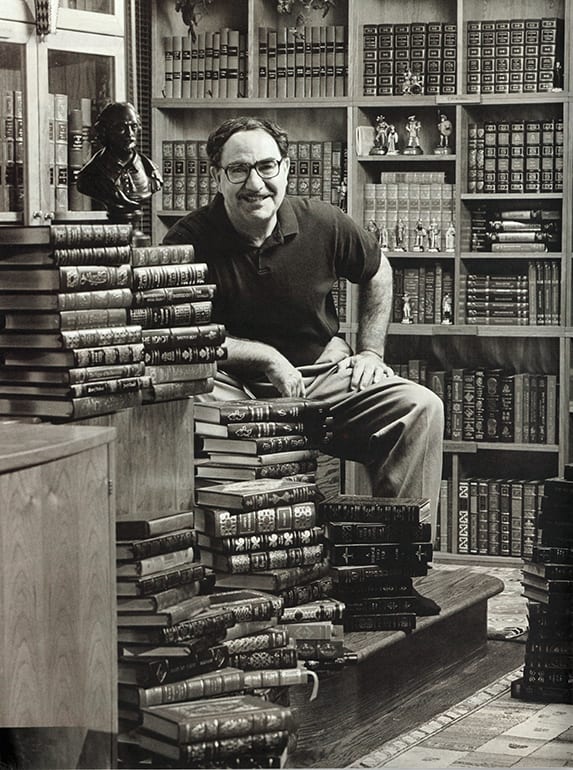
Portrait of Mark Rubinstein
. Jim Block; photograph in his home library, 2002, hosted by Berkeley Haas. Source.Robert Litterman developed the Black-Litterman model with Fischer Black. Their 1992 paper makes equilibrium expected returns a neutral starting point for portfolio modeling, then incorporates views that can differ in their confidence. The contribution addresses how uncertain inputs enter modern portfolio theory, rather than treating every proposed expected return as equally reliable.[ref]
Global Portfolio Optimization by Fischer Black and Robert Litterman. Publisher abstract: neutral equilibrium reference and views with differing confidence
An elementary Bayesian inference analogy illustrates the role of uncertainty. For an unknown quantity with normal distribution prior and an independent observation error giving , Gaussian conditional expectation gives the posterior meanThe more uncertain input receives less weight. This scalar example explains a modeling principle; the full Black-Litterman model treats related expected returns jointly, with a covariance matrix describing their uncertainty.
Robert Litterman with Fischer Black in 1994
. Historical photograph hosted and identified by Goldman Sachs, linked externally. Source.Harry Markowitz developed modern portfolio theory, making the tradeoff between expected return and variability a mathematical allocation problem. His 1952 Portfolio Selection by Harry Markowitz emphasizes that the variability of a combination depends on relationships between its components, not just on each component considered alone.[ref]
Portfolio Selection by Harry Markowitz. pp.79–82, expected return, covariance and portfolio variance
For an original toy example, let two return random variables each have variance one. Equal weighting givesWith zero covariance the result is ; with covariance one it is one. The calculation explains why counting assets alone does not determine diversification. Expected values, covariance estimates and allocation constraints supply distinct inputs to the optimization.
The 1990 economics prize recognized his theory of portfolio choice. The awarding academy's account identifies both the 1952 paper and his expanded 1959 treatment.[ref]
The Prize in Economic Sciences 1990 press release. 16 October 1990, Markowitz and portfolio selection
https://photoarchive.lib.uchicago.edu/db.xqy?show=browse8.xml%7C545. Named portrait record and credit
. Photograph undated.Martin Leverkus coauthored the 2016 crystal violet assay protocol with Maria Feoktistova and Peter Geserick. The paper's affiliations connect the collaboration with molecular dermatology at Mannheim and dermatology at Aachen.[ref]
Crystal Violet Assay for Determining Viability of Cultured Cells by Maria Feoktistova and others. Byline and affiliations
Its scientific value includes making an assay's biological interpretation explicit: less retained stain does not, by itself, identify a particular mechanism of cell death.A useful distinction is between reduced cell proliferation and increased cell death. An original constant-rate model giveswhere and are per-cell proliferation and death rates. Parameter pairs and give the same net growth rate. Starting from 10000 cells, both predict approximately 14918 after ten hours, although only the first model includes ongoing deaths.
A staining endpoint proportional to retained cell number would not distinguish those two histories. Time-resolved counting or a measurement specific to a death process supplies additional information. Moreover, altered attachment or staining can invalidate the assumed proportionality before that biological comparison even begins. This is why the protocol's requirement for additional characterization matters.[ref]
Crystal Violet Assay for Determining Viability of Cultured Cells by Maria Feoktistova and others. Abstract, requirement to characterize the cause of reduced staining
The calculation is an original identifiability example, not a reconstruction of Leverkus's data.
Martin Leverkus, portrait accompanying the Cell Death Discovery memorial
. External portrait from the memorial to Martin Leverkus.Alicia M. Maceira is a physician working in cardiology and cardiac imaging. Her hospital profile identifies cardiac diagnostic imaging as her specialization.[ref]
Alicia Maceira profile at Hospital Ascires. “Cardióloga” and “Especialista en Diagnóstico Cardiológico por Imagen”
Her primary research includes establishing right ventricle reference measurements with magnetic resonance imaging.In a 2006 paper, Maceira and colleagues studied 120 healthy adults, 60 men and 60 women aged 20–80 years, using cine images acquired by steady-state free-precession imaging and three-dimensional modelling. The study examined how age, sex and body surface area related to ventricular volumes and function.[ref]
Reference right ventricular systolic and diastolic function normalized to age, gender and body surface area from steady-state free precession cardiovascular magnetic resonance by Alicia M. Maceira and others. Abstract, Methods and results; European Heart Journal 27, 2879–2888, DOI 10.1093/eurheartj/ehl336
An original numerical example separates the measurements. If end-diastolic volume is 150 mL and end-systolic volume is 60 mL, the volume difference is 90 mL and right ventricular ejection fraction is . Dividing the 150 mL end-diastolic volume by a body surface area of gives an indexed volume of approximately . The fraction and the indexed volume describe different properties; neither numerical value alone specifies a universal reference interval.
The study found associations with age even for several size-normalized measurements. This motivates population conditioning of ventricular reference intervals: scaling by body surface area need not eliminate all dependence on age or sex.[ref]
Reference right ventricular systolic and diastolic function normalized to age, gender and body surface area from steady-state free precession cardiovascular magnetic resonance by Alicia M. Maceira and others. Abstract, Results and Conclusion
Reference values also belong to an acquisition and analysis procedure. A numerical example explains the quantities; clinical interpretation requires the appropriate validated reference framework.
Alicia Maceira, identified on her official Hospital Ascires cardiology profile.
Alexander R. Opotowsky is a physician whose research includes adult congenital heart conditions, exercise physiology and evaluation of cardiac output measurements. His institutional profile identifies these scientific interests.[ref]
Alexander Opotowsky profile at Cincinnati Children's. Research interests: exercise physiology, pulmonary vascular disease and right ventricular function
In a 2017 primary study, Opotowsky and colleagues compared paired thermodilution and estimated-oxygen-uptake Fick principle measurements from 12,232 adults in a Veterans Affairs cohort and 3,391 adults at Vanderbilt. The investigators examined method agreement and subsequent mortality associations.[ref]
Thermodilution vs Estimated Fick Cardiac Output Measurement in Clinical Practice by Alexander R. Opotowsky and others. Abstract, Design, Exposures and Main outcomes; JAMA Cardiology 2, 1090–1099, DOI 10.1001/jamacardio.2017.2945
Comparing two methods does not make either an error-free ground truth.The measurement distinction can be explained by oxygen-uptake assumptions in estimated Fick output. At steady state, the oxygen Fick principle writeswhere is cardiac output, the numerator is oxygen consumption per unit time and the denominator is the arterial-minus-mixed-venous oxygen content difference. Estimating the numerator from an external formula introduces an assumption that directly scales the inferred cardiac output; it is distinct from measuring oxygen consumption.
For stipulated oxygen uptake of 200 mL/min and a content difference of , L/min. Substituting an estimated uptake of 250 mL/min gives 5 L/min, a 25% increase with unchanged content measurements. This is an original error-propagation example, not a patient result or a universal performance estimate. Errors in the content difference can also affect the ratio.
The primary study found that a small average difference between methods coexisted with wide limits of agreement.[ref]
Thermodilution vs Estimated Fick Cardiac Output Measurement in Clinical Practice by Alexander R. Opotowsky and others. Abstract, Results; Figure 1, paired-method differences
Positive and negative discrepancies can cancel in a mean while remaining substantial for individuals. This separates average bias, individual agreement and prognostic association, rather than treating all three as one measure of accuracy.
Christopher M. Kramer is a cardiologist whose research uses cardiovascular magnetic resonance imaging to assess the heart. His University of Virginia profile identifies cardiovascular imaging as an area of expertise.[ref]
Christopher M. Kramer profile at UVA Health. Bio & Overview
He is the first author of the 2020 primary protocol document specifying standardized cardiovascular magnetic resonance imaging acquisitions.[ref]One concrete contribution of such a protocol is to make image geometry reproducible. Its left-ventricular procedure links the cardiac apex, mitral valve center, cardiac long axis views and a cardiac short-axis stack.[ref]
Standardized cardiovascular magnetic resonance imaging (CMR) protocols: 2020 update by Christopher M. Kramer and others. Left ventricular structure and function, items 3 and 6; Figures 1–3
The geometry determines which anatomy is acquired before an analyst draws a cavity boundary.An original example explains the measurement consequence. A volume reconstructed as depends on both the cavity areas and the represented slice thicknesses. If ten slices each have area 8 cm and represented thickness 0.8 cm, the estimate is 64 mL. Omitting one such slice loses 6.4 mL even if every retained boundary is traced perfectly. Standardized coverage and phase selection therefore address errors that cannot be removed merely by improving image segmentation on the available slices.
The documented protocol work connects acquisition choices to interpretable measurements of chamber structure and function. It provides technical procedures and reference geometry; the arithmetic example here illustrates their purpose rather than reporting a result from that document.

Halfdan Ihlen was a Norwegian cardiologist who developed cardiac ultrasound research and diagnostic facilities at Rikshospitalet. A primary memorial by his colleagues records his specialist qualification in internal medicine and cardiology in 1982 and his later leadership of an ultrasound laboratory and appointment as professor.[ref]
Halfdan Ihlen obituary in Tidsskrift for Den norske legeforening. Opening biographical paragraphs, published 4 April2022
Ihlen is first author of the 1984 primary study comparing cardiac output determined by Doppler echocardiography with independently obtained values. Ten patients were studied using thermodilution at rest and during dobutamine infusion, and eleven using the Fick method at rest. This design tested an imaging-and-flow measurement against different physical reference methods and across changing flow conditions.[ref]
Determination of cardiac output by Doppler echocardiography by Halfdan Ihlen and others. Abstract: comparison methods, groups and changed-flow protocol
The measurement combines complementary quantities. The velocity-time integral supplies a length-like integral over a beat, while a measured anatomical area converts a representative integral into stroke volume. Multiplication by heart rate then gives cardiac output. An image alone, a peak velocity alone and an integrated velocity with an appropriate area are different kinds of evidence.
An original sensitivity example shows why the geometry matters. If an area is computed as , a diameter overestimate by multiplies the estimated area and, at unchanged velocity integral, the estimated volume by . Thus a modest diameter error produces a volume error even when the Doppler integral is reproduced perfectly. Comparison studies assess the complete measurement chain rather than only the repeatability of one display.

Halfdan Ihlen in the portrait accompanying his colleagues' memorial
. The external portrait appears immediately before the opening biographical paragraph in the Norwegian Medical Association journal memorial. Pinned article: Introduction to the OurBigBook Project
Welcome to the OurBigBook Project! Our goal is to create the perfect publishing platform for STEM subjects, and get university-level students to write the best free STEM tutorials ever.
Everyone is welcome to create an account and play with the site: ourbigbook.com/go/register. We belive that students themselves can write amazing tutorials, but teachers are welcome too. You can write about anything you want, it doesn't have to be STEM or even educational. Silly test content is very welcome and you won't be penalized in any way. Just keep it legal!
Intro to OurBigBook
. Source. We have two killer features:
- topics: topics group articles by different users with the same title, e.g. here is the topic for the "Fundamental Theorem of Calculus" ourbigbook.com/go/topic/fundamental-theorem-of-calculusArticles of different users are sorted by upvote within each article page. This feature is a bit like:
- a Wikipedia where each user can have their own version of each article
- a Q&A website like Stack Overflow, where multiple people can give their views on a given topic, and the best ones are sorted by upvote. Except you don't need to wait for someone to ask first, and any topic goes, no matter how narrow or broad
This feature makes it possible for readers to find better explanations of any topic created by other writers. And it allows writers to create an explanation in a place that readers might actually find it.
Figure 1. Screenshot of the "Derivative" topic page. View it live at: ourbigbook.com/go/topic/derivativeVideo 2. OurBigBook Web topics demo. Source. - local editing: you can store all your personal knowledge base content locally in a plaintext markup format that can be edited locally and published either:This way you can be sure that even if OurBigBook.com were to go down one day (which we have no plans to do as it is quite cheap to host!), your content will still be perfectly readable as a static site.
- to OurBigBook.com to get awesome multi-user features like topics and likes
- as HTML files to a static website, which you can host yourself for free on many external providers like GitHub Pages, and remain in full control

Figure 2. You can publish local OurBigBook lightweight markup files to either OurBigBook.com or as a static website.
Figure 3. Visual Studio Code extension installation.
Figure 5. . You can also edit articles on the Web editor without installing anything locally. Video 3. Edit locally and publish demo. Source. This shows editing OurBigBook Markup and publishing it using the Visual Studio Code extension. 
- Infinitely deep tables of contents:



All our software is open source and hosted at: github.com/ourbigbook/ourbigbook
Further documentation can be found at: docs.ourbigbook.com
Feel free to reach our to us for any help or suggestions: docs.ourbigbook.com/#contact