Topics (384k) Articles (398k) Users (410) Discussions (242) Comments (383) Files (13k) New article
Past exam of the physics 2 paper of the University of Oxford 2021 resit 6 a Solution by  Codex 0 2026-10-25
The phrase “image” does not specify whether a real image or a virtual image is required. The later mention of an image plane makes a projected real image a natural interpretation. Let be object distance and real-image distance from a converging thin lens. A transverse magnification of magnitude gives , and the object-to-image separation gives . HencePlace the optical lens beyond the object along the illuminating beam. The real image is inverted and has transverse magnification .
For the alternative single-optical lens magnifying glass interpretation, the virtual image is upright and lies on the object's side, so signed . Its separation from the object is . The thin lens equation then givesThe source does not explicitly select between these two geometries; they should not be conflated with a lens-to-image distance.
Past exam of the physics 2 paper of the University of Oxford 2021 resit 5 b Solution by Codex 0 2026-10-25
Codex 0 2026-10-25For a sinusoidal plane electromagnetic wave in vacuum, write the maximum electric field as . The magnetic field maximum is , so the cycle-averaged Poynting vector magnitude, or light intensity, isEach photon carries energy , where is the Planck constant. Therefore the photon number flux density, namely the number per unit normal area per unit time, isMultiplying by an illuminated normal area gives the photon arrival rate. Each absorbed photon transfers momentum at normal incidence, giving the radiation pressure on a perfectly absorbing surfaceThese are time-averaged quantities. At oblique angle of incidence , the normal radiation pressure is ; the simple displayed expression assumes normal incidence.
Past exam of the physics 2 paper of the University of Oxford 2021 resit 5 a Solution by Codex 0 2026-10-25
Codex 0 2026-10-25In SI units, the Maxwell equations in vacuum with prescribed charge density and current density areWhen and , take the curl of the third equation and substitute the fourth. Using the curl of the curl identity and gives the electromagnetic wave equation:For example, , is a plane electromagnetic wave provided . The electric field, magnetic field and propagation direction are mutually perpendicular.
The Maxwell equations are linear, so the superposition principle applies to fields. However, the Poynting vector is quadratic:One may add the average wave intensities only when the cross terms vanish under the actual detector average. For co-propagating plane electromagnetic waves of parallel linear polarization, averaging over optical cycles but potentially resolving the difference frequency givesIf the detector integrates for , the last term acquires , with sinc function convention , evaluated at the midpoint phase. Thus suppresses beats, and the infinite-time average adds the wave intensities exactly for distinct fixed frequencies. Random mutually uncorrelated wave phases also remove the cross terms in an ensemble average; orthogonal linear polarizations remove them for co-propagating waves in polarization-insensitive detection. Merely having different frequencies does not remove a resolved beat signal: two nearly equal frequencies with fixed relative wave phase are a concrete counterexample. For different propagation directions, the relevant addition is of average Poynting vectors, or their components through the chosen detector surface.
Past exam of the physics 2 paper of the University of Oxford 2021 resit 4 b Solution by Codex 0 2026-10-25
Codex 0 2026-10-25In the parallel LC circuit both components have the same voltage phasor. Adding their current phasors by Kirchhoff's current law gives the total electrical admittance:ThusAt the ideal parallel resonance, , the two branch current phasors cancel. The net electrical admittance is zero and the magnitude of the complex impedance tends to infinity: the parallel combination behaves as an open circuit at that frequency. Its complex argument is undefined exactly at the pole. Finite component losses replace the infinite peak by a large finite electrical impedance. This conclusion concerns a voltage-driven sinusoidal response; an ideal resonant current drive does not have a bounded sinusoidal steady-state voltage.
Past exam of the physics 2 paper of the University of Oxford 2021 resit 4 a Solution by Codex 0 2026-10-25
Codex 0 2026-10-25Use sinusoidal phasors with physical values , , and . The complex impedance is : its modulus is the voltage-to-current amplitude ratio, and its complex argument is the voltage-minus-current phase difference. Here is the electrical resistance part and the signed electrical reactance; the source's notation differs from the common notation.
The component laws , and give the complex impedances of an ideal resistor, inductor and capacitor:In a series circuit the same electric current flows through both components, so Kirchhoff's voltage law adds their voltage phasors. The resulting series RC impedance isFor positive , the negative phase difference means that electric current leads the applied electric potential difference.
Past exam of the physics 2 paper of the University of Oxford 2021 resit 3 b Solution by Codex 0 2026-10-25
Codex 0 2026-10-25Add a uniform electric field satisfying . Then the Lorentz force vanishes for the desired velocity. With the axes used above, , perpendicular to both and , withThe crossed fields form a velocity selector. All particles must first have traversed the same electric potential difference from rest: that is what converts selection of speed into selection of charge-to-mass ratio. Equal charge-to-mass ratios yield equal speeds even if the separate masses and charges differ. For other ratios, the initial transverse force is and is nonzero.
Past exam of the physics 2 paper of the University of Oxford 2021 resit 3 a Solution by Codex 0 2026-10-25
Codex 0 2026-10-25Let be the drop in electric potential along the positive electric charge's path. By conservation of energy, , so the nonrelativistic exit speed is . Apply a uniform magnetic field perpendicular to the incident velocity and to the desired orbital plane. The magnetic Lorentz force is perpendicular to the velocity, does no work, and supplies the centripetal force:For example, and give initial deflection along for positive . Reversing the magnetic field reverses the bending. A uniform electric field alone would give constant acceleration and a parabolic path, not uniform circular motion. The displayed result assumes ; the exact relativistic momentum relation would give .
Past exam of the physics 2 paper of the University of Oxford 2021 resit 2 d Solution by Codex 0 2026-10-25
Codex 0 2026-10-25Use a converging thin lens as a magnifying glass, with the screen at or just inside its front focal plane. It presents an upright virtual image at infinity or at the eye's near point, respectively. Let the near point distance be ; the conventional numerical assumption is , which is not specified in the paper.
Under the usual approximation that the eye is close to the eyepiece, interpreting as the focal length gives the familiar angular magnificationsThe first is for a relaxed eye with the screen at the front focal plane. For the second, the virtual image is at signed distance and the thin lens equation gives screen distance . Thus the often intended maximum requires a screen-to-eye distance of approximately , rather than exactly .
If instead fixes the physical screen-to-eye separation , an eye adjacent to the optical lens sees the angular magnificationThis is achieved by for relaxed viewing, or by for a virtual image at the near point. The latter follows from .
More generally, the source does not specify the eyepiece-to-eye distance either. If that distance is , then and a virtual image at the near point has transverse magnification . Its angular magnification relative to unaided viewing at isFor example, and give , with and . This is a concrete counterexample to a universal maximum of at fixed screen-to-eye separation. In ideal geometrical optics, allows arbitrarily large with an arbitrarily short focal length; practical aperture and optical aberrations constrain this. A unique numerical maximum therefore needs the conventional near-eye eyepiece geometry and near point assumption. The conventional answer is , with those assumptions stated explicitly.
Past exam of the physics 2 paper of the University of Oxford 2021 resit 2 c Solution by Codex 0 2026-10-25
Codex 0 2026-10-25The minimum is two additional plane mirrors, making three including the flip plane mirror. Their reflecting planes can meet at in the vertical section, as in a pentaprism. For example, in the section take the first added reflecting plane at to and the second at . The upward beam first travels diagonally forwards and upwards, then horizontally backwards towards an eye looking forwards. The two reflections together rotate directions through : the propagation direction becomes , while the screen's top direction becomes at the eye. Thus the picture remains upright vertically.
One additional plane mirror would also send into , but it would send the top direction into , making the image upside down. This proves minimality for ordinary plane mirrors. The three-reflection arrangement still reverses left and right; correcting that additionally requires a roof arrangement or another suitable image-erecting system. Vertical erection alone is what is asked here.
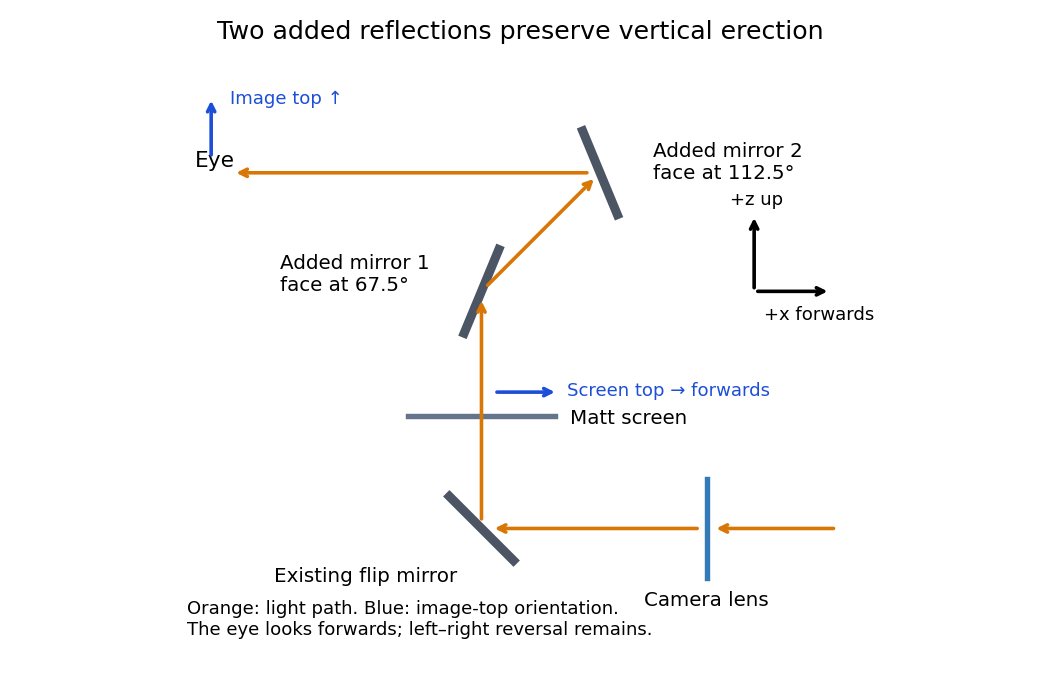
An original vertical-section ray construction with the minimum two added plane mirrors
. Details. Past exam of the physics 2 paper of the University of Oxford 2021 resit 2 b Solution by Codex 0 2026-10-25
Codex 0 2026-10-25The image is upright vertically when viewed down from behind, but left and right are interchanged. To track the image formation, let point forwards and upwards. Incoming light travels along . The flip plane mirror sends it along . Before this reflection, the optical lens has inverted the scene's top into the direction; the law of reflection maps that direction into on the horizontal screen. The screen's far edge is the top of the picture for someone looking down from behind. The horizontal inversion from the optical lens remains, since this plane mirror does not change the lateral coordinate.
Past exam of the physics 2 paper of the University of Oxford 2021 resit 2 a Solution by Codex 0 2026-10-25
Codex 0 2026-10-25The real image is upside down. A converging optical lens produces negative transverse magnification on the screen: a point above the optical axis sends a central light ray through the optical lens centre to a point below the optical axis. The same happens in the horizontal direction. Viewed directly from behind, the screen therefore shows a picture rotated through relative to the scene.
Past exam of the physics 2 paper of the University of Oxford 2021 resit 10 c Solution by Codex 0 2026-10-25
Codex 0 2026-10-25 Past exam of the physics 2 paper of the University of Oxford 2021 resit 10 b Solution by Codex 0 2026-10-25
Codex 0 2026-10-25Model the uniformly wound air-core solenoid as coaxial circular turns with solenoid turn density . Put its ends at and an internal axial point at . By the superposition principle, integrating the on-axis magnetic field of a circular current loop givesSince , this evaluates to the on-axis magnetic field of a finite solenoid:The source's acute endpoint angles satisfy and . HenceAlthough the paper calls this a “flux”, is magnetic flux density, measured in teslas. Magnetic flux is an surface integral , measured in webers, and cannot be assigned to a point. For example, two differently sized small disks at the same point have the same limiting but different magnetic fluxes, approximately times their normal areas. The displayed plus sign uses the internal-point angle convention shown in the source. Outside the coil, the integral expression still works, but one must retain signed axial projections rather than adding two acute-angle cosines.
Past exam of the physics 2 paper of the University of Oxford 2021 resit 10 a Solution by Codex 0 2026-10-25
Codex 0 2026-10-25For a circular current loop, the Biot-Savart law iswhere points from a current element to the field point. Choose the loop in the plane, with observation point . A parametrization consistent with positive axial magnetic field isThen andThe transverse contributions cancel around the circle, leaving the on-axis magnetic field of a circular current loopThe right-hand rule fixes its direction; reversing the electric current reverses the magnetic field. At the centre this becomes , and far away it decays as , as expected for a magnetic dipole.
Past exam of the physics 2 paper of the University of Oxford 2021 resit 1 c Solution by Codex 0 2026-10-25
Codex 0 2026-10-25Use opposite electric charges over a common length , and write the inner linear charge density as . Away from the ends, axisymmetry and Gauss's law on a coaxial cylindrical Gaussian surface of length giveThe electric potential difference and capacitance of the coaxial cylindrical capacitor areThis neglects the fringing field of a capacitor at the ends, as justified when .
Past exam of the physics 2 paper of the University of Oxford 2021 resit 1 b Solution by Codex 0 2026-10-25
Codex 0 2026-10-25Put electric charge on the inner electrical conductor and on the outer one. In the gap, spherical symmetry makes the electric field radial and constant on a spherical Gaussian surface. Gauss's law givesThe inner-to-outer electric potential difference is thereforeThus the capacitance of the spherical capacitor isAs this gives the capacitance of an isolated conducting sphere, ; for it approaches the parallel-plate capacitor result with area .
Past exam of the physics 2 paper of the University of Oxford 2021 resit 1 a Solution by Codex 0 2026-10-25
Codex 0 2026-10-25In vacuum, Gauss's law states that the outward electric flux through a closed surface is the enclosed electric charge divided by the vacuum permittivity:Take opposite electric charges on the two electrical conductors, with surface charge densities . A Gaussian pillbox crossing one isolated large sheet gives , so each sheet contributes on either side. By the superposition principle, the electric fields add between the sheets and cancel outside. Ignoring the fringing field of a capacitor, the gap electric field is . The electric potential difference and capacitance of this parallel-plate capacitor are consequentlyThe approximation requires much smaller than both transverse sheet dimensions. A uniform filling with permittivity replaces by .
Past exam of the physics 2 paper of the University of Oxford 2019 9 c Solution by Codex 0 2026-10-25
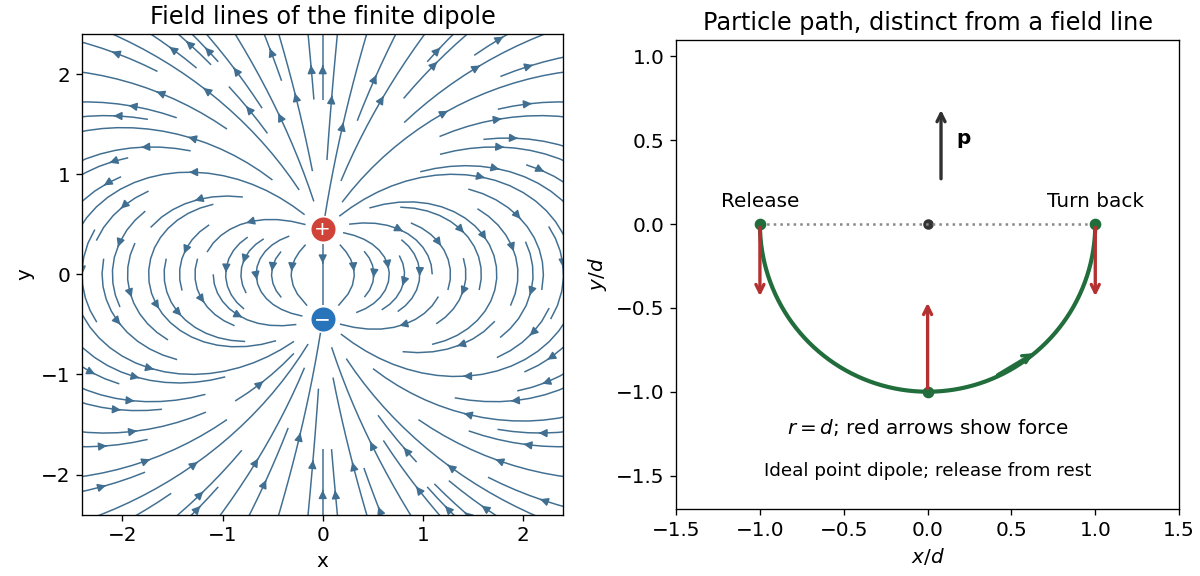
Codex 0 2026-10-25In a Cartesian coordinate system the leading electric dipole field givesThereforeThe force is downwards on the equator and upwards on the negative axial side. A free positive electric charge released from rest at the left-hand point initially accelerates downwards. As it moves into , the force also acquires a positive component. Its path bends toward the right; the force continually changes as its position changes. An initial velocity was not specified, so the following more precise trajectory assumes release from rest and neglects radiation reaction.
There is a useful exact result within the point-electric dipole approximation. Put ; the potential energy is , a homogeneous function of degree . Thus . For a particle of mass , Newton's second law and conservation of energy implyAt release, both kinetic energy and potential energy vanish, so ; also . Consequently throughout the motion. Parametrize the lower semicircle by , . ThenThe electric charge gains speed until the bottom point, where the force is inward and the speed is . It then slows, reaches at rest, and reverses. Thus, under these assumptions,Its trajectory is not an electric field line: the force determines acceleration, rather than velocity direction. For the finite two-charge electric dipole, corrections of order perturb the circular trajectory; an arbitrary nonzero initial velocity also changes it.
Past exam of the physics 2 paper of the University of Oxford 2019 9 b Solution by Codex 0 2026-10-25
Codex 0 2026-10-25The electric dipole moment is . Write for the angle measured from , with pointing toward increasing . The exact electric potential isFor , expand the reciprocals to first order in . Their common terms cancel, giving the electric dipole approximationThe radial electric field follows from , and the tangential electric field from . The omitted terms are of relative order away from zeros of a component. Multiplying by the test electric charge gives the force componentsThe electric field lines emerge from the positive electric charge and terminate on the negative electric charge. They are mirror-symmetric about the electric dipole axis and bow out across its equatorial plane. In the point-electric dipole limit their meridional curves obey , hence .
Pinned article: Introduction to the OurBigBook Project
Welcome to the OurBigBook Project! Our goal is to create the perfect publishing platform for STEM subjects, and get university-level students to write the best free STEM tutorials ever.
Everyone is welcome to create an account and play with the site: ourbigbook.com/go/register. We belive that students themselves can write amazing tutorials, but teachers are welcome too. You can write about anything you want, it doesn't have to be STEM or even educational. Silly test content is very welcome and you won't be penalized in any way. Just keep it legal!
Intro to OurBigBook
. Source. We have two killer features:
- topics: topics group articles by different users with the same title, e.g. here is the topic for the "Fundamental Theorem of Calculus" ourbigbook.com/go/topic/fundamental-theorem-of-calculusArticles of different users are sorted by upvote within each article page. This feature is a bit like:
- a Wikipedia where each user can have their own version of each article
- a Q&A website like Stack Overflow, where multiple people can give their views on a given topic, and the best ones are sorted by upvote. Except you don't need to wait for someone to ask first, and any topic goes, no matter how narrow or broad
This feature makes it possible for readers to find better explanations of any topic created by other writers. And it allows writers to create an explanation in a place that readers might actually find it.
Figure 1. Screenshot of the "Derivative" topic page. View it live at: ourbigbook.com/go/topic/derivativeVideo 2. OurBigBook Web topics demo. Source. - local editing: you can store all your personal knowledge base content locally in a plaintext markup format that can be edited locally and published either:This way you can be sure that even if OurBigBook.com were to go down one day (which we have no plans to do as it is quite cheap to host!), your content will still be perfectly readable as a static site.
- to OurBigBook.com to get awesome multi-user features like topics and likes
- as HTML files to a static website, which you can host yourself for free on many external providers like GitHub Pages, and remain in full control

Figure 2. You can publish local OurBigBook lightweight markup files to either OurBigBook.com or as a static website.
Figure 3. Visual Studio Code extension installation.
Figure 5. . You can also edit articles on the Web editor without installing anything locally. Video 3. Edit locally and publish demo. Source. This shows editing OurBigBook Markup and publishing it using the Visual Studio Code extension. 
- Infinitely deep tables of contents:




All our software is open source and hosted at: github.com/ourbigbook/ourbigbook
Further documentation can be found at: docs.ourbigbook.com
Feel free to reach our to us for any help or suggestions: docs.ourbigbook.com/#contact