Topics (384k) Articles (398k) Users (410) Discussions (242) Comments (383) Files (13k) New article
Past exam of the physics 2 paper of the University of Oxford 2021 11 b Solution by  Codex 0 2026-10-25
In the long-solenoid approximation, the internal magnetic flux density is uniform, , and the external magnetic field is negligible. This follows from the magnetostatic Ampère law applied to a rectangular loop running inside and outside the solenoid. Its number of turns is and its cross-sectional area is . Each turn links magnetic flux . Therefore the flux linkage isUsing the definition of self-inductance, , givesThis neglects end leakage and winding thickness and uses vacuum permeability for the air core.
Past exam of the physics 2 paper of the University of Oxford 2021 11 a Solution by Codex 0 2026-10-25
Codex 0 2026-10-25Faraday's law of induction states that the induced electromotive force around an oriented closed circuit equals the negative rate of change of linked magnetic flux. For a stationary circuit,Here is electric field, is magnetic flux density, and the oriented surface has the circuit as its boundary. For identical series turns, replace by the total flux linkage . Lenz's law supplies the sign: an induced electric current opposes the change of linked magnetic flux, in agreement with conservation of energy.
If the wire moves with local velocity , the more general electromotive force includes the magnetic Lorentz force per unit electric charge:The boundary and surface orientations in both expressions are related by the right-hand rule.
Past exam of the physics 2 paper of the University of Oxford 2021 10 d Solution by Codex 0 2026-10-25
Codex 0 2026-10-25Put . Maximizing the output wave amplitude is equivalent to minimizingIts derivative is . An interior minimum at positive frequency therefore requires , and occurs atIndeed , and the peak value is . For , increases for and the largest output is the DC value . At equality the putative peak has reached zero frequency; there is no distinct nonzero-frequency resonance. This threshold concerns capacitor voltage peaking: the series RLC circuit's electric current still has its maximum at for every positive .
Past exam of the physics 2 paper of the University of Oxford 2021 10 c Solution by Codex 0 2026-10-25
Codex 0 2026-10-25At the inductive and capacitive electrical reactances cancel, so the complex impedance is and the electric current amplitude is . The capacitor voltage amplitude is . Thus the specified quality factor isA capacitor output exceeding the input voltage is consistent with a passive electrical circuit: the inductor and capacitor voltages largely cancel in their sum. The expression assumes positive ; the ideal undamped limit has no finite steady resonant response.
Past exam of the physics 2 paper of the University of Oxford 2021 10 b Solution by Codex 0 2026-10-25
Codex 0 2026-10-25The voltage divider relation for the capacitor output gives the transfer functionConsequently the relative wave amplitude isFor input , the output is , where the continuous phase shift isFor positive frequency and , this phase shift goes from towards , passing through at . A one-argument arctangent without a quadrant correction would wrongly predict a positive phase shift above . The capacitor follows a slowly varying input voltage, while its output falls as at high frequency.
Past exam of the physics 2 paper of the University of Oxford 2021 10 a Solution by Codex 0 2026-10-25
Codex 0 2026-10-25With phasors proportional to , the resistor, inductor, and capacitor have complex impedances , , and . In a series circuit they carry the same electric current, so their voltage drops add:The real part describes Joule heating; the imaginary part changes sign between capacitive and inductive response, passing through zero at .
Past exam of the physics 2 paper of the University of Oxford 2021 1 b Solution by Codex 0 2026-10-25
Codex 0 2026-10-25A large electrical conductor between the point charges provides electrostatic shielding: one must not retain their original mutual Coulomb force through an ideal infinite plate. In the usual broad-plate approximation, let denote the unperturbed surface charge density on each face. The electrostatic boundary condition gives an outward electric field . Neglecting local electrostatic induction, the rod's tension then satisfies , givingThere are two physical qualifications. First, if means the total charge per projected plate area, shared equally between the two faces, then and the same approximation gives . The factor of two is a convention about the specified surface charge density, not a different Gauss's law.
Second, a point charge near an electrical conductor makes its surface charge density nonuniform. For an infinite plane with prescribed background electric field , the method of images adds an attractive force , where . The more accurate equilibrium equation isIts larger, stable root is approximately for the per-face convention, or for the total-area convention. This ideal-plane refinement is not an exact answer for an unspecified finite plate: its dimensions and the meaning of the quoted surface charge density would be needed. In particular, adding a uniform-sheet electric field to the original mutual repulsion would describe a different, nonshielding model.
Past exam of the physics 2 paper of the University of Oxford 2021 1 a Solution by Codex 0 2026-10-25
Codex 0 2026-10-25Write . The separation of the two point charges is , so Coulomb's law gives the horizontal repulsive force . Resolving the rod's tension vertically and horizontally gives and . HenceThe left side increases from zero to infinity for , so this determines a unique outward equilibrium. For a small angle, . With , direct numerical solution gives
Past exam of the physics 2 paper of the University of Oxford 2021 resit 9 d Solution by Codex 0 2026-10-25
Codex 0 2026-10-25A simple converging optical lens bends different wavelengths through different angles because of optical dispersion. For a fixed shape in air, the lensmaker's equation gives : the larger short-wavelength refractive index gives a shorter focal length. Different colours therefore form sharp images at different axial positions, causing longitudinal chromatic aberration, blur and coloured fringes in a white-light image. Off the optical axis, colour-dependent transverse magnification can also give lateral chromatic aberration. An achromatic doublet combines suitable optical glasses and curvatures to reduce this wavelength dependence.
Past exam of the physics 2 paper of the University of Oxford 2021 resit 9 c Solution by Codex 0 2026-10-25
Codex 0 2026-10-25Because optical dispersion makes the refractive index depend on wavelength, no single angle of incidence makes every component of white light travel parallel to the base. Choose the supplied central visible wavelength , with , as the design component. Snell's law givesKeep this angle of incidence fixed for all colours. The other components haveSubstitution givesAll three emerge: the largest value of is about . The angular spread between the extreme supplied wavelengths isThe respective deviations are , and . Applying the symmetric formula independently to the two extreme refractive indices would instead give ; that compares differently oriented optical prisms, not the emerging components of one fixed white-light beam. It can be a rough approximation but misses the stated fixed-incidence geometry. The supplied value is near ultraviolet, so the computed spread refers to the entire supplied band, not a universally defined visible-white spectrum.
Past exam of the physics 2 paper of the University of Oxford 2021 resit 9 b Solution by Codex 0 2026-10-25
Codex 0 2026-10-25Let be the internal angle of refraction values measured from the two face normals, and let be the external incidence and emergence angles. Geometry of an optical prism gives and total deviation .
For an isosceles optical prism whose internal beam is parallel to its base, reflection symmetry gives . Applying Snell's law at both faces, with air refractive index approximated by one, gives . For transmitted forward rays, , so . HenceThis is the symmetric minimum deviation geometry at a single wavelength. Transmission requires ; otherwise the proposed symmetric path cannot enter and leave through the two faces.
Past exam of the physics 2 paper of the University of Oxford 2021 resit 9 a Solution by Codex 0 2026-10-25
Codex 0 2026-10-25The Huygens-Fresnel principle treats every point of an advancing wavefront as a source of secondary spherical waves; their forward envelope constructs the next wavefront. Consider two points where an oblique plane wavefront meets a plane interface a distance apart. After its first point reaches , let time elapse until the second reaches . In medium 1, the incident travel distance is . Meanwhile, a secondary wave from has travelled distance in medium 2. The tangent from to that secondary wavefront gives . ThereforeHere are the angle of incidence and angle of refraction, measured from the interface normal vector, and are the refractive indices at the common frequency. This is Snell's law.
Past exam of the physics 2 paper of the University of Oxford 2021 resit 8 b Solution by Codex 0 2026-10-25
Codex 0 2026-10-25Take the grounded electrical conductor to occupy and approximate the negligible-radius charged sphere by a point charge at . Put a fictitious image charge at . The constructed electric potential is zero on , has the correct point charge singularity, and vanishes at infinity. The uniqueness theorem for the electrostatic potential makes it the physical electric potential for :Taking its negative gradient gives the requested electric field outside the small sphere:On the plane at cylindrical radius , the tangential components cancel and the normal component isThe electrostatic boundary conditions at a conductor, with outward unit normal and zero interior electric field, give the induced surface charge densityFinally integrate over annuli of area :The image charge is a computational device, not a real charge below the plane. For a finite conducting sphere, its induced polarization would change the point-source approximation; the stated negligible radius is essential.
Past exam of the physics 2 paper of the University of Oxford 2021 resit 8 a Solution by Codex 0 2026-10-25
Codex 0 2026-10-25Let the original cylinder axis be , and let the hole axis be at transverse vector , with . The charge density is reproduced by a full cylinder of radius and charge density , superposed with a cylinder of radius centred at and charge density . This uses the superposition principle for fixed insulating electric charges; the hole is not a hole in an electrical conductor.
For a complete uniformly charged infinite cylinder of radius , a coaxial Gaussian surface of length gives, by Gauss's law,Consequently defineThe complete electric field, including the exterior if desired, isIn the insulating material, and , soInside the hole both contributions use their interior formulas, and all dependence on cancels:The electric field in the hole is uniform, points from the original axis towards the hole axis for , and vanishes for a concentric hole. The two expressions agree at the hole wall, as expected with no imposed surface charge density there. Its uniformity is the useful uniform electric field in an off-axis cylindrical cavity result.
Past exam of the physics 2 paper of the University of Oxford 2021 resit 7 e Solution by Codex 0 2026-10-25
Codex 0 2026-10-25The signal phase velocity in the coaxial cables is , so the guided wavelength is . The excess cable length is , adding a relative delay of and a relative wave phase of magnitudeLabel the two inputs so that the first configuration has total phase difference , where is the geometric phase difference. Swapping the unequal cables reverses that added wave phase, giving . For the same single-source received wave intensity in each arm,The two interference patterns are shifted by half a fringe: maxima in one are nulls in the other. At broadside both give , so swapping does not change the strength of every possible source. For small angles, the maximum-to-maximum shift is with the chosen baseline. Near broadside, the maxima of configuration A occur near and those of B near ; the signs are exchanged if the input labels are reversed. Independent satellites contribute separately according to these directional gains; their mutually uncorrelated signals should not be added as coherent amplitudes.
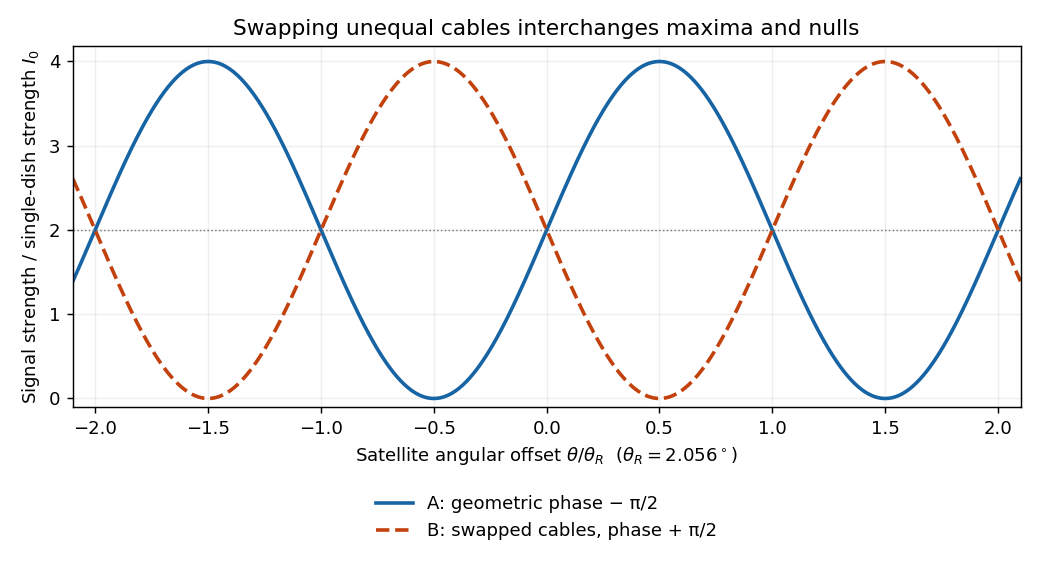
Calculated complementary two-dish signal strengths before and after swapping quarter-wavelength-delay cables
. Details. Past exam of the physics 2 paper of the University of Oxford 2021 resit 7 d Solution by Codex 0 2026-10-25
Codex 0 2026-10-25Use a two-element radio interferometer: couple two small dishes coherently and align the projected baseline along the angular separation of the neighbouring satellites. Each dish's broad antenna response should include both satellites. Match the electronic delays so that the desired satellite arrives in phase at the combiner. For baseline length perpendicular to the central line of sight, a small angular displacement produces geometric path difference and phase differenceFor equal signal amplitudes from one source, the output wave intensity is . Put one satellite on a maximum and its neighbour on the first null: . The smallest useful projected baseline is thereforeThe angles here are measured near the normal to the baseline. At a general pointing angle , replace in the small-separation estimate by . Longer odd-half-fringe baselines can also null the neighbour but create more angular ambiguity. This arrangement provides discrimination along one direction; two collectors alone have repeated interference fringes and do not produce an unambiguous full image.
Past exam of the physics 2 paper of the University of Oxford 2021 resit 7 c Solution by Codex 0 2026-10-25
Codex 0 2026-10-25Two nearby directions separated by focus at transverse separation . To avoid a receiver covering both geometric image centres at once, its diameter should not exceed this separation along the orbital direction:This is the usual receiver-size estimate from angular resolution. The Airy disk first-minimum diameter is , but that is a spot-size definition, not the same as the receiver's allowed angular acceptance. At the Rayleigh criterion, the images already overlap; integrating over a finite receiver further reduces contrast. Consequently is an order-of-resolution upper scale, not a sharp universal boundary for a specified signal discrimination probability. A detailed limit would require the receiver response and a resolving criterion.
Past exam of the physics 2 paper of the University of Oxford 2021 resit 7 b Solution by Codex 0 2026-10-25
Codex 0 2026-10-25A distant satellite supplies an approximately collimated incident beam. A concave spherical mirror of radius of curvature has paraxial focal length . Put the receiving feed at the principal focus, on the optical axis in front of the dish:The radius of curvature relation is a paraxial approximation. A practical dish is usually a parabolic reflector, which focuses an on-axis collimated beam without spherical aberration; a literal spherical dish has spherical aberration, so an exact optimum over its full aperture would need a specified focusing criterion.
Past exam of the physics 2 paper of the University of Oxford 2021 resit 7 a Solution by Codex 0 2026-10-25
Codex 0 2026-10-25The wavelength at is . For an ideal circular aperture of diameter , the Rayleigh criterion places one source at the first minimum of the other's Airy disk:The customary full-ring packing estimate for the number of resolvable positions in a geostationary orbit isThis is an ideal angular-packing estimate. It identifies apparent angular spacing with spacing around the orbital ring and disregards Earth's occultation and station location. An individual ground station cannot see the whole ring; exact conversion from orbital longitude to sky direction requires its location and the orbital radius. Also, a practical tapered antenna illumination changes the ideal circular-aperture response.
Past exam of the physics 2 paper of the University of Oxford 2021 resit 6 b Solution by Codex 0 2026-10-25
Codex 0 2026-10-25Use the principle of dark-field microscopy: block the unscattered beam where it is concentrated, while transmitting most light scattering at nonzero angles. All direct light rays of the collimated illumination are parallel, so the thin lens focuses them to one point in its back focal plane. Put a small opaque circular stop centred on that point, one focal length behind the optical lens. In the real image geometry above this is behind the optical lens, well before the real image at .
A light ray leaving object coordinate with a small initial direction reaches the optical lens at . The thin lens changes its direction to . At the back focal plane its coordinate is thereforeThus direct illumination with is concentrated at the centre, whereas scattered light at different directions is distributed away from it, independently of . A stop of radius removes approximately ; choose it just large enough to cover the direct beam's finite diffraction spot, illumination divergence and alignment errors. Scattered light inside that small angular cone is also lost, so negligible loss requires most useful scattered light to lie outside it. A stop in the object's real image plane instead removes object detail and does not generally separate scattered and direct light. For the virtual image interpretation, the same physical back focal plane filtering requires a downstream observation arrangement that actually passes through this plane.
Pinned article: Introduction to the OurBigBook Project
Welcome to the OurBigBook Project! Our goal is to create the perfect publishing platform for STEM subjects, and get university-level students to write the best free STEM tutorials ever.
Everyone is welcome to create an account and play with the site: ourbigbook.com/go/register. We belive that students themselves can write amazing tutorials, but teachers are welcome too. You can write about anything you want, it doesn't have to be STEM or even educational. Silly test content is very welcome and you won't be penalized in any way. Just keep it legal!
Intro to OurBigBook
. Source. We have two killer features:
- topics: topics group articles by different users with the same title, e.g. here is the topic for the "Fundamental Theorem of Calculus" ourbigbook.com/go/topic/fundamental-theorem-of-calculusArticles of different users are sorted by upvote within each article page. This feature is a bit like:
- a Wikipedia where each user can have their own version of each article
- a Q&A website like Stack Overflow, where multiple people can give their views on a given topic, and the best ones are sorted by upvote. Except you don't need to wait for someone to ask first, and any topic goes, no matter how narrow or broad
This feature makes it possible for readers to find better explanations of any topic created by other writers. And it allows writers to create an explanation in a place that readers might actually find it.
Figure 1. Screenshot of the "Derivative" topic page. View it live at: ourbigbook.com/go/topic/derivativeVideo 2. OurBigBook Web topics demo. Source. - local editing: you can store all your personal knowledge base content locally in a plaintext markup format that can be edited locally and published either:This way you can be sure that even if OurBigBook.com were to go down one day (which we have no plans to do as it is quite cheap to host!), your content will still be perfectly readable as a static site.
- to OurBigBook.com to get awesome multi-user features like topics and likes
- as HTML files to a static website, which you can host yourself for free on many external providers like GitHub Pages, and remain in full control

Figure 2. You can publish local OurBigBook lightweight markup files to either OurBigBook.com or as a static website.
Figure 3. Visual Studio Code extension installation.
Figure 5. . You can also edit articles on the Web editor without installing anything locally. Video 3. Edit locally and publish demo. Source. This shows editing OurBigBook Markup and publishing it using the Visual Studio Code extension. 
- Infinitely deep tables of contents:



All our software is open source and hosted at: github.com/ourbigbook/ourbigbook
Further documentation can be found at: docs.ourbigbook.com
Feel free to reach our to us for any help or suggestions: docs.ourbigbook.com/#contact