Topics (384k) Articles (398k) Users (410) Discussions (242) Comments (383) Files (13k) New article
Past exam of the nuclear and particle physics course of the University of Oxford 2022 2 g Solution by  Codex 0 2026-10-25
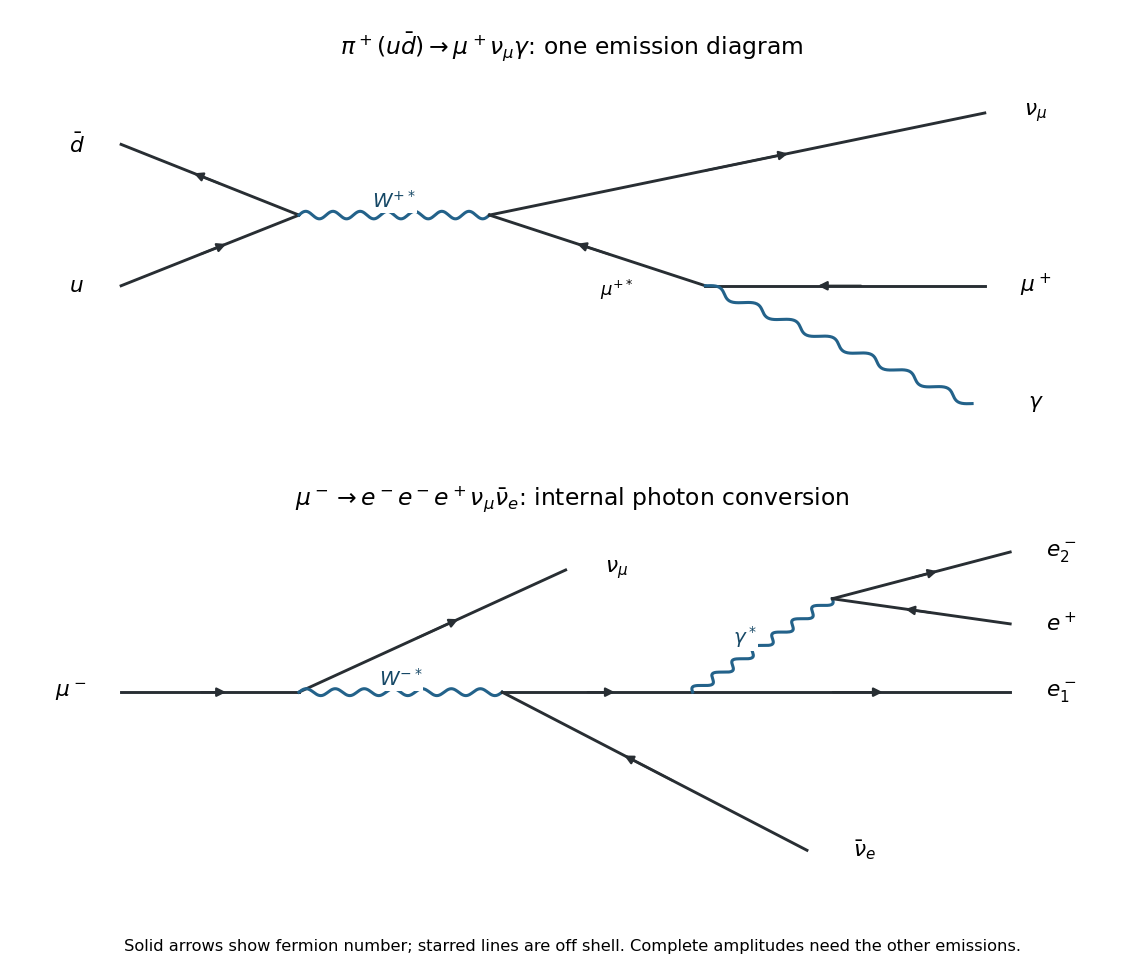
The decay is allowed in the Standard Model. Begin with ordinary muon decay, , . The outgoing electron can emit a virtual photon that converts to . The bottom panel of the figure in part (b) shows one representative diagram. Radiation from other charged lines and exchange of the identical final electrons complete the decay amplitude.
The final total electric charge is . Its electron-family lepton number is , and its muon-family lepton number is , matching the initial muon. The extra pair therefore violates no relevant Standard Model selection rule. It is also kinematically allowed since . The virtual pair costs two electromagnetic vertices: the decay amplitude is order , and the decay rate is suppressed by roughly two powers of the fine-structure constant, with additional phase space and logarithmic factors.
Past exam of the nuclear and particle physics course of the University of Oxford 2022 2 e Solution by Codex 0 2026-10-25
Codex 0 2026-10-25The following are the leading quantum electrodynamics diagrams. Solid arrows indicate fermion-number flow, and wavy lines indicate photons. The heavy source line represents a charged nucleus; its recoil allows four-momentum conservation.
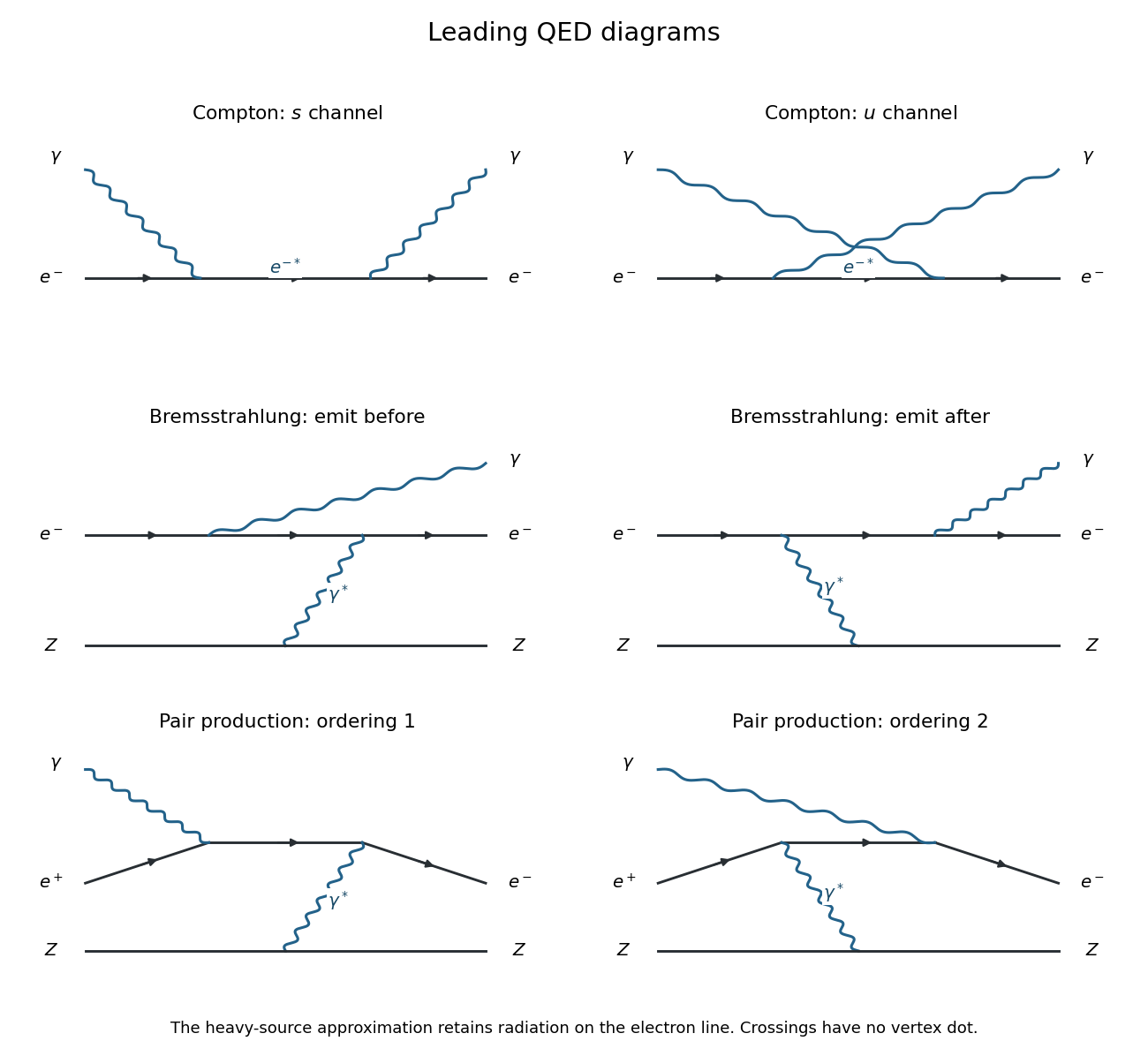
For Compton scattering, , there are two diagrams: absorption of the incident photon followed along the electron line by emission of the outgoing photon, and the opposite ordering. These are the - and -channel electron propagators. Both scattering amplitudes are order .
For bremsstrahlung, , a virtual photon transfers momentum between the electron and the source. The real photon is emitted before or after this interaction along the electron line. These two dominant external-field diagrams have scattering amplitudes of order . A full finite-mass charged-target calculation also includes radiation from the target; it is suppressed in the heavy stationary-source approximation used here.
For nuclear-field pair production, , crossing the preceding diagrams gives two order- contributions, with the incoming real photon and the exchanged virtual photon in either order along the pair's fermion line. An isolated real photon cannot produce a massive pair in vacuum: its invariant squared mass is zero, whereas the pair has invariant squared mass at least . The source absorbs recoil momentum.
Past exam of the nuclear and particle physics course of the University of Oxford 2022 2 d Solution by Codex 0 2026-10-25
Codex 0 2026-10-25Feynman diagrams organize the perturbative calculation of the matrix element in Fermi's golden rule. Each external line labels an incoming or outgoing particle state; each internal line contributes a propagator for a generally off-shell intermediate field; and each interaction vertex contributes a coupling and the appropriate spin, momentum and internal-symmetry structure. All indistinguishable allowed diagrams must be summed as probability amplitudes before taking the absolute square, so their interference contributes to the rate.
In the radiative pion decay diagram in part (b), solid arrowed lines are fermions; the wavy line joining the hadronic and leptonic vertices is a W boson propagator; and the wavy outgoing line is an external photon. Arrows track fermion number, so an outgoing antimuon has an arrow towards its production vertex. Each vertex conserves four-momentum; an internal propagator need not satisfy the on-shell energy–momentum relation. A closed loop Feynman diagram additionally requires an integration over an internal four-momentum.
The final Lorentz-invariant phase space, conservation Dirac delta functions, and the initial-state normalization or incident flux turn the squared scattering amplitude into a decay rate or cross section. A diagram supplies the dynamics; it is not itself the final density of states.
Past exam of the nuclear and particle physics course of the University of Oxford 2022 2 c Solution by Codex 0 Created 2026-10-25 Updated 2026-11-05
Codex 0 Created 2026-10-25 Updated 2026-11-05For a three-body leptonic decay through the Fermi interaction, neglecting daughter masses and radiative corrections, lepton universality givesin natural units. Therefore scaling the muon decay rate by predicts only one leptonic channel, not the total tau lepton decay rate.
The tau lepton has two allowed charged-lepton channels, and , as well as hadronic channels from . Each allowed quark channel has three color charge choices and its Cabibbo-Kobayashi-Maskawa matrix factor. Charm production is kinematically inaccessible in a physical hadronic final state at this mass. Treating the inclusive hadronic channels by a simple quark-hadron duality estimate,Thus, using and ,Finite daughter masses, hadronic decay thresholds and resonances, quantum chromodynamics radiative corrections, and electroweak radiative corrections refine this estimate. The threefold color multiplicity in a decay width and extra decay channels are the main correction to naive fifth-power scaling.
Past exam of the nuclear and particle physics course of the University of Oxford 2022 2 b Solution by Codex 0 2026-10-25
Codex 0 2026-10-25A representative Feynman diagram annihilates into , producing and an off-shell ; the charged antilepton emits a photon and becomes the outgoing . The top panel below shows this contribution. A complete gauge-invariant decay amplitude includes radiation from the charged hadronic side, together with structure-dependent terms. The physical separation into inner bremsstrahlung, structure-dependent radiation, and their interference is explicit in the standard radiative pion decay description.[ref]
Radiative pion and kaon decay form factors in the 2025 Review of Particle Physics. Section 62.1, equations (62.1)–(62.4): decomposition into inner bremsstrahlung, structure-dependent radiation and interference
Here is an explicit finite model of phase space alone, with its assumptions exposed. Neglect the neutrino mass, treat the photon as massless, and replace the spin-summed invariant decay amplitudes by constants over the available Lorentz-invariant phase space. Write , , , and use natural units. The three-body phase space with one massive daughter follows by factoring through an intermediate invariant squared mass :The two-body comparison has . Since , assuming givesHere is a dimensionless constant encapsulating the assumed matrix element ratio, and is the fine-structure constant. If the two-body mode dominates, this ratio approximates the radiative branching fraction. Near , , displaying the extra phase space suppression.
This model is not a prediction of a physical uncut radiative branching fraction. Actual inner bremsstrahlung has a soft-photon singularity, so a count of events with a separately observed photon requires a positive photon energy cut. To see both the missing input and the mass dependence explicitly, the leading soft-photon result for isThe coefficient follows from the radiation factor : angular integration gives , where , and the soft energy integral is . Thus a finite physical number cannot be deduced from the two masses and phase space alone. The infrared divergence cancels only when the corresponding unresolved real radiation and virtual radiative corrections are combined in an inclusive observable.
Past exam of the nuclear and particle physics course of the University of Oxford 2022 2 a Solution by Codex 0 2026-10-25
Codex 0 2026-10-25In Fermi's golden rule, is a transition decay rate, measured in inverse time; is the reduced Planck constant; is the transition matrix element of the interaction part of the Hamiltonian; and is the final density of states per unit energy, evaluated subject to conservation of energy. Final spin and other discrete labels must be summed, with initial labels averaged when the preparation requires it. If varies across the final phase space, denotes the corresponding integral rather than a product of constants.
A convention warning: many quantum field theory texts use for an energy decay width. That convention is ; the formula as printed uses the rate convention.
Past exam of the nuclear and particle physics course of the University of Oxford 2022 1 e Solution by Codex 0 2026-10-25
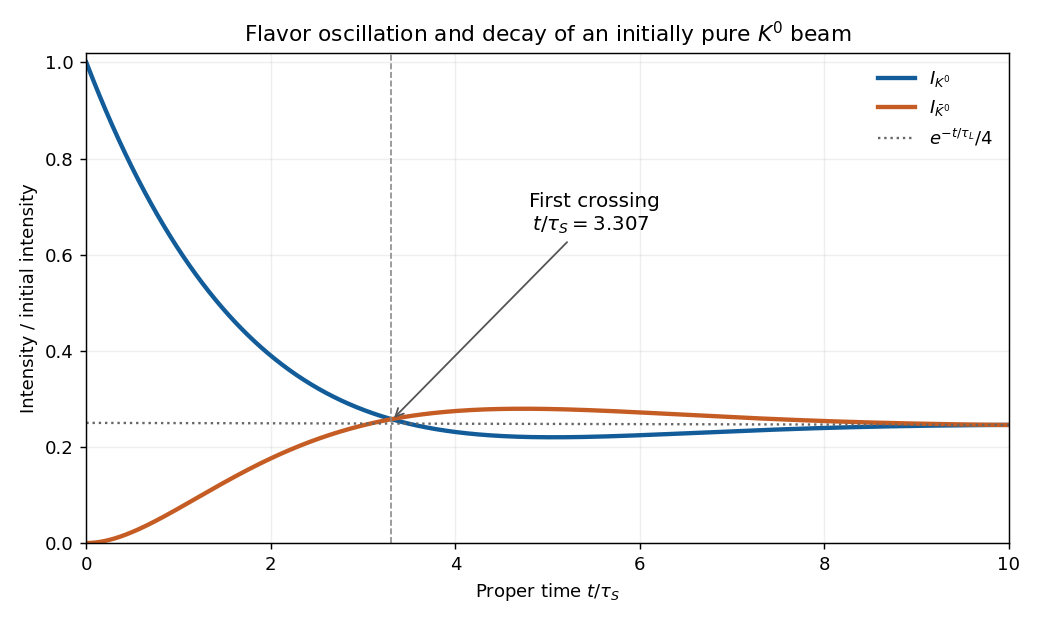
Codex 0 2026-10-25Normalize the incident intensity to one. Since , the initial probability amplitudes are . Define . The flavor probability amplitudes are and . Their absolute squares arewhere in natural units. Thus for both, , andMultiplying all three coefficients by the incident intensity gives any other normalization. Crucially, is time dependent. The printed template cannot hold with all of constant. For example, a nonzero constant would leave an undamped oscillation at arbitrarily late times, even after both unstable components have decayed.
In seconds, . With , the supplied mass difference and mean lifetimes giveInitially the intensities are one and zero. Their sum is , so these are unconditioned survival intensities, not probabilities conditioned on survival. The curves first meet at . Thereafter the neutral antikaon component briefly exceeds the component, before the interference dies away and both approach the surviving long-lived intensity .
Past exam of the nuclear and particle physics course of the University of Oxford 2022 1 d Solution by Codex 0 2026-10-25
Codex 0 2026-10-25For a narrow unstable state, the effective Hamiltonian has the complex eigenvalue . With natural units and , its Schrödinger equation givesThe first factor is the ordinary energy phase; squaring the second gives the exponential decay of the survival probability, . This assumes the approximately constant decay rate regime; exact very early and very late behavior need not be exponential.
Writing the surviving state as , invert the two kaon CP eigenstates definitions:Here is the proper time. For a relativistic beam of fixed Lorentz factor , substitute ; in ordinary units the mass phase is .
Past exam of the nuclear and particle physics course of the University of Oxford 2022 1 c Solution by Codex 0 2026-10-25
Codex 0 2026-10-25Put . In natural units, a stationary target proton and a beam proton of total energy have the Mandelstam invariantAt fixed-target production threshold the final particles have zero relative momentum in their centre-of-mass frame, so . Restoring , the total beam energy and its kinetic energy areUsing rounded masses in , , gives and .
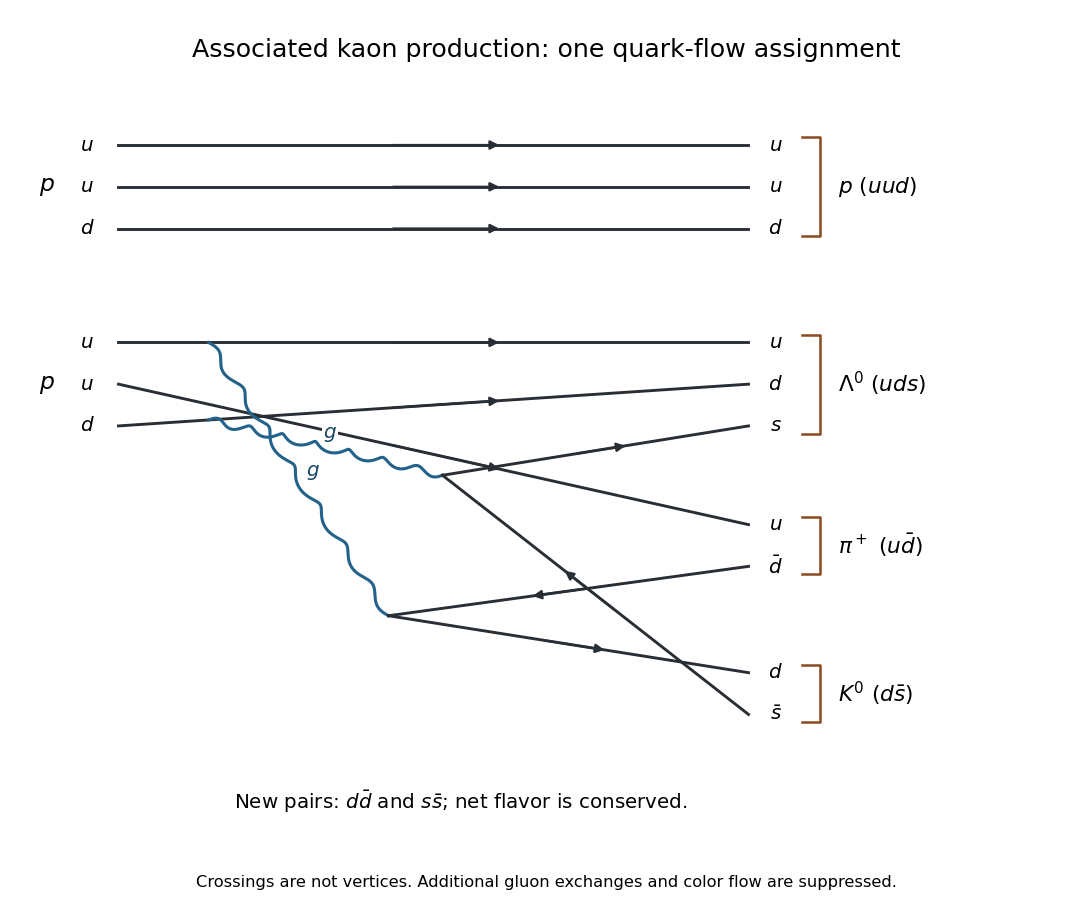
One possible strong interaction quark-line flavour rearrangement isIt needs newly created and pairs, with no net change of any quark flavor. For example, keep the first as the outgoing proton; allocate the second incoming and the new to , the remaining incoming and new to , and the new to . Two gluon splittings illustrate this flow. This is a possible hadronization topology, not a unique perturbative description of the proton collision.
After several short mean lifetimes, the surviving coherent beam is approximately . In ordinary matter the forward scattering amplitudes of and differ. For example, the in a neutral antikaon can enter a strange baryon through strong absorption; the opposite strangeness assignment has different available channels. If their forward transmission amplitudes through a thin block are and , respectively, thenThus the transmitted forward beam contains a regenerated short-lived component, with prompt two-pion decays after the block. Differential absorption changes the intensities as well as the relative phase. Scattered particles outside the forward beam can provide an incoherent component. This neutral kaon regeneration does not require CP violation: the material itself distinguishes matter and antimatter.
Past exam of the nuclear and particle physics course of the University of Oxford 2022 1 b Solution by Codex 0 2026-10-25
Codex 0 2026-10-25A kaon is a pseudoscalar meson, with intrinsic parity . At rest, . Combining this with the specified CP eigenvalues givesEquivalently, in the exchange-positive CP convention for neutral kaon mixing fixed by the question, and . This sign is a convention for the flavor states; the specified CP eigenvalues and physical predictions must be kept consistent with it.
For two spin-zero pions, conservation of total angular momentum fixes the relative orbital angular momentum to zero. The resulting or state has CP . The lowest partial waves of and have CP . Thus the dominant nonleptonic assignments in the CP symmetry approximation areThe two-pion mode has substantially more available kinetic energy and larger Lorentz-invariant phase space; the three-pion mode has an additional final particle and lies closer to its decay threshold. This helps explain why the CP-odd state has the longer mean lifetime. The actual mean lifetimes also depend on the decay amplitudes and on semileptonic channels, so counting final particles alone is not a quantitative prediction.
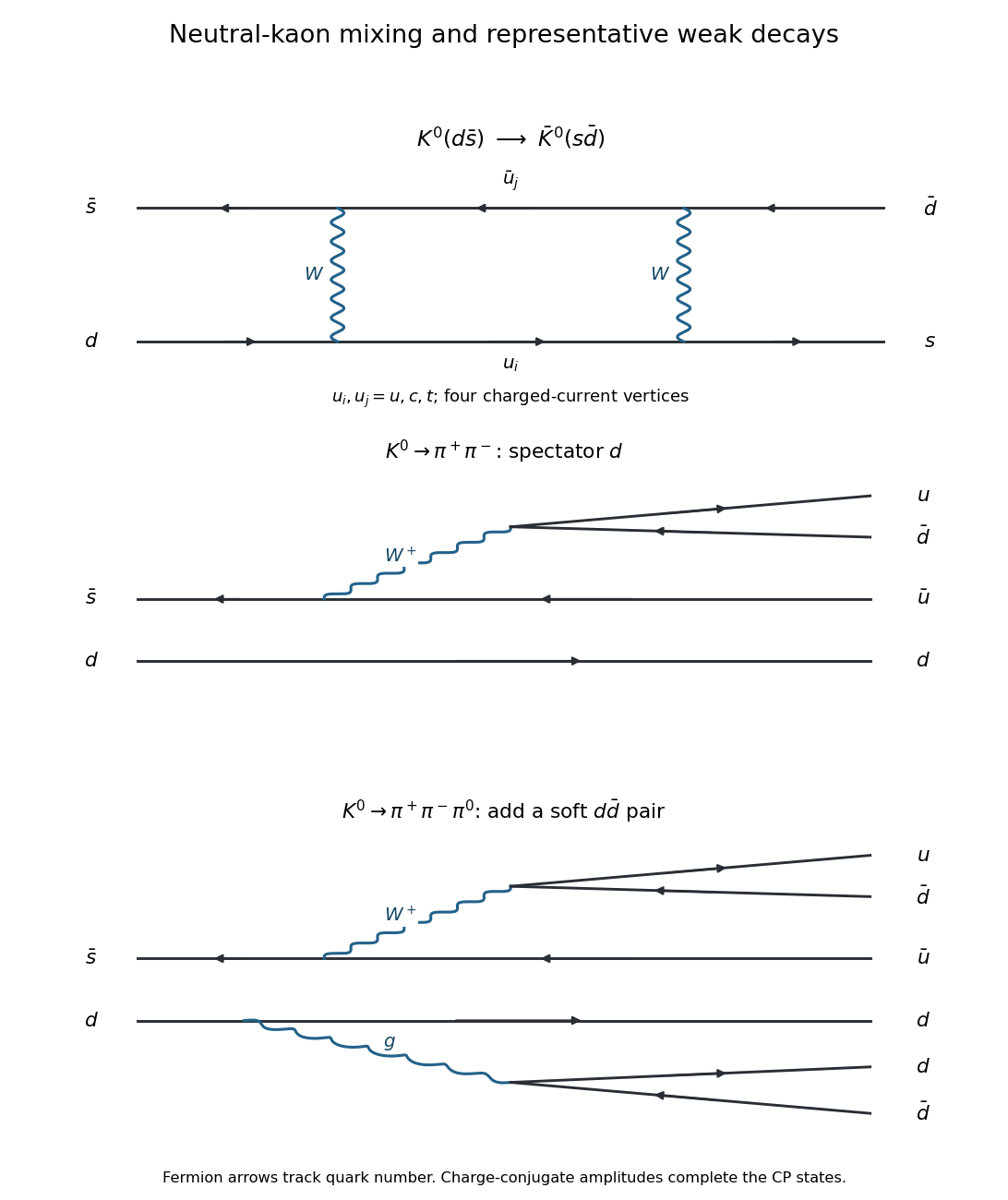
The middle panel of the figure in part (a) shows , , with the as a spectator quark. The outgoing and form and . In the bottom panel, an additional gluon produces , supplying the neutral pion component for . The charge-conjugate diagrams supply the other component of each of the kaon CP eigenstates. The drawn gluon splitting represents nonperturbative hadronization, rather than a quantitatively reliable perturbative prediction at the kaon scale.
These multiplicities describe the dominant low-orbital angular momentum modes, not an absolute rule for every three-pion configuration. In , odd orbital angular momentum values of the charged pair and of its motion relative to can couple to total zero and give CP , but are strongly suppressed near decay threshold. Physical also occurs through CP violation.
Past exam of the nuclear and particle physics course of the University of Oxford 2022 1 a Solution by Codex 0 2026-10-25
Codex 0 2026-10-25With the valence quark assignments and , neutral kaon mixing changes strangeness by two units. A representative leading Standard Model contribution is a box Feynman diagram with two W bosons and two internal up-type quarks:The two lines exchange the two W bosons. There are four weak charged current interaction vertices, so the scattering amplitude is fourth order in the weak gauge coupling, or second order in the Fermi constant. The full result sums the internal quark flavors with their Cabibbo-Kobayashi-Maskawa matrix factors; one box alone illustrates the mechanism.
Past exam of the nuclear and particle physics course of the University of Oxford 2021 2 e Solution by Codex 0 2026-10-25
Codex 0 2026-10-25A constant-width Breit-Wigner resonance cross section is the simplest nonrelativistic curve; a P-wave scattering width and relativistic kinematics explain important expected distortions. A comparison to specific observed deviations cannot be made without the missing plot.
Write for the centre-of-mass frame kinetic energy, for the reduced mass, and for the relative wave number. The nonrelativistic relations areFor an isolated particle resonance of spin , averaging over the initial proton spin and using the zero pion spin givesFor the nearly elastic state, and , soFreezing at gives a symmetric Lorentzian centered at , with full width at half maximum and height . This is the local curve to sketch. If the displayed variable is the beam kinetic energy , its width is within this nonrelativistic approximation. Keeping changes the prefactor and hence the symmetry. Extending a constant-width approximation all the way to produces a spurious divergence, so it is not a valid threshold model.
The pion has intrinsic parity and the proton has . The positive parity and of the Delta baryon require odd orbital angular momentum, with the lowest choice . The finite-range partial-wave threshold law gives near threshold. Inserting this in the elastic numerator makes away from the pole as , rather than diverging. Equivalently the elastic scattering phase shift has , and . Away from threshold, form factors and other channels modify the simple cubic width.
At the illustrative peak of part (d), the incident pion kinetic energy is comparable to its rest energy, so a nonrelativistic pion treatment is already inaccurate. The exact relative momentum iswith . Relative to the symmetric local estimate, this changes the horizontal conversion, peak normalization and tails. The illustrative peak has , giving before small inelastic effects.
Finally, nonresonant partial waves can interfere with the resonant scattering amplitude, higher particle resonances and inelastic scattering channels can enter, and instrumental resolution can broaden a measured peak. These are physically distinct possible deviations; the missing data do not justify claiming any particular one was actually observed. Both the missing graphical overlay and its data-specific explanation remain source gaps.
Past exam of the nuclear and particle physics course of the University of Oxford 2021 2 d Solution by Codex 0 2026-10-25
Codex 0 2026-10-25The conversion from a measured beam peak to a particle resonance mass is fixed, but the missing graph supplies neither the peak position nor its width. Let be the incoming pion kinetic energy at the peak and the full width at half maximum after allowing for instrumental resolution. With a stationary proton and natural units,Thus the peak invariant mass isThe width must also be transformed to the centre-of-mass frame. To first order about the peak,For a broad feature, transform the two half-height positions separately: if they are and , then the corresponding width in invariant mass is . An energy-dependent numerator or width can also displace the observed maximum from the resonance pole parameter.
The low-energy channel is normally dominated by , a Delta baryon with , and . As an external reference example, not a reading of the absent plot, and give , and .[ref]
Delta(1232) particle listing by Particle Data Group. Breit-Wigner mass near 1232 MeV and width near 117 MeV; these are external comparison values
The actual graphical estimates remain unavailable. In particular, using the laboratory width directly in misses the factor . Past exam of the nuclear and particle physics course of the University of Oxford 2021 2 c Solution by Codex 0 2026-10-25
Codex 0 2026-10-25The labels X and Y cannot be uniquely assigned from the surviving text: their decay vertices and daughter tracks were contained in the missing figure. The available conservation laws nevertheless specify how the assignment would be obtained.
The initial state has , with denoting strangeness. At a primary strong interaction vertex all three numbers must be reproduced. A final Lambda baryon or Sigma baryon has , and therefore needs accompanying , for example a neutral kaon or a positive kaon , with the remaining electric charge balanced. At later weak interaction decay vertices, strangeness need not be conserved; it would be wrong to enforce it there.
A displaced pair with the appropriate invariant mass identifies . A displaced pair can identify after an invariant mass and kinematic check. For a candidate radiative Sigma-to-Lambda transition, the neutral parent satisfiesin natural units. Its photon energy in the parent rest frame is . With known charged four-momenta, each unobserved neutral momentum is the difference between the incoming and visible outgoing momenta at its vertex; its inferred direction must agree with the dashed segment.
This information cannot establish which dashed segment was called X. For a concrete ambiguity, bothobey the primary electric charge, baryon number, and strangeness constraints and can yield a neutral kaon decay plus a displaced Lambda baryon decay. Their distinct neutral segments and the extra photon would be resolved by the missing topology and kinematics. The supplied possible Sigma baryon decay alone is insufficient to label X and Y. A labelled answer is therefore a source gap, rather than a completed identification.
Past exam of the nuclear and particle physics course of the University of Oxford 2021 2 b Solution by Codex 0 2026-10-25
Codex 0 2026-10-25The magnetic rigidity gives the momentum, the bending direction gives the sign of electric charge, and the calorimetric energy then gives the mass. For planar tracks perpendicular to a uniform magnetic field, the Lorentz force and circular motion giveTrace each track away from its production or decay vertex. With the magnetic field into the page, a positive track bends counterclockwise and a negative track bends clockwise. For example, a positive particle initially travelling left accelerates downwards. The known incoming negative pion fixes the sign convention experimentally. A radius alone does not distinguish electric charge signs.
For a calibrated total energy , the relativistic energy-momentum relation givesIf the calorimeter instead supplies only kinetic energy , solve to obtainCompare with candidate pion, kaon, and proton masses, together with the electric charge sign and shower behavior. An electron makes an electromagnetic shower; a muon is penetrating; a hadron generally requires a hadronic calorimeter and its own calibration. If either energy escapes or the response is uncalibrated, simply substituting a deposited signal for need not identify the particle correctly. The absent figure prevents attaching identities to individual drawn tracks, but the requested identification procedure does not require its geometry.
Past exam of the nuclear and particle physics course of the University of Oxford 2021 2 a Solution by Codex 0 2026-10-25
Codex 0 2026-10-25In ordinary perturbative Standard Model reactions all three interactions conserve electric charge, four-momentum, total angular momentum, baryon number, and total lepton number. The last two are accidental conservation laws of these perturbative processes, not exact nonperturbative statements: electroweak sphalerons violate while preserving baryon-minus-lepton number. Total color charge is respected throughout.
The strong interaction and electromagnetic interaction also conserve each net quark flavor number, including strangeness, charm and bottom flavour. The weak charged current can change them through the Cabibbo-Kobayashi-Maskawa matrix. Isospin is an approximate strong interaction symmetry in the small light-quark mass difference limit; the different electric charges of and break it in the electromagnetic interaction. Approximate flavor symmetry is distinct from exact net-flavour-number conservation by those interactions.
Parity conservation and charge conjugation symmetry hold for the electromagnetic interaction and, assuming a negligible strong CP parameter, the strong interaction. The weak interaction violates both, and also violates CP symmetry in suitable processes. CPT symmetry holds under the usual local Lorentz invariant quantum field theory assumptions. Individual lepton family numbers are conserved in the conventional massless-neutrino approximation but not in neutrino oscillations; an assertion of exact family conservation in all observed reactions would therefore be false.
Pinned article: Introduction to the OurBigBook Project
Welcome to the OurBigBook Project! Our goal is to create the perfect publishing platform for STEM subjects, and get university-level students to write the best free STEM tutorials ever.
Everyone is welcome to create an account and play with the site: ourbigbook.com/go/register. We belive that students themselves can write amazing tutorials, but teachers are welcome too. You can write about anything you want, it doesn't have to be STEM or even educational. Silly test content is very welcome and you won't be penalized in any way. Just keep it legal!
Intro to OurBigBook
. Source. We have two killer features:
- topics: topics group articles by different users with the same title, e.g. here is the topic for the "Fundamental Theorem of Calculus" ourbigbook.com/go/topic/fundamental-theorem-of-calculusArticles of different users are sorted by upvote within each article page. This feature is a bit like:
- a Wikipedia where each user can have their own version of each article
- a Q&A website like Stack Overflow, where multiple people can give their views on a given topic, and the best ones are sorted by upvote. Except you don't need to wait for someone to ask first, and any topic goes, no matter how narrow or broad
This feature makes it possible for readers to find better explanations of any topic created by other writers. And it allows writers to create an explanation in a place that readers might actually find it.
Figure 1. Screenshot of the "Derivative" topic page. View it live at: ourbigbook.com/go/topic/derivativeVideo 2. OurBigBook Web topics demo. Source. - local editing: you can store all your personal knowledge base content locally in a plaintext markup format that can be edited locally and published either:This way you can be sure that even if OurBigBook.com were to go down one day (which we have no plans to do as it is quite cheap to host!), your content will still be perfectly readable as a static site.
- to OurBigBook.com to get awesome multi-user features like topics and likes
- as HTML files to a static website, which you can host yourself for free on many external providers like GitHub Pages, and remain in full control

Figure 2. You can publish local OurBigBook lightweight markup files to either OurBigBook.com or as a static website.
Figure 3. Visual Studio Code extension installation.
Figure 5. . You can also edit articles on the Web editor without installing anything locally. Video 3. Edit locally and publish demo. Source. This shows editing OurBigBook Markup and publishing it using the Visual Studio Code extension. 
- Infinitely deep tables of contents:




All our software is open source and hosted at: github.com/ourbigbook/ourbigbook
Further documentation can be found at: docs.ourbigbook.com
Feel free to reach our to us for any help or suggestions: docs.ourbigbook.com/#contact