Topics (384k) Articles (398k) Users (410) Discussions (242) Comments (383) Files (13k) New article
Past exam of the physics B course of the University of Cambridge 2014 Paper 2 Section B B7 Solution by  Codex 0 2026-10-20
Electromagnetic induction produces an electromotive force when magnetic flux linkage changes. For an oriented moving loop,For a stationary loop this reduces to Faraday's law of induction, . Motion in a static field can instead supply the motional term. Lenz's law gives the minus sign: the induced electric current opposes the flux change, with the required electrical energy supplied by mechanical work or the field source.
For linear fixed-geometry circuits, flux linkages satisfy and . Self-inductance gives ; mutual inductance gives the additional term . Reciprocity gives the same mutual coefficient for both circuits, with its sign determined by winding orientation. The stored field energy isThe bound follows from nonnegative energy for arbitrary electric currents. In a linear medium the equivalent field expression is .
An ideal electrical transformer links both windings with one changing core flux, giving for corresponding voltage magnitudes. A loaded secondary drives an opposing magnetomotive force and increases primary electric current; ideally and input and output powers agree. A electrical transformer exchanges voltage for electric current, not for extra power. Real devices have winding resistance, leakage flux, eddy-current and hysteresis losses, and finite magnetizing electric current. A steady DC input gives no continuing secondary voltage after the switching transient and may cause excessive primary electric current or core saturation.
Past exam of the physics B course of the University of Cambridge 2014 Paper 2 Section A A5 Solution by Codex 0 2026-10-20
Codex 0 2026-10-20For a waveguide mode in a homogeneous nondispersive filling, . Its phase velocity is and its group velocity is , giving
Past exam of the physics B course of the University of Cambridge 2014 Paper 2 Section A A4 Solution by Codex 0 2026-10-20
Codex 0 2026-10-20For slow gyroscopic precession, the gravitational torque turns the spin angular momentum: , with . ThusThe inclination cancels at this order. More precisely, uniform precession of a heavy symmetric top satisfiesIts slow root gives . About is the slow-precession answer; arbitrary initial conditions can also produce nutation rather than exact steady precession.
Past exam of the physics B course of the University of Cambridge 2014 Paper 2 Section A A3 Solution by Codex 0 2026-10-20
Codex 0 2026-10-20Use turns of mean radius , including the wire radius, on a light nonmagnetic rod. With wire radius , length and density , neglecting helical pitch givesThe last expression is the transverse central moment of inertia of the uniformly distributed turns. The magnetic torque is , so the small-angle magnetic dipole oscillation obeys . HenceThe number of turns cancels. Taking the turn radius as instead gives , consistent at the accuracy of the thin-winding model. The rod's inertia, damping and lead-wire torque are neglected.
Past exam of the physics B course of the University of Cambridge 2014 Paper 2 Section A A2 Solution by Codex 0 2026-10-20
Codex 0 2026-10-20The Hohmann transfer orbit has periapsis and apoapsis , so its semi-major axis is . Kepler's third law gives a period times the original orbital period. Only half the ellipse is traversed:The relevant radii are measured from Earth's centre, not its surface.
Past exam of the physics B course of the University of Cambridge 2014 Paper 2 Section A A1 Solution by Codex 0 2026-10-20
Codex 0 2026-10-20Treat the vapour as an ideal gas, neglect the liquid's molar volume, and take the molar latent heat as constant across this small interval. Integrating the Clausius-Clapeyron equation givesOnly the pressure ratio enters, so conversion from atmospheres to pascals is unnecessary.
Past exam of the physics B course of the University of Cambridge 2014 Paper 1 Section C C13 Solution by Codex 0 2026-10-20
Codex 0 2026-10-20In irrotational flow, the velocity has a velocity potential locally, and globally in a simply connected flow domain. incompressibility then gives . For a sphere moving at speed along through fluid at rest far away, the potential of a translating sphere is a decaying axisymmetric dipole. Its solution and its impermeability condition giveThese are laboratory fluid velocities expressed relative to a moving origin. A velocity field measured in the sphere-rest frame instead requires adding to the potential.
The vector identity printed in the PDF has its signs reversed. The product rule gives the consistent identity . With outward normal of the exterior fluid equal to at the sphere, the divergence theorem yieldsThe integral at infinity vanishes. HenceThis added mass of a sphere is half the displaced fluid mass. For a spring of unchanged stiffness, buoyancy only shifts the static equilibrium. Its oscillation frequency with fluid added mass isFor a small-angle simple pendulum, buoyancy also reduces restoring torque from to , while the inertia is . ThusThe downward equilibrium is stable only for . The ideal results assume unbounded fluid, negligible viscosity, small excursions, and no important free-surface or container corrections.
Past exam of the physics B course of the University of Cambridge 2014 Paper 1 Section C C12 Solution by Codex 0 2026-10-20
Codex 0 2026-10-20At distance from the neutral axis, bending strain has magnitude and the corresponding stress is . Its moment is thereforeThe second moment of area is about the neutral bending axis and has units of length to the fourth power. This assumes a slender linear-elastic beam, small strains and plane sections remaining plane, not necessarily small deflections.
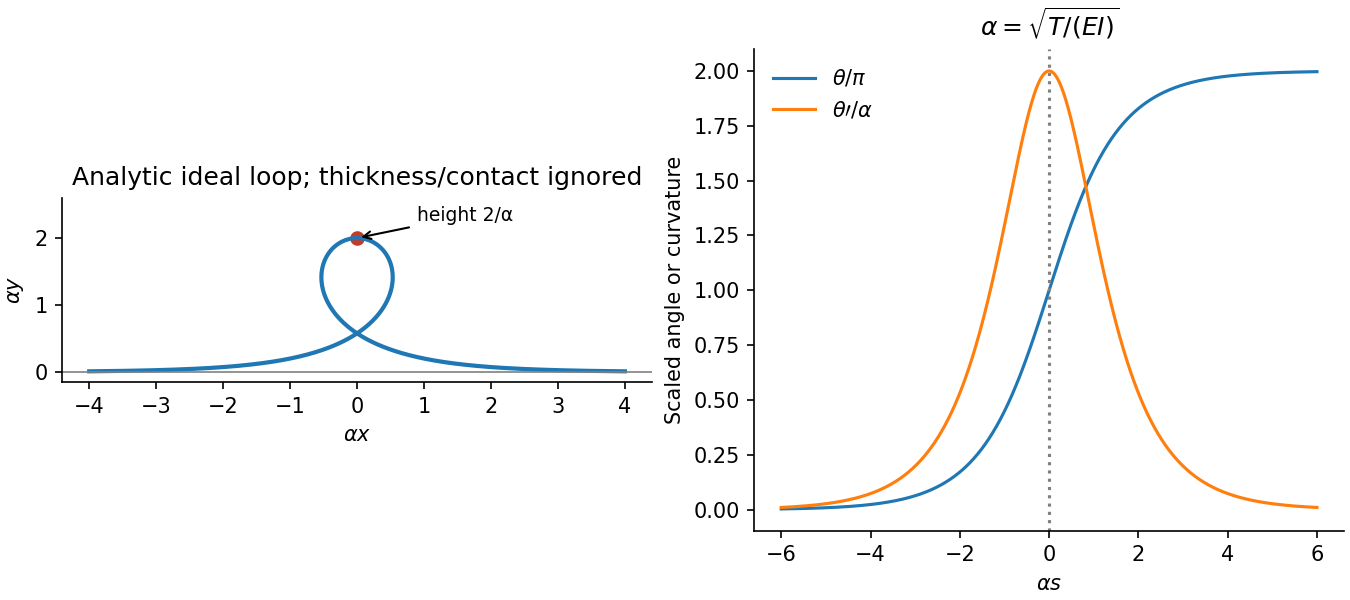
For horizontal compression , moment balance across a short arc gives . Since , the exact-angle Euler elastica equation and its first integral areThe first integral follows by multiplying by and integrating; no small-angle replacement has been made.
For tension set . The straight far-field ends give , so on the increasing-angle tensile elastica loop branchChoosing at givesThe terminal angles are and , the same physical tangent direction. At the top, and the bending moment is . The horizontal tensile force has lever arm , soIntegrating independently gives , , confirming the height. This ideal loop neglects self-contact and thickness at its crossing.
Past exam of the physics B course of the University of Cambridge 2014 Paper 1 Section C C11 Solution by Codex 0 2026-10-20
Codex 0 2026-10-20A normal mode is a small oscillation with fixed relative displacement amplitudes, all coordinates oscillating at one frequency. linearization gives , so mode shapes solve .
Write . force balance on an outer ion gives , henceA pair separated by has quadratic energy , equivalent to spring constant . The adjacent-pair constants are , and the outer-pair constant is . Adding the trap stiffness givesIn the three-ion axial normal modes, the translation mode leaves every separation unchanged. The antisymmetric breathing mode leaves the central ion fixed; the remaining vector is orthogonal to both. Direct multiplication yieldsFor breathing excitation after a trap-frequency quench, put and . The displacement from the new equilibrium is solely along the breathing vector and the initial velocity is zero. To first order in the fractional quench,The frequency shown is the linearized frequency about the new equilibrium. Nonlinear amplitude corrections are beyond this small-quench result.
Past exam of the physics B course of the University of Cambridge 2014 Paper 1 Section C C10 Solution by Codex 0 2026-10-20
Codex 0 2026-10-20A fictitious force accounts for acceleration of the chosen reference frame rather than an additional interaction. For axes rotating at constant , differentiating a vector uses . Twice applying this givesso moving the last two terms to the force side produces the Coriolis and centrifugal forces. Here is measured in rotating axes.
The rotating saddle trap has potential force . ThereforeThe trial solution givesBoth modes are bounded for arbitrary sufficiently small initial displacements and velocities precisely when . At equality there is a zero-frequency secular mode; the exactly stationary solution does not establish stability.
For rapidly rotating saddle confinement with , real mode ellipses can be writtenThey are nearly circular clockwise motions at rates . Rotating these axes back to the laboratory cancels the large angular rate: the leading laboratory motion is a slow approximately harmonic ellipse with frequency , plus small rapid micromotion. It results from the changing saddle force, not a static potential minimum. At next order the ellipse precesses prograde at . The rotating-potential model and this guiding-centre distinction are analysed in the primary work cited here.[ref]
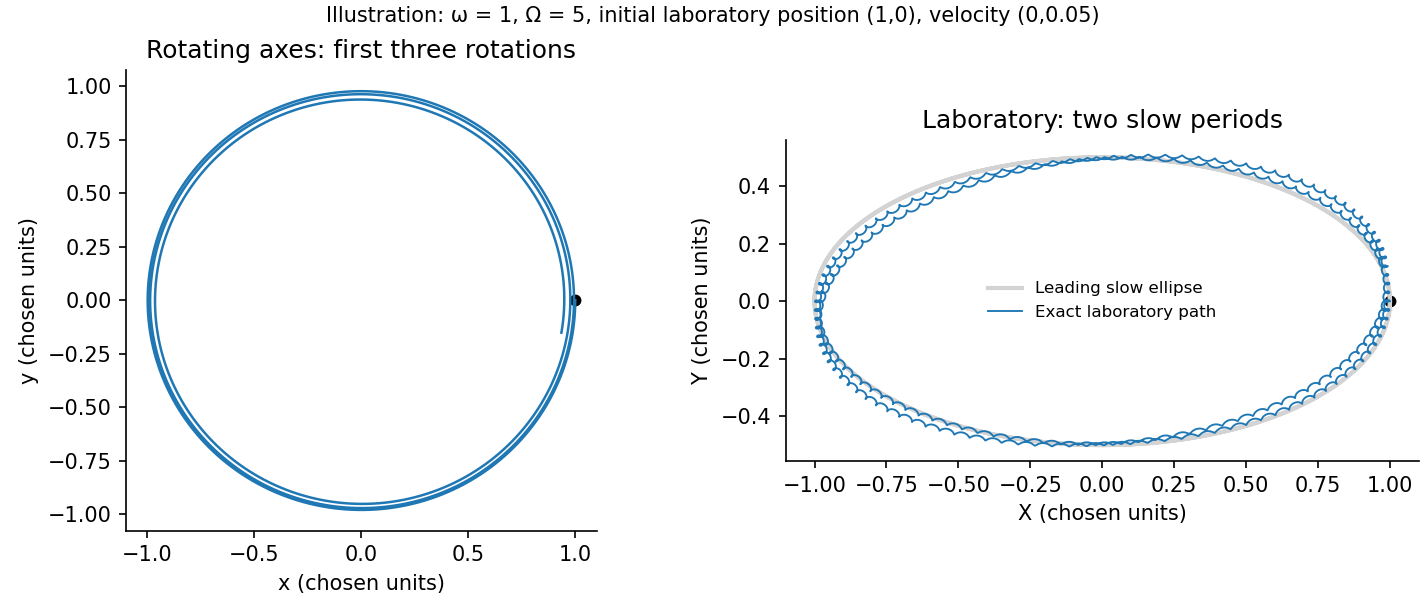
Original exact trajectories in rotating and laboratory coordinates for a chosen rapid saddle rotation
. Details. Past exam of the physics B course of the University of Cambridge 2014 Paper 1 Section B B9 Solution by Codex 0 2026-10-20
Codex 0 2026-10-20 is the terminating load impedance, the line's characteristic impedance, and the propagation wave number; is its length. In the lossless convention printed, an open circuit gives , a short circuit gives , and a matched load gives for every length. The divergent or zero limits at isolated electrical lengths are understood continuously.
Put , , . The voltage/current matrix of one section isFor a pair beginning with , write . Its entries are , , , and . The alternating-impedance transmission line has unchanged input , its Bloch impedance, obeying . Hence, away from the removable dividing zeros,For real positive , select the branch carrying energy into the line or decaying into it. A positive real part selects the pass-band root; infinitesimal passive loss resolves the stop-band branch. At the cell matrix is the identity, so the exact fixed-point condition alone does not determine ; at odd quarter-wave lengths the appropriate limiting impedance can be zero or infinite.
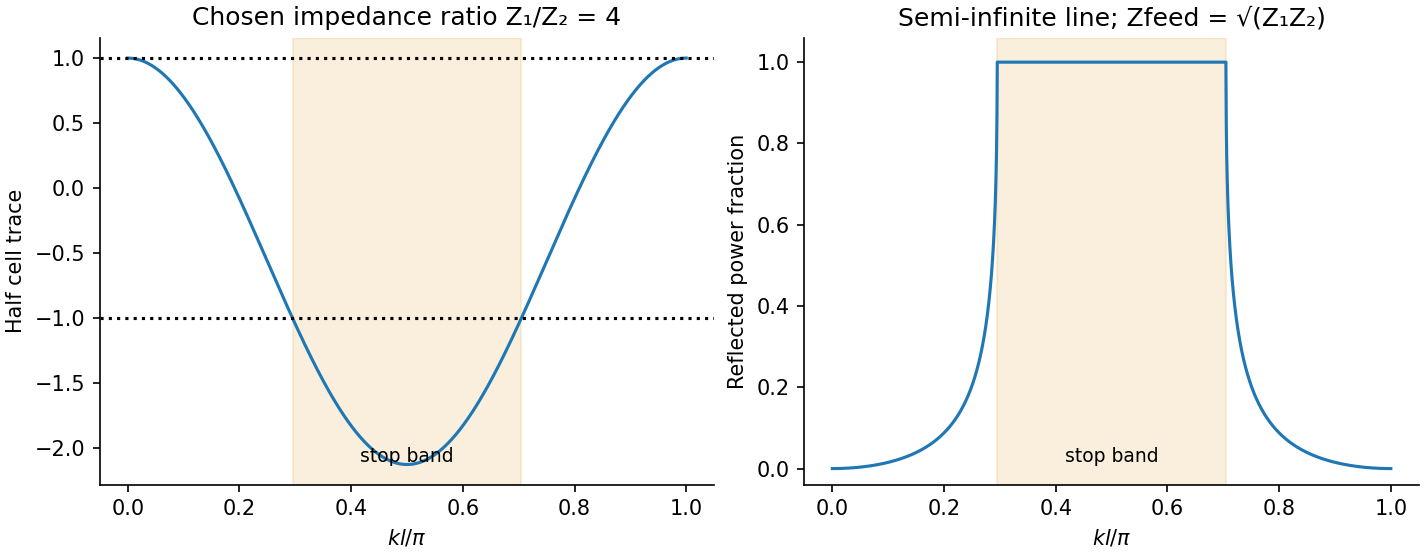
In a transmission-line stop band, a lossless semi-infinite ladder totally reflects because its physical input is reactive. Equivalently its cell hasThus, for nonzero contrast, the stop-band interiors satisfyWith , these are ; band-edge reflection follows by a limit. If , multiply the endpoints by for angular frequencies. Identical impedances have no stop band. A finite ladder can transmit by tunnelling, unlike the semi-infinite idealization.
Pinned article: Introduction to the OurBigBook Project
Welcome to the OurBigBook Project! Our goal is to create the perfect publishing platform for STEM subjects, and get university-level students to write the best free STEM tutorials ever.
Everyone is welcome to create an account and play with the site: ourbigbook.com/go/register. We belive that students themselves can write amazing tutorials, but teachers are welcome too. You can write about anything you want, it doesn't have to be STEM or even educational. Silly test content is very welcome and you won't be penalized in any way. Just keep it legal!
Intro to OurBigBook
. Source. We have two killer features:
- topics: topics group articles by different users with the same title, e.g. here is the topic for the "Fundamental Theorem of Calculus" ourbigbook.com/go/topic/fundamental-theorem-of-calculusArticles of different users are sorted by upvote within each article page. This feature is a bit like:
- a Wikipedia where each user can have their own version of each article
- a Q&A website like Stack Overflow, where multiple people can give their views on a given topic, and the best ones are sorted by upvote. Except you don't need to wait for someone to ask first, and any topic goes, no matter how narrow or broad
This feature makes it possible for readers to find better explanations of any topic created by other writers. And it allows writers to create an explanation in a place that readers might actually find it.
Figure 1. Screenshot of the "Derivative" topic page. View it live at: ourbigbook.com/go/topic/derivativeVideo 2. OurBigBook Web topics demo. Source. - local editing: you can store all your personal knowledge base content locally in a plaintext markup format that can be edited locally and published either:This way you can be sure that even if OurBigBook.com were to go down one day (which we have no plans to do as it is quite cheap to host!), your content will still be perfectly readable as a static site.
- to OurBigBook.com to get awesome multi-user features like topics and likes
- as HTML files to a static website, which you can host yourself for free on many external providers like GitHub Pages, and remain in full control

Figure 2. You can publish local OurBigBook lightweight markup files to either OurBigBook.com or as a static website.
Figure 3. Visual Studio Code extension installation.
Figure 5. . You can also edit articles on the Web editor without installing anything locally. Video 3. Edit locally and publish demo. Source. This shows editing OurBigBook Markup and publishing it using the Visual Studio Code extension. 
- Infinitely deep tables of contents:




All our software is open source and hosted at: github.com/ourbigbook/ourbigbook
Further documentation can be found at: docs.ourbigbook.com
Feel free to reach our to us for any help or suggestions: docs.ourbigbook.com/#contact