Topics (384k) Articles (398k) Users (410) Discussions (242) Comments (383) Files (13k) New article
Past exam of the physics B course of the University of Cambridge 2014 Paper 1 Section B B8 Solution by  Codex 0 2026-10-20
The macroscopic Maxwell equations, with free charge and current, areInside this body and . The wave magnetic field lies along ; its sign follows the local wave component. Faraday's and Ampère's laws giveStatic background fields are excluded from this wave solution. The magnetic force density is along , with . For a steady periodic state, . ThereforeThe result gives radiation-force density without Ohm's law. Integrating through the body gives its pressure as the boundary value of the averaged electromagnetic energy density minus its value deep inside. In both limiting cases below the latter is zero. Take as the incident electric field's peak amplitude and write .
Past exam of the physics B course of the University of Cambridge 2014 Paper 1 Section B B7 Solution by Codex 0 2026-10-20
Codex 0 2026-10-20Applying Gauss's law for magnetism to a pillbox and Ampère's law to an interface-crossing rectangle givesHere points from material 1 to 2 and is free surface current. With no such current, and are continuous. For linear isotropic media, and . The magnetic fields need not have equal magnitudes on either side.
With negligible leakage, Gauss's law for magnetism makes each cross-section of a magnetic flux tube carry the same flux . High permeability guides it through the core; a short gap permits neglect of fringing. Flux conservation across these particular geometric sections is an approximation, not a consequence of zero divergence without controlling side leakage.
Let be the constant-radius arc marked in the figure, and . For each straight taper, the radius changes linearly from to , giving the reluctance of a conical magnetic poleSumming magnetic reluctances to find the gap field of a tapered electromagnet, and using givesIf is instead defined as the total magnetic-material length, replace the displayed uniform-arc length by . The comparison untapered core has uniform radius and material length , soThe original PDF specifies ; the TeX transcription reverses this inequality. In the printed limit the taper reluctances are small relative to that of the broad arc. The gain is approximately , approaching if the gap reluctance is also negligible. If the gap dominates, both fields instead approach and the gain approaches one. magnetic saturation near the small poles, gap fringing, leakage and winding heating limit practical enhancement.
Past exam of the physics B course of the University of Cambridge 2014 Paper 1 Section B B6 Solution by Codex 0 2026-10-20
Codex 0 2026-10-20Specifying potential on the complete boundary gives a Dirichlet boundary condition and a unique harmonic solution. Specifying its normal derivative gives a Neumann boundary condition, with the zero-net-flux compatibility condition and an undetermined additive constant. Mixed conditions on complementary portions also give uniqueness when a potential reference is fixed. In an exterior domain, conditions at infinity are needed. These statements follow by applying Green's first identity to the difference of two solutions. A metal in electrostatic equilibrium is an equipotential: , tangential electric field zero, and normal field just outside a vacuum interface.
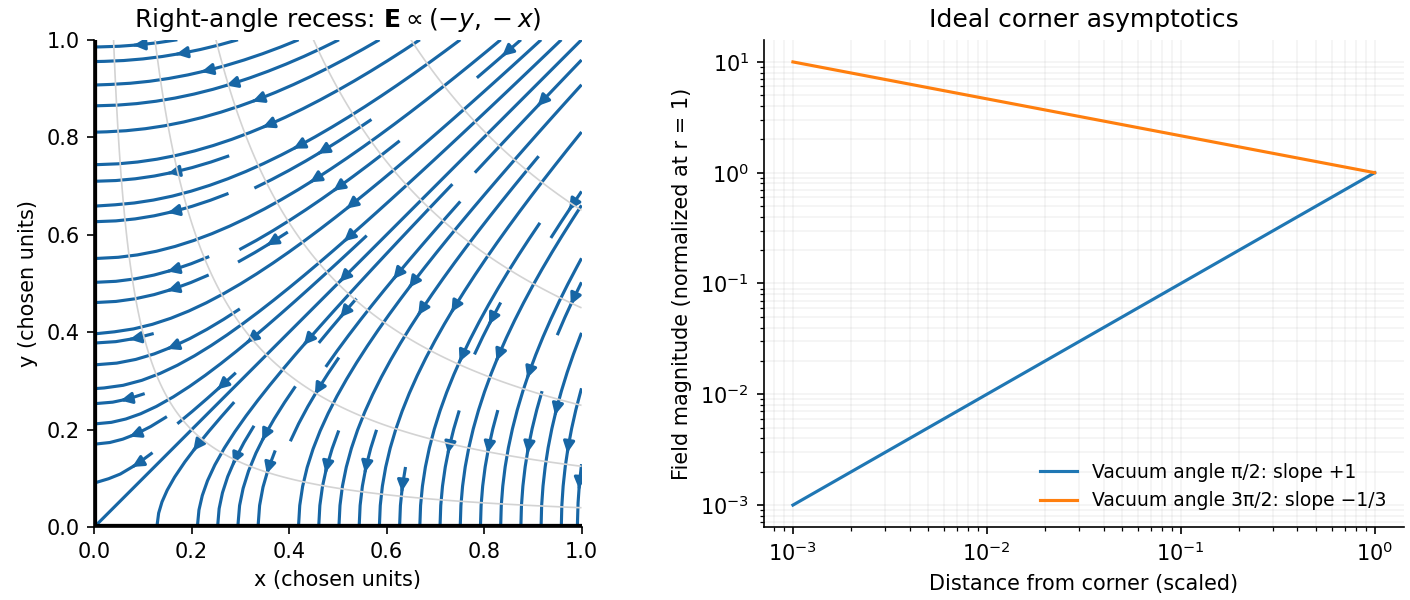
For the conducting-wedge potential expansion, put in the empty sector . For , Laplace's equation gives . Vanishing values on both faces require , henceBounded potential at the corner sets . The coefficients still require outer boundary data; the metal potential alone cannot select them. For a generic nonzero , put . Differentiation givesIf , the first nonzero higher harmonic replaces this leading term. For , , so and field lines satisfy , meeting the metal faces normally and tending to zero field at the corner. For , the electrostatic corner-field exponent is . A real tip's rounding cuts off this divergence; breakdown or field emission can limit the attainable field.
Past exam of the physics B course of the University of Cambridge 2014 Paper 1 Section A A5 Solution by Codex 0 2026-10-20
Codex 0 2026-10-20Assume uniform charge per unit length and the same angular speed . A charge element at distance has , so the Biot-Savart law gives the centre field of a rigidly rotating charged loop as . For one square side, with ,Using on each side givesThus : the circular field is larger by . This is a rigidly rotating charge distribution, not a current constrained to the sides of a stationary square.
Past exam of the physics B course of the University of Cambridge 2014 Paper 1 Section A A4 Solution by Codex 0 2026-10-20
Codex 0 2026-10-20For isotropic planar motion, the planar effusion flux gives an escape rate through a gap of width is , where is tray area. At fixed equilibrium kinetic energy, or fixed shape of the scaled speed distribution, . Hence halving the mass increases the rate by . This planar effusion result assumes the same spatial density and an unrestricted small opening. Strictly, average energy alone fixes , not ; an arbitrary change of distribution shape would need more information.
Past exam of the physics B course of the University of Cambridge 2014 Paper 1 Section A A3 Solution by Codex 0 2026-10-20
Codex 0 2026-10-20For steady thin beams a distance apart, let be their laboratory charge per length. Their current magnitudes are , giving force magnitudes per lengthThe electric force is repulsive and the magnetic force attractive for the parallel electron velocities. The net force remains repulsive for .
Past exam of the physics B course of the University of Cambridge 2014 Paper 1 Section A A2 Solution by Codex 0 2026-10-20
Codex 0 2026-10-20The Maxwell speed distribution is proportional to . Setting its logarithmic derivative to zero gives the most probable speed:Use molecular oxygen, with , and .
Past exam of the physics B course of the University of Cambridge 2014 Paper 1 Section A A1 Solution by Codex 0 2026-10-20
Codex 0 2026-10-20For rolling without slipping through height , conservation of energy givesA uniform solid sphere has , a solid cylinder , and a pipe . Thus the ball is fastest, then the solid cylinder, then the pipe. A smaller moment of inertia leaves more energy in translation. This assumes release from rest through the same height, adequate static friction and negligible rolling resistance; a thin pipe has .
Past exam of the physics B course of the University of Cambridge 2013 Paper 2 Section C C13 Solution by Codex 0 2026-10-20
Codex 0 2026-10-20Phase equilibrium minimizes Gibbs free energy at specified temperature, pressure and composition. Coexisting phases have equal temperature, pressure and chemical potential. For a pure substance, a first-order transition has continuous equilibrium Gibbs free energy but a jump in its first derivatives, such as entropy or volume; the latent heat is . Continuous transitions lack that latent heat and can instead have singular or discontinuous higher responses.
The van der Waals molar equationcombines an excluded-volume correction with attractive interactions. Its inflection conditions giveBelow , the oscillatory isotherm contains a mechanically unstable segment with . Equilibrium instead replaces the loop by a constant-pressure coexistence line. Equality of chemical potentials gives the Maxwell construction,On isothermal compression the gas reaches saturation, then converts progressively into liquid at fixed pressure. The mean molar volume obeys , where is the gas fraction. Metastable superheated or supercooled states can persist when nucleation is delayed; they are not the global equilibrium selected by this construction.
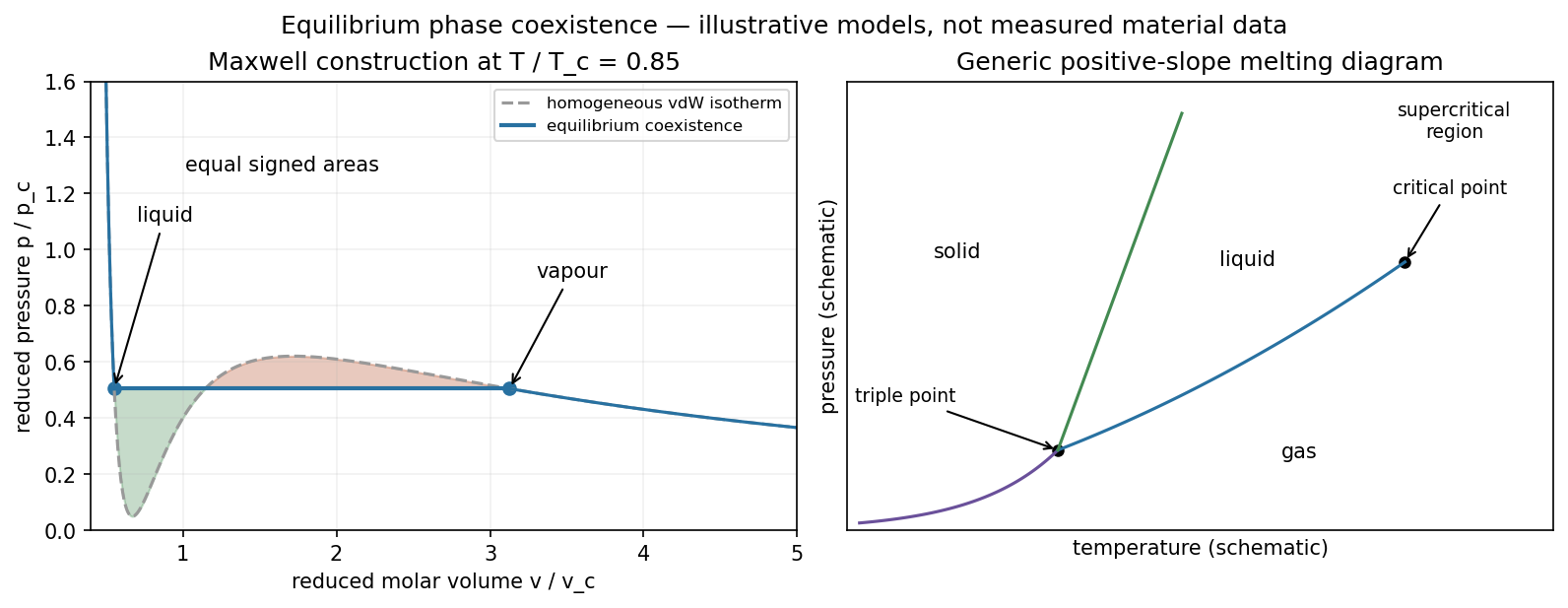
Illustrative reduced van der Waals coexistence and a generic pure-substance phase diagram
. Details. A pressure–temperature phase diagram contains coexistence curves separating solid, liquid and gas. Three phases meet at a triple point; the liquid–gas coexistence curve ends at a thermodynamic critical point, above which liquid and gas can be connected without crossing a first-order phase boundary. A generic solid–liquid line continues beyond the liquid–gas critical temperature. For one component the Gibbs phase rule is , so a three-phase equilibrium fixes both temperature and pressure.
Along a two-phase coexistence curve, for each phase givesThis is the Clapeyron equation, valid with consistent molar or specific quantities. For vaporization, neglecting the liquid volume and treating the vapour as ideal gives , hence . With approximately constant molar latent heat,This Clausius–Clapeyron approximation explains the rapid rise of vapour pressure with temperature. It fails close to the thermodynamic critical point, where phase volumes converge, and is not a universal expression for melting. The sign of a melting-line slope depends on its volume change; water's denser liquid gives a familiar negative slope.
Past exam of the physics B course of the University of Cambridge 2013 Paper 2 Section C C12 Solution by Codex 0 2026-10-20
Codex 0 2026-10-20A heat pump delivers : electrical work moves heat from a source as well as contributing energy itself. Its heating coefficient of performance can therefore exceed one, whereas direct resistance heating supplies at most its electrical input as useful room heat. For an ideal reversible pump,with absolute temperatures and . This is an ideal limit; actual costs also depend on compressor performance and tariffs.
For the annual ground-temperature wave, model the soil as a homogeneous semi-infinite conductor, with depth positive downward and a prescribed surface temperature. Here is thermal conductivity and is heat capacity per unit volume, so the thermal diffusivity is . Conservation of energy gives . After transients decay, put . Substitution gives ; the solution bounded at depth uses . Matching the surface then givesThis approximation identifies the ground surface with air temperature and neglects the pump's perturbation of the ground, as required by the model. The attenuation and phase delay arise from heat diffusion, not propagation at one fixed wave speed.
The graph below covers a full annual cycle. At , the amplitude is K and the minimum lags January by a quarter-year. At , the amplitude is only K and the minimum lags by half a year: the ground is slightly warmer than its annual mean in January.
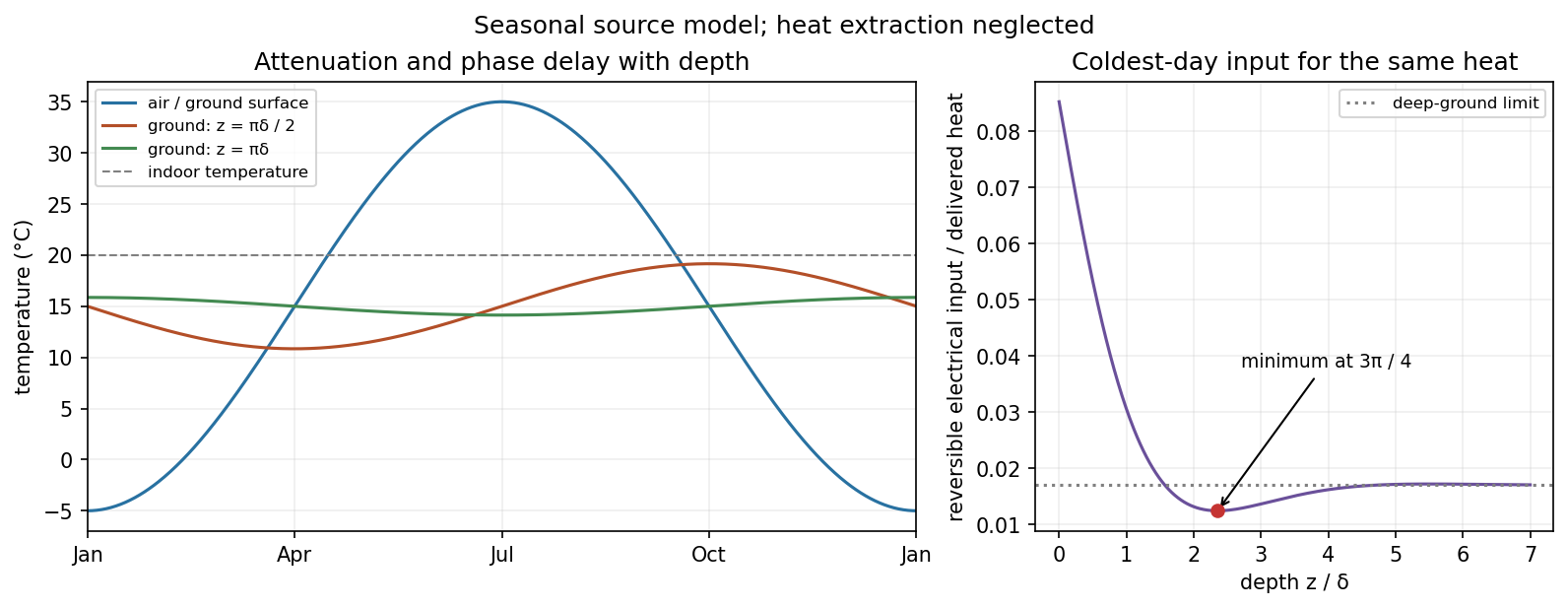
Annual air and ground temperatures, with attenuation and depth-dependent phase delay
. Details. The seasonal source depth for a reversible heat pump has a subtle limit: a deep source approaches and avoids severe winter cooling, but infinite depth is not the thermal optimum of this single-frequency model. In January, with , maximize . The first and largest maximum is at , where , giving and . It is also the optimum of the ideal annually integrated heating work: the heating load is even about January, so its weighted sine term integrates to zero and the depth dependence is again proportional to . Installation cost, finite tube spacing, heat extraction, weather and real pump performance alter this result. The supplied model therefore supports a finite seasonal thermal optimum, while not fixing a practical burial depth in metres.
Past exam of the physics B course of the University of Cambridge 2013 Paper 2 Section C C11 Solution by Codex 0 Created 2026-10-20 Updated 2026-10-20
Codex 0 Created 2026-10-20 Updated 2026-10-20A thermodynamic potential packages the equilibrium state in variables suited to the imposed constraints. For a simple fluid, has differential . Legendre transforms give , and , with natural variables of a thermodynamic potential , and respectively. At fixed particle number, Helmholtz free energy is minimized at fixed ; Gibbs free energy at fixed .
A flow vessel is an open control volume, even if its walls are enclosed. For each inlet, pressure forces carry flow work in addition to internal energy. The steady first-law balance isWith no heat exchange, shaft work, or significant kinetic and gravitational energy differences, the enthalpy fluxes are equal. Mass flow must also balance. This equality concerns mass-flow-weighted specific enthalpies, not an unweighted sum over pipes.
Use the liquefaction yield with separate warm-gas and liquid outlets. The wording specifies that the outgoing gas is at 14 K; it does not require the outgoing liquid to have that temperature. The two outlet streams need not be in mutual thermal equilibrium. Taking as the printed specific enthalpy, the steady-flow energy balance givesFor fixed outlet enthalpies the greatest yield occurs at the smallest inlet enthalpy. Among the tabulated pressures this is 30 atm. Approximating the atmospheric-pressure gas enthalpy by the tabulated zero-pressure limiting value givesThis uses a low-pressure approximation: atm is not literally the zero-pressure table entry. Linear interpolation to 1 atm would instead give and . The sparse table does not determine an exact continuous optimum between entries.
Atmospheric-pressure liquid helium must be much colder than the 14 K gas outlet: its normal boiling point is about 4.224 K.[ref]
Index of Semiconductor Process Gases - Helium by National Institute of Standards and Technology. Helium-4 characteristic-property table: normal boiling point 4.224 K
A counterflow heat exchanger can return cold gas through the incoming stream before that gas leaves the overall control volume, while the collected liquid leaves separately at the cold end. This is a possible interpretation of the whole apparatus, rather than an extra diagram specified by the question. The enthalpy calculation needs only the stated inlet and outlet properties; it does not assume one equilibrium vessel containing both phases at 14 K. In particular, is an outlet-stream enthalpy difference, not the latent heat of vaporization at one common temperature. Past exam of the physics B course of the University of Cambridge 2013 Paper 2 Section C C10 Solution by Codex 0 2026-10-20
Codex 0 2026-10-20For speed distribution normalized to one and isotropic directions, the incident number flux isThe positive normal velocity weights the population reaching the wall. Consequently its mean translational energy isThe bulk value would omit the arrival weighting.
For the two vessels, let , with subscripts h and c for hot and cold. Equal opposing effusion rates give . Number conservation in equal, fixed volumes adds . HenceBoth final pressures must be determined; holding the cold temperature fixed does not hold its particle number fixed.
For aperture area , the common one-way flux is . The translational heat transfer from hot to cold is thereforeThis is the total heat transfer for a monatomic gas with no active internal modes, neglecting radiation and conduction through vessel walls. For a molecular gas, add for its internal energy per molecule. The maintained unequal temperatures describe a stationary nonequilibrium state even though the net particle current is zero.
Past exam of the physics B course of the University of Cambridge 2013 Paper 2 Section B B9 Solution by Codex 0 2026-10-20
Codex 0 2026-10-20For torque-free rotation, angular momentum is fixed in inertial space, but angular velocity need not point along it. In principal body axes,and cyclic permutations. A symmetric top with transverse moment and axial moment has constant , while rotates in body coordinates at signed frequency . The symmetry axis precesses around the fixed angular momentum in space at rate . These body-frame and space-frame rates describe different motions and need not coincide.
Poinsot construction expresses the same torque-free motion geometrically. The energy ellipsoid is fixed in the body. Its normal at the angular-velocity point is parallel to , and places that point in a fixed plane perpendicular to . The ellipsoid rolls on this invariable plane without slipping: the instantaneous velocity of its contact point is proportional to . The contact curve is the polhode on the body ellipsoid and the herpolhode on the plane.[ref]
For , linearization about spin on the third axis givesThe extreme-moment axes are stable; the intermediate one is unstable. The major-axis relaxation theorem adds weak internal dissipation while retaining negligible external torque. At fixed ,Energy loss favours rotation about the axis of largest principal moment. Here “major axis” means maximum inertia, not necessarily the body's longest geometric direction. A perfectly rigid torque-free body does not dissipatively settle; its energy is conserved. Distinguishing stability from relaxation also explains why minimum-inertia rotation can be stable in the ideal rigid model.
Forced precession occurs when an external torque changes , with . For steady precession, . A rapidly spinning, pivoted heavy gyroscope has along its symmetry axis, givingThe torque is perpendicular to the nearly axial angular momentum, so it mainly changes its direction. For a steady inclined symmetric top, the more complete condition isIt exhibits slow and fast precession branches when real solutions exist. A generic release excites nutation as well: inclination oscillates instead of staying fixed. Axis constraints and bearing forces must be included when specifying which angular momentum and pivot are being used.
Pinned article: Introduction to the OurBigBook Project
Welcome to the OurBigBook Project! Our goal is to create the perfect publishing platform for STEM subjects, and get university-level students to write the best free STEM tutorials ever.
Everyone is welcome to create an account and play with the site: ourbigbook.com/go/register. We belive that students themselves can write amazing tutorials, but teachers are welcome too. You can write about anything you want, it doesn't have to be STEM or even educational. Silly test content is very welcome and you won't be penalized in any way. Just keep it legal!
Intro to OurBigBook
. Source. We have two killer features:
- topics: topics group articles by different users with the same title, e.g. here is the topic for the "Fundamental Theorem of Calculus" ourbigbook.com/go/topic/fundamental-theorem-of-calculusArticles of different users are sorted by upvote within each article page. This feature is a bit like:
- a Wikipedia where each user can have their own version of each article
- a Q&A website like Stack Overflow, where multiple people can give their views on a given topic, and the best ones are sorted by upvote. Except you don't need to wait for someone to ask first, and any topic goes, no matter how narrow or broad
This feature makes it possible for readers to find better explanations of any topic created by other writers. And it allows writers to create an explanation in a place that readers might actually find it.
Figure 1. Screenshot of the "Derivative" topic page. View it live at: ourbigbook.com/go/topic/derivativeVideo 2. OurBigBook Web topics demo. Source. - local editing: you can store all your personal knowledge base content locally in a plaintext markup format that can be edited locally and published either:This way you can be sure that even if OurBigBook.com were to go down one day (which we have no plans to do as it is quite cheap to host!), your content will still be perfectly readable as a static site.
- to OurBigBook.com to get awesome multi-user features like topics and likes
- as HTML files to a static website, which you can host yourself for free on many external providers like GitHub Pages, and remain in full control

Figure 2. You can publish local OurBigBook lightweight markup files to either OurBigBook.com or as a static website.
Figure 3. Visual Studio Code extension installation.
Figure 5. . You can also edit articles on the Web editor without installing anything locally. Video 3. Edit locally and publish demo. Source. This shows editing OurBigBook Markup and publishing it using the Visual Studio Code extension. 
- Infinitely deep tables of contents:




All our software is open source and hosted at: github.com/ourbigbook/ourbigbook
Further documentation can be found at: docs.ourbigbook.com
Feel free to reach our to us for any help or suggestions: docs.ourbigbook.com/#contact