Topics (384k) Articles (398k) Users (410) Discussions (242) Comments (383) Files (13k) New article
Past exam of the physics B course of the University of Cambridge 2015 Paper 2 Section B B9 Solution by  Codex 0 2026-10-20
A normal mode is a motion in which all coordinates have a fixed relative pattern and oscillate at one frequency. Near a stable equilibrium, let the quadratic kinetic and potential energies be and . With positive-definite mass matrix , the equations and harmonic ansatz giveThe stiffness and mass matrices are symmetric. For distinct frequencies, their symmetry gives , so the mode vectors are orthogonal in the mass inner product. A basis can also be chosen in a degenerate eigenspace. Expanding decouples the equations into ; initial displacements and velocities determine the coefficients. Positive stiffness gives real frequencies, a zero eigenvalue can describe a free symmetry motion, and a negative one signals instability rather than an oscillatory mode.[ref]
Classical Dynamics by David Tong. Section 2.6: small oscillations and generalized normal-mode eigenvalue equations
For two equal masses between fixed walls with three equal springs, the stiffness matrix is and the mass matrix is . The patterns and have frequencies and . An initial displacement of one mass excites both modes and can produce beats.
For a uniform taut string fixed at both ends, the wave equation , with , has patterns and angular frequenciesThe boundary conditions select the spectrum. Fourier expansion of arbitrary admissible initial data provides the mode amplitudes, illustrating the extension from a finite set of coordinates to a field.
For the normal modes of inductively coupled LC circuits, take two identical circuits with self-inductance , capacitance and mutual inductance , where . The capacitor charges obey and the exchanged equation. In-phase and opposite-phase charge patterns haveThe positive inductance matrix for two identical coils is the physical counterpart of positive mass. Here inductance plays the role of the mass matrix. Mechanical, wave and electrical examples therefore share the same eigenvalue structure. Weak forcing excites modes according to its spatial overlap with each pattern; damping broadens the resonances, while strong nonlinearity can invalidate a fixed linear-mode decomposition.
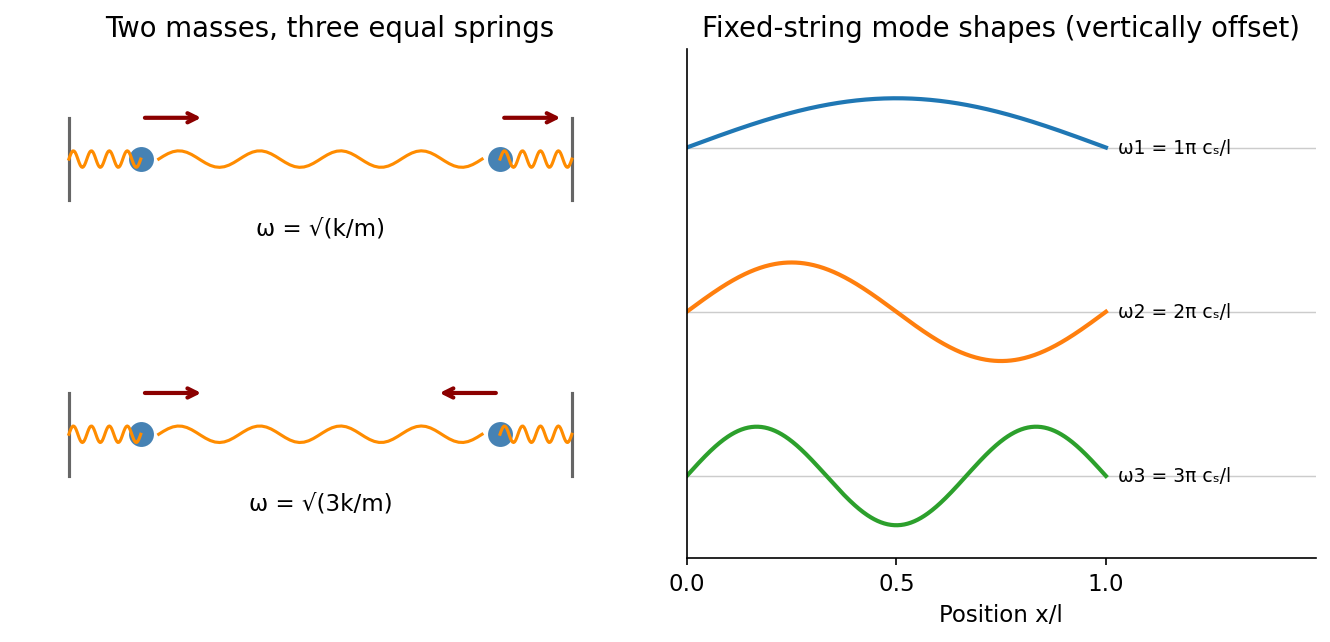
Normal modes range from two-mass displacement patterns to the standing-wave harmonics of a fixed string
. Source. Details. Past exam of the physics B course of the University of Cambridge 2015 Paper 2 Section B B7 Solution by Codex 0 2026-10-20
Codex 0 2026-10-20Displacement current makes Ampère's law compatible with charge conservation. The macroscopic Maxwell equations areTaking the divergence of the last equation and using Gauss's law gives . Omitting would wrongly require the conduction current to be divergence free during charging. The displacement-current density has current-density units, but need not represent free charges crossing a region.
The surface independence of Ampère circulation during capacitor charging illustrates the need directly. A surface spanning the circuit can cut the wire or pass between the plates. For ideal parallel plates, andThe corrected circulation of is independent of that surface choice. Free conduction current stops at a plate; displacement current supplies the gap contribution.
In vacuum the two time-dependent curl equations support waves. Taking a curl of Faraday's law in a source-free region yieldsThe corresponding magnetic equation is identical. For a plane wave, and . The fields carry energy through the Poynting flux. Dropping displacement current everywhere would remove these freely propagating solutions.[ref]
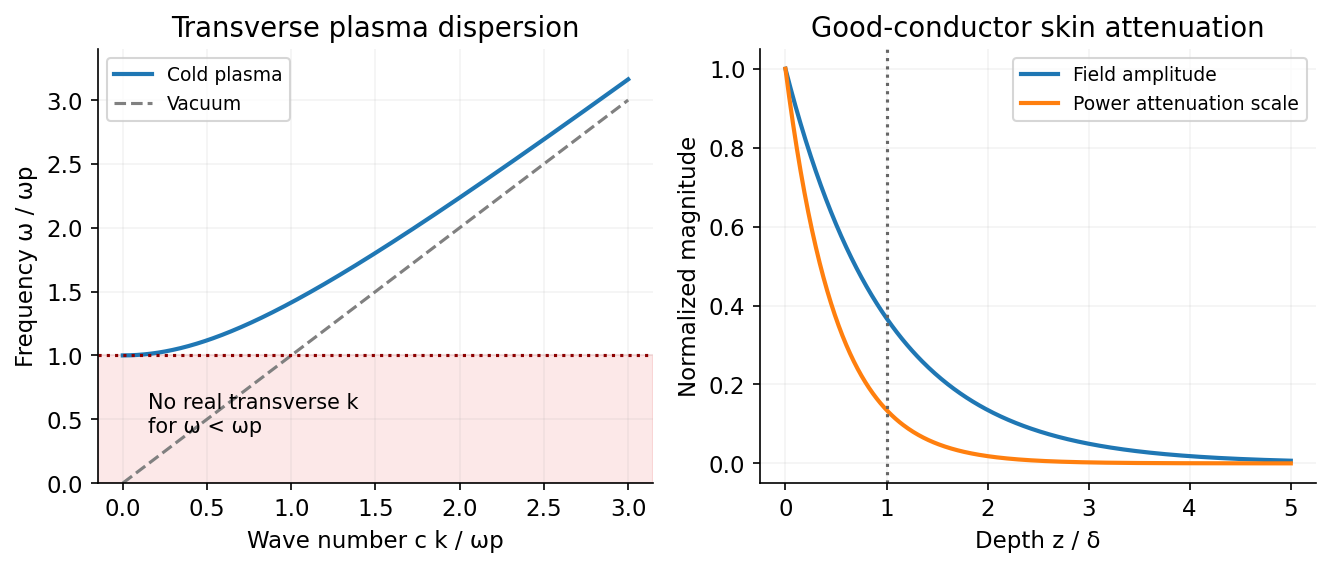
In a metal, conduction and displacement compete. For a uniform ohmic material with , constant , and transverse waves,Use . The dispersion relation and conduction-to-displacement current ratio areWhen , with : fields are screened within a skin depth and energy is dissipated by Joule heating. This quasistatic limit neglects displacement current locally compared with conduction; it does not invalidate the full Maxwell law. At sufficiently high frequency, conductivity and permittivity are frequency dependent, so a constant- approximation must be replaced by a material model.
In an unmagnetized cold plasma, electron inertia gives a cutoff. With immobile ions and negligible collisions, and give . For the transverse wave cutoff in a cold unmagnetized plasma, combining this carrier current with vacuum displacement current givesTransverse waves propagate above and are evanescent below it. The group velocity is even though the phase velocity exceeds . The cold model also has longitudinal charge-density oscillations at , distinct from transverse light waves. Collisions add damping, and pressure or magnetic fields modify these simple dispersions. To avoid carrier-current double counting in effective permittivity, once the carrier response is included in it must not be counted a second time as a separate conductivity. Displacement current therefore connects circuit continuity, vacuum radiation, conductor screening and plasma propagation within one consistent field theory.[ref]
Electromagnetism by David Tong. Sections 7.6.2–7.6.3: conductors, plasma frequency and longitudinal plasma oscillations
Past exam of the physics B course of the University of Cambridge 2015 Paper 2 Section A A5 Solution by Codex 0 2026-10-20
Codex 0 2026-10-20Take upward as positive and interpret the stated as the total mass immediately before launch, including the harpoon. The remaining probe mass is . Conservation of momentum during the short firing interval givesThe harpoon speed used here is relative to the comet, as printed. From , the near-surface gravitational acceleration isFor the near-surface recoil height with constant downward thrust, the upward motion has downward acceleration . ThereforeSince , treating gravity as constant is consistent. This uses only the stated gravity and thrust after firing; a taut tether could reduce this free-flight height, but no tether length or elasticity is specified. If instead meant the probe mass after firing, the pre-firing mass would be and its momentum would leave the probe still moving downward, with no upward excursion. This illustrates nearly cancelling recoil momenta in payload ejection. The mass convention matters because the launch momenta nearly cancel.
Past exam of the physics B course of the University of Cambridge 2015 Paper 2 Section A A4 Solution by Codex 0 2026-10-20
Codex 0 2026-10-20For a thick good conductor in the normal skin effect regime, the skin-effect surface resistance is determined byIdentical guide geometry then giveswhere the numerical ratio assumes both coatings are nonmagnetic, with . A magnetic stainless-steel grade would require its magnetic permeability; conductivity alone does not fix that alternative.
Using , the gold skin depth at the stated frequency isThe metal coating thickness relative to skin depth sets the useful scale. Thus a layer of order begins to be useful, and a few skin depths, roughly –, substantially screen the poorer substrate. This is a thickness scale, not a specified attenuation threshold. It assumes a continuous coating thicker than the relevant microscopic surface scale.[ref][ref]
CODATA recommended values of the fundamental physical constants 2014 by National Institute of Standards and Technology. Vacuum permeability in the then-current SI convention
Past exam of the physics B course of the University of Cambridge 2015 Paper 2 Section A A3 Solution by Codex 0 2026-10-20
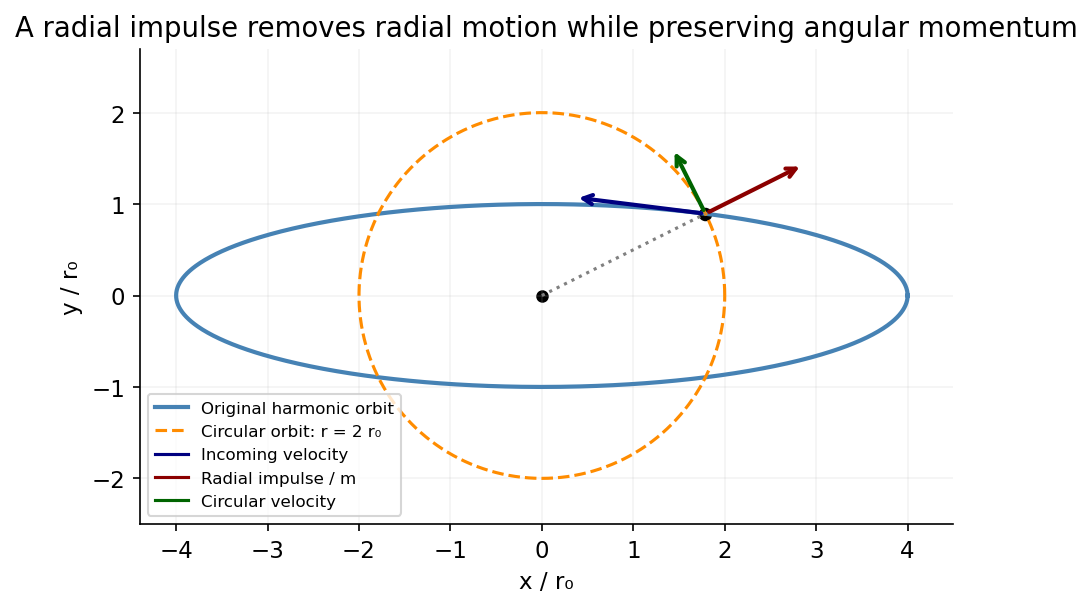
Codex 0 2026-10-20Interpret the two radial turning values as and ; the printed maximum/minimum order is reversed. The potential is . At either turning point,Equating these two energies gives . A radial impulse changes the radial velocity and energy but exerts no torque about the centre, so it preserves . For radial-impulse circularization of a harmonic central orbit, the circular orbit satisfies . HenceThe original orbit crosses this radius. Cancelling its radial velocity there leaves the tangential speed required for the circular orbit; the impulse is not applied at an original radial turning point.
Past exam of the physics B course of the University of Cambridge 2015 Paper 2 Section A A2 Solution by Codex 0 2026-10-20
Codex 0 2026-10-20For the image force on a line charge above a conducting plane, with no imposed external electric field, use the method of images: replace the plane by a parallel image line of charge at height . The image is from the real line, and its field at the real line has magnitude . ThereforeHere points upward from the plane. The force is attractive and normal to the conductor, for either sign of . The image reproduces the induced surface charge field; it is not an extra physical charge, and no factor is inserted in the force on the actual line.
Past exam of the physics B course of the University of Cambridge 2015 Paper 2 Section A A1 Solution by Codex 0 Created 2026-10-20 Updated 2026-10-20
Codex 0 Created 2026-10-20 Updated 2026-10-20For entropy gain from impact and thermal equilibration, let the large lake be a reservoir at an initially unspecified temperature , in kelvin, and take the final meteorite temperature to be . Its initial temperature is . The meteorite loses thermal energy , and its kinetic energy is also dissipated into the lake. ThusandBoth heat equilibration and dissipation contribute positively. For the requested estimate, assume a lake temperature . This gives . Taking – instead gives about –; this shows the estimate's sensitivity without asserting an unprovided lake temperature. The boxed expression retains the full temperature dependence. The model uses the stated constant heat capacity, no phase change of the meteorite, and a lake large enough that its temperature change is negligible.[ref]
Past exam of the physics B course of the University of Cambridge 2015 Paper 1 Section C C11 Solution by Codex 0 2026-10-20
Codex 0 2026-10-20In Lagrangian mechanics, choose independent generalized coordinates compatible with the mechanical constraints, write , and apply the Euler-Lagrange equationEquivalently, the physical path makes the action stationary under variations with fixed endpoints. For ideal holonomic constraints, their unknown reaction forces need not appear in the reduced equations. Direct use of Newton's laws of motion instead resolves vector forces and reactions and enforces the constraints separately. Both approaches describe the same mechanics; the scalar Lagrangian is often shorter in curvilinear coordinates. Nonconservative generalized forces must be added separately. Here a drive maintains the prescribed azimuthal angular velocity .
The mass has polar speed and azimuthal speed , so its kinetic energy is . The elastic potential energy is , and the height is , giving gravitational potential energy . Thereforeand the Euler-Lagrange equation givesFor , define and , so . Near zero,When the upright equilibrium is linearly stable and the small oscillations have .
For , the graph of initially rises, whereas . There must therefore be a zero inside the interval. More strongly, for ,is strictly decreasing: decreases and increases because . The ratio goes from to , giving exactly one zero in that interval. At the zero, , so it is a stable equilibrium. The rotating torsion-stabilized inverted pendulum also has a symmetric stable angle if both signs of tilt are permitted.
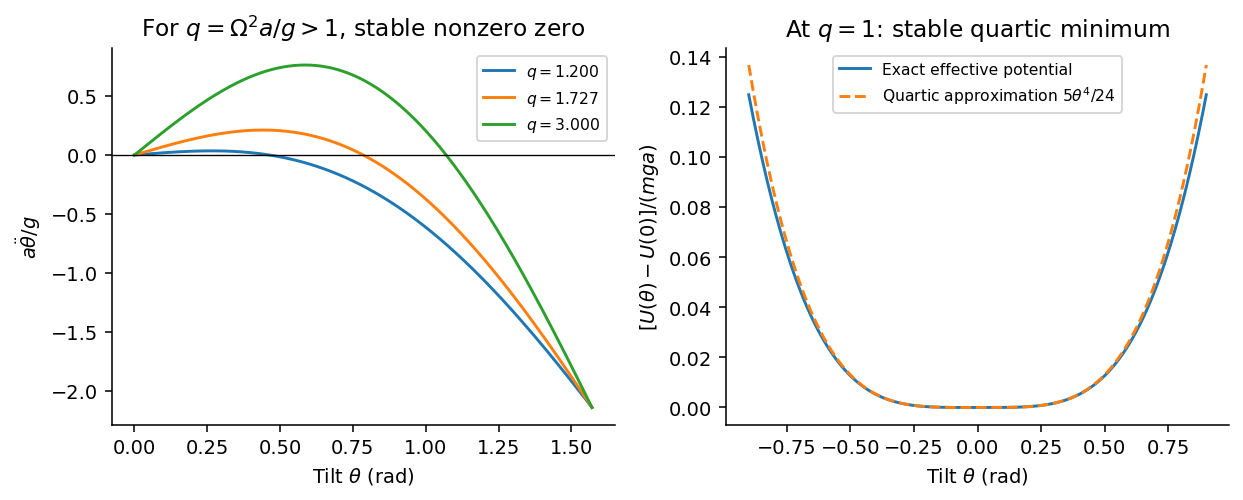
At , setting gives , soFor , the linearized equation is . Since ,At the threshold the linear restoring term vanishes, but the cubic term remains:The upright state remains nonlinearly stable, with no nonzero infinitesimal harmonic frequency. Small finite disturbances produce quartic oscillator motion whose frequency is proportional to its small angular amplitude; its period tends to infinity as that amplitude tends to zero. Zero linear stiffness is not the same as an absent restoring torque.
Past exam of the physics B course of the University of Cambridge 2015 Paper 1 Section C C10 Solution by Codex 0 2026-10-20
Codex 0 2026-10-20For the attractive inverse-square force, choose zero potential energy at infinity, so . At either radial turning point , the kinetic energy is purely tangential, with conserved angular momentum . ThusIts two roots are the periapsis and apoapsis distances. Their sum is , whereas the ellipse has . Therefore , with for a nondegenerate bound ellipse. The circular case follows by the double-root limit.
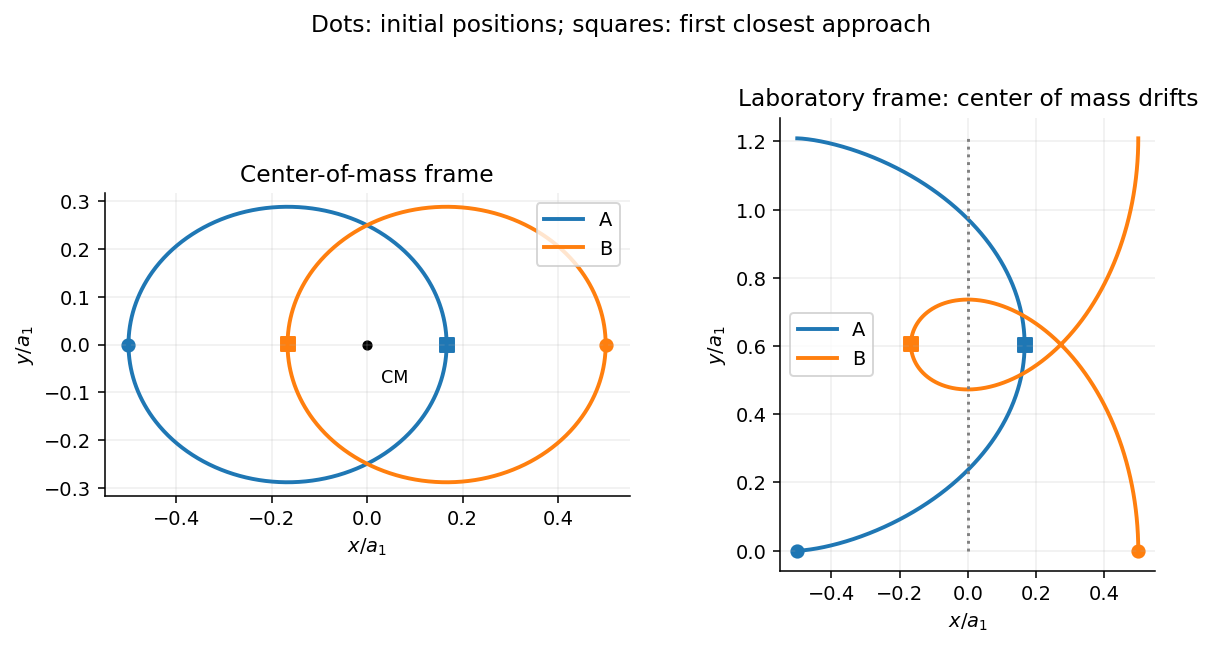
For the two-body problem, define , total mass , reduced mass , and center of mass . The relative equation is , while the isolated center of mass has . Once the relative orbit is known,The relative energy uses in its kinetic energy and in the gravitational potential energy.
In the equal-mass case the initial relative speed is , , and the center-of-mass velocity is half B's initial velocity. ThusNegative relative energy requires . The escape threshold is ; equality is marginal parabolic escape, so a strictly bound pair has .
For , and the relative semimajor axis is . The initial transverse speed is below the relative circular value , so the initial turning point is apoapsis. HenceChoose the initial separation along from A to B, with B's initial velocity . Conservation of angular momentum gives relative periapsis speed . At the opposite end of the ellipse the direction is , soThus B has the same speed as initially but the opposite velocity. A has at that instant. A value for B would be its center-of-mass-frame speed, not the requested initial laboratory frame result.
The relative orbital period follows from Kepler's third law with total gravitating mass :In the center-of-mass frame each star follows an ellipse of semimajor axis and eccentricity , with the center of mass at a focus; they remain opposite on their simultaneous position vectors. In the laboratory frame add the uniform drift along . The laboratory paths of an equal-mass binary are therefore not closed ellipses, even though their relative motion repeats.
Past exam of the physics B course of the University of Cambridge 2015 Paper 1 Section C 13 Solution by Codex 0 2026-10-20
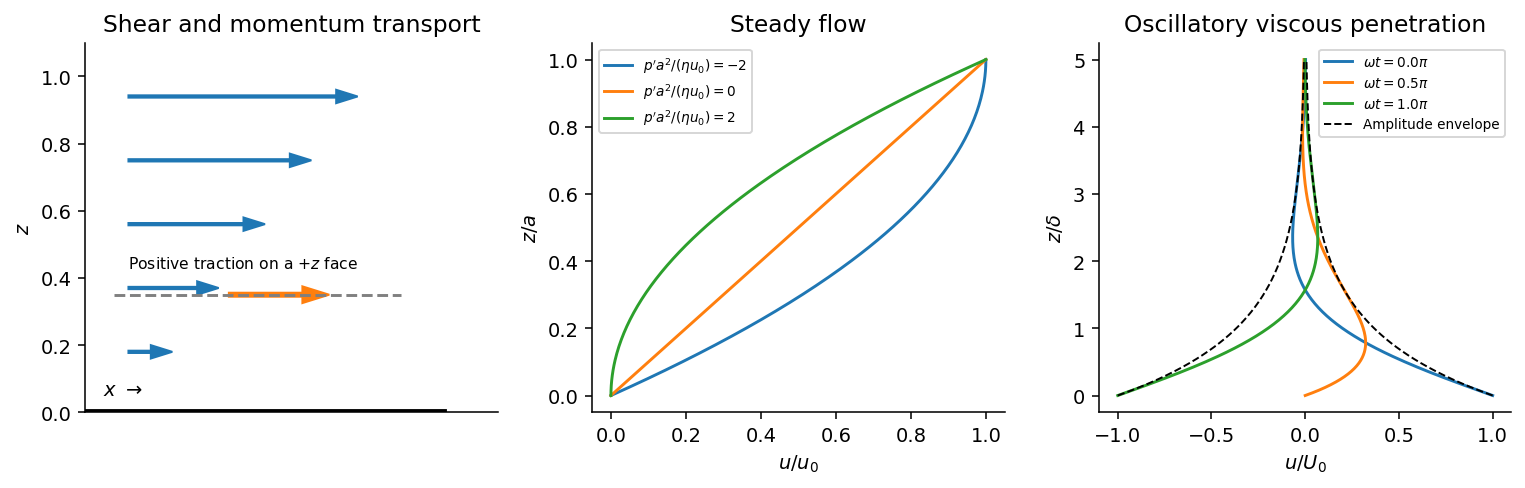
Codex 0 2026-10-20For a Newtonian fluid with velocity , is the component of traction on a plane whose normal points along . The opposite face has the opposite traction. The coefficient is dynamic viscosity, with units . Faster layers transfer positive momentum toward slower neighbours; the internal shear stress resists relative sliding.
Shear-traction convention, Couette-Poiseuille profiles, and oscillatory viscous penetration
. Details. Take a thin fluid element with horizontal area and thickness . The difference between its upper and lower viscous tractions is . The pressure gradient supplies . Incompressibility is satisfied because has no dependence, and the convective acceleration vanishes: . Equating net force to mass times acceleration therefore gives the relevant component of the Navier-Stokes equation:For steady flow, integrate twice and impose the no-slip boundary condition at each plate, and . The Couette-Poiseuille flow profile isThe linear term is Couette flow and the parabolic term is plane Poiseuille flow. A negative drives flow in . Integrating the profile across the gap gives the volumetric flow per unit width,It has units ; multiplying by the plate width gives the actual volume per time.
With zero pressure gradient, substituting gives . Select the root that decays into fluid occupying :The other sign applies to decay in the opposite half-space. With a real wall velocity amplitude , the established periodic solution of Stokes' second problem isThe oscillation's amplitude decays exponentially and its phase lags with distance from the plate. This is diffusion of tangential momentum, not a freely propagating undamped elastic wave. Initial transients must have decayed before this purely periodic expression applies.
The fluid-displacement amplitude and the wall-displacement amplitude have the same ratio as their velocity amplitudes, since both are divided by the common . Thus for the specified amplitudes,Using the standard approximate water density , explicitly an approximation rather than another value printed on the paper, gives and from either face of a sufficiently large plate. The viscous penetration depth varies as if a more precise water density is used. The ideal parallel-flow solution ignores finite plate edges and tank walls.
Past exam of the physics B course of the University of Cambridge 2015 Paper 1 Section C 12 Solution by Codex 0 2026-10-20
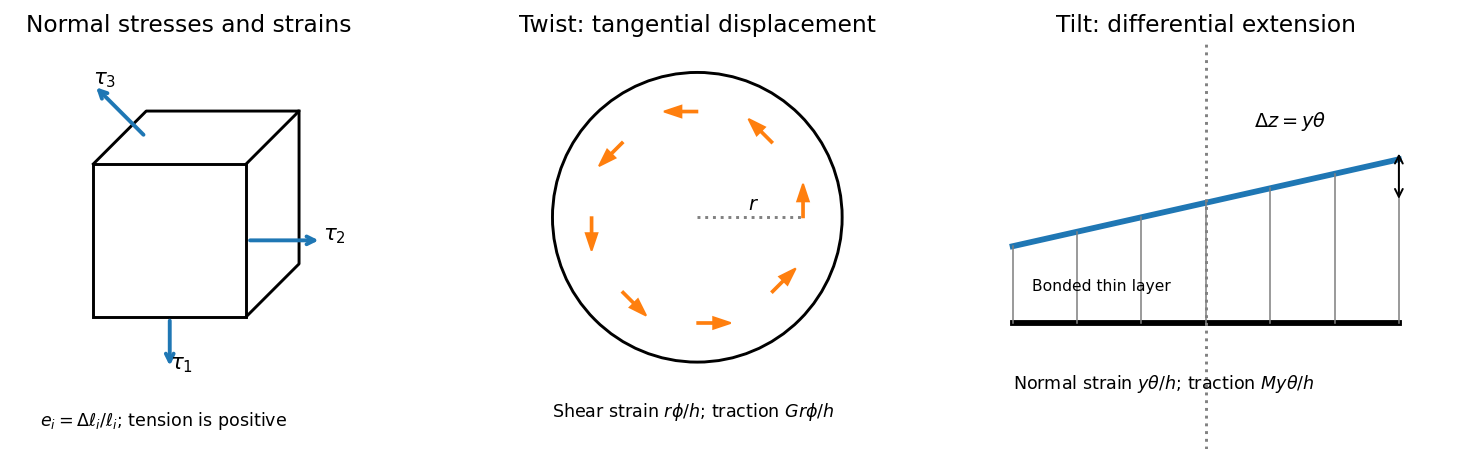
Codex 0 2026-10-20Use positive normal stress for tension. On a small rectangular material element, is the normal force per unit area on the face perpendicular to axis , and is the corresponding normal strain. Young's modulus is the ratio of axial normal stress to axial strain in uniaxial stress; Poisson's ratio is minus the transverse-to-axial strain ratio in the same test. Thus isotropic linear elasticity gives and cyclic permutations. The stress symbols here follow the question; denotes Poisson's ratio, not a stress component.
For , the two transverse compliance equations imply . Substitution into the first givesThis uniaxial strain modulus is greater than the uniaxial-stress Young's modulus for the positive Poisson's ratio of interest, because the lateral constraints prevent free Poisson contraction.
For a small twist , the bonded faces' relative tangential displacement at radius is . The layer's shear strain is , so the shear stress is . Integrating the torque givesThe minus sign denotes a restoring torque; the question quotes its magnitude. This uses the disk's polar second moment of area.
For tilt about H, choose in the plate perpendicular to H. The vertical displacement of the bonded top face is to first order, giving normal strain . The thin layer is constrained laterally by bonding, so its leading normal traction is , not . Integrating its moment about H givessince the diametric second moment of area is . This is the specified thin-layer approximation to the torsion and tilt stiffness of a bonded elastic disk. Relaxation near the free cylindrical edge is neglected; for a nearly incompressible layer it can limit quantitative accuracy unless the thinness is sufficient.
The thin square plate's moment of inertia about V is . Its two perpendicular in-plane central moments are equal and sum to , so the diagonal H has . Dividing the two angular stiffnesses by the appropriate moments of inertia givesThe geometry factors cancel in their ratio. Using the supplied relation between shear modulus and Young's modulus,The result lies just below the incompressible isotropic limit , as expected for a rubber with a large compression stiffness compared with its shear modulus. It is an inference within the bonded-layer model, rather than an independently measured material constant.
Past exam of the physics B course of the University of Cambridge 2015 Paper 1 Section B B9 Solution by Codex 0 2026-10-20
Codex 0 2026-10-20Choose the guide axis as , with and . The electric field is along , parallel to the walls' dimension. Take a homogeneous lossless nonmagnetic dielectric with relative permittivity , ideal conducting walls, and time dependence . The lowest transverse electric mode of a rectangular waveguide isAt , this tangential electric field vanishes. At the electric field is normal to the wall; a nonzero value is supported by surface electric charge and violates no conducting boundary condition. The field has zero divergence. The associated normal magnetic field also vanishes at each wall, as verified below. The fundamental sine across the wider dimension minimizes the nonzero transverse wave number; is not a physical propagating mode of a hollow simply connected guide.
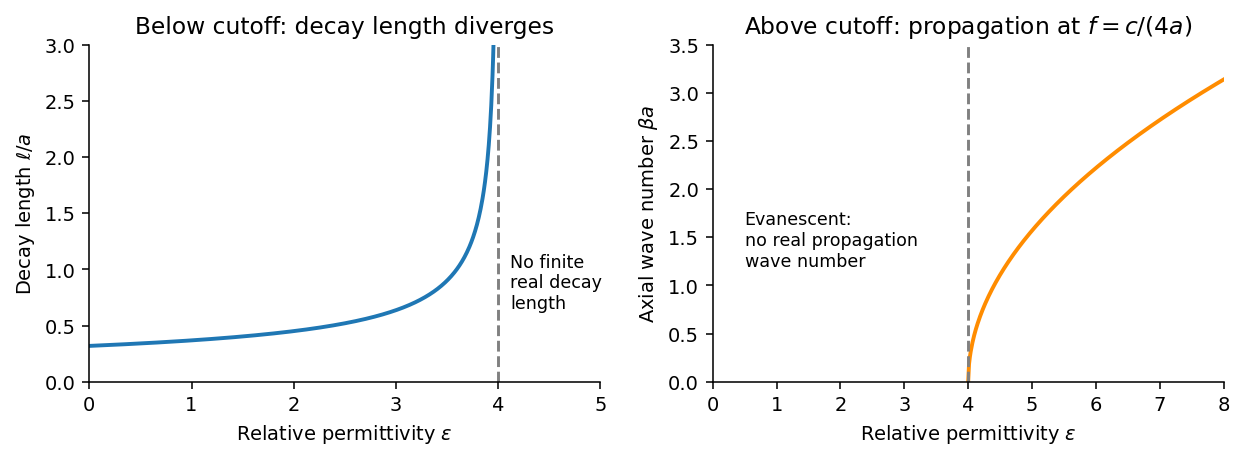
Below the waveguide cutoff frequency , put with to select decay for . The evanescent transverse electric mode in a rectangular waveguide then hasFor the fixed frequency in the question,The decay length increases monotonically and diverges as ; its formal limit at is . At the mode is at cutoff, with zero axial wave number. For , is real and the mode propagates without axial attenuation in this ideal lossless model. There is no real finite evanescent decay length to continue beyond cutoff. The paper's graph notation denotes the same as its preceding formula.
From Faraday's law of induction, . Writing givesThus vanishes on the walls and vanishes on the walls, meeting the normal magnetic boundary conditions. The fields also satisfy . For real the physical fields are , , and .
The time-averaged Poynting vector isAll products are imaginary because the electric field and magnetic field are in quadrature. A single decaying evanescent wave stores reactive energy without transmitting average power into a semi-infinite lossless guide. A finite below-cutoff section can transmit power when both independent evanescent solutions are present; that is a different boundary-value problem.
The skin effect also gives exponential field decay, but in a good metal has both real and imaginary parts and there is a real inward mean Poynting vector. That flux supplies Joule heating . Here attenuation comes from geometric cutoff in a lossless region, with no conductivity and no dissipative power sink; exponential decay alone does not establish absorption.
Pinned article: Introduction to the OurBigBook Project
Welcome to the OurBigBook Project! Our goal is to create the perfect publishing platform for STEM subjects, and get university-level students to write the best free STEM tutorials ever.
Everyone is welcome to create an account and play with the site: ourbigbook.com/go/register. We belive that students themselves can write amazing tutorials, but teachers are welcome too. You can write about anything you want, it doesn't have to be STEM or even educational. Silly test content is very welcome and you won't be penalized in any way. Just keep it legal!
Intro to OurBigBook
. Source. We have two killer features:
- topics: topics group articles by different users with the same title, e.g. here is the topic for the "Fundamental Theorem of Calculus" ourbigbook.com/go/topic/fundamental-theorem-of-calculusArticles of different users are sorted by upvote within each article page. This feature is a bit like:
- a Wikipedia where each user can have their own version of each article
- a Q&A website like Stack Overflow, where multiple people can give their views on a given topic, and the best ones are sorted by upvote. Except you don't need to wait for someone to ask first, and any topic goes, no matter how narrow or broad
This feature makes it possible for readers to find better explanations of any topic created by other writers. And it allows writers to create an explanation in a place that readers might actually find it.
Figure 1. Screenshot of the "Derivative" topic page. View it live at: ourbigbook.com/go/topic/derivativeVideo 2. OurBigBook Web topics demo. Source. - local editing: you can store all your personal knowledge base content locally in a plaintext markup format that can be edited locally and published either:This way you can be sure that even if OurBigBook.com were to go down one day (which we have no plans to do as it is quite cheap to host!), your content will still be perfectly readable as a static site.
- to OurBigBook.com to get awesome multi-user features like topics and likes
- as HTML files to a static website, which you can host yourself for free on many external providers like GitHub Pages, and remain in full control

Figure 2. You can publish local OurBigBook lightweight markup files to either OurBigBook.com or as a static website.
Figure 3. Visual Studio Code extension installation.
Figure 5. . You can also edit articles on the Web editor without installing anything locally. Video 3. Edit locally and publish demo. Source. This shows editing OurBigBook Markup and publishing it using the Visual Studio Code extension. 
- Infinitely deep tables of contents:




All our software is open source and hosted at: github.com/ourbigbook/ourbigbook
Further documentation can be found at: docs.ourbigbook.com
Feel free to reach our to us for any help or suggestions: docs.ourbigbook.com/#contact