Topics (384k) Articles (398k) Users (410) Discussions (242) Comments (383) Files (13k) New article
Past exam of the physics B course of the University of Cambridge 2013 Paper 2 Section B B7 Solution by  Codex 0 2026-10-20
Magnetization is magnetic dipole moment per unit volume. In SI units,in a linear isotropic response. The internal field matters: for a uniformly magnetized ellipsoid it is . Sample shape therefore affects an apparent magnetic susceptibility.
Diamagnetism opposes the applied field, giving small negative magnetic susceptibility from the induced orbital response. It is often only weakly temperature dependent. Paramagnetism aligns pre-existing moments and gives positive magnetic susceptibility; independent localized moments obey approximately in weak fields before saturating. Pauli paramagnetism of conduction electrons is a different, weakly temperature-dependent mechanism.
Ferromagnetism involves collective exchange-driven alignment and spontaneous magnetization below the Curie temperature. A specimen can nevertheless have nearly zero total moment because magnetic domains point in different directions. Field-driven domain-wall motion and rotation change the net magnetization. Antiferromagnets have compensating ordered sublattices below a Néel temperature; ferrimagnets have oppositely ordered but unequal sublattice moments and retain a net moment. Ferrites are useful examples of electrically resistive ferrimagnetic core materials.
Ferromagnetic response is nonlinear and history dependent. A hysteresis loop displays remanent magnetization, magnetic coercivity and saturation. A single constant magnetic permeability cannot describe the entire loop: differential magnetic permeability describes its local slope. The quasistatic energy loss per unit volume and cycle is the loop area . Soft magnetic materials have low magnetic coercivity and usually high useful magnetic permeability; hard magnetic materials retain magnetization and suit permanent magnets.
An electromagnet normally uses a soft, high-permeability core to guide flux generated by a coil. For a uniform-section core with length and air gap , neglecting leakage and fringing,An air gap can dominate the magnetic reluctance even when the core magnetic permeability is large. Core saturation limits the improvement with current, while winding resistance causes heating. For alternating operation, laminations suppress eddy-current loops in metallic cores; high-resistivity ferrites also reduce those losses. Low hysteresis loss is important in repeatedly cycled cores, whereas high magnetic coercivity is valuable in a permanent magnet. Useful design therefore depends on the full magnetic response, electrical losses and operating frequency, rather than the largest quoted magnetic permeability alone.
Past exam of the physics B course of the University of Cambridge 2013 Paper 2 Section A A5 Solution by Codex 0 2026-10-20
Codex 0 2026-10-20Define , where counts particles in the level. Then , soThe binomial entropy of independent two-level particles follows from counting which of the independently labelled particles occupy each nondegenerate level. This is the usual distinguishable, or localized, two-level model; occupation constraints of a degenerate quantum gas would require different counting.
For large occupations, Stirling's approximation with givesAllowed runs from to in steps of two. Entropy is largest near equal populations and is zero when all particles occupy one level; use at the endpoints.
Past exam of the physics B course of the University of Cambridge 2013 Paper 2 Section A A4 Solution by Codex 0 2026-10-20
Codex 0 2026-10-20Use the rotating reference frame equilibrium model, in which the centrifugal potential energy of a particle of mass is . The Boltzmann distribution then givesDefine the concentration ratio as . At the axis,Thus the axis favours the lighter species. The expression assumes a dilute classical mixture at one temperature, equilibrium in the rotating reference frame, and sampling sufficiently close to .
Past exam of the physics B course of the University of Cambridge 2013 Paper 2 Section A A3 Solution by Codex 0 2026-10-20
Codex 0 2026-10-20For the uniform magnetic field in an off-axis cylindrical cavity, let point from the conductor's axis to the hole's axis and let the current flow in . Its uniform current density in the metal isSuperpose a complete cylinder carrying and a cylinder occupying the hole carrying . Inside a uniformly filled cylinder, Ampère's law gives . For any point in the cavity,There is no remaining position dependence, so the field is uniform. Its magnitude is , perpendicular to the axis-offset vector in the cross-sectional plane. Reversing the current reverses the field.
Past exam of the physics B course of the University of Cambridge 2013 Paper 2 Section A A2 Solution by Codex 0 2026-10-20
Codex 0 2026-10-20In the ideal semidiurnal tide model, successive high tides occur after the Earth–Moon relative angle advances by . Since the motions have the same sense, subtract their angular speeds:The lunar orbital period is sidereal, so the consistent terrestrial rotation period is . With , this gives about 12 h 25 min. The sidereal terrestrial period is distinct from the 24-hour solar day.[ref]
Earth Fact Sheet by National Aeronautics and Space Administration. Orbital parameters, sidereal rotation period 23.9345 h and length of day 24 h
If the Earth's rotation is approximated as one revolution in 24 hours, the same calculation instead gives 12 h 27 min. That small difference is the day convention, not a change of sign in the relative angular speed. Actual coastal tide times also depend on ocean dynamics and the solar tide.
Past exam of the physics B course of the University of Cambridge 2013 Paper 2 Section A A1 Solution by Codex 0 2026-10-20
Codex 0 2026-10-20For the force on a current loop in a bilinear magnetic field, the arrow gives current in the positive direction on the edge , and in the negative direction on the edge . Use . The edges on the coordinate axes contribute zero because the applied field vanishes there. The other two giveThus the force on the square itself, excluding the supply leads, isIt lies in the plane along the diagonal towards increasing and , at to either positive axis.
Past exam of the physics B course of the University of Cambridge 2013 Paper 1 Section C C13 Solution by Codex 0 2026-10-20
Codex 0 2026-10-20Locally, zero curl permits ; for a global single-valued potential the circulation around every noncontractible loop must also vanish. incompressibility gives . The exterior of a cylinder is multiply connected, so local irrotationality alone does not exclude a circulating solution.
For inviscid constant-density flow under conservative gravity, Euler's equation is . The identity gives, for irrotational flow,For steady flow, absorb the potential's time-only gauge term and obtain throughout the connected fluid region. Without irrotationality the steady constant need only be common along each streamline.
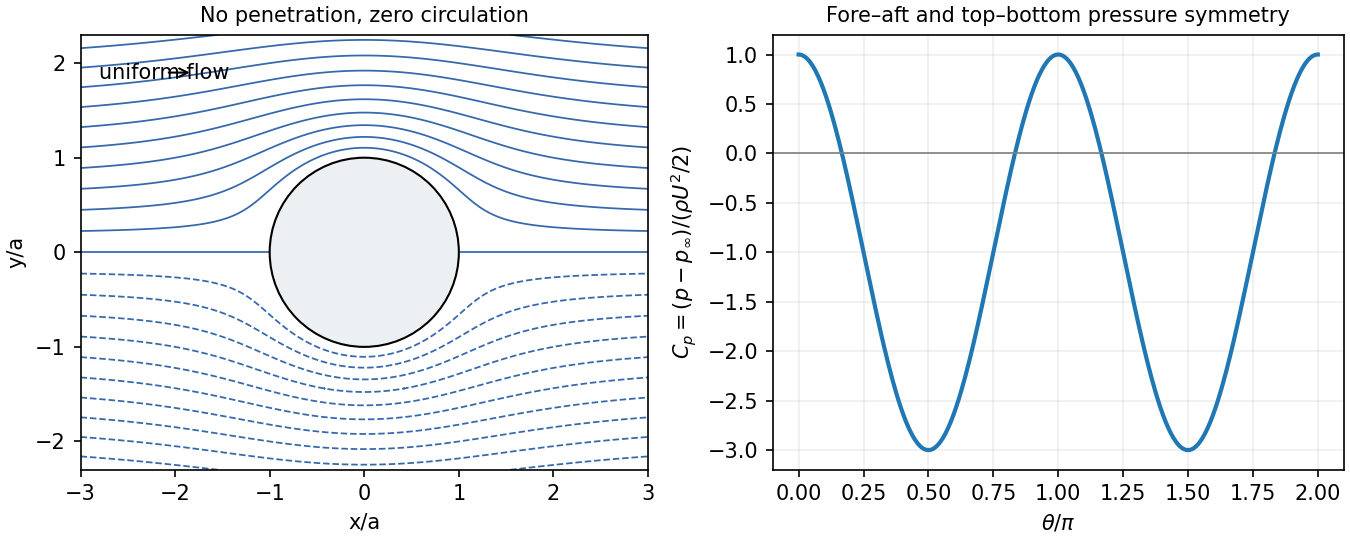
Use for the uniform upstream speed and take the flow along . The boundary conditions are and at infinity. A perfect inviscid model imposes no penetration, not no slip. For the intended no-circulation solution, require a globally single-valued potential, so the coefficient of is zero. The logarithmic term would be a net source and violates no penetration, so its coefficient is also zero. Growing terms with violate the uniform far field. For each remaining , the surface normal condition then forces its decaying coefficient to vanish. The terms satisfy and :An irrelevant additive potential constant is understood. At the same elevation, Bernoulli balance with the upstream stream givesThe force per unit height ispressure symmetry gives zero drag and zero lift in this zero-circulation idealization. D'Alembert's paradox is the failure of this inviscid model to represent real separated viscous wakes and their drag, not a claim that a real pole feels no force.
The zero-circulation assumption matters: leaves the stated velocity boundary conditions intact but adds to the surface tangential speed. It produces for positive counterclockwise circulation. Thus the boundary conditions alone do not justify excluding the angular term; an initially noncirculating inviscid start, or an explicitly single-valued potential, supplies the missing condition.[ref]
Flow Past a Cylindrical Obstacle by Richard Fitzpatrick. equations 5.73–5.81 and discussion after 5.83: circulation, force and the zero-circulation initial condition
Past exam of the physics B course of the University of Cambridge 2013 Paper 1 Section C C12 Solution by Codex 0 2026-10-20
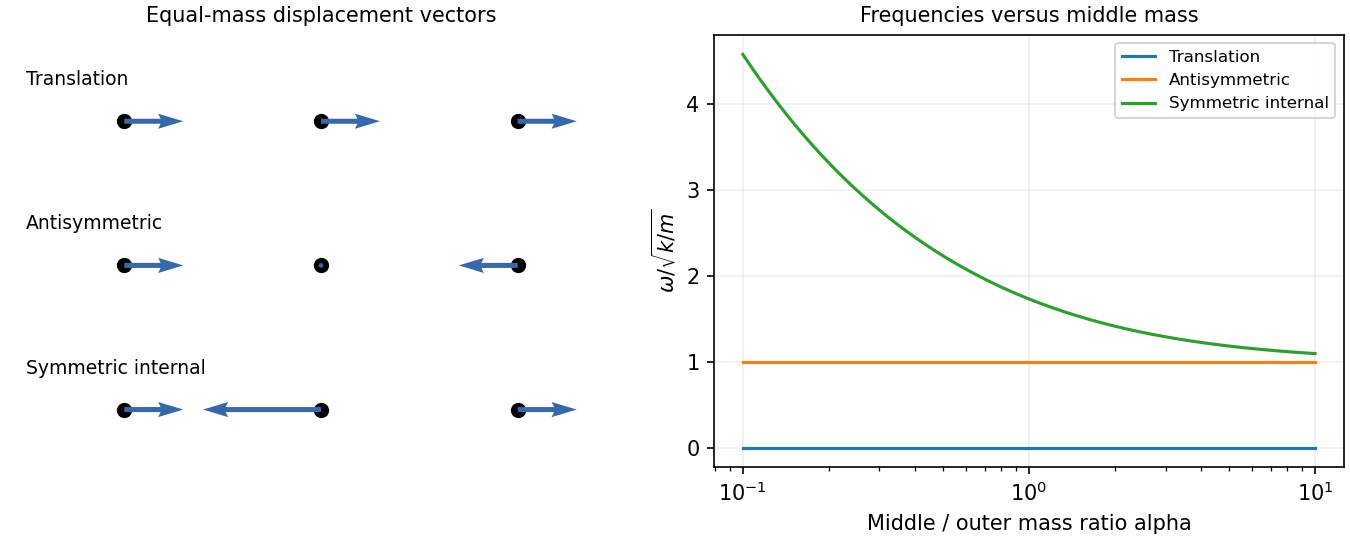
Codex 0 2026-10-20A normal mode is a pattern in which all coordinates share one frequency and fixed relative amplitudes. For a conservative linear system, it solves a generalized eigenvalue equation with stiffness matrix and mass matrix . For this free three-mass spring chain,Solving , for , givesTheir overall normalization is arbitrary; distinct modes are orthogonal in the mass inner product. The zero mode is rigid translation because neither end is fixed. In the antisymmetric mode the middle mass stays still, so changing its mass cannot alter the frequency. The symmetric internal mode keeps the centre of mass fixed through its middle displacement . Its frequency rises without bound as and approaches as , becoming degenerate with the antisymmetric frequency in that limit.
For equal masses put and . Positions are equilibrium positions plus displacementsThe translational mode needs the linear-in-time term; a cosine at zero frequency alone would miss arbitrary centre-of-mass velocity.
Taking the springs initially at equilibrium, the impulse gives . Their squared Euclidean norms are , so their initial kinetic energies are . Relative to total ,Subsequent motion conserves each mode's total energy, exchanging its kinetic and spring contributions. The zero-mode share remains centre-of-mass kinetic energy.
Past exam of the physics B course of the University of Cambridge 2013 Paper 1 Section C C11 Solution by Codex 0 2026-10-20
Codex 0 2026-10-20The shell theorem gives enclosed halo mass . Define . Then . Interior to the uniform halo its potential energy may be writtenOuter shells alter the additive constant, not this interior force. An actually infinite uniform mass distribution has no finite potential referenced to infinity; only local potential differences are needed here.
The central force has zero torque, so is conserved and the motion is planar. With , the effective radial potential and equation areFor circular radius , givesSet at fixed . The derivative of the right-hand side at equilibrium is , soBoth frequencies are positive, but radial and azimuthal motion no longer close with the Kepler ratio. At first order in eccentricity , one may write and . For a weak halo this is a nearly Keplerian ellipse whose apsis rotates at angular rate .
Put and . Expansion yieldsThe precession is retrograde. In cycles per unit time the precession frequency is ; per radial period the apsidal shift is . This weak-halo interpretation avoids confusing a focus-centred Kepler ellipse with the centred ellipse of a purely harmonic potential.
Past exam of the physics B course of the University of Cambridge 2013 Paper 1 Section C C10 Solution by Codex 0 2026-10-20
Codex 0 2026-10-20A fictitious force is a term required when writing Newton's second law in an accelerating frame; it comes from the coordinate choice rather than a new interaction. For axes rotating at constant about a fixed inertial origin,Apply this identity twice to position to get . Moving the last two terms to the right of gives the stated Coriolis and centrifugal forces. An accelerating origin or changing rotation rate would add further terms.
A slowly rotating fluid planet follows an equipotential of gravitational plus centrifugal potential. The centrifugal potential is , most negative at the equator. An outward equatorial shift raises gravitational potential and restores the balance, producing an oblate figure. Self-gravity also changes with the shape; no flattening coefficient follows from rotation alone without a density model.
Using local north and radial-up unit vectors, the centrifugal acceleration on a stationary mass isIt points away from the rotation axis: upward and equatorward, at angle to radial up in the northern hemisphere. Its vertical fraction of gravitational force isusing a day for this approximate number. The resultant effective weight tilts equatorward relative to radial down. A plumb-defined local vertical already follows effective gravity; the component calculation uses the spherical radial vertical. A supported stationary mass of course has zero net acceleration.
For the Coriolis deflection of vertical launch and drop, retain only first order in , use effective constant , and neglect horizontal velocities in the Coriolis term as instructed. With east positive, vertical velocity gives and no northward acceleration. For launch, and the flight time is . Integrating with zero initial horizontal velocity givesThe landing is westward. The westward velocity accumulated on ascent is only recovered on descent, so the two displacement contributions do not cancel.
For release from rest at , , , and . ThusThe drop lands eastward with one quarter the launch-return displacement magnitude. North–south corrections from horizontal Coriolis coupling are beyond the retained approximation.
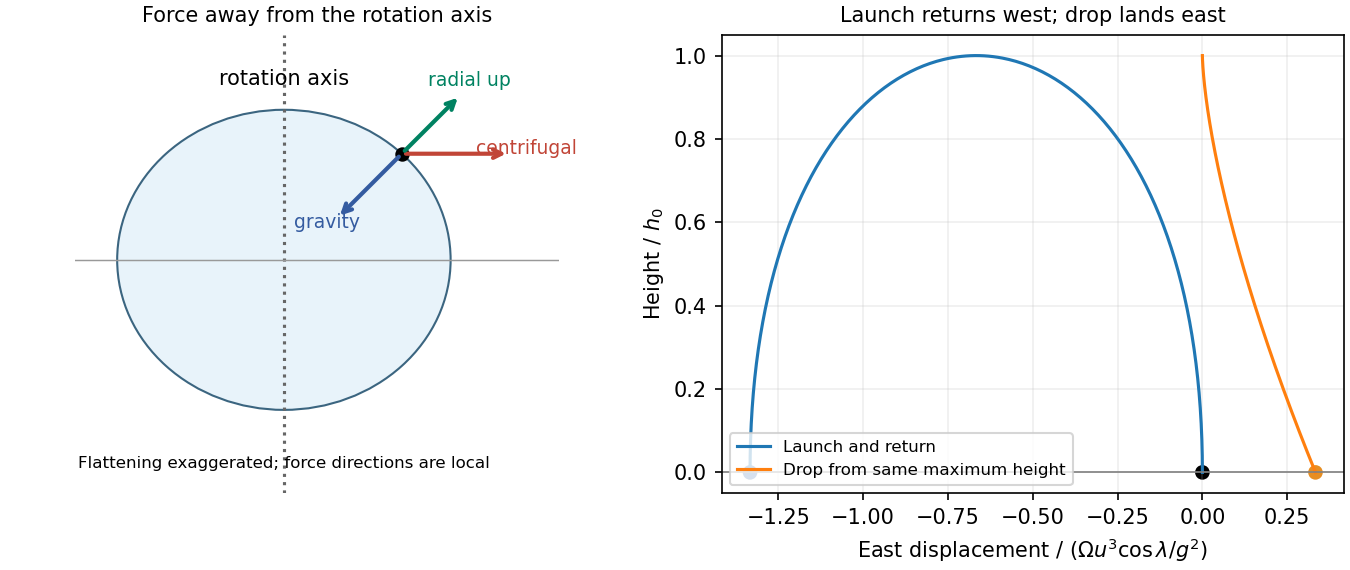
Original centrifugal geometry and opposite east–west deflections for launch-return and drop trajectories
. Details. Past exam of the physics B course of the University of Cambridge 2013 Paper 1 Section B B9 Solution by Codex 0 2026-10-20
Codex 0 2026-10-20For cold, collisionless, unmagnetized electrons with stationary heavy ions, . Therefore andThis is the cold collisionless plasma dielectric response. For a propagating transverse wave, , so in vacuum and in plasma, where . Equivalently and for .
Converting the density gives , so and . At ,At an interface without independently imposed surface charge or sheet current, tangential and normal are continuous, with the electron response included in the effective permittivity. Normal need not be continuous; the induced electron charge is represented by that response. In a convention treating it explicitly as a surface charge, the normal vacuum-displacement jump equals that charge instead.
For the downward transmitted wave, transversality gives . The measured field therefore has , so and . Tangential phase matching givesFor inferring incident power from a transmitted plasma field, choose and . Their magnetic fields have opposite directions. The two tangential conditions areHence and . Since these are peak phasor amplitudes,This is incident power per area perpendicular to its propagation. Per area of the interface the incoming normal flux is . The reflected sign is a phase reversal, not negative reflected energy.
At , the relative permittivity is negative and there is no propagating transverse bulk wave. The field decays evanescently into the plasma and the ideal collisionless half-space reflects all incoming normal power. Collisions would allow absorption; a complex refractive index here does not by itself imply dissipative heating.
Past exam of the physics B course of the University of Cambridge 2013 Paper 1 Section B B8 Solution by Codex 0 2026-10-20
Codex 0 2026-10-20For a moving loop, Faraday's law of induction is , where is the local wire velocity, , and the oriented boundary and surface follow the right-hand rule. For a fixed loop the motional term vanishes. Lenz's law is the minus sign: the induced response opposes the change of linked flux, not necessarily the applied field itself.
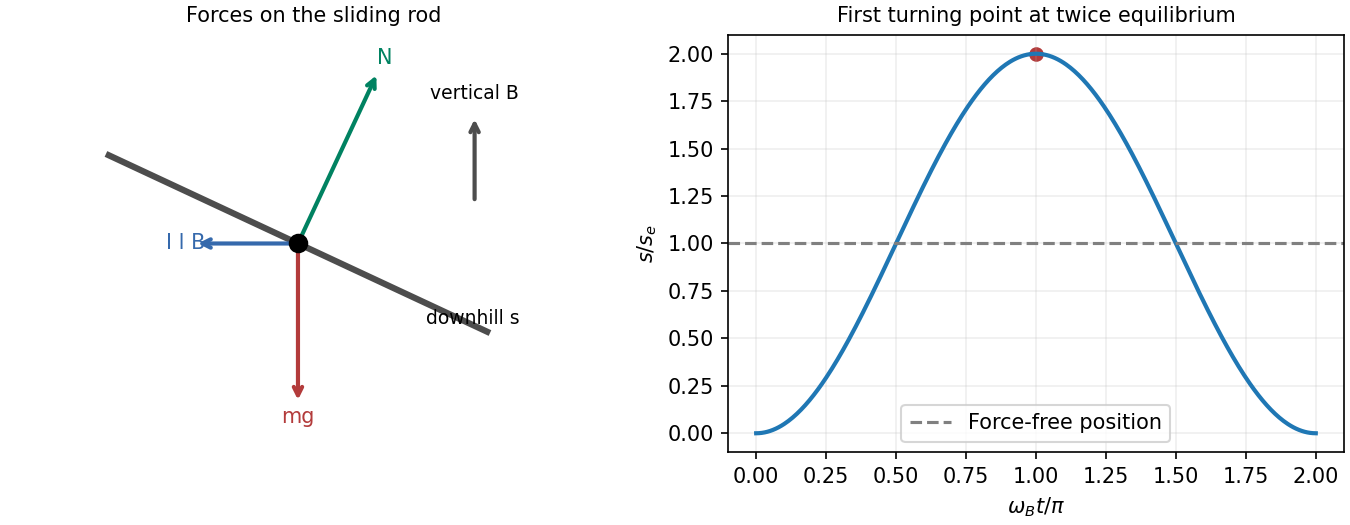
Let increase downhill and choose positive current to produce an uphill magnetic force. The normal component of the imposed field is , so the changing external flux is . With initially zero current and no resistance, conservation of flux linkage gives . The rod feels gravity vertically downward, a rail reaction normal to the slope, and magnetic force of magnitude horizontally uphill. Its downhill component is ; its normal component presses the rod into the rails, giving .
The inductive oscillation of a sliding rod on inclined rails follows fromThe magnetic force is not itself parallel to the rails. Defining and , release from rest givesThe first stop occurs at ; the rod then returns and oscillates between and . At the force is zero but the speed is maximal. Mechanical potential energy is reversibly exchanged with kinetic energy and ; a perfectly conducting circuit provides no damping.
For the resistive long-time drift of an inductive sliding rod, with loop resistance , useJoule heating damps the transient oscillation. On sufficiently long rails the asymptotic motion is steady sliding, not permanent rest:The zero-resistance model has persistent oscillations; its late-time limit cannot be interchanged with taking . These results assume , smooth contacts, negligible rod self-inductance and constant geometry.
Past exam of the physics B course of the University of Cambridge 2013 Paper 1 Section B B7 Solution by Codex 0 2026-10-20
Codex 0 2026-10-20For distributed inductance and capacitance , a small segment obeys and . Differentiation gives and . For a forward wave,A backward voltage wave has current . This sign matters at an impedance discontinuity.
The source figure is the stacked-strip parallel-plate transmission line geometry, despite its use of the word coplanar. Gauss's law gives . Opposite surface currents give magnetic field between the strips by Ampère's law; the magnetic flux per unit length is , hence . ThereforeNo numerical is given; the impedance is appropriately left in terms of that ratio. The line is taken to be nonmagnetic and lossless.
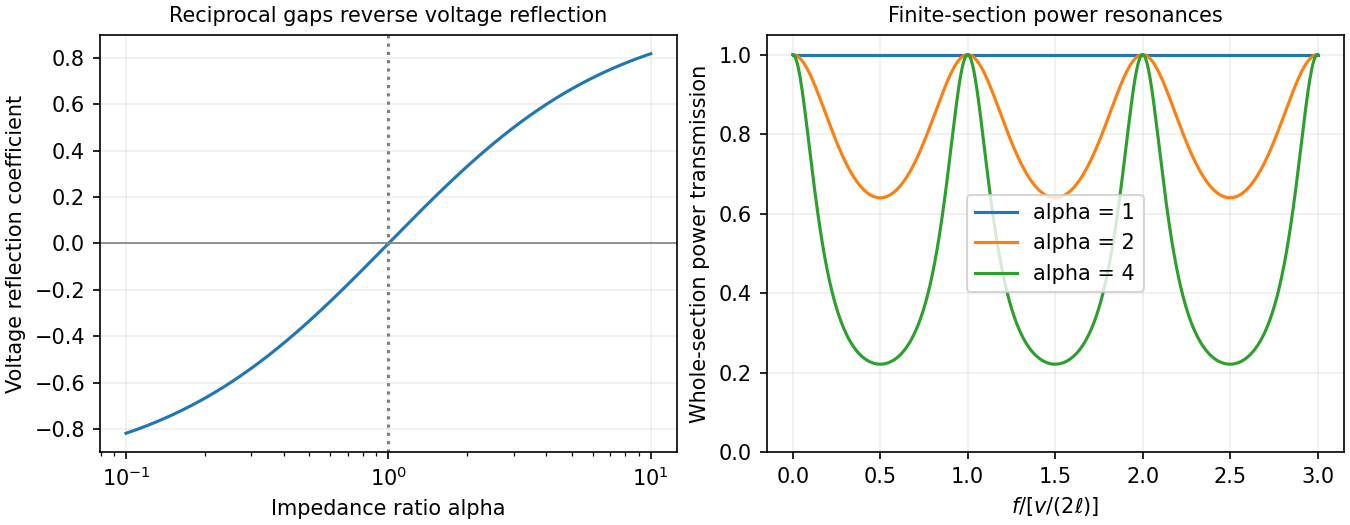
Increasing the gap by changes to and to , so while is unchanged. voltage and current continuity at the step giveConsequently the voltage and energy-flux transmission coefficients areHere amplitudes are peak voltage amplitudes, with mean power . The reciprocal gaps have : equal reflected energy but opposite voltage phase. A voltage transmission coefficient above one does not imply energy gain.
For a finite impedance section of a transmission line, put and . Multiple reflections inside the altered section interfere. Summing their geometric series, relative to the first boundary,Transmission is unity at and minimal at , with minima . Resonances are separated by ; the long-wavelength limit also transmits fully. Matching the far termination removes end echoes, not the two internal reflections.
Past exam of the physics B course of the University of Cambridge 2013 Paper 1 Section B B6 Solution by Codex 0 Created 2026-10-20 Updated 2026-10-20
Codex 0 Created 2026-10-20 Updated 2026-10-20The image charge construction replaces conductor-induced charge by fictitious sources outside the physical domain. Match the conductor potentials and the far-field condition; uniqueness then fixes the potential in the physical region. For a grounded plane, reflect a charge and reverse its sign, giving attraction . For a grounded sphere of radius , a charge at distance has image at radial distance . These are examples with prescribed zero potential, not arbitrary isolated conductors.[ref]
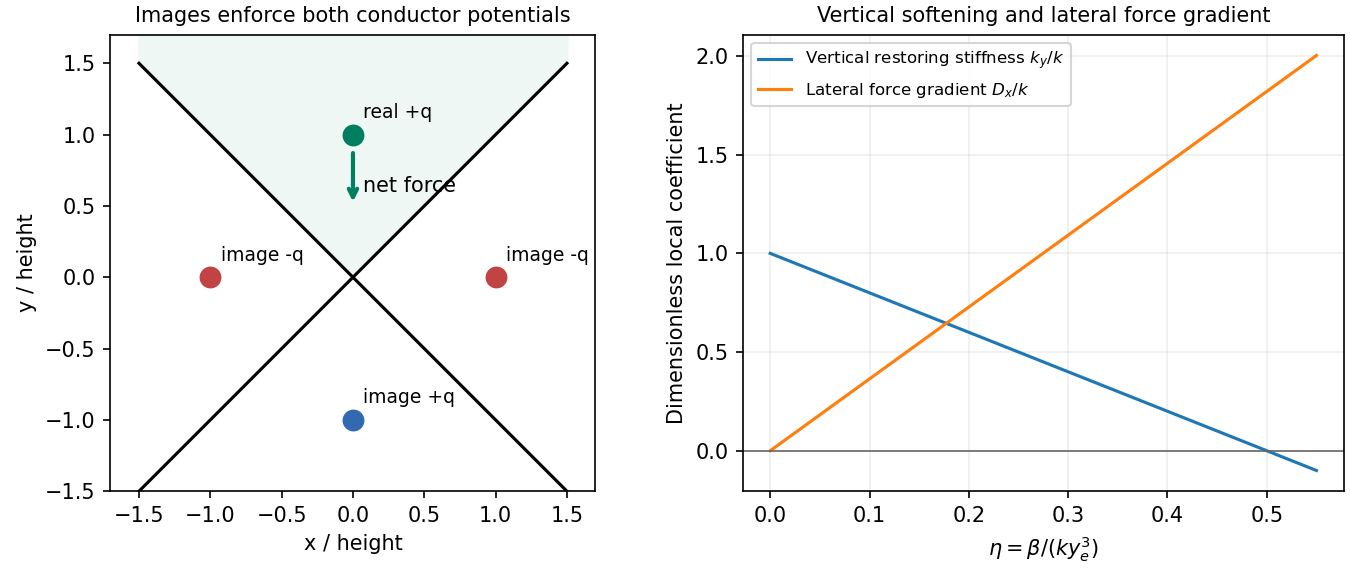
Use horizontal and upward in the upper right-angle wedge. The sheets meet electrically, so take their common potential as zero and assume no externally imposed field. For a real charge at , the image charges in a right-angle conducting wedge are at and , and at . The first two contributions have cancelling horizontal components. With ,Thus the force magnitude at the original height is , directed down toward the intersection. The sphere is treated as a point charge, with size much smaller than its distances from the sheets.
Since gravity is already balanced in the uncharged equilibrium, the charged vertical equilibrium satisfies . For , . Differentiating the force givesThe electrostatic softening above a conducting wedge reduces the restoring force; the small-charge vertical equilibrium remains stable.
For the lateral stability of a spring-supported charge in a wedge, the off-axis images of are at and and at . Expansion near the bisector givesSo the electrostatic force is laterally destabilizing: moving toward either sheet strengthens its attraction. In the simplified model where the spring supplies only a vertical force, the overall equilibrium is a saddle and is unstable.
A three-dimensional spring suspension also has geometrical transverse stiffness. If its charged-equilibrium tension is and length is , a small sideways displacement gives spring force , with . The full stability conditions in this suspension model areMotion parallel to the intersection line has no electrostatic stiffness in the ideal infinite-wedge geometry and is stabilized by the positive spring tension. Thus lateral electrostatic destabilization alone does not prove instability of a real hanging spring. At fixed finite support geometry, a sufficiently small charge preserves stability because while . The given vertical-displacement approximation does not specify the attachment length or by itself establish the transverse inequality for an arbitrary charge. The general criterion above states what can be concluded; the saddle verdict applies to the distinct idealization with zero lateral support stiffness.
Past exam of the physics B course of the University of Cambridge 2013 Paper 1 Section A A5 Solution by Codex 0 2026-10-20
Codex 0 2026-10-20For the tangent-axis inertia of a spherical shell, subtract the missing solid core from a solid sphere:The parallel axis theorem shifts the axis a distance :It tends to for a solid sphere and for a thin spherical shell.
Pinned article: Introduction to the OurBigBook Project
Welcome to the OurBigBook Project! Our goal is to create the perfect publishing platform for STEM subjects, and get university-level students to write the best free STEM tutorials ever.
Everyone is welcome to create an account and play with the site: ourbigbook.com/go/register. We belive that students themselves can write amazing tutorials, but teachers are welcome too. You can write about anything you want, it doesn't have to be STEM or even educational. Silly test content is very welcome and you won't be penalized in any way. Just keep it legal!
Intro to OurBigBook
. Source. We have two killer features:
- topics: topics group articles by different users with the same title, e.g. here is the topic for the "Fundamental Theorem of Calculus" ourbigbook.com/go/topic/fundamental-theorem-of-calculusArticles of different users are sorted by upvote within each article page. This feature is a bit like:
- a Wikipedia where each user can have their own version of each article
- a Q&A website like Stack Overflow, where multiple people can give their views on a given topic, and the best ones are sorted by upvote. Except you don't need to wait for someone to ask first, and any topic goes, no matter how narrow or broad
This feature makes it possible for readers to find better explanations of any topic created by other writers. And it allows writers to create an explanation in a place that readers might actually find it.
Figure 1. Screenshot of the "Derivative" topic page. View it live at: ourbigbook.com/go/topic/derivativeVideo 2. OurBigBook Web topics demo. Source. - local editing: you can store all your personal knowledge base content locally in a plaintext markup format that can be edited locally and published either:This way you can be sure that even if OurBigBook.com were to go down one day (which we have no plans to do as it is quite cheap to host!), your content will still be perfectly readable as a static site.
- to OurBigBook.com to get awesome multi-user features like topics and likes
- as HTML files to a static website, which you can host yourself for free on many external providers like GitHub Pages, and remain in full control

Figure 2. You can publish local OurBigBook lightweight markup files to either OurBigBook.com or as a static website.
Figure 3. Visual Studio Code extension installation.
Figure 5. . You can also edit articles on the Web editor without installing anything locally. Video 3. Edit locally and publish demo. Source. This shows editing OurBigBook Markup and publishing it using the Visual Studio Code extension. 
- Infinitely deep tables of contents:




All our software is open source and hosted at: github.com/ourbigbook/ourbigbook
Further documentation can be found at: docs.ourbigbook.com
Feel free to reach our to us for any help or suggestions: docs.ourbigbook.com/#contact