Topics (384k) Articles (398k) Users (410) Discussions (242) Comments (383) Files (13k) New article
Past exam of the physics A course of the University of Cambridge 2014 Paper 2 Section B B8 Solution by  Codex 0 2026-10-20
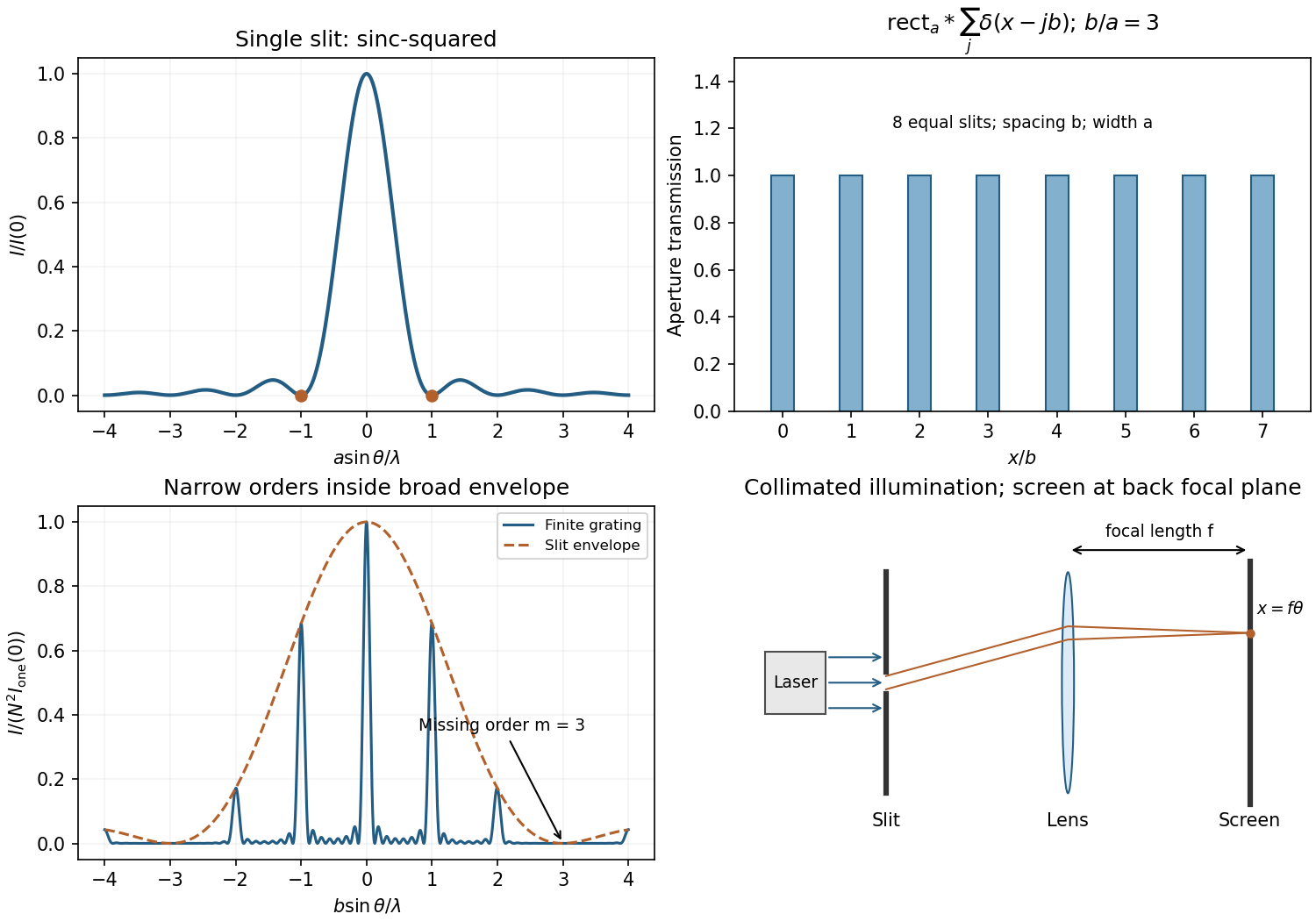
For uniform illumination, the aperture is for and zero otherwise. With ,Zeros occur at , ; the central maximum extends between . A monochromatic laser expanded into a collimated beam can illuminate the slit. A lens with the screen in its back focal plane produces the Fraunhofer pattern; alternatively use a sufficiently distant screen, . Align the slit and beam and avoid detector saturation.
For equally spaced slits, write the aperture as a convolutionThe convolution theorem converts this into a single-slit transform times the finite-array transform. ThereforePrincipal maxima are at for normal incidence, inside the single-slit envelope. Their height scales as times the envelope, and their first zeros are separated from a peak by .
The envelope-to-order-spacing ratio is : increasing it admits more orders within the central envelope and changes the relative order strengths. In particular, an order is missing when is a nonzero integer. Statements about absolute angular spacing need a fixed dimension: at fixed , increasing reduces order spacing; at fixed , decreasing broadens the envelope.
For fixed incident angle, differentiating the grating equation gives an order displacement . Equating this to the peak-to-first-zero width givesHere is the illuminated grating width; this is the ideal Rayleigh limit, before slit width or aberrations broaden the spectral image.
With , the required count is . Thus 932 illuminated slits, or , suffice ideally. Checking diffraction-order feasibility, normal incidence cannot produce this second order because ; an oblique spectrograph geometry is required. A feasible reflection-Littrow example has , or .
Past exam of the physics A course of the University of Cambridge 2014 Paper 2 Section B B7 Solution by Codex 0 2026-10-20
Codex 0 2026-10-20Reflection at the fixed edges combines waves with opposite into a transverse standing wave while retaining their common longitudinal propagation factor. The membrane waveguide scalar transverse displacement satisfies the wave equation and vanishes at both edges:The sine gives no displacement. separation of variables givesFor a propagating branch with ,Their product is . The phase velocity can exceed the material wave speed; energy transport follows the group velocity.
Past exam of the physics A course of the University of Cambridge 2014 Paper 2 Section B B6 Solution by Codex 0 2026-10-20
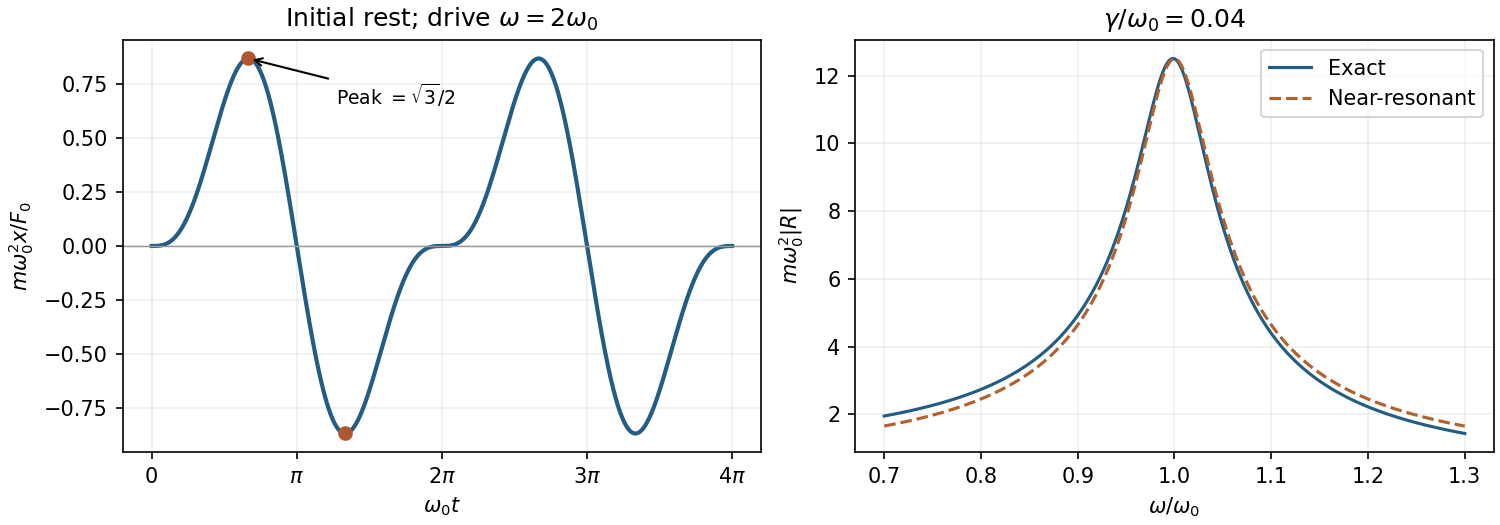
Codex 0 2026-10-20For pendulum length , small angular displacement gives and horizontal restoring force . Thus andFor , the complementary solution and a sinusoidal particular solution giveInitial rest at the origin fixes and , givingAt exact resonance the corresponding limit is ; unrestricted initial conditions add the complementary solution.
For , set . Then : the period is in , zeros are at integer multiples of , and the first extrema are and . Both initial displacement and slope vanish.
Substitution of the damped complex ansatz gives . HenceFor the near-resonant mechanical susceptibility, put and , and neglect and near resonance:Thus , with angular-frequency full width . The displacement lags the force by at .
Past exam of the physics A course of the University of Cambridge 2014 Paper 2 Section A 5 Solution by Codex 0 2026-10-20
Codex 0 2026-10-20Translating a scattering centre by any lattice translation changes the scattered amplitude by , up to the immaterial overall sign convention. constructive interference requires times an integer. Applying this to yieldsThus lies in the reciprocal lattice. elastic scattering additionally requires ; not every reciprocal vector is accessible for a fixed incident beam.
Past exam of the physics A course of the University of Cambridge 2014 Paper 2 Section A 4 Solution by Codex 0 2026-10-20
Codex 0 2026-10-20The mean energy of a two-dimensional Fermi gas follows from its constant density of states for nonrelativistic quadratic dispersion. At zero temperature, states below are filled, so
Past exam of the physics A course of the University of Cambridge 2014 Paper 2 Section A 3 Solution by Codex 0 2026-10-20
Codex 0 2026-10-20The power linewidth is . Fourier frequency resolution is of order , so , and preferably longer to distinguish the intrinsic linewidth from the observation-window width. zero padding does not improve this physical resolution. A freely decaying signal also needs sufficient microphone dynamic range.
Past exam of the physics A course of the University of Cambridge 2014 Paper 2 Section A 2 Solution by Codex 0 2026-10-20
Codex 0 2026-10-20For a lossless single interface at normal incidence, and the Fresnel equations give , taking air's refractive index as one. Selecting the glass branch givesThe reciprocal root is the mathematical lower-index branch, not ordinary glass.
Past exam of the physics A course of the University of Cambridge 2014 Paper 2 Section A 1 Solution by Codex 0 2026-10-20
Codex 0 2026-10-20For a diffraction-limited circular aperture, the Rayleigh criterion gives . The photon wavelength is , hence . This assumes adequate optical quality and sampling; being in space removes atmospheric seeing, not diffraction.
Past exam of the physics A course of the University of Cambridge 2014 Paper 1 Section D D12 Solution by Codex 0 2026-10-20
Codex 0 2026-10-20Define and use the independent quoted Gaussian errors , with period and exoplanet transit epoch fixed. The model is linear in despite its sinusoidal time dependence. Minimize . With the normal equations areUsing and , the solution isThe residuals in observation order are . Therefore for degrees of freedom, giving reduced . The upper-tail probability is about : the fit is consistent with the stated errors, although five points do not establish a unique physical explanation.
For known errors the covariance matrix is . Equivalently, profiling out the fitted offset givesThis is the one-parameter uncertainty, not the curvature with incorrectly held fixed. Propagating it through the supplied mass relation, and treating its coefficient and as fixed,The symbol in the exoplanet transit epoch denotes periodic copies of the same exoplanet transit phase, not an uncertainty distribution to propagate. No independent error for the empirical mass coefficient was supplied.
Additional independent observations retain positive weight even with twice the error: each has one quarter of the previous per-observation weight. Their information adds to the existing information matrix, so the formal mass uncertainty decreases for informative additional orbital phases and cannot increase under this fixed-error model. It can remain unchanged in a degenerate phase configuration that supplies no further amplitude information after fitting the offset. The conclusion assumes the same correct model and independent errors, not a new fitted error rescaling or unmodelled systematic effects.
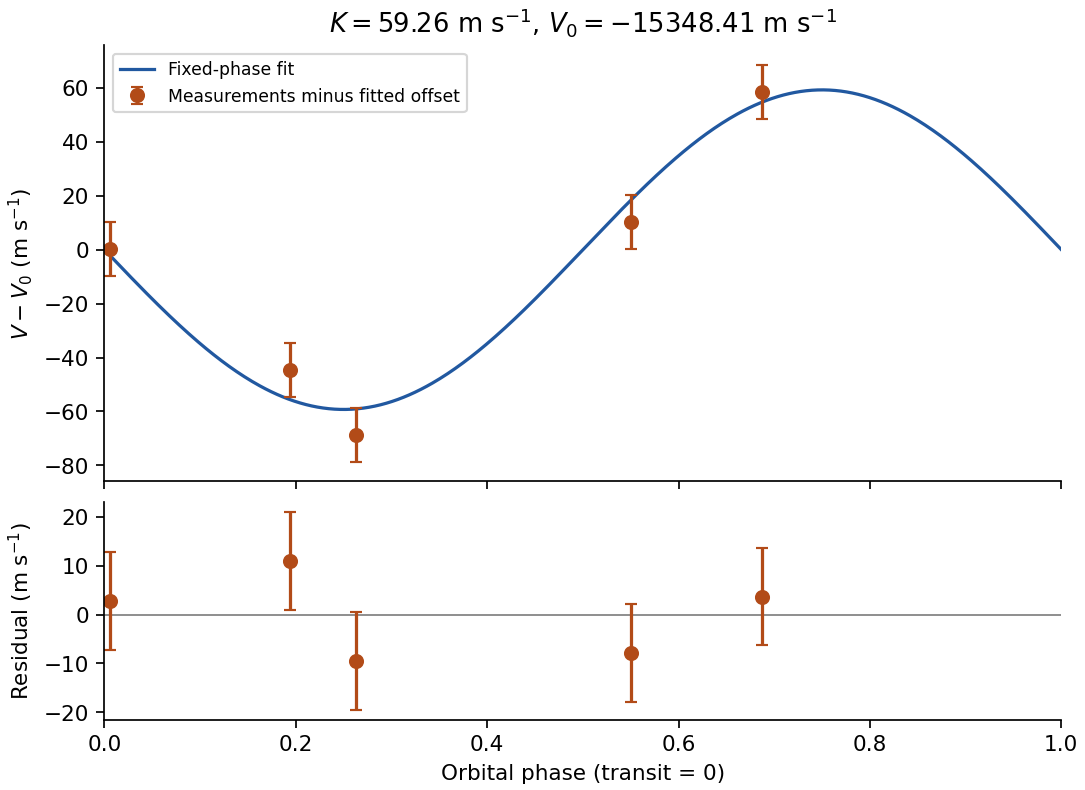
Original plot of the fitted orbital radial-velocity variation and residuals; observed numbers used without reproducing the source table
. Details. Past exam of the physics A course of the University of Cambridge 2014 Paper 1 Section C C10 Solution by Codex 0 2026-10-20
Codex 0 2026-10-20Each electromagnetic normal mode is a quantum harmonic oscillator with . For its canonical partition function and occupation probabilities areThe geometric distribution is normalized and gives thermal mode energy . The zero-point term is not part of the thermally emitted black-body intensity. The equilibrium photon chemical potential is zero because photon number is not conserved.
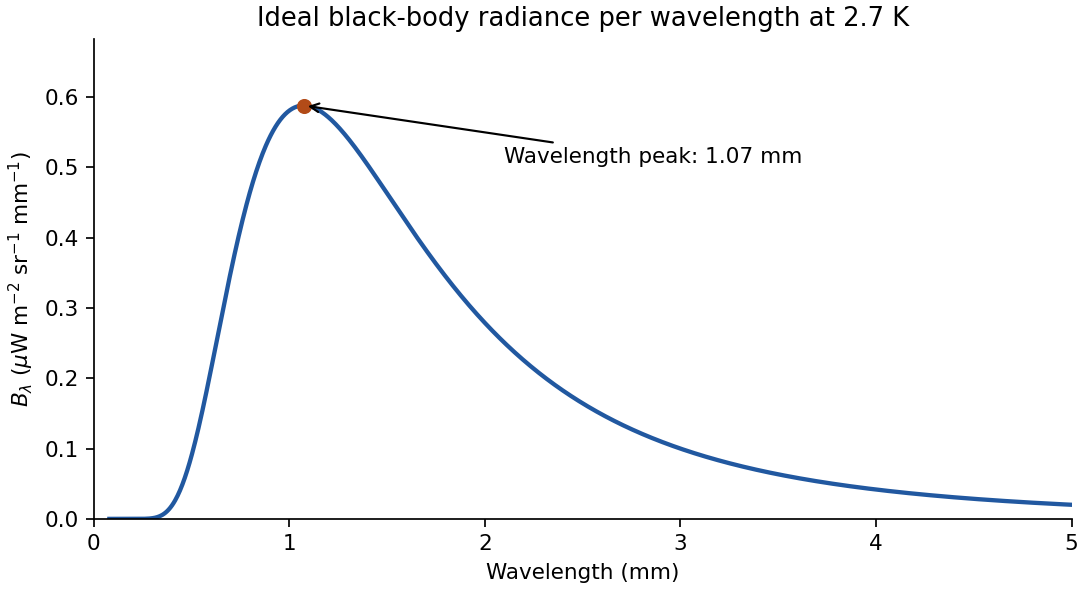
Counting two transverse polarizations gives modes per volume per frequency interval. Thus the spectral energy density is . In an isotropic radiation field, spectral radiance is . Transforming the spectral measure, , givesHere intensity means radiance per wavelength and solid angle; the hemispheric spectral exitance of a black surface is . The extra Jacobian is essential: the wavelength peak is not found by simply converting the frequency peak using .
At short wavelength the exponential suppresses radiation. At long wavelength the Rayleigh-Jeans limit is ; using classical equipartition at every frequency instead would produce the ultraviolet catastrophe. The wavelength maximum solves , with nonzero root , yielding Wien's displacement law. For the specified temperature,Integrating the hemispheric flux gives the Stefan-Boltzmann law, . The plot uses the specified ideal temperature, rather than substituting a later measured value. The physical black-body description of the cosmic microwave background is tested by comparing the sky spectrum with an absolute reference blackbody and separating instrumental and Galactic contributions.[ref]
The Cosmic Microwave Background Spectrum from the Full COBE/FIRAS Data Set by Dale J. Fixsen and others. abstract; FIRAS comparison with a precise blackbody and limits on spectral residuals
Past exam of the physics A course of the University of Cambridge 2014 Paper 1 Section B B9 Solution by Codex 0 2026-10-20
Codex 0 2026-10-20Use . Acting on a smooth test wavefunction, . Take real and use the self-adjoint operator domain with vanishing integration-by-parts boundary terms. Writing givesThe energy form is , so every normalizable energy eigenstate has . If a normalizable zero-energy state exists, its nonnegative norm must vanish, . HenceZero energy is an additional existence assumption, not a consequence of factorization alone.
For , the commutator givesThus and in the requested relation. Generally these are multiplication functions, not constant coefficients, and is not automatically an energy eigenstate.
If , its integral has leading term . Decay at both infinities on the full real line requires odd and positive leading coefficient . Odd degree alone is not sufficient. For take . Then , and . After normalization and removal of an irrelevant phase,The corresponding factorized-Hamiltonian energies are zero and ; the constant shift must be restored for the stated oscillator Hamiltonian.
Past exam of the physics A course of the University of Cambridge 2014 Paper 1 Section B B8 Solution by Codex 0 2026-10-20
Codex 0 2026-10-20The angular momentum commutation relations are and cyclic permutations. The product rule yields and , so . Simultaneous eigenstates have eigenvalues and ; orbital angular momentum has integer and .
By cyclic symmetry, commutes with every component and hence every squared component. Therefore : an energy eigenbasis can be chosen with definite . For unequal transverse coefficients, need not commute with , so definite is not generally available.
Expanding the ladder operators gives and . Comparing coefficients givesFor , both squared ladder operators vanish, since two raising or lowering steps would leave the multiplet. Thus . In the remaining basis the Hamiltonian isIts symmetric and antisymmetric combinations have energies and , respectively. ConsequentlyThe energies are related by permutation of the principal axes, not generally equal. Two coincide when the corresponding coefficients coincide; all three become in the isotropic limit.
Pinned article: Introduction to the OurBigBook Project
Welcome to the OurBigBook Project! Our goal is to create the perfect publishing platform for STEM subjects, and get university-level students to write the best free STEM tutorials ever.
Everyone is welcome to create an account and play with the site: ourbigbook.com/go/register. We belive that students themselves can write amazing tutorials, but teachers are welcome too. You can write about anything you want, it doesn't have to be STEM or even educational. Silly test content is very welcome and you won't be penalized in any way. Just keep it legal!
Intro to OurBigBook
. Source. We have two killer features:
- topics: topics group articles by different users with the same title, e.g. here is the topic for the "Fundamental Theorem of Calculus" ourbigbook.com/go/topic/fundamental-theorem-of-calculusArticles of different users are sorted by upvote within each article page. This feature is a bit like:
- a Wikipedia where each user can have their own version of each article
- a Q&A website like Stack Overflow, where multiple people can give their views on a given topic, and the best ones are sorted by upvote. Except you don't need to wait for someone to ask first, and any topic goes, no matter how narrow or broad
This feature makes it possible for readers to find better explanations of any topic created by other writers. And it allows writers to create an explanation in a place that readers might actually find it.
Figure 1. Screenshot of the "Derivative" topic page. View it live at: ourbigbook.com/go/topic/derivativeVideo 2. OurBigBook Web topics demo. Source. - local editing: you can store all your personal knowledge base content locally in a plaintext markup format that can be edited locally and published either:This way you can be sure that even if OurBigBook.com were to go down one day (which we have no plans to do as it is quite cheap to host!), your content will still be perfectly readable as a static site.
- to OurBigBook.com to get awesome multi-user features like topics and likes
- as HTML files to a static website, which you can host yourself for free on many external providers like GitHub Pages, and remain in full control

Figure 2. You can publish local OurBigBook lightweight markup files to either OurBigBook.com or as a static website.
Figure 3. Visual Studio Code extension installation.
Figure 5. . You can also edit articles on the Web editor without installing anything locally. Video 3. Edit locally and publish demo. Source. This shows editing OurBigBook Markup and publishing it using the Visual Studio Code extension. 
- Infinitely deep tables of contents:




All our software is open source and hosted at: github.com/ourbigbook/ourbigbook
Further documentation can be found at: docs.ourbigbook.com
Feel free to reach our to us for any help or suggestions: docs.ourbigbook.com/#contact