Topics (384k) Articles (398k) Users (410) Discussions (242) Comments (383) Files (13k) New article
Past exam of the physics A course of the University of Cambridge 2015 Paper 2 Section C C10 Solution by  Codex 0 2026-10-20
The free electron model replaces the microscopic ionic potential and interacting electronic motion by independent mobile electrons in a uniform neutralizing background, with approximately parabolic dispersion . Its quantum version fills states according to Fermi-Dirac statistics and the Pauli exclusion principle. Scattering is represented by a momentum relaxation time , rather than derived from the model's ideal free trajectories. This model explains a Fermi energy much larger than room-temperature thermal energy, an electronic heat capacity proportional to temperature at low temperature, and a Drude electrical conductivity. With appropriate scattering assumptions it also yields the Wiedemann-Franz law. It cannot by itself explain band gaps, detailed band anisotropy, strong correlations, or the microscopic temperature dependence of .
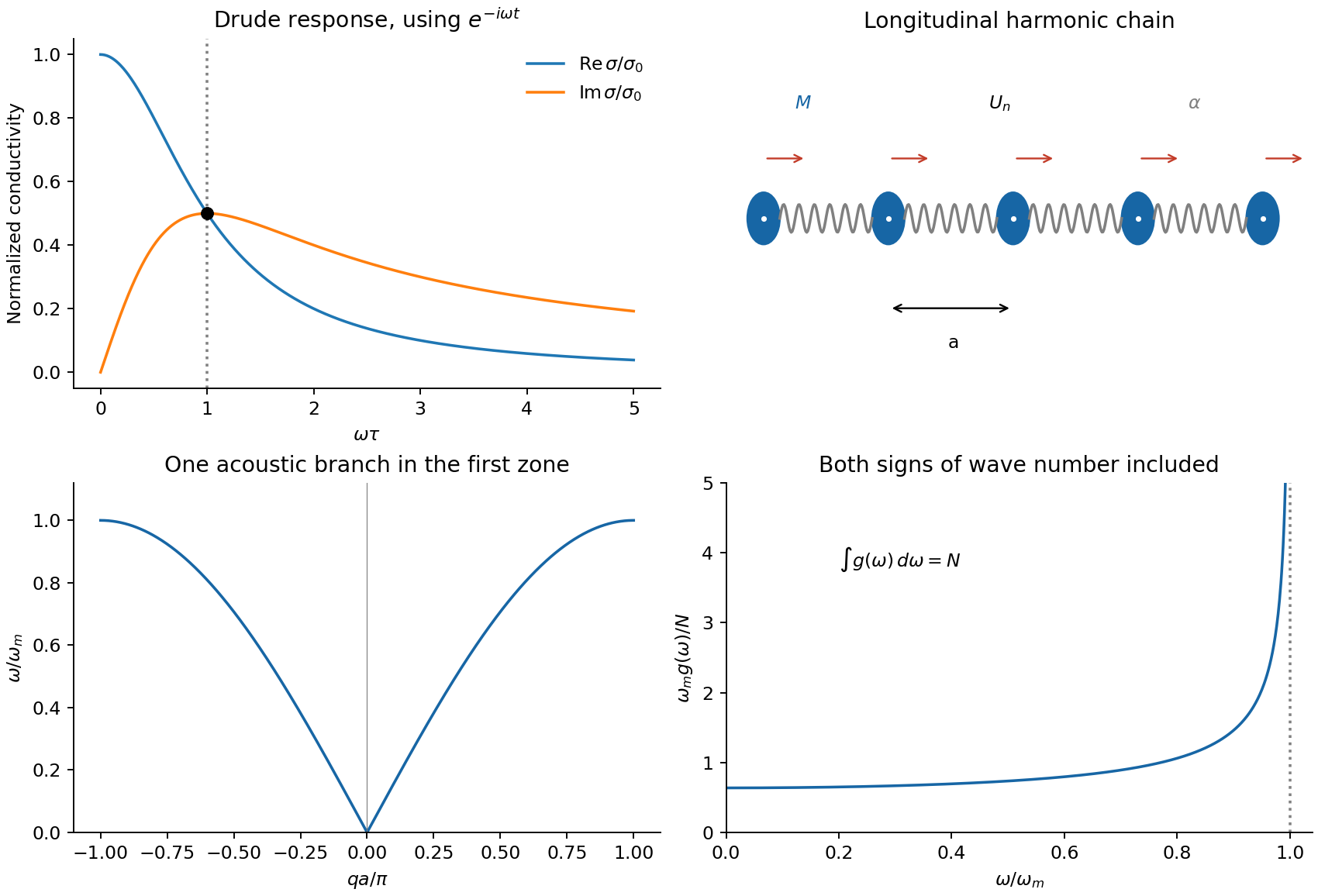
The inertial term is mass times the rate of change of mean drift velocity. The electric force is , taking the printed as the signed electron charge, and describes loss of directed momentum to scattering. electrons retain large microscopic velocities; this damping is of their mean directed motion. In a steady DC field,Both charge factors are negative for electrons, so the conductivity is positive. If instead denotes a positive charge magnitude, the force and current equations each require a minus sign and give the same result.
For AC response choose physical fields as real parts of phasors proportional to . Substitution givesThusThe real part decreases from to zero. The imaginary part starts at zero, reaches at , and falls as . The real part falls as at high frequency. With an convention, only the sign of the imaginary part changes. Positive gives positive cycle-averaged dissipation .
Past exam of the physics A course of the University of Cambridge 2015 Paper 2 Section B B9 Solution by Codex 0 2026-10-20
Codex 0 2026-10-20A Michelson interferometer divides a source beam at a partially reflecting beam splitter. The two perpendicular arms terminate in mirrors whose reflected beams return to the splitter and overlap at the detector. The recombined fields must have overlapping wavefronts and compatible polarization of waves. Moving one mirror by changes the round-trip optical path difference by , so passing fringes determine . Conversely a known mirror displacement measures wavelength. Scanning the delay can determine temporal optical coherence and, by Fourier transform spectroscopy, spectral structure. A compensating plate may equalize glass traversal, particularly for broadband illumination.
For equal real peak field amplitudes, the superposition isTime averaging the square over many optical cycles gives . With after absorbing a constant port-dependent phase into the zero of ,Here is the sum of the two separate-arm intensities; maximum intensity is and the ideal minimum is zero. Equal amplitudes give unit interference visibility.
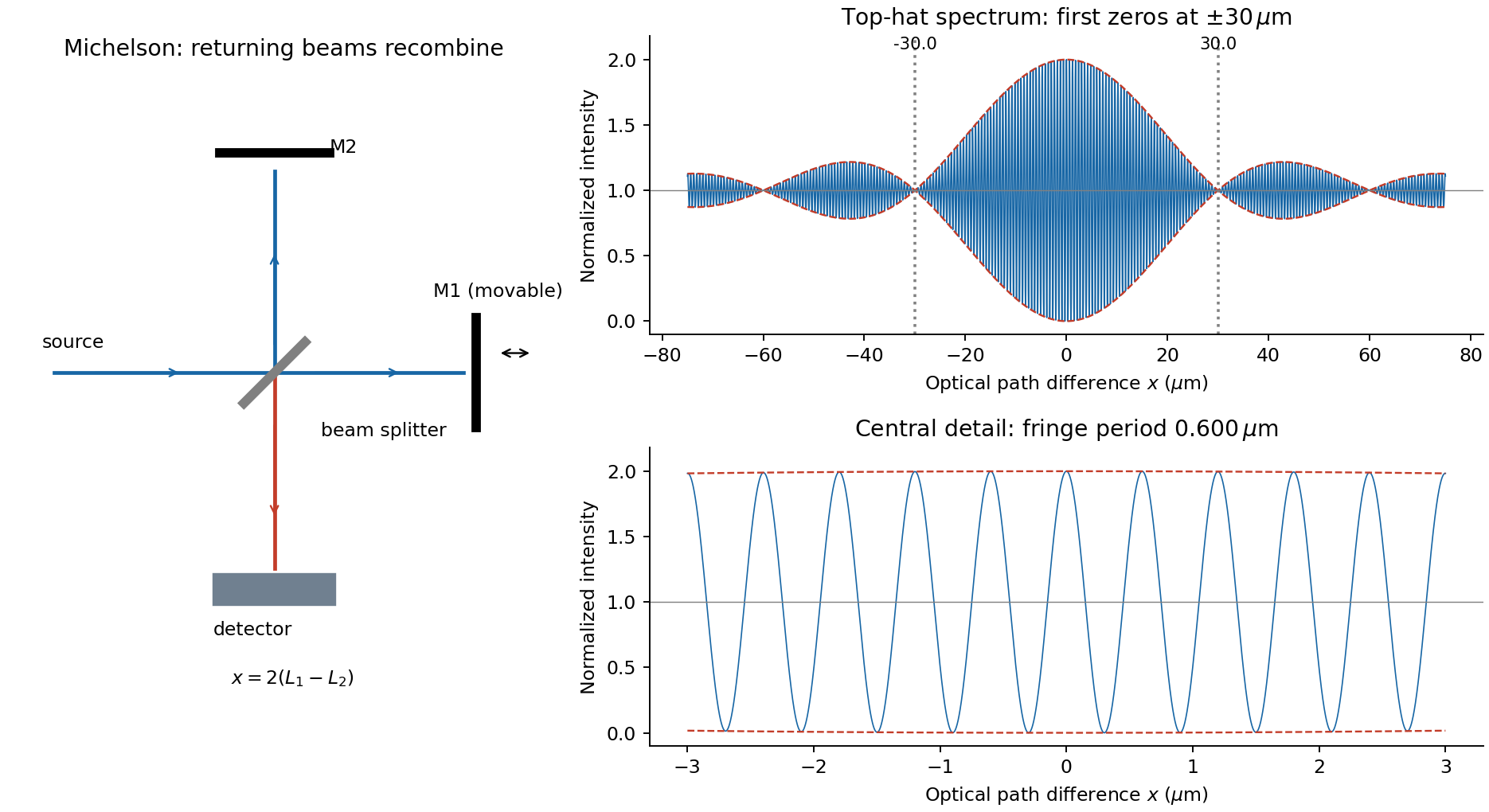
For a stationary source with a flat intensity spectrum, different spectral components add in time-averaged intensity. Keeping their individual two-arm interference terms and defining givesOne must not coherently add unrelated source frequencies as if they had a fixed common phase. The sinc envelope is the Fourier transform of the rectangular spectral intensity.
Numerically, and . The annotated interferogram usesIt is even in , has central value 2 and background 1, and its carrier-fringe period in optical path difference is . The first envelope zeros are at , corresponding to mirror shifts of from equal paths. Side lobes persist beyond the zeros; a negative sinc reverses fringe phase. The intensity remains between and , not between the signed sinc curves with an assumed fixed ordering.
Past exam of the physics A course of the University of Cambridge 2015 Paper 2 Section B B8 Solution by Codex 0 2026-10-20
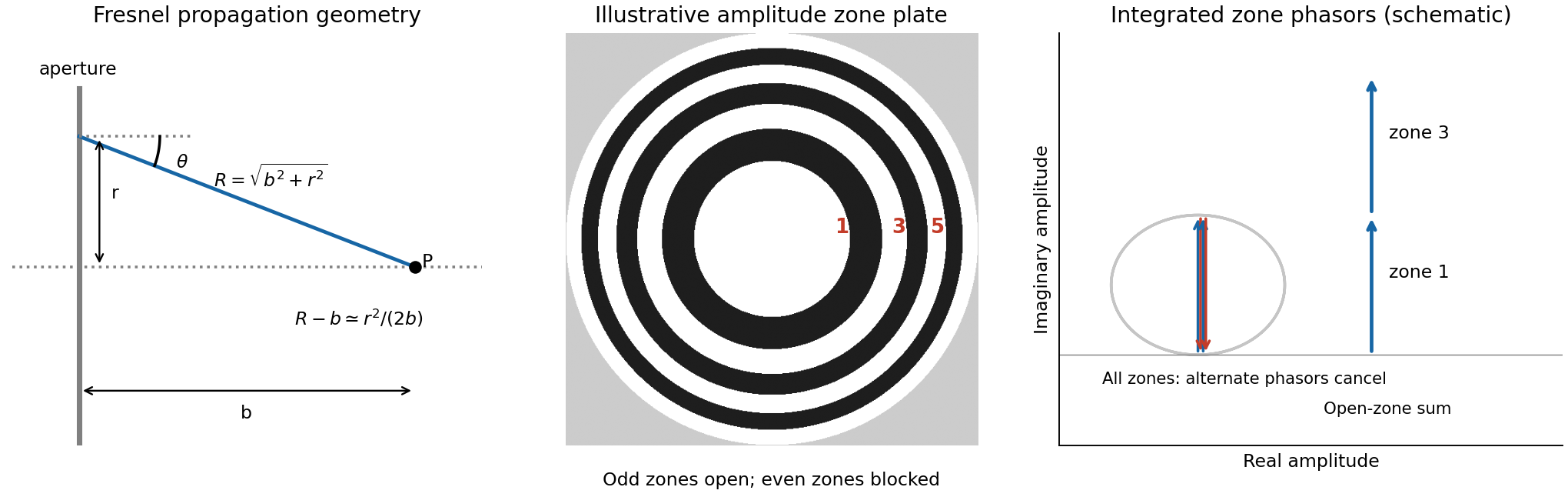
Codex 0 2026-10-20Take the aperture in and the observation point , with . Under scalar diffraction theory, the Huygens-Fresnel principle sums complex amplitudes from area elements, rather than summing their intensities. Apart from a common normalization,Here is the complex aperture transmission, is the axial distance, and is the angle of the secondary ray to the aperture normal. The obliquity factor describes the direction dependence of the secondary contribution; one Kirchhoff convention is for normal illumination. Other scalar boundary approximations have slightly different angular weights, all tending to unity near the axis.
Put . The paraxial approximation gives in the phase and in the amplitude. Removing common yieldsAssumptions are uniform normally incident plane-wave illumination, coherent monochromatic propagation, aperture dimensions large enough for the scalar description, , and phase accuracy over the relevant aperture. The last condition justifies dropping the quartic distance term; geometric smallness alone does not guarantee phase accuracy.
For a circular aperture, for and zero elsewhere. Rotational symmetry and give , , andThe constant can be absorbed into the proportionality factor, producing the required one-dimensional integral.
At a focus a distance away, half-period-zone boundaries obeyWith slowly varying obliquity and illumination, each zone has almost the same area and its integrated phasor has the opposite sign to its neighbour. A zone plate blocks alternate zones, so the remaining phasors add instead of nearly cancelling. Choosing an open central zone, the first three open regions have outer boundaries :These are outer radii, not zone widths; the second open region is the annulus between and .
For the specified outer radius, : there are approximately 49 half-period zones, of which 25 odd zones are open. Normalize to the field of the unobstructed plane wave. The normalized Fresnel aperture integral isFor any odd open annulus this gives , so the whole plate gives andThe axial intensity gain of an amplitude zone plate grows as the square of the number of open zones. Treating the number of zones continuously gives , the same accuracy as an estimate. This large local intensity gain is consistent with conservation of energy because light is concentrated into a small focal spot. It is not a power efficiency; the ideal first-order power efficiency of a binary amplitude zone plate is only .[ref]
Zone Plates by Janos Kirz and David Attwood. X-Ray Data Booklet, §4.4, first-order efficiency paragraph
“Without the zone plate” has here meant removing the finite plate and its outer stop, giving the unobstructed incident wave. If instead a clear circular aperture of radius is retained, its axial field is , so the ratio to that finite-aperture reference is . The two reference experiments differ; neither ratio should be confused with total transmitted power.
Past exam of the physics A course of the University of Cambridge 2015 Paper 2 Section B B7 Solution by Codex 0 2026-10-20
Codex 0 2026-10-20For a monochromatic wave, a constant phase moves at phase velocity . For a narrow wave packet around , expansion shows that its envelope moves at group velocity . The envelope interpretation requires a sufficiently narrow spectrum and weak distortion; it is not a general identification with a causal signal front. Since and ,For the gravity-capillary wave, put and take . Direct differentiation givesThus when , orAt this wavelength the gravity and surface-tension restoring terms contribute equally. Also with positive second derivative: this is the minimum phase speed of a gravity-capillary wave, . Locally the carrier crests and narrow envelope travel together. The medium has not become nondispersive: there, so a finite wave packet can still spread. In the gravity-dominated limit ; in the capillary-dominated limit it tends to .
Past exam of the physics A course of the University of Cambridge 2015 Paper 2 Section B B6 Solution by Codex 0 2026-10-20
Codex 0 2026-10-20Take , and define and . Substitution of into the unforced equation gives . The roots determine whether the return is oscillatory.
For return after a displacement in this ideal model, critical damping, case (b), is the usual comfort choice: it removes repeated bouncing while avoiding the slow relaxation mode of strong overdamping. For release from rest it gives a monotone return with the fastest asymptotic decay available without oscillation. This criterion does not prove optimal comfort for every road profile or initial velocity; actual comfort also depends on acceleration, road forcing and suspension travel.
For the forced response, set and use . ThenThe general forced solution adds the appropriate homogeneous transient from (a), (b) or (c). Initial data were not specified, so its constants cannot be fixed. Positive damping removes this transient at long times. This solution uses the particular driving force in the supplied equation; it does not silently replace it by a different moving-support model.
Maximising is minimising its squared denominator . Differentiation givesA nonzero displacement resonance exists only if . Here , and thereforeThe low-frequency limit is , whereas at large . The parameters give damping ratio , consistent with an underdamped system and the existence of this amplitude maximum.
Past exam of the physics A course of the University of Cambridge 2015 Paper 2 Section A 5 Solution by Codex 0 2026-10-20
Codex 0 2026-10-20Write for the primitive cubic lattice spacing. With wavevector convention , reciprocal-lattice primitive vectors have length . The first Brillouin zone is the cube , henceIt has the same volume as any primitive reciprocal unit cell. A reciprocal coordinate defined in cycles per metre would instead give ; that is a different convention from this -space convention.
Past exam of the physics A course of the University of Cambridge 2015 Paper 2 Section A 4 Solution by Codex 0 2026-10-20
Codex 0 2026-10-20Count two electron spin states in each reciprocal-space cell of volume . Filling a Fermi sphere at zero temperature givesThe free electron model then givesThe energy zero is the bottom of the model's conduction band. The supplied carrier density already incorporates the one-electron-per-atom assumption; it must not be multiplied by another atomic count.
Past exam of the physics A course of the University of Cambridge 2015 Paper 2 Section A 3 Solution by Codex 0 2026-10-20
Codex 0 2026-10-20Compare a directly transmitted ray emerging at with a ray that makes one extra round trip inside the Fabry–Pérot interferometer and emerges at . Both emerge parallel at angle to the plate normal. The extra internal distance is , and their emergence points differ laterally by . The first ray has already travelled towards a common outgoing wavefront when the second reaches . The air-gap optical path difference in a Fabry–Pérot interferometer follows because optical path length equals geometric path length in the air-gap approximation:The subtraction is essential: comparing distances only inside the plates would compare different outgoing wavefronts. The corresponding propagation phase difference is . Coating reflection phases can add a separate phase offset; they do not change this geometric optical path difference.
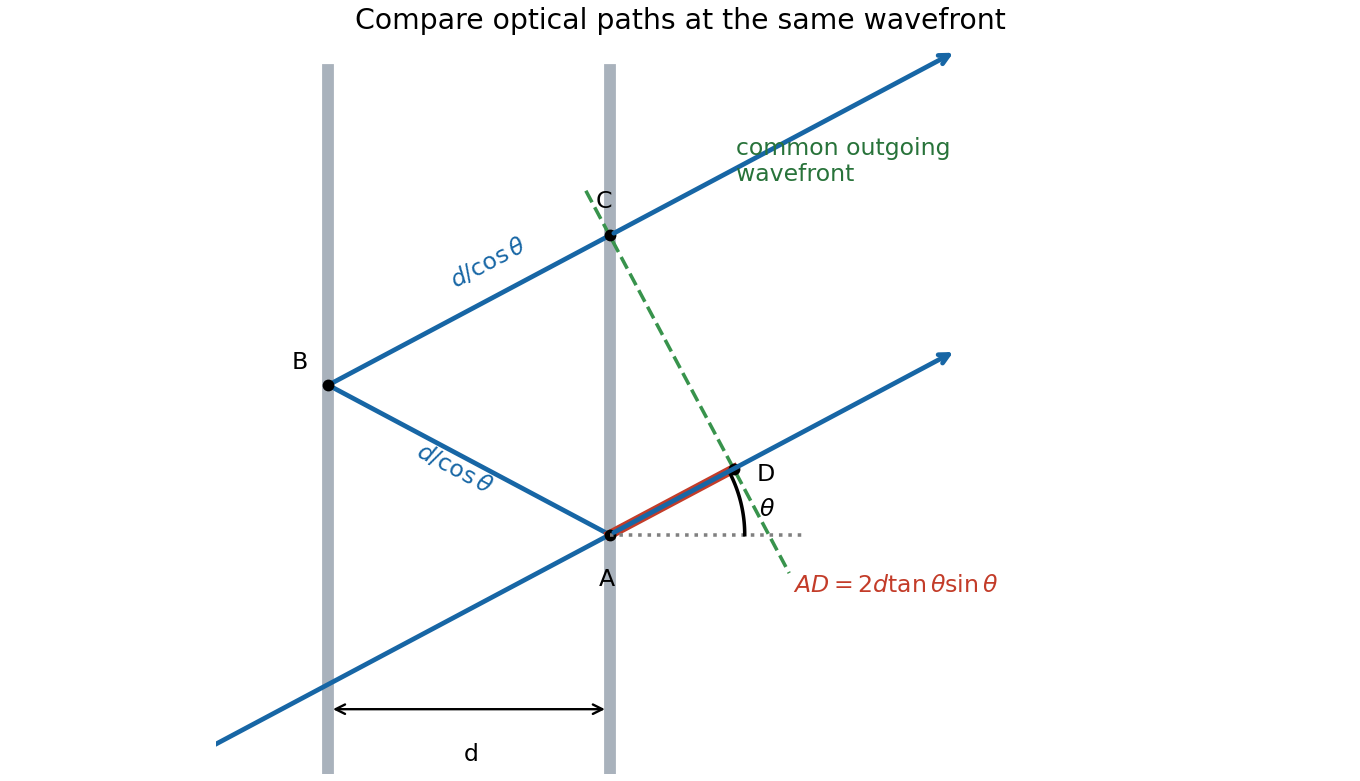
One extra round trip and the common outgoing wavefront in an air-spaced Fabry–Pérot interferometer
. Details. Past exam of the physics A course of the University of Cambridge 2015 Paper 2 Section A 2 Solution by Codex 0 2026-10-20
Codex 0 2026-10-20Let be the common tension and the linear mass densities. The characteristic impedance of a stretched string is . Continuity of displacement and transverse force at a massless junction gives and . ConsequentlyThe reflected power is . The minus sign of represents a phase reversal, not negative power. Both incident and reflected waves travel in the first string, so their power ratio is simply the squared displacement-amplitude ratio. As a check, and .
Past exam of the physics A course of the University of Cambridge 2015 Paper 1 Section D D12 Solution by Codex 0 2026-10-20
Codex 0 2026-10-20Graph. The original plot below places distance on the horizontal axis and recession speed on the vertical axis. Both axes include the origin, so the proportional model and departures from it can be judged directly. The displayed line is the fitted through-origin line, not a sequence joining adjacent observations.
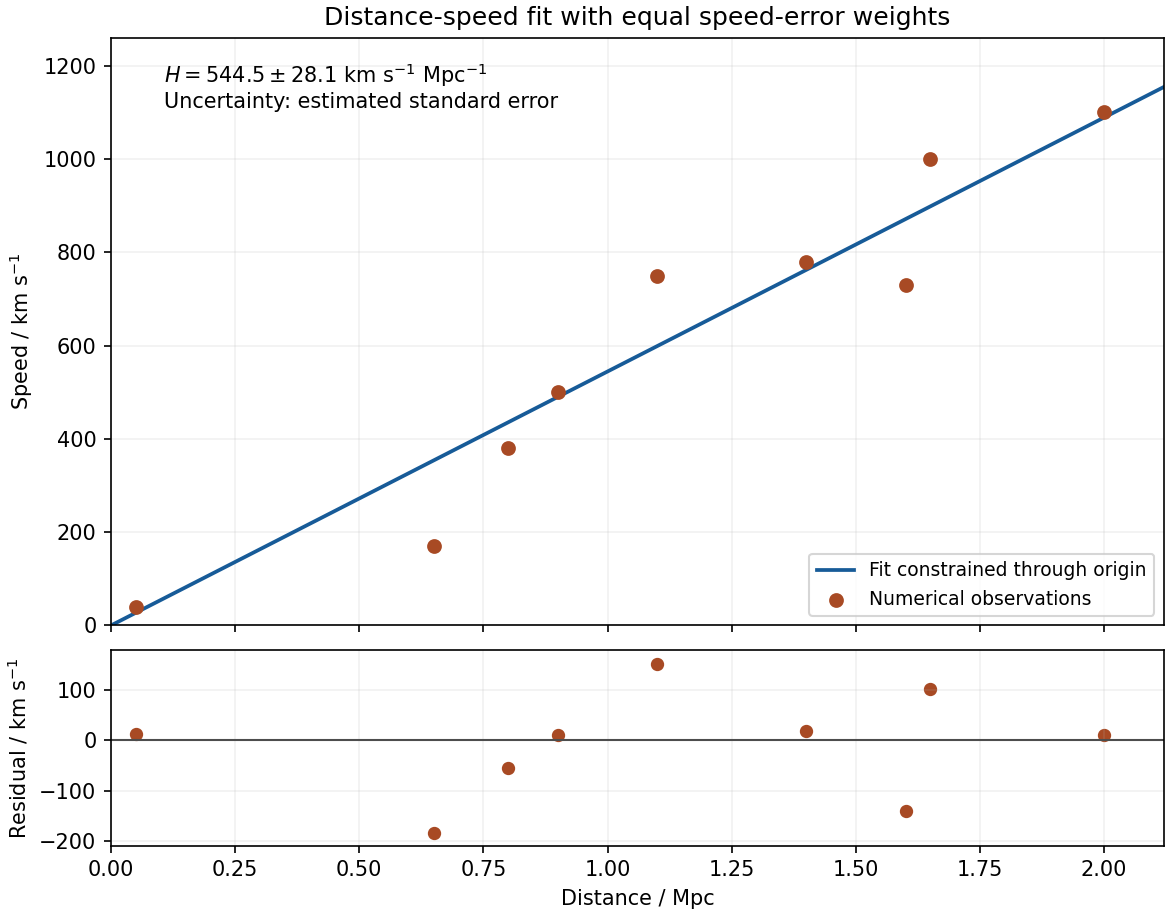
Minimization. Write and . Differentiating the specified chi-squared objective givesThus the unique least-squares minimum isConsequentlyAn unweighted average of would not minimize this chi-squared objective: equal speed errors give greater slope information to the more distant points. No intercept is fitted because the supplied model constrains it to zero.
Estimated error. For the residual estimate of slope uncertainty through the origin, independent equal-variance speed errors implyEquivalently, completing the square gives . The common is not supplied. Estimate it from the residuals, using eight residual degrees of freedom after fitting one parameter:The estimated standard error is km s kpc, givingwith the uncertainty interpreted as one estimated standard error. If the common errors are Gaussian, has a Student's t-distribution with eight degrees of freedom; an exact confidence interval uses the corresponding quantile rather than treating the estimated as known. The quoted error is conditional on exact distances, independent constant-variance speed scatter and the proportional model. A common distance-calibration bias or correlated velocities would not be captured by this residual calculation.
Pinned article: Introduction to the OurBigBook Project
Welcome to the OurBigBook Project! Our goal is to create the perfect publishing platform for STEM subjects, and get university-level students to write the best free STEM tutorials ever.
Everyone is welcome to create an account and play with the site: ourbigbook.com/go/register. We belive that students themselves can write amazing tutorials, but teachers are welcome too. You can write about anything you want, it doesn't have to be STEM or even educational. Silly test content is very welcome and you won't be penalized in any way. Just keep it legal!
Intro to OurBigBook
. Source. We have two killer features:
- topics: topics group articles by different users with the same title, e.g. here is the topic for the "Fundamental Theorem of Calculus" ourbigbook.com/go/topic/fundamental-theorem-of-calculusArticles of different users are sorted by upvote within each article page. This feature is a bit like:
- a Wikipedia where each user can have their own version of each article
- a Q&A website like Stack Overflow, where multiple people can give their views on a given topic, and the best ones are sorted by upvote. Except you don't need to wait for someone to ask first, and any topic goes, no matter how narrow or broad
This feature makes it possible for readers to find better explanations of any topic created by other writers. And it allows writers to create an explanation in a place that readers might actually find it.
Figure 1. Screenshot of the "Derivative" topic page. View it live at: ourbigbook.com/go/topic/derivativeVideo 2. OurBigBook Web topics demo. Source. - local editing: you can store all your personal knowledge base content locally in a plaintext markup format that can be edited locally and published either:This way you can be sure that even if OurBigBook.com were to go down one day (which we have no plans to do as it is quite cheap to host!), your content will still be perfectly readable as a static site.
- to OurBigBook.com to get awesome multi-user features like topics and likes
- as HTML files to a static website, which you can host yourself for free on many external providers like GitHub Pages, and remain in full control

Figure 2. You can publish local OurBigBook lightweight markup files to either OurBigBook.com or as a static website.
Figure 3. Visual Studio Code extension installation.
Figure 5. . You can also edit articles on the Web editor without installing anything locally. Video 3. Edit locally and publish demo. Source. This shows editing OurBigBook Markup and publishing it using the Visual Studio Code extension. 
- Infinitely deep tables of contents:




All our software is open source and hosted at: github.com/ourbigbook/ourbigbook
Further documentation can be found at: docs.ourbigbook.com
Feel free to reach our to us for any help or suggestions: docs.ourbigbook.com/#contact