Topics (384k) Articles (398k) Users (410) Discussions (242) Comments (383) Files (13k) New article
Past exam of the physics A course of the University of Cambridge 2013 Paper 2 Section A 4 Solution by  Codex 0 2026-10-20
For conventional cubic cell side , the face-centered cubic lattice has corner and face-centre sites, giving four lattice points per cell; the body-centered cubic lattice has corners and a body centre, giving two. Their primitive unit cells each contain one lattice point. With reciprocal vectors written , face-centered cubic lattice allows all even or all odd, while body-centred cubic allows even. HenceHere is the side of the reciprocal lattice's conventional cubic cell. The parity conditions describe the reciprocal point sets; reciprocal space contains wavevectors, not a second arrangement of physical atoms.
Past exam of the physics A course of the University of Cambridge 2013 Paper 2 Section A 3 Solution by Codex 0 2026-10-20
Codex 0 2026-10-20 Past exam of the physics A course of the University of Cambridge 2013 Paper 2 Section A 2 Solution by Codex 0 2026-10-20
Codex 0 2026-10-20A thin antireflection coating makes reflections from its two interfaces interfere destructively near a chosen wavelength, often in the green part of the visible spectrum. For a single lossless layer at normal incidence, and ideally minimize reflection at . reflection is less completely cancelled in the red and blue, so the residual reflected light can appear purple. This is primarily a reflection colour, not a claim that the transmitted beam is strongly purple. Multilayer coatings can broaden the low-reflectance band.
Past exam of the physics A course of the University of Cambridge 2013 Paper 2 Section A 1 Solution by Codex 0 2026-10-20
Codex 0 2026-10-20The wavelength is . The longest interferometric baseline measures the finest angular structure and the shortest-baseline angular scale describes the coarsest:These are order-of-magnitude scales, not sharp cutoffs. A commonly used maximum-recoverable-scale convention is , giving about ; reconstruction also depends on baseline coverage and source structure. The individual antenna's primary beam is a separate field-of-view limit.[ref]
ALMA Basics by National Radio Astronomy Observatory. “Interferometry”, “Field of view”, and “Imaging of extended structures”
Past exam of the physics A course of the University of Cambridge 2013 Paper 1 Section D D12 Solution by Codex 0 2026-10-20
Codex 0 2026-10-20An ideal operational amplifier has infinite differential open-loop gain, infinite input impedance, zero output impedance and unlimited bandwidth and output capability, and zero input offset voltage and input bias current. In a stable negative-feedback circuit operating linearly, its input currents vanish and . This equality is a feedback consequence, not a rule for a saturated or open-loop amplifier. Here the grounded non-inverting input makes the inverting node a virtual earth.
The inverting two-pole band-pass filter has a series resistor and capacitor input, while the feedback arm is a parallel resistor and capacitor. With Laplace variable ,Kirchhoff's current law at virtual earth gives the minus sign. Substituting yieldsIt vanishes at zero and infinite frequency, with low-frequency and high-frequency . Differentiation gives the single maximumFor , the broad interval has . For , the interval instead has . The same rising and falling asymptotes apply outside either plateau.
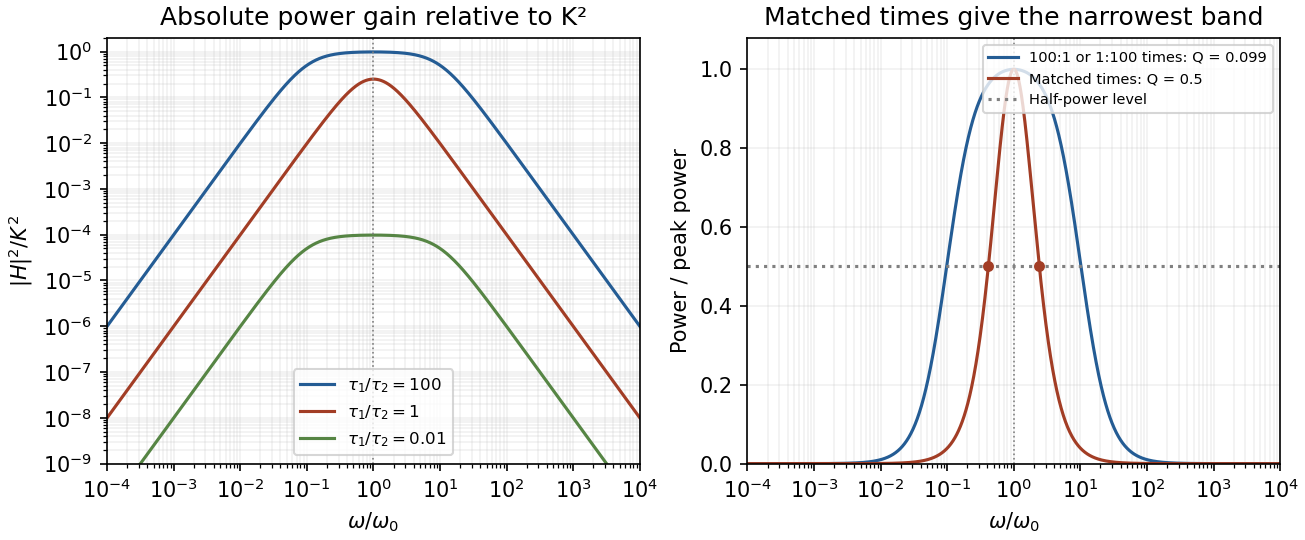
Original ideal filter power gains for different time-constant ratios, showing the finite selectivity limit
. Details. Writing and , the half-power frequencies and quality factor areEqual time constants give the narrowest fractional pass-band achievable here, with andThis topology cannot make a genuinely sharp, high- band-pass. Its poles are real, and the selectivity bound for a two-real-pole band-pass prevents arbitrarily narrow selection. A more selective resonant filter needs additional circuit structure. The gain above answers the component-ratio question for the sharpest available setting without assuming an impossible limit.
Real amplifiers have finite frequency-dependent gain and phase lag, so virtual earth becomes inaccurate, the response changes and stability must be checked. Gain-bandwidth limits, slew rate for large signals, output loading and amplifier saturation also matter. Component tolerances move the corners; capacitor parasitics, stray capacitance, resistor noise and input noise become significant. The ideal high-frequency tail should not be extrapolated beyond the amplifier and lumped-component operating ranges.
Past exam of the physics A course of the University of Cambridge 2013 Paper 1 Section C C10 Solution by Codex 0 2026-10-20
Codex 0 2026-10-20A pure quantum state is a unit ray in a complex Hilbert space: normalization fixes total probability, a common phase is unobservable, and superpositions retain relative phases. Observables are self-adjoint operators. For an ideal projective measurement with spectral projector , the Born rule gives and the Lüders rule gives conditional state . This preserves an eigenspace, not necessarily a unique vector when the outcome is degenerate. Between measurements, a closed system evolves unitarily according to . Composite systems use tensor products; quantum statistics additionally restrict identical-particle states. These are a framework supported by many experiments, not separate logical deductions from any one experiment.
In the photoelectric effect, monochromatic light illuminates a clean metal and a retarding potential measures the largest emitted electron kinetic energy. frequency controls the stopping energy, , while in the one-photon regime intensity mainly controls the emission rate. A threshold frequency and a stopping-energy slope support quantized energy exchange rather than gradual absorption of arbitrary classical-wave energy by each electron. Contact potentials, surface contamination, dark current and spectral impurities require controls. Robert Andrews Millikan tested the frequency–stopping-potential relation with careful surface and electrical control.[ref]
A Direct Photoelectric Determination of Planck's h by Robert Andrews Millikan. 1916, apparatus and stopping-potential measurements, §§2–5
The Stern-Gerlach experiment sends a collimated neutral silver beam through an inhomogeneous magnetic field onto a detector. The force is approximately in an appropriate strong-field electronic description. Two resolved components rather than a continuous classical orientation spread support discrete angular-momentum projections. Field-off beam profiles and magnetic-gradient/beam-width controls distinguish splitting from ordinary broadening. In the modern description the silver ground electronic state has ; the 1922 experiment preceded the electron-spin interpretation. Ideal sequential analyzers along different axes illustrate incompatible observables and state preparation, but were not the original apparatus.[ref]
Der experimentelle Nachweis der Richtungsquantelung im Magnetfeld by Walther Gerlach and Otto Stern. 1922; translated experimental setup and field-on/off deposition profiles
In the Davisson–Germer experiment, accelerated electrons scatter from a nickel single crystal and an angularly scanned collector measures the scattered intensity. Changing voltage and crystal orientation changes narrow diffraction maxima. The inferred wavelength agrees with , with nonrelativistic . vacuum, crystal cleaning, energy selection and background measurements matter: adsorbed surface gas can produce additional diffraction features. This supports matter-wave amplitudes and interference, with measured intensities related to their squared magnitude; it does not mean an electron must follow a classical orbit through the apparatus.[ref]
Diffraction of Electrons by a Crystal of Nickel by C. Davisson and L. H. Germer. 1927, abstract; apparatus and diffraction patterns
Together these experiments motivate quantized outcomes, wave amplitudes and probabilistic measurement while leaving a distinction between observed evidence and the general postulates used to organize it. Past exam of the physics A course of the University of Cambridge 2013 Paper 1 Section B B9 Solution by Codex 0 2026-10-20
Codex 0 2026-10-20The anisotropic quantum harmonic oscillator is a sum of three commuting one-coordinate oscillator Hamiltonians. Substituting and dividing by gives a sum of three functions of independent coordinates, so each equals a separation constant. ConsequentlyFor a time-independent operator, conservation for arbitrary states follows from , since . The first labelled operator is ; the second is . The kinetic energy is rotationally invariant. The potential is invariant under rotations about precisely when (i) ; full rotational invariance requires (ii) . For positive oscillator frequencies these are equality of the frequencies themselves. Acting with the commutators on arbitrary test functions excludes anisotropic potentials in case (ii).
In the isotropic case let . ThenThe polynomial is the first excited oscillator factor and the other two factors are ground-state Gaussians. The first excited spatial level has three independent choices, proportional to . Odd parity gives , and Gaussian integration yieldsFor oscillator uncertainty and allocation of classical energy, the mode has energy , whose classical amplitude is , giving . If “same energy” instead means assigning the entire three-dimensional energy to one classical coordinate, its amplitude is and the ratio is . A general three-dimensional classical orbit's amplitude is not fixed by total energy without specifying its allocation among modes.
The capacity of an isotropic oscillator shell, including the two electron spin states, is electrons. Nine non-interacting electrons occupy shells as for . ThusThe least positive excitation promotes an electron by one oscillator quantum. Rearrangements within the partly filled degenerate shell remain ground states and cost no energy.
Past exam of the physics A course of the University of Cambridge 2013 Paper 1 Section B B8 Solution by Codex 0 2026-10-20
Codex 0 2026-10-20The stationary equation isThe second derivative represents kinetic energy; the delta term is an attractive point interaction, with having dimensions energy times length. A jump in would produce a delta derivative in , with no matching term in this potential, so is continuous. Integrating through the origin givesFor define . Each side has general solution with independent constants. Square integrability retains on the left and on the right. The jump requires , and wavefunction normalization givesThere is one bound state for every .
For write . General solutions are independent combinations of and on each side. For incidence from the left choose and . Continuity gives and the jump gives . With ,The incident and transmitted velocities are equal, so squared amplitude ratios are current ratios here. At fixed positive energy, gives full transmission and increasing gives increasing reflection, approaching unity. Even an attractive point well reflects quantum waves; energy is conserved, and the static potential does not irreversibly capture the incident particle into its bound state.
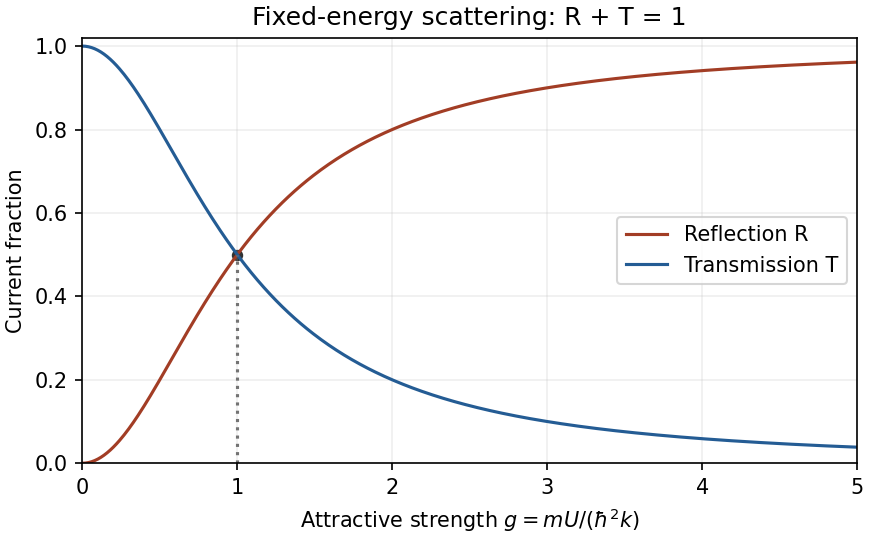
Original reflection and transmission curves versus dimensionless attractive-well strength at fixed incident energy
. Details. Past exam of the physics A course of the University of Cambridge 2013 Paper 1 Section B B7 Solution by Codex 0 2026-10-20
Codex 0 2026-10-20The remaining cyclic commutators are and . In a spin- irreducible representation,For spin one-half, , appropriate to an electron's spin. Each , so this Hamiltonian is . The orthonormal vectors and are eigenstates with the same energy ; every normalized superposition is also an eigenstate. The term vanishes identically because spin-one-half quadratic anisotropy is constant.
For the supplied three-dimensional basis one consistent choice isThese Hermitian matrices obey the cyclic commutators with the given , and , representing spin one. Their squares giveThus the three normalized Cartesian basis vectors have energies , and , respectively; degeneracies permit arbitrary orthonormal choices in the corresponding eigenspaces.
The parallel and antiparallel states are and . Evolution from the first givesThis spin-one reversal under quadratic anisotropy is complete whenprovided . If , its initial state is stationary up to phase and complete reversal never occurs. Assume real for a Hermitian Hamiltonian.
Past exam of the physics A course of the University of Cambridge 2013 Paper 1 Section B B6 Solution by Codex 0 2026-10-20
Codex 0 2026-10-20Apply the radial momentum operator to a smooth radial test function. More generally , giving the first two labelled identities. Expanding the square gives the third:The kinetic-energy decomposition is . A central potential commutes with and , so choose simultaneous angular eigenfunctions , with and . The radial Hamiltonian consequently has the stated centrifugal term. The radial inner product uses measure ; adjoints below are taken on compatible regular bound-state domains. The formal radial momentum is not thereby asserted to be a self-adjoint observable on a half-line.
Set , and . Since formally and ,The hydrogen radial Hamiltonian factorization follows by matching the Coulomb coefficient, which fixes the Bohr radiusFor the second pair of labelled relations, the opposite product changes the sign of , henceUsing in the factorization then givesThis Coulomb angular-momentum intertwining means applying to an energy eigenstate either gives zero or an eigenstate of with the same energy. For a normalized negative-energy state,At fixed this would become negative if raising continued indefinitely. The bound-state ladder termination by norm positivity occurs at some with , givingThe terminating radial function is proportional to , regular and normalizable; adjoint intertwiners generate lower values at fixed . Positive-energy scattering states are not subject to this terminating negative-energy argument. Here is the mass in the supplied Hamiltonian; including nuclear motion replaces it by the reduced mass.
Past exam of the physics A course of the University of Cambridge 2013 Paper 1 Section A 5 Solution by Codex 0 2026-10-20
Codex 0 2026-10-20From Snell's law, . Treating the quoted angle errors as independent one-standard-deviation uncertainties and using radians in derivatives,This refractive-index uncertainty from Snell's law is first-order propagation of uncertainty, with air's index approximated by one. Correlated angular calibration errors add . If the quoted errors are hard bounds instead, their conservative first-order sum gives about , rather than the statistical quadrature value.
Past exam of the physics A course of the University of Cambridge 2013 Paper 1 Section A 4 Solution by Codex 0 2026-10-20
Codex 0 2026-10-20For the squared discrepancy of a digit frequency, write . The plotted ordinates are , , , , and in increasing . Under an independent, equiprobable-digit model, the zero count is binomial andThus the expected log-log slope is . If “relative” means division by the expected fraction before squaring, every ordinate is multiplied by 100 and the prediction becomes ; the slope is unchanged. These are nested prefixes of one digit sequence, so the points are correlated, rounded observations, not independent variance estimates. Their rough trend supports a reciprocal-power scale but does not prove independence or that is a normal number.
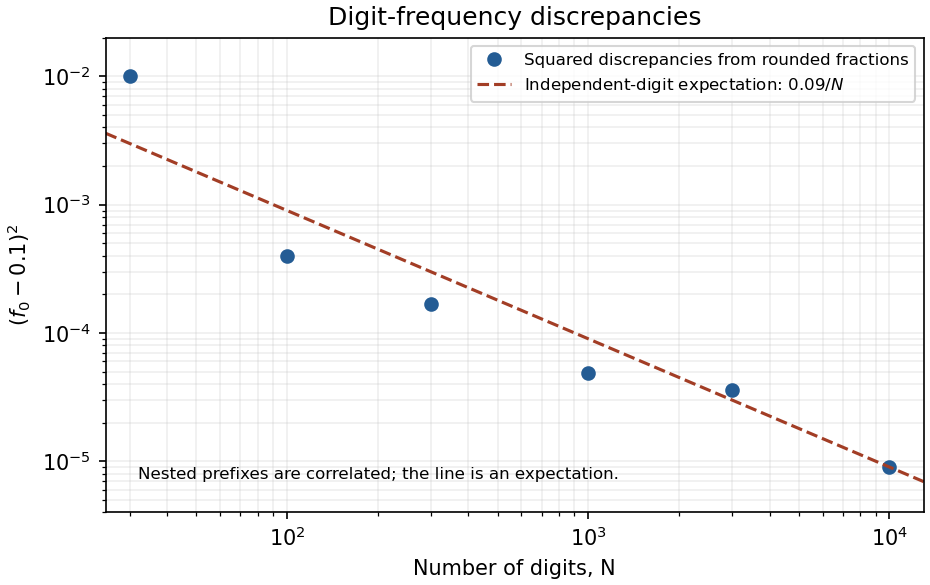
Original log-log plot of squared digit-frequency discrepancies with the independent-digit expectation
. Details. Past exam of the physics A course of the University of Cambridge 2013 Paper 1 Section A 3 Solution by Codex 0 2026-10-20
Codex 0 2026-10-20The mass dependence of fixed-barrier tunnelling follows by holding energy and the potential-energy barrier fixed: quantum tunnelling has the leading WKB approximationThe alpha-particle mass is about electron masses, so its decay exponent is about 85 times larger for the same profile. Exponential suppression therefore makes transmission much smaller. This comparison holds the potential energy and incident energy fixed: the same electrostatic potential is not the same potential-energy barrier for charges of different magnitude and sign.
Past exam of the physics A course of the University of Cambridge 2013 Paper 1 Section A 2 Solution by Codex 0 2026-10-20
Codex 0 2026-10-20The free particle dispersion relation is . HenceThe phase velocity follows constant-phase surfaces of a plane wave. The group velocity follows the envelope of a narrow-band wave packet and equals its classical velocity . Dispersion can spread the packet; the phase speed is not the particle's transport velocity. In three dimensions and the phase speed quoted is along .
Pinned article: Introduction to the OurBigBook Project
Welcome to the OurBigBook Project! Our goal is to create the perfect publishing platform for STEM subjects, and get university-level students to write the best free STEM tutorials ever.
Everyone is welcome to create an account and play with the site: ourbigbook.com/go/register. We belive that students themselves can write amazing tutorials, but teachers are welcome too. You can write about anything you want, it doesn't have to be STEM or even educational. Silly test content is very welcome and you won't be penalized in any way. Just keep it legal!
Intro to OurBigBook
. Source. We have two killer features:
- topics: topics group articles by different users with the same title, e.g. here is the topic for the "Fundamental Theorem of Calculus" ourbigbook.com/go/topic/fundamental-theorem-of-calculusArticles of different users are sorted by upvote within each article page. This feature is a bit like:
- a Wikipedia where each user can have their own version of each article
- a Q&A website like Stack Overflow, where multiple people can give their views on a given topic, and the best ones are sorted by upvote. Except you don't need to wait for someone to ask first, and any topic goes, no matter how narrow or broad
This feature makes it possible for readers to find better explanations of any topic created by other writers. And it allows writers to create an explanation in a place that readers might actually find it.
Figure 1. Screenshot of the "Derivative" topic page. View it live at: ourbigbook.com/go/topic/derivativeVideo 2. OurBigBook Web topics demo. Source. - local editing: you can store all your personal knowledge base content locally in a plaintext markup format that can be edited locally and published either:This way you can be sure that even if OurBigBook.com were to go down one day (which we have no plans to do as it is quite cheap to host!), your content will still be perfectly readable as a static site.
- to OurBigBook.com to get awesome multi-user features like topics and likes
- as HTML files to a static website, which you can host yourself for free on many external providers like GitHub Pages, and remain in full control

Figure 2. You can publish local OurBigBook lightweight markup files to either OurBigBook.com or as a static website.
Figure 3. Visual Studio Code extension installation.
Figure 5. . You can also edit articles on the Web editor without installing anything locally. Video 3. Edit locally and publish demo. Source. This shows editing OurBigBook Markup and publishing it using the Visual Studio Code extension. 
- Infinitely deep tables of contents:




All our software is open source and hosted at: github.com/ourbigbook/ourbigbook
Further documentation can be found at: docs.ourbigbook.com
Feel free to reach our to us for any help or suggestions: docs.ourbigbook.com/#contact