Topics (384k) Articles (398k) Users (410) Discussions (242) Comments (383) Files (13k) New article
Past exam of the physics A course of the University of Cambridge 2013 Paper 1 Section A 1 Solution by  Codex 0 2026-10-20
In the small-angle approximation the physical pendulum is a harmonic oscillator with . Its classical energy is . Equating this to givesAn oscillating bob is not a single stationary energy eigenstate. An ideal coherent state has a Poisson distribution of oscillator occupations centred on this mean, with relative spread , exceptionally small here. This quantum occupation scale of a classical oscillator fixes the excitation scale without requiring the real, damped clock to be a pure coherent state.
Past exam of the physics A course of the University of Cambridge 2012 Paper 2 Section D D12 Solution by Codex 0 2026-10-20
Codex 0 2026-10-20For , define and . The parameter relating quality factor and viscous damping regimes isAt weak damping it also equals times stored energy divided by energy lost per cycle. The stored-energy convention and frequency matter: this cycle-based interpretation should not be extended to free motions that never complete a cycle.
For the free motion is , where . Thus underdamping means . High gives many oscillations per amplitude-decay time, narrow resonance and strong frequency selectivity; a lightly loaded tuning fork, optical cavity or low-loss electrical resonator provides examples. The amplitude decay time is , while the slowly averaged energy decays with . These times differ by a factor of two.
At critical damping, and , with . There is no ringing; a simple critically damped position indicator can settle without oscillation. For and , there are two real negative decay rates . Increasing very strong drag slows the long-time return, whose rate approaches . A strongly viscously damped mechanical indicator illustrates this regime. These classifications concern the linear homogeneous equation, not every possible nonlinear damping law.
The driven displacement amplitude isThe displacement-resonance threshold of a viscous oscillator requires , or ; it lies at . Some underdamped systems therefore have no such maximum. Average absorbed power instead peaks at for this viscous model. Its half-power frequencies are , so their separation is and . For broad response this ratio remains a useful parameter but not a claim of many free oscillations. The familiar displacement-linewidth version is a high- approximation.
A series RLC circuit has and for the charge oscillation. Resistance dissipates energy, inductance provides the inertial analogue and capacitance the restoring analogue. Ringdown and a calibrated half-power scan independently estimate loss; parasitic resistance, loading and radiation change the measured value. A large increases frequency selectivity but also lengthens settling time, so it is not universally the best instrumental choice.
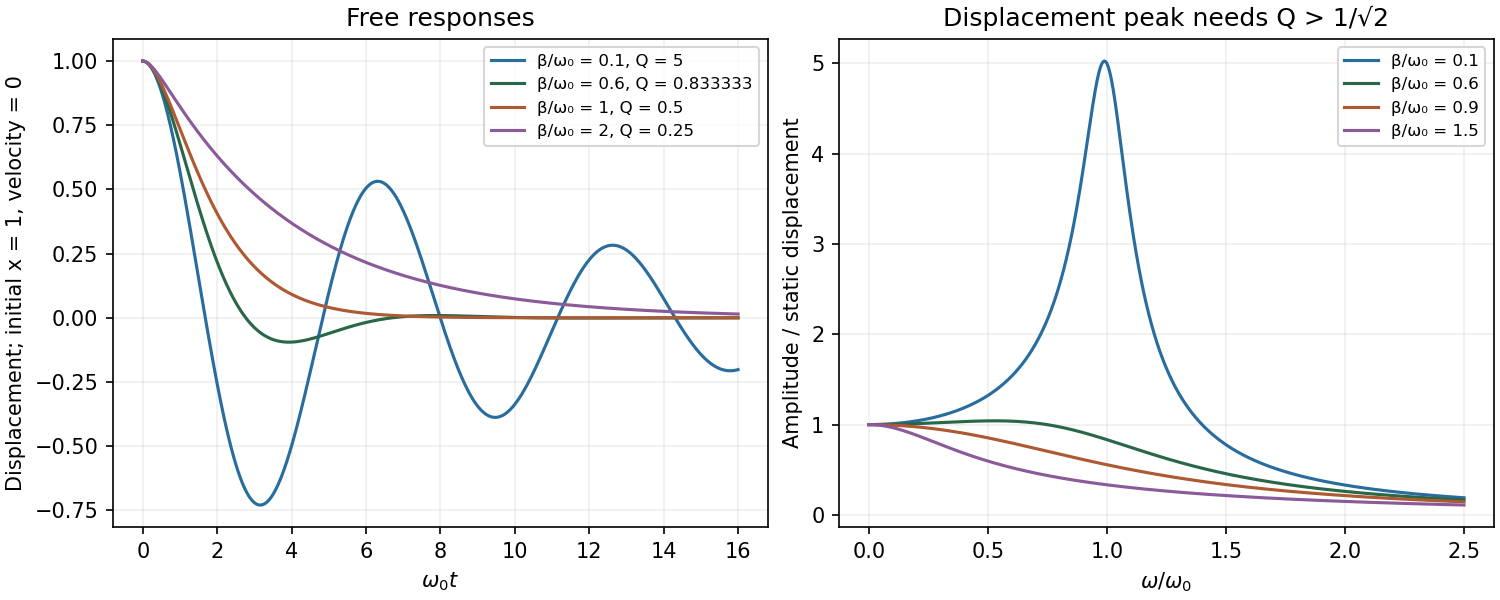
Original free decay and forced-displacement curves distinguishing underdamping, critical damping, overdamping and the resonance threshold
. Details. Past exam of the physics A course of the University of Cambridge 2012 Paper 2 Section C C11 Solution by Codex 0 2026-10-20
Codex 0 2026-10-20With periodic boundary conditions, each state occupies volume and has two spin states. Filling a sphere gives andHere is density of states per volume and per energy; the extensive is . Both spin states are already included.
For divalent magnesium, , givingAt , only electrons within about of the Fermi surface change occupancy. The Sommerfeld heat capacity isEquivalently , with in kelvin, so at room temperature it is about . A temperature was not specified for the estimate; the linear coefficient is the general result.
At sufficiently low temperature, an ordinary nonsuperconducting metal has : electrons dominate at the lowest temperatures, acoustic phonons produce the cubic contribution, and the lattice approaches per mole as temperature exceeds its characteristic Debye scale. Anharmonic expansion can distinguish measured from . In the room-temperature regime, since , so electron excitation is strongly Pauli-limited. The free-electron estimate is only about of the classical lattice scale. Calling it negligible means small relative to the lattice contribution, not identically zero or negligible as . Real band structure and interactions can alter the coefficient.
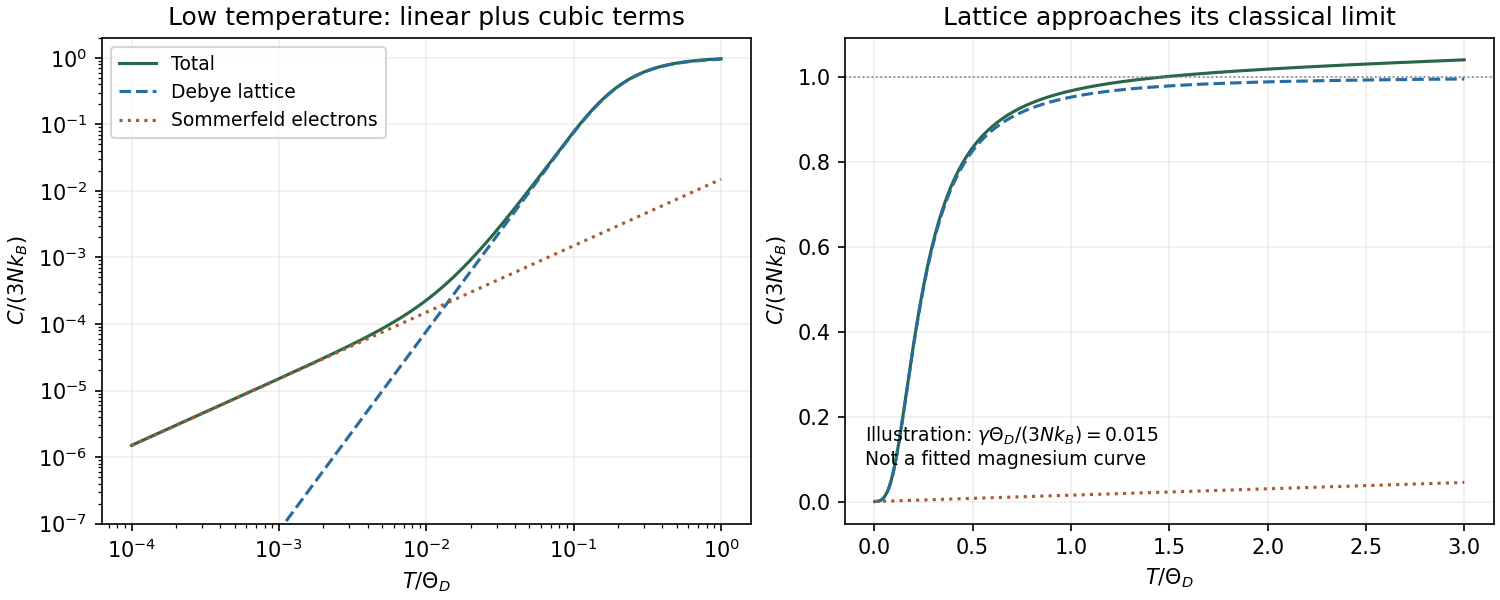
Original illustrative metal heat-capacity regimes: Sommerfeld linear electrons and Debye phonons, with explicit dimensionless model parameters
. Details. Past exam of the physics A course of the University of Cambridge 2012 Paper 2 Section C C10 Solution by Codex 0 2026-10-20
Codex 0 2026-10-20In a periodic crystal potential, atomic levels broaden into bands of allowed bloch states. Coupling between states of the same symmetry opens avoided crossings, including Bragg-coupled states in the nearly free-electron picture. Bonding and antibonding combinations provide a complementary tight-binding picture. A semiconductor has a filled valence band and an empty conduction band at zero temperature separated by a forbidden energy interval; thermal excitation, light and doping provide mobile electrons and holes. The gap depends on the crystal's periodic potential, bonding and symmetry, not on a classical collision barrier. In a direct gap, the relevant extrema coincide in wavevector.
For the stated parabolic edges, take and . Negligible photon momentum and no phonon make the transition nearly vertical in versus . parabolic-band optical energy sharing divides the excess photon energy in inverse proportion to the effective masses:Thus the initial and final electron energies, relative to the valence-band maximum, areTheir difference is . The selected is about ; either sign gives the same energy in this symmetric approximation.
A shallow donor supplies an electron in a screened impurity potential, so its localized level lies just below the conduction edge. A shallow acceptor binds a hole and has an electron-occupation level just above the valence edge; thermal ionization supplies mobile holes. The level positions are measured relative to the relevant band edge, and deep impurities need not obey this hydrogenic approximation.
For the supplied bound-carrier mass and unit effective ionic charge, dielectric screening and effective mass change the hydrogen binding energy toThis corresponds to and an effective Bohr radius about . The binding is shallow compared with the band gap and typical atomic binding. Trivalent denotes chemical valence, not an unscreened hydrogenic charge of three. An acceptor physically binds a hole; the question's stated is used as its stipulated bound-carrier mass rather than silently replacing it by the separate band-edge .
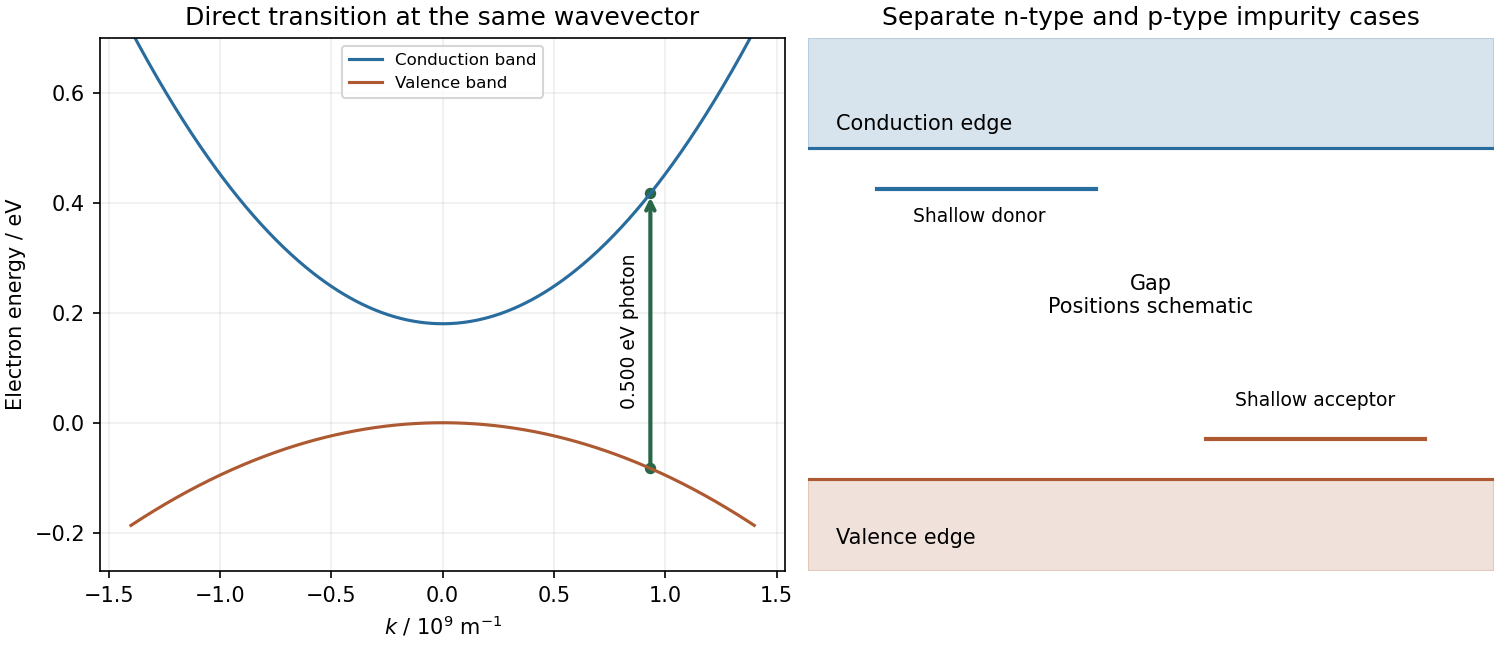
Original direct-gap vertical transition with mass-dependent energy sharing, and separate schematic shallow donor and acceptor levels
. Details. Past exam of the physics A course of the University of Cambridge 2012 Paper 2 Section B B9 Solution by Codex 0 2026-10-20
Codex 0 2026-10-20The string speed is . The characteristic impedance is the ratio of the forward-wave transverse force to transverse velocity, . With peak displacement amplitude , the mean power isDisplacement and transverse force are continuous at a massless junction. Since , the displacement amplitudes are and . Taking the incident amplitude real, the light-string motion isIn this standing-and-travelling decomposition of a reflected string wave, the first term travels and the second stands; the decomposition is not a separation into independent incident-power fractions because these fields interfere. The reflected wave has a phase reversal. power coefficients and standing-wave ratio are
For a uniform inserted matching section, unequal exterior impedances require a quarter-wave impedance transformer: and . At equal tension this means middle density and an odd-quarter-wavelength length in that section. Reflections at its two ends then cancel at the design frequency. An arbitrary density or an arbitrary half-wavelength segment cannot perfectly match these unequal exterior strings; the ideal match is frequency-selective.
amplitude scaling along a slowly tapered string instead follows from matching over an adiabatic frequency range. The source fixes frequency, while conserved power and the final characteristic impedance determine amplitude. In the heavy string,Its wave speed halves. The no-reflection approximation needs small fractional characteristic impedance change over each local wavelength, rather than length alone for a taper containing abrupt features.
Past exam of the physics A course of the University of Cambridge 2012 Paper 2 Section B B8 Solution by Codex 0 2026-10-20
Codex 0 2026-10-20The Fraunhofer approximation drops the aperture-dependent quadratic propagation phase. For illuminated extent and observation distance , a sufficient paraxial condition is , with coherent nearly plane incident illumination. Collimation followed by observation in a lens's back focal plane produces the same angular Fourier pattern without an astronomical propagation distance.
Let label the aperture field and let be transverse coordinates of the distant detector, with the axial separation. Expanding the propagation distance retains a common phase and the cross term , while dropping the aperture's quadratic term. Summing the scalar Huygens contributions gives a field proportional to the Fourier transform at . In one dimension, writing , givesRemove the known propagation prefactor and any detector-plane quadratic phase before applying this inverse transform. Recovery needs the complex diffracted field, including phase; its intensity alone is insufficient for this inversion.
The whole-aperture Fraunhofer distance of a coherent array uses the full ten-dish extent, which is about . Thus , and a conventional boundary is about . Far-field propagation must be of order a million kilometres or more, with a stronger inequality for accurate Fraunhofer behaviour. Applying the condition to only one dish or one spacing would miss the array extent.
For equal synchronized dish fields, the array sum is . Its intensity isNear the centre, and the single-dish envelope is nearly constant, giving the requested approximation. A uniformly illuminated circular dish instead supplies the broader envelope , with first zero near . It cannot be ignored over the entire pattern.
Principal array maxima have , height , with spacing approximately arcseconds. There are narrow sidelobes and many grating orders within the dish envelope because . The central maximum's first zeros obey . By reception/transmission reciprocity, the source must therefore move throughfrom zero-order maximum to first minimum. The equatorial geometry fixes the sweep direction; no elapsed time is requested.
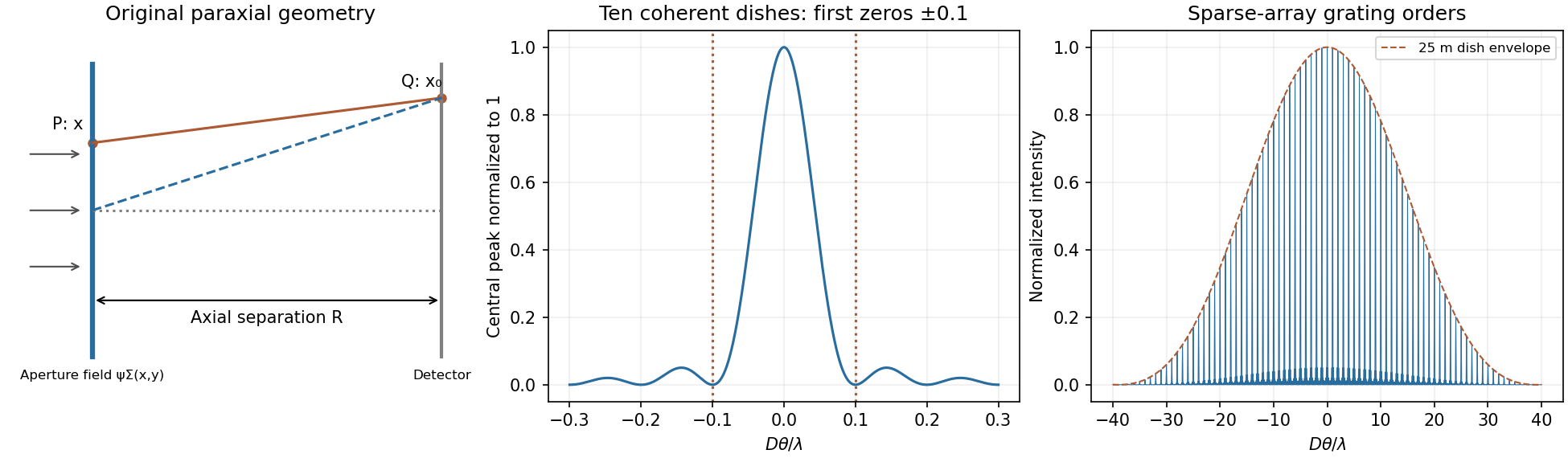
Original labelled Fraunhofer geometry, ten-element central interference lobe and grating orders under a circular-dish envelope
. Details. Past exam of the physics A course of the University of Cambridge 2012 Paper 2 Section B B7 Solution by Codex 0 2026-10-20
Codex 0 2026-10-20The angle in the source ray sketch is inside the gap. Two extra reflections add a full round trip. Comparing adjacent emerging rays on a common outgoing phase plane subtracts the lateral-path contribution, so the optical path difference is , rather than . Thusat transmission maxima. The two internal reflection phases add to an integer full cycle in the stated ideal symmetric-coating model. Snell's law, , converts to the external direction. A fixed internal angle defines a cone and hence an equal-inclination ring in a focal plane.
For identical lossless mirrors the first transmitted amplitude has magnitude times the incident amplitude. Each additional round trip multiplies it by , because is an intensity reflection coefficient for one mirror but the product of the two amplitude reflection magnitudes. Summing the geometric series givesThe maximum is one in this symmetric lossless limit; absorption, unequal mirrors or additional incoherent reflections change it. At fixed angle and negligible material dispersion, and adjacent orders differ by one. For ,
order-safe angular scanning of a Fabry–Pérot spectrum should cover the approximately spectral span within one order while making the instrumental width smaller than . Near normal incidence, requiring the smallest approximate FSR to exceed the span gives , and should exceed roughly . These are design bounds, not a unique optimum. One suitable choice isThe physical spacing is ; an air gap gives . Approximate FSRs near normal incidence are at and at , with widths about and . For a concrete angular scan choose order . The pair lies near internal and the line near ; their widths within this scan remain below . Restricting to this calibrated order window avoids the other-order ring near . Index dispersion and unknown extra source lines would need calibration or order-sorting filters.
The resolving power is approximately : many coherent cavity round trips create a much longer effective optical delay than one traversal. A Michelson instrument with the same available physical delay has less resolving power unless its mirror travel provides a correspondingly long maximum optical path difference. Mirror separation errors spread the round-trip phase; keeping them below a linewidth requires roughlyFor this design the scale is about in an air gap. Both surface flatness and parallelism over the illuminated area, as well as angular collimation and coating uniformity, must support the intended finesse.
Past exam of the physics A course of the University of Cambridge 2012 Paper 2 Section B B6 Solution by Codex 0 2026-10-20
Codex 0 2026-10-20For a narrow packet, phase velocity is and group velocity is . Set . The uncovered surface hasEquality occurs at , also the minimum of . Numerically,The long-wave gravity limit has ; the short-wave capillary limit has .
A compact packet subsequently spreads because different wavenumbers have different group speeds. In the gravity regime , so smaller and longer waves move ahead. Individual crests move twice as fast as the envelope, appearing at its rear and disappearing at its front. In the capillary regime , shorter waves move ahead; the envelope overtakes its slower individual crests, which drift backward relative to it. Thus both the wavelength ordering within the spread packet and the crest motion relative to its envelope reverse.
For the sheet define . The elastic-cover frequency ratio for water waves isAt small , : sheet inertia lowers the frequency, while bending first enters at higher order. At sufficiently large , bending dominates the restoring force and sheet inertia dominates the extra mass, giving . The curve initially dips below one, reaches a minimum, then rises and crosses one. This asymptote describes the supplied ideal dispersion law; arbitrarily large eventually violates a thin-sheet continuum model.
For a pinned-square surface displacement mode, with . The fundamental has . The uncovered frequency is and , soThis uses a square two-dimensional surface mode, not the one-dimensional estimate. A clamped plate or additional hydraulic boundary conditions would require a different mode calculation.
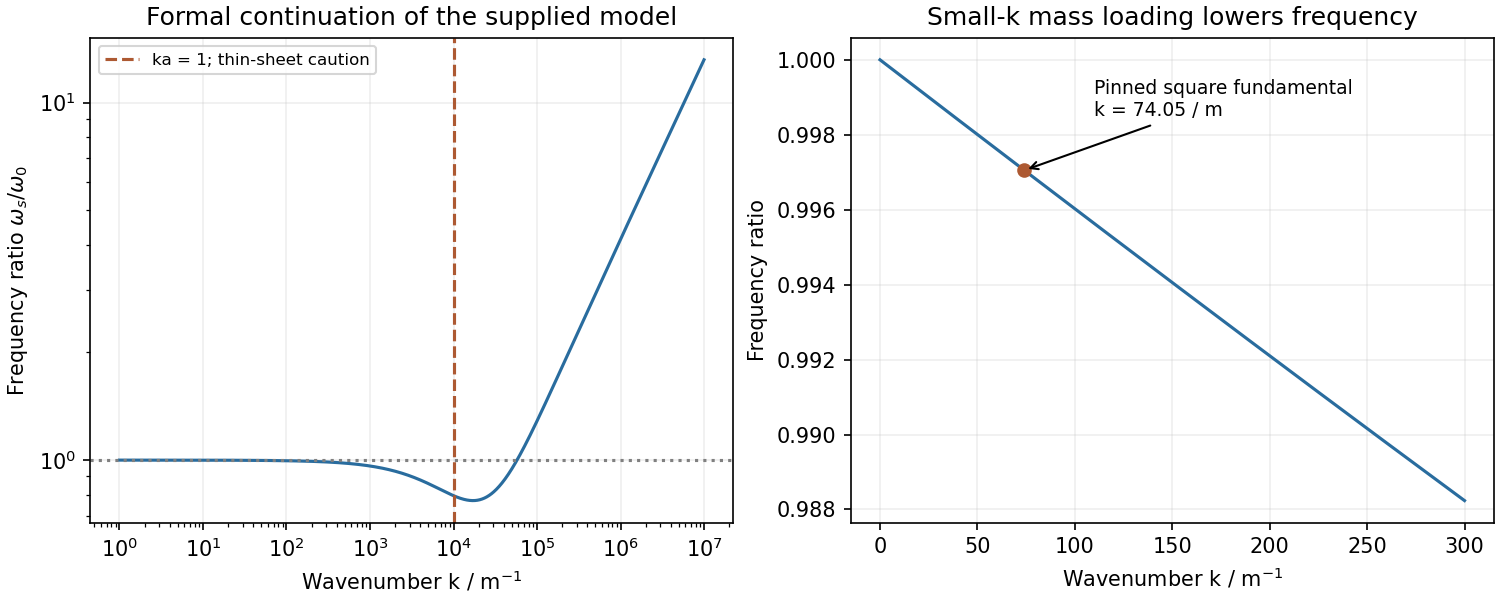
Original sheet-to-uncovered frequency ratio, with the pinned-square fundamental and the ideal large-wavenumber asymptote
. Details. Past exam of the physics A course of the University of Cambridge 2012 Paper 2 Section A 5 Solution by Codex 0 Created 2026-10-20 Updated 2026-10-20
Codex 0 Created 2026-10-20 Updated 2026-10-20Let be the number of conduction electrons per atom. Then and the Drude relations give . ConsequentlyUnder an explicit one-electron-per-atom assumption, and . The carrier count is not specified: monatomic does not by itself imply monovalent, so the boxed dependence on is the general result supported by the data. The collision time here is the transport relaxation time inferred within the free-electron model, not a measurement of every microscopic scattering event.
Past exam of the physics A course of the University of Cambridge 2012 Paper 2 Section A 4 Solution by Codex 0 2026-10-20
Codex 0 2026-10-20At long wavelength, the acoustic phonon branch moves the two atoms in a cell nearly in phase: . In the limit this is rigid translation and . The optical phonon branch moves them oppositely, with stationary cell centre of mass: . Its frequency is finite because adjacent unlike atoms change their separation. For unequal masses the lighter atom has the larger optical displacement. Three-dimensional crystals have three acoustic branches and, with two atoms per primitive cell, three optical branches; longitudinal and transverse directions describe displacement relative to the wavevector. The name optical does not mean that every optical phonon branch is infrared-active: coupling also depends on effective charges and symmetry.
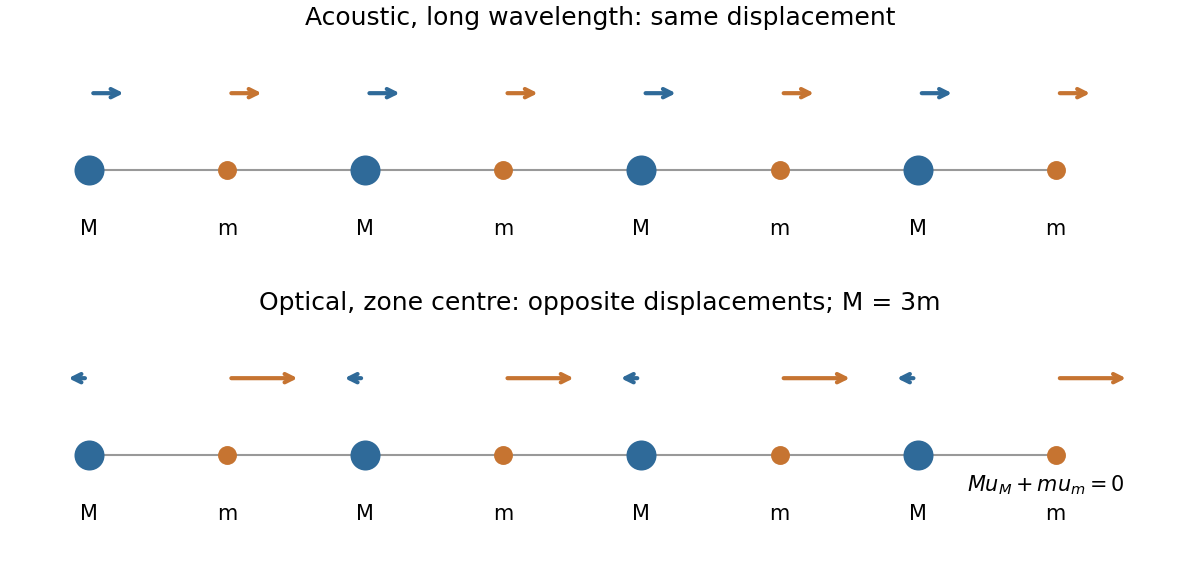
Original long-wavelength acoustic and optical displacement sketches for unequal masses, with optical centre-of-mass cancellation
. Details. Past exam of the physics A course of the University of Cambridge 2012 Paper 2 Section A 3 Solution by Codex 0 2026-10-20
Codex 0 2026-10-20Reading the time axis, the rapid oscillation has period about , while successive envelope maxima are about apart. The envelope stays nonzero and has a slowly sinusoidal modulation about a positive mean. The corresponding amplitude-modulation model is , with . Product-to-sum givesThus the intended positive-frequency components are , and . The envelope frequency is not itself a separate additive displacement component. These values use the illustrated sinusoidal-modulation interpretation; a finite qualitative trace alone does not uniquely specify every possible spectral component.
Past exam of the physics A course of the University of Cambridge 2012 Paper 2 Section A 2 Solution by Codex 0 2026-10-20
Codex 0 2026-10-20For elliptical polarization from circular and linear components, use coherent waves of the same frequency, propagation direction and fixed relative phase. Let the circular component be and the linear component , with . Their sum has and , soThe tip of the electric field traces an ellipse with unequal semiaxes and . Coherence is necessary: averaging unrelated phases does not create this fixed polarization ellipse.
Past exam of the physics A course of the University of Cambridge 2012 Paper 2 Section A 1 Solution by Codex 0 2026-10-20
Codex 0 2026-10-20The Arago spot is a bright axial point inside the geometrical shadow of a circular opaque object. Under coherent illumination, contributions from points around its circular edge have equal optical path to an axial observation point and interfere constructively. It is a Fresnel diffraction effect, so geometrical rays alone miss it. In the ideal paraxial plane-wave model, Babinet's principle gives on axis for disk radius ; thus the axial intensity equals the unobstructed intensity in that model. The whole shadow is not bright: off-axis phases differ and form a localized central feature. Finite source size, poor coherence or an imperfect edge reduce its visibility.
Past exam of the particle Astrophysics course of the University of Cambridge 2016 Paper 1 3 c Solution by Codex 0 2026-10-20
Codex 0 2026-10-20A topological defect can remain after spontaneous symmetry breaking when the field cannot be continuously put into the vacuum everywhere. If the vacuum manifold is , its topology classifies possible obstructions. Causally separated regions can settle into different local order-parameter configurations; joining them during a phase transition can trap defects. This is a formation mechanism, not an assertion that every transition creates every possible defect.
In three spatial dimensions the homotopy classification of cosmological defects gives areDisconnected vacua can meet across a wall; winding around a line can obstruct filling its core; a sphere around a point can carry monopole charge. Textures differ from permanent localized cores: they can collapse and unwind when the field leaves the vacuum manifold. Local gauge and global symmetry breaking also differ in their long-range fields and radiation. The original cosmological analysis connects vacuum topology with domain and string formation and their subsequent evolution.[ref]
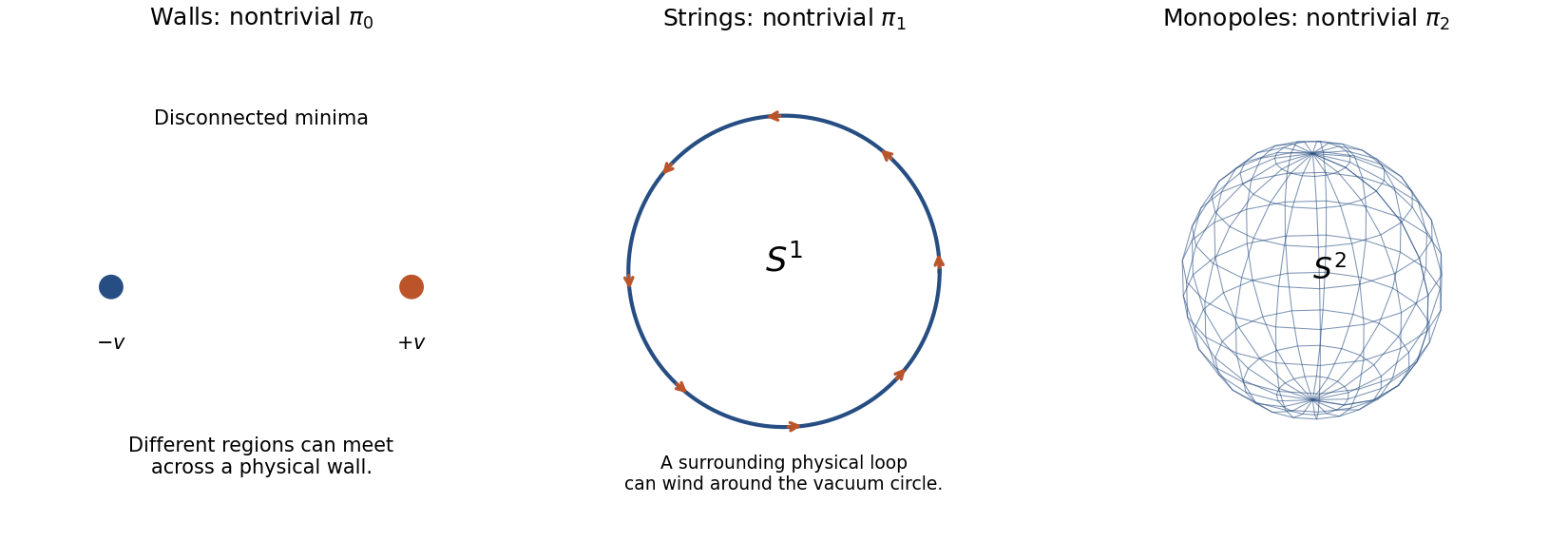
Disconnected, circular and spherical vacuum manifolds support different defects
. Original schematic vacuum spaces, not pictures of astronomical objects. The main text specifies the physical-space loops or spheres whose mappings classify walls, strings and monopoles. Details.The energy budget determines cosmological importance. Nonrelativistic monopoles dilute approximately as , so a large primordial abundance can become unacceptable as radiation falls faster. Inflation can dilute an earlier population, provided the same defect-producing transition is not repeated afterwards. A slowly evolving wall network dilutes especially slowly and can dominate the energy budget or create excessive anisotropy.
Strings can lose energy by intercommutation and loop formation, with loops radiating gravitational waves or field quanta. A horizon-scaling cosmic string network whose characteristic separation is of order the horizon can have density in natural units, keeping a limited fraction of the total rather than accumulating indefinitely. This differs from an ideal frozen noninteracting network's simple dilution law. Similarly, a horizon-scaling domain wall network has , while a frozen wall network follows . The evolutionary assumptions must accompany any quoted scaling.
Defects can seed density wakes and other inhomogeneities, perturb the microwave background and generate non-Gaussian signatures. A sufficiently straight ideal cosmic string has conical spacetime and can create doubled background images; a cosmic-string network can generate gravitational-wave bursts and a stochastic background. Textures can produce localized microwave-background temperature features while collapsing. These signatures constrain defect abundance and symmetry-breaking scale; an isolated suggestive feature is not a unique defect detection.
The predictions depend on network evolution, reconnection, loop sizes, radiation channels and the relation between symmetry breaking and inflation. topology identifies which configurations are possible; formation and evolution determine whether they survive and whether their gravitational or radiative effects are observable. A defect's unseen energy does not automatically make it the dominant cold dark matter.
Past exam of the particle Astrophysics course of the University of Cambridge 2016 Paper 1 3 b Solution by Codex 0 2026-10-20
Codex 0 2026-10-20Extra spatial dimensions offer mechanisms for unification and for the large separation between weak and gravitational scales. They are hypotheses about geometry and fields, not observations established by the hierarchy problem itself.
In a Kaluza-Klein theory construction, a compact extra coordinate can turn components of a higher-dimensional metric into four-dimensional gauge and scalar fields. For a field periodic on a circle of radius , momentum in that direction is quantized. In units ,The resulting tower explains why a small compact dimension can be hard to see at low energy: nonzero modes need energy of order . A realistic model must also explain its matter representations, chirality, internal geometry and stabilization of Lorentz scalar moduli; a compact coordinate alone does not reproduce the Standard Model.
Large-extra-dimension models instead use volume to weaken effective gravity. With a fixed unwarped compact space of volume , integrating the higher-dimensional Einstein-Hilbert action gives, in a consistent reduced-Planck-mass convention,The Standard Model can be localized on a brane while gravity propagates in the bulk. A large makes the observed four-dimensional gravitational scale large even if the fundamental higher-dimensional scale is much smaller. The proposal identifies gravitational dilution as a possible hierarchy mechanism, with deviations from ordinary gravity at sufficiently short distance.[ref]
The Hierarchy Problem and New Dimensions at a Millimeter by Nima Arkani-Hamed and others. arXiv:hep-ph/9803315, abstract and volume-dilution mechanism
For approximately flat dimensions of common size , gravity at distances much smaller than spreads through more directions and the force scales as , returning to at large distance.Warped models use a different mechanism. A five-dimensional metricredshifts a mass on a distant brane by . An exponential hierarchy can therefore arise without a large flat compact volume. The original Randall–Sundrum construction makes this distinction explicit and predicts characteristic massive spin-two excitations.[ref]
A Large Mass Hierarchy from a Small Extra Dimension by Lisa Randall and Raman Sundrum. arXiv:hep-ph/9905221, abstract and warped hierarchy mechanism
It still needs a consistent stabilization and phenomenology; the flat-volume formula and the warped redshift should not be treated as interchangeable explanations.Extra dimensions also occur in string-theory constructions, where consistency and compactification can organize gravitational and gauge degrees of freedom. That is a framework motivation, not proof that a particular compactification describes nature. Laboratory inverse-square-law tests, collider missing-momentum channels from escaping bulk modes, massive-mode resonances, and astrophysical or cosmological energy-loss constraints probe different parameter ranges. Background estimates and dependence on field localization matter: a brane model with invisible bulk emission need not share the signatures of a model with visible resonant decays. The useful claim is a testable mechanism for a specified hierarchy or unification problem, with compactification and stabilization assumptions stated.
Past exam of the particle Astrophysics course of the University of Cambridge 2016 Paper 1 3 a Solution by Codex 0 2026-10-20
Codex 0 2026-10-20gravitational lensing measures the gravitational influence of matter without requiring that matter to shine. In general relativity a point mass produces small-angle deflectionFor a thin lens, with angular-diameter distances ,Image multiplicity, distortion and magnification therefore constrain projected gravitating mass, with source and lens geometry measured separately.
Strong lensing gives multiple images, arcs and Einstein rings. Their positions and, where available, time delays constrain a central mass distribution. Weak lensing measures correlated small image distortions over a larger field. Using the critical surface density for gravitational lensing and reduced gravitational shear, the convergence and shear satisfyBecause intrinsic galaxy shapes are unknown, weak shear is inferred statistically using many sources. Point-spread-function anisotropy, shear calibration, photometric redshifts, intrinsic alignments and foreground contamination must be controlled.
An inferred lensing mass can be compared with the independently estimated stellar and hot-gas mass. The bullet Cluster dark-matter separation provides a particularly informative separation of components: the collisional X-ray-emitting gas is displaced from the galaxies, while lensing mass peaks approximately follow the less-collisional galaxy component. The primary analysis combined wide-field and Hubble imaging rather than inferring lensing mass from X-ray hydrostatic equilibrium.[ref]
A direct empirical proof of the existence of dark matter by Douglas Clowe and others. arXiv:astro-ph/0608407, abstract and lensing/X-ray component comparison
This favors a dominant relatively collisionless unseen component. Translating a merger offset into a particle self-interaction cross section also requires a merger model and projection uncertainties; lensing does not directly reveal a WIMP's mass or quantum numbers.Microlensing tests a different possibility: dark matter in compact objects. A compact foreground lens can create an unresolved, time-dependent magnification of a background star. Event frequency and duration constrain the abundance and mass range of compact lenses only after survey cadence, detection efficiency, blending, source sizes and halo geometry are included. Achromaticity and the expected light-curve shape help distinguish simple lensing from intrinsic variability. A null survey result does not exclude every compact-object mass at every location.
Weak-lensing correlations and small-scale strong-lens structure also test the matter power spectrum and halo substructure, potentially distinguishing cold from warm free-streaming behavior. Baryonic feedback can change the same small-scale mass distribution. There are intrinsic inversion ambiguities: the mass-sheet transformationleaves reduced gravitational shear unchanged. Source-redshift information, absolute magnification or other data can restrict such degeneracies. Lensing establishes where gravitating matter is and tests its distribution and interactions; identification of its particle species requires complementary evidence.
Past exam of the particle Astrophysics course of the University of Cambridge 2015 Paper 1 3 c Solution by Codex 0 2026-10-20
Codex 0 2026-10-20The inference of dark matter uses a gravitational law to turn observed motions and lensing into a mass distribution. modified gravity asks whether some discrepancies instead reveal a breakdown of that law. The strongest motivation at galactic scales is the regular relation between baryonic structure and galaxy rotation curves, including approximately flat outer rotation speeds and the baryonic Tully-Fisher relation.
In modified Newtonian dynamics, the low-acceleration spherical relation is , with at high acceleration and at low acceleration. For an isolated baryonic mass in the latter regime,Thus an asymptotically flat rotation curve and a fourth-power mass–speed relation arise from a common acceleration scale, without assigning an independent halo profile to every galaxy. This is a substantive phenomenological motivation. Distances, stellar mass-to-light ratios, gas distributions and the external gravitational environment must still be controlled.[ref]
A modification of the Newtonian dynamics as a possible alternative to the hidden mass hypothesis by Mordehai Milgrom. Astrophysical Journal 270, pp. 365–370, low-acceleration law and asymptotic rotation-speed prediction
A nonrelativistic acceleration prescription does not itself specify light bending or cosmology. A relativistic completion must determine the metric followed by photons and matter. tensor-vector-scalar gravity illustrates the need for additional dynamical fields and a specified physical metric; lensing predictions then have to be calculated within that theory rather than imported unchanged from general relativity.[ref]
Relativistic gravitation theory for the MOND paradigm by Jacob Bekenstein. Abstract and relativistic field construction, physical metric and lensing
Several observations challenge a simple replacement of dark matter by a single galactic acceleration law. galaxy clusters retain substantial mass discrepancies even after such a modification. In the bullet Cluster dark-matter separation, the dominant X-ray-emitting baryonic gas is displaced from the galaxies, whereas weak-lensing mass concentrations lie nearer the galaxies. Collisionless dark matter accompanying the galaxies provides a natural account of this separation. The inference uses a lensing model and does not constitute a theorem excluding every conceivable modified-gravity theory, but a successful alternative must reproduce the displaced lensing signal quantitatively.[ref]
The cosmic microwave background, acoustic structure, expansion history and growth of cosmic structure provide additional simultaneous tests. A theory that fits galaxy rotation curves must also supply the appropriate cosmological perturbation evolution and lensing. Adding extra clustering fields can help, but may reintroduce an effective unseen gravitating component. Solar-system and binary-pulsar agreement with general relativity constrain alternatives in their tested regimes, although a modification designed to act only at very low acceleration is not automatically ruled out by a high-acceleration test.
A discriminating programme compares dynamics, which probes the potential accelerating nonrelativistic matter, with lensing, which probes the sum of the two scalar metric potentials. Scale-dependent discrepancies, gravitational slip and environmental screening can then be tested with controlled galaxy bias and selection effects. Galaxy-scale tensions in a dark-matter model must likewise be separated from uncertain baryonic astrophysics. Regular galactic scaling relations motivate modified gravity; clusters and the combined cosmological evidence strongly challenge its simplest dark-matter-free forms. Failure to detect a particular WIMP is not positive evidence for a particular modified-gravity theory.
Pinned article: Introduction to the OurBigBook Project
Welcome to the OurBigBook Project! Our goal is to create the perfect publishing platform for STEM subjects, and get university-level students to write the best free STEM tutorials ever.
Everyone is welcome to create an account and play with the site: ourbigbook.com/go/register. We belive that students themselves can write amazing tutorials, but teachers are welcome too. You can write about anything you want, it doesn't have to be STEM or even educational. Silly test content is very welcome and you won't be penalized in any way. Just keep it legal!
Intro to OurBigBook
. Source. We have two killer features:
- topics: topics group articles by different users with the same title, e.g. here is the topic for the "Fundamental Theorem of Calculus" ourbigbook.com/go/topic/fundamental-theorem-of-calculusArticles of different users are sorted by upvote within each article page. This feature is a bit like:
- a Wikipedia where each user can have their own version of each article
- a Q&A website like Stack Overflow, where multiple people can give their views on a given topic, and the best ones are sorted by upvote. Except you don't need to wait for someone to ask first, and any topic goes, no matter how narrow or broad
This feature makes it possible for readers to find better explanations of any topic created by other writers. And it allows writers to create an explanation in a place that readers might actually find it.
Figure 1. Screenshot of the "Derivative" topic page. View it live at: ourbigbook.com/go/topic/derivativeVideo 2. OurBigBook Web topics demo. Source. - local editing: you can store all your personal knowledge base content locally in a plaintext markup format that can be edited locally and published either:This way you can be sure that even if OurBigBook.com were to go down one day (which we have no plans to do as it is quite cheap to host!), your content will still be perfectly readable as a static site.
- to OurBigBook.com to get awesome multi-user features like topics and likes
- as HTML files to a static website, which you can host yourself for free on many external providers like GitHub Pages, and remain in full control

Figure 2. You can publish local OurBigBook lightweight markup files to either OurBigBook.com or as a static website.
Figure 3. Visual Studio Code extension installation.
Figure 5. . You can also edit articles on the Web editor without installing anything locally. Video 3. Edit locally and publish demo. Source. This shows editing OurBigBook Markup and publishing it using the Visual Studio Code extension. 
- Infinitely deep tables of contents:




All our software is open source and hosted at: github.com/ourbigbook/ourbigbook
Further documentation can be found at: docs.ourbigbook.com
Feel free to reach our to us for any help or suggestions: docs.ourbigbook.com/#contact