Topics (384k) Articles (398k) Users (410) Discussions (242) Comments (383) Files (13k) New article
Past exam of the particle Astrophysics course of the University of Cambridge 2015 Paper 1 3 b Solution by  Codex 0 2026-10-20
supersymmetry predicts partners with spins differing by one half. At a proton collider, strongly interacting squarks and gluinos can be pair produced if kinematically accessible. With conserved R-parity, their cascade decays end in a stable lightest supersymmetric particle, often a neutralino. The generic signature is energetic particle jets, possibly leptons or heavy-flavour jets, together with missing transverse momentum from invisible particles. Longitudinal missing momentum is not an equally clean observable because the initial parton momentum fractions are unknown.
A practical inclusive search defines collider signal regions using jet multiplicity, transverse momenta, missing transverse momentum and an event scale such asLeptonic and heavy-flavour selections probe other decay chains. For a compressed supersymmetric spectrum, the daughter particles can be soft, making a hard initial-state radiation jet useful for triggering and recoil. Direct chargino or neutralino production instead motivates multilepton searches. Decays with R-parity violation can yield high jet or lepton multiplicities with little missing momentum, and long-lived particles motivate displaced vertices, disappearing tracks or anomalous ionization. No single selection covers all these cases.
The difficult issue is background inference. Invisible decay with jets is a real missing-momentum background: a photon-plus-jets sample or reconstructed decays to charged leptons constrains its normalization and recoil shape through modeled transfer factors. A single-lepton collider control region constrains and top backgrounds whose charged lepton is missed in the collider signal region. Jet mismeasurement in ordinary multijet events gives instrumental missing momentum; angular cuts, detector-quality checks and control samples test that tail. Validation regions check these extrapolations without tuning on the final signal count.
detector acceptance, trigger efficiency, jet calibration, collider luminosity, theoretical production rates and transfer factors enter a likelihood as nuisance parameters. One compares the observed signal-region distribution with background-only and signal-plus-background hypotheses, using a profile likelihood and reporting exclusions for specified masses, branching fractions and spectra. As a pre-examination example, the 2014 ATLAS zero-lepton jets-plus-missing-momentum search used at and found no significant excess. Its interpretation depended on R-parity conservation and a neutralino lightest state; different simplified models gave different mass exclusions.[ref]
A null search excludes the tested parameter region, not supersymmetry as a whole. Conversely, a missing-momentum excess alone would not establish supersymmetry: one would need consistent masses, decay chains, couplings and eventually spin information. A stable particle on detector flight-time scales is not thereby proved stable for the age of the universe.
Past exam of the particle Astrophysics course of the University of Cambridge 2015 Paper 1 3 a Solution by Codex 0 2026-10-20
Codex 0 2026-10-20When a cosmological phase transition breaks a symmetry to a subgroup , the degenerate vacuum configurations form a vacuum manifold . Causally separated regions need not choose the same vacuum orientation. The Kibble mechanism explains how joining those choices can leave a field configuration that cannot be continuously deformed to a uniform vacuum without leaving . The field then stores energy in a defect core, gradients or gauge fields.[ref]
Topology of cosmic domains and strings by Thomas Walter Bannerman Kibble. Sections on vacuum topology, domains and strings
The relevant homotopy classification of cosmological defects uses the vacuum map on a surface surrounding a proposed defect:A domain wall separates different disconnected vacua. A cosmic string has nonzero winding number on a loop around its core. A magnetic monopole has a nontrivial vacuum map on an enclosing sphere. Nontrivial can instead support cosmological texture configurations extending over a volume; cosmological textures can unwind dynamically by leaving the vacuum manifold and need not possess a permanently localized stable core. Nontrivial topology permits a defect; formation efficiency, interactions and the cosmological history still determine its abundance.
For example, a complex scalar with a circular set of minima can wind by around a cosmic string. Continuity forces the field away from its vacuum value near the core. A local gauge symmetry allows gauge fields to screen much of the exterior gradient and trap flux, whereas a global symmetry leaves long-range Goldstone-field gradients. Thus local and global cosmic strings have different energy-loss channels; they should not be treated as identical networks.
Relic defects can be tightly constrained because their energy dilutes differently from radiation. Nonrelativistic magnetic monopoles approximately dilute as , so excessive production causes the cosmological monopole problem. A roughly frozen wall network has energy density proportional to , even slower dilution. An evolving cosmic string network can approach a scaling regime with characteristic separation proportional to cosmic time and density of order in units, losing energy into loops and radiation. That is a dynamical network statement, not the dilution law of a fixed collection of cosmic strings.
cosmic inflation can dilute defects made before it; reheating and later symmetry breaking must not regenerate an unacceptable abundance. Observational tests include microwave-background anisotropy, gravitational lensing by cosmic strings, gravitational radiation from string loops, and searches for magnetic monopoles. Each is sensitive to model-dependent tensions, couplings and evolution. Defects are possible relics of symmetry breaking, not an inevitable dominant dark-matter population. Their absence constrains a transition and its subsequent history rather than every theory possessing a nontrivial vacuum topology.
Past exam of the particle Astrophysics course of the University of Cambridge 2015 Paper 1 2 b Solution by Codex 0 2026-10-20
Codex 0 2026-10-20Standard Model active neutrinos decouple while relativistic and retain a thermal momentum distribution. They therefore constitute hot dark matter for the light masses compatible with the standard cosmological picture. Their collisionless free streaming erases linear cosmological density perturbations below a characteristic scale. Making them the dominant gravitating matter would delay small-scale structure formation and suppress the observed matter power spectrum.
For standard thermal abundances and nonrelativistic neutrinos today,Increasing the mass sum enough to provide all the stipulated dark matter conflicts with the successful cold dark matter description of cosmological structure. Independently, the Tremaine-Gunn bound on the fermionic phase-space occupation limits the density light neutrinos can supply in small galactic haloes.[ref]
Dynamical Role of Light Neutral Leptons in Cosmology by Scott Tremaine and James Edward Gunn. Pages 407–410, collisionless phase-space bound
Oscillations establish nonzero neutrino mass differences, but do not make the relic neutrinos cold. Active neutrinos can contribute some matter; they cannot supply the dominant cold component. A heavier sterile neutrino candidate would be a different hypothesis, not an ordinary Standard Model relic. Past exam of the particle Astrophysics course of the University of Cambridge 2015 Paper 1 2 a Solution by Codex 0 2026-10-20
Codex 0 2026-10-20The primordial-element abundances from Big Bang nucleosynthesis, together with the cosmic microwave background, constrain the total baryonic density. massive compact halo objects such as ordinary faint stars, brown dwarfs and stellar remnants are baryonic whether or not they shine. With the stipulated density fractions, the entire baryonic budget is only one fifth of the required dark-matter density, and much of it is already accounted for by ordinary gas and stars.
A second test does not require a compact object to emit light: gravitational microlensing temporarily magnifies a background star as the object crosses the line of sight. Monitoring many Magellanic-Cloud stars constrains the microlensing optical depth and event-duration distribution. Surveys such as EROS-2 found too few suitable events for a standard halo predominantly composed of compact objects over their tested mass range.[ref]
Limits on the Macho Content of the Galactic Halo from the EROS-2 Survey of the Magellanic Clouds by the EROS-2 Collaboration. Abstract and halo-fraction limits; mass-dependent detection efficiency
Artificial-event injection, cadence and blending corrections are needed because very short or long events are easily missed; lensing by stars within the Clouds must also be separated from halo lensing. These are mass-range and halo-model constraints, not a proof excluding every compact-object mass. Primordial black holes are not limited by the ordinary-baryon budget in the same way as stellar remnants; their viability requires their own observational bounds. Past exam of the particle Astrophysics course of the University of Cambridge 2014 Paper 1 3 c Solution by Codex 0 2026-10-20
Codex 0 2026-10-20Baryogenesis dynamically creates a baryon–antibaryon imbalance rather than assuming it as an initial condition. Under the usual local relativistic assumptions, the Sakharov conditions are baryon-number violation, C and CP violation, and departure from thermal equilibrium. Without the last condition, inverse reactions and equilibrium constraints cancel a net asymmetry; CP-conjugate rates must differ in a channel with the required number violation.
In heavy-boson decay baryogenesis, heavy particles decay through baryon-violating channels with CP-asymmetric branching. Expansion makes decays/inverse decays fall out of equilibrium; washout reactions must then become ineffective. Inflation would dilute an earlier asymmetry, so the generation/reheating history matters.
In leptogenesis, out-of-equilibrium Majorana-neutrino decays first produce lepton number. Electroweak sphalerons violate while preserving and convert part of the surviving asymmetry to baryon number. In the minimal Standard Model chemical-equilibrium limit, ; the coefficient depends on particle content and equilibrated interactions. Electroweak baryogenesis is another possibility if CP violation and a sufficiently strong nonequilibrium phase transition are supplied. The Standard Model's observed parameters do not by themselves furnish an adequate conventional electroweak scenario. Each proposal must quantitatively match the relic asymmetry and avoid washout.
Past exam of the particle Astrophysics course of the University of Cambridge 2014 Paper 1 3 b Solution by Codex 0 2026-10-20
Codex 0 2026-10-20Cosmic inflation is accelerated expansion with decreasing comoving Hubble radius, or . It can make the observed region causally connected before inflation and dilute spatial curvature or unwanted relics. A slowly rolling scalar has energy and pressure , in natural units. Potential domination gives near-exponential expansion; ending inflation and reheating must create the hot radiation era.
For a canonical single scalar with reduced Planck mass ,Quantum fluctuations stretched to cosmological scales seed density perturbations. Tests include the scalar spectral tilt, acoustic coherence, spatial curvature, non-Gaussianity and tensor-induced CMB B-mode polarization. Foregrounds and lensing must be separated from primordial tensors. A tensor non-detection does not exclude all inflation; tilt and tensor consistency predictions depend on the model. Approximate flatness and near-scale-invariant fluctuations support the framework but do not uniquely determine a potential or prove an exact de Sitter phase.
Past exam of the particle Astrophysics course of the University of Cambridge 2014 Paper 1 3 a Solution by Codex 0 2026-10-20
Codex 0 2026-10-20Supersymmetry relates bosons and fermions whose spins differ by one-half. Broken supersymmetry can soften Higgs-mass sensitivity and improve gauge-coupling unification in suitable spectra; neither feature establishes that nature realizes it. Collider searches look for squarks/gluinos or electroweak superpartners through jets/leptons, missing transverse momentum and appropriate cascade-decay kinematics. Null searches constrain specified masses and branching fractions, with weaker reach for compressed or nonstandard spectra.
With conserved R-parity, superpartners are pair-produced and the lightest supersymmetric particle is stable. A neutral weakly coupled lightest state, such as a neutralino, can be a dark-matter candidate. Its thermal abundance follows annihilation freeze-out when ; later expansion dilutes number density while leaving the comoving relic abundance approximately fixed. Coannihilation and resonances can change the result. Recoil searches and cosmic-ray/photon searches test complementary couplings.
Cosmology also constrains unstable long-lived relics through nucleosynthesis and reheating; not every supersymmetric spectrum gives the observed dark matter. R-parity is an additional assumption: supersymmetry by itself does not guarantee a stable neutral relic. Laboratory discovery and a matching cosmological abundance would both be needed.
Past exam of the particle Astrophysics course of the University of Cambridge 2013 Paper 1 2 d Solution by Codex 0 2026-10-20
Codex 0 2026-10-20The cosmic microwave background is relic thermal radiation from the hot early universe. Its temperature anisotropy is expanded in spherical harmonics, with angular power spectrum . Thomson scattering of a local radiation quadrupole generates linear polarization around last scattering and again during reionization. Polarization maps are decomposed into E-mode polarization and B-mode polarization, giving spectra such as , and in addition to temperature information.
Cosmic microwave background acoustic peak positions compare the sound horizon with the angular-diameter distance to last scattering, constraining geometry and expansion history. Relative peak heights constrain baryon loading and matter-radiation equality; the damping tail constrains diffusion and other early-universe physics. The scalar spectral index and primordial scalar amplitude constrain inflationary perturbations. Coherent acoustic structure and temperature-polarization correlations support predominantly adiabatic initial perturbations. Large-angle E-mode polarization measures the reionization optical depth, helping break its degeneracy with the scalar amplitude inferred from small-scale temperature anisotropy.
Under a specified cosmological model, these data constrain ordinary and cold dark matter densities, the Hubble constant, spatial curvature and cosmic age. Complementary distance information helps break the geometrical degeneracy: temperature peaks alone do not uniquely establish a cosmological constant. The Planck 2013 parameter analysis used Planck temperature data and, in important combinations, WMAP low-multipole polarization; it should not be described as a full Planck polarization release.[ref]
Linear scalar cosmological perturbations generate E-mode polarization but no primordial B-mode polarization in the simplest treatment. tensor cosmological perturbations can generate B-mode polarization, making them a possible probe of inflationary gravitational waves. gravitational lensing converts some E-mode power into B-mode polarization, however, and Galactic dust and synchrotron radiation also contribute polarized foregrounds. Multifrequency observations, foreground modelling, beam calibration and control of temperature-to-polarization leakage are therefore necessary. Polarization does not by itself establish a primordial tensor signal. temperature and polarization jointly test the expansion history and primordial perturbations, while complementary data and foreground control determine how uniquely parameters can be inferred.
Past exam of the particle Astrophysics course of the University of Cambridge 2013 Paper 1 2 c Solution by Codex 0 2026-10-20
Codex 0 2026-10-20A gravitational wave produces a time-dependent tidal distortion. For a normally incident plus-polarized wave in the long-wavelength limit, two perpendicular freely suspended arms change by and . Their differential length is thereforefor a simple round-trip Michelson interferometer. LIGO uses kilometre-scale orthogonal arms with optical cavities that enhance the phase response, a stabilized laser and suspended mirrors in vacuum. As an illustrative scale, across a 4 km arm corresponds to differential length . The measured quantity is returning light phase, not mirror displacement against a rigid external ruler. Optical storage and control loops give a frequency-dependent calibrated response.
Seismic and terrestrial disturbances dominate low frequencies, thermal motion of suspensions and mirror coatings contributes at intermediate frequencies, and photon shot noise limits high-frequency readout. Isolation and suspension systems reduce ground coupling; low-loss materials reduce thermal noise; vacuum suppresses gas scattering and forces. Greater optical power reduces shot noise but increases radiation-pressure fluctuations and thermal demands. Stable optical alignment and feedback are essential, yet their own sensor and actuator noise must be controlled. These are engineering requirements because the desired strain is extraordinarily small.[ref]
LIGO: The Laser Interferometer Gravitational-Wave Observatory by B. P. Abbott and others. Instrument configuration and detector-noise discussion; primary initial-LIGO account
A candidate should appear coherently at separated observatories with consistent propagation delay and antenna response. Auxiliary environmental monitors, calibration injections and time-shifted coincidence backgrounds test instrumental explanations. Matched filtering is powerful for modelled compact-binary chirps; coherent burst searches allow less predictable signals. Binary-pulsar orbital energy loss already provided indirect evidence for gravitational radiation before 2013, but it is distinct from directly measuring passing waves.[ref]
Binary Pulsars and Relativistic Gravity by Joseph Hooton Taylor Jr.. Binary-pulsar orbital-decay test of relativistic gravity
At the examination date, direct detection remained a search objective. Reliable detection requires both sufficient strain sensitivity and a demonstrated astrophysical signal rather than correlated or accidental noise. Past exam of the particle Astrophysics course of the University of Cambridge 2013 Paper 1 2 b Solution by Codex 0 2026-10-20
Codex 0 2026-10-20supersymmetry pairs bosonic and fermionic degrees of freedom; broken supersymmetry permits partners heavier than known particles. At the Large Hadron Collider, strong production of squarks and gluinos is an important channel. If R-parity is conserved, partners are produced in pairs and their cascades end in a stable lightest supersymmetric particle. A neutral weakly interacting lightest supersymmetric particle escapes, giving missing transverse momentum together with jets and possibly leptons. Conservation is tested transversely because the initial parton longitudinal momenta are unknown.
The experimental observable isneutrinos produce genuine missing transverse momentum, and calorimeter mismeasurement or detector defects can imitate it. Searches use jet multiplicity, transverse momenta, missing momentum, angular separation cuts and a collider effective mass such as . Isolated-lepton selections explore complementary cascades. Trigger efficiency, jet energy scale, collision pileup and event cleaning affect acceptance.
A credible search estimates backgrounds from particle-physics control regions before inspecting the signal region. Invisible plus jets can be constrained using photon-plus-jets or visible samples with control-region transfer factors. Lepton-enriched samples constrain and top backgrounds with lost leptons; multijet samples constrain fake missing momentum. A joint likelihood includes these observations and nuisance parameters for systematic uncertainties. Agreement with background gives upper bounds on signal rate and conditional mass exclusions. The pre-examination ATLAS 7 TeV analysis is a concrete example of this strategy and reported no significant excess.[ref]
Search for squarks and gluinos with the ATLAS detector in final states with jets and missing transverse momentum using 4.7 fb^-1 of sqrt(s) = 7 TeV proton-proton collision data by ATLAS Collaboration. Sections III, IX and XI, control-region likelihood and background estimates; abstract for the null result
Electroweak production motivates multilepton searches; compressed spectra can give soft visible decay products and require special selections such as recoil against initial-state radiation. R-parity violation can instead remove the stable missing-particle signature, requiring other searches. An exclusion always depends on masses, branching fractions, production rates and decay assumptions; a null jets-plus-missing-momentum result does not exclude supersymmetry as a whole.
Past exam of the particle Astrophysics course of the University of Cambridge 2013 Paper 1 2 a Solution by Codex 0 2026-10-20
Codex 0 2026-10-20A grand unified theory embeds the strong and electroweak gauge groups in a larger group, for example . quarks and leptons can belong to common representations, while heavy extra gauge or scalar bosons connect them. The resulting interactions can violate baryon number, unlike ordinary perturbative Standard Model reactions. Running gauge couplings and proton-decay searches test such ideas; unification is a theoretical possibility, not an established observation.[ref]
Unified Gauge Theories and the Baryon Number of the Universe by Motohiko Yoshimura. Abstract, early-universe baryon-number-violating reactions in unified theories; later erratum noted in source record
baryogenesis must explain why a nearly matter-antimatter-symmetric early state evolves into a surviving baryon asymmetry. In the usual local CPT-invariant framework, the Sakharov conditions require baryon-number violation, C and CP violation, and departure from thermal equilibrium. baryon conservation would forbid creating a net excess; exact conjugation symmetries would pair baryon-producing processes with equal antibaryon production; equilibrium with no imposed asymmetry would erase a source term through detailed balance.
For heavy particles and , let decay channels carry different baryon numbers. CP-violating interference can make their branching fractions differ, even though CPT symmetry requires equal total widths. Defining the mean baryon number produced per decay as , an out-of-equilibrium abundance can generate of order times its initial number per entropy, reduced by inefficient production and washout. A rough condition is that decays become effective after inverse production has ceased, with the relevant reaction rate compared with the Hubble parameter. Complex couplings alone do not guarantee a nonzero rate asymmetry: a relative absorptive phase is also needed.
Survival matters as much as production. Electroweak sphalerons violate while conserving baryon-minus-lepton number , so a minimal GUT-generated asymmetry with can be washed out if sphalerons and the other relevant reactions equilibrate. Generating nonzero , as in suitable heavy-Majorana-neutrino leptogenesis, can avoid this problem. A viable GUT baryogenesis model must generate an asymmetry and demonstrate that subsequent reactions do not erase it. The Sakharov conditions are necessary ingredients under these assumptions, not a numerical prediction of the observed abundance.
Past exam of the particle and nuclear physics course of the University of Cambridge 2016 Paper 1 4 e Solution by Codex 0 2026-10-20
Codex 0 2026-10-20In neutron-proton radiative capture, the initial pair at rest has total energy , where . The emitted photon carries momentum, requiring equal and opposite nuclear recoil. Some binding energy becomes deuteron kinetic energy.
Exact two-body kinematics in natural units givesSince ,With the stated rounded masses,The photon energy is . At leading order the difference equals the nonrelativistic recoil estimate ; exact kinematics fixes the small distinction between using and in that approximation.
Past exam of the particle and nuclear physics course of the University of Cambridge 2016 Paper 1 4 d Solution by Codex 0 2026-10-20
Codex 0 2026-10-20Use the relative coordinate and reduced massTake inside, outside, and . For , define inverse lengthsThe radial equation becomes inside and outside. Finiteness of the full wavefunction at the origin imposes ; normalizability excludes the growing exterior exponential. HenceContinuity of was built in. Continuity of its derivative at the finite step givesFor the nodeless ground state, selects the first branch. Higher roots would correspond to different wells with more bound states. Normalization is
For the requested weak-binding estimate, makes . On the first branch , and . The leading threshold estimate isThis is the zero-binding threshold of a spherical square well, so nonzero positive binding needs a depth above it. Corrections start at order , not just at order : setting gives and
The actual numbers permit an accuracy check: and are not extremely small. Retaining the exterior decay, solveThis gives , and the full square-well result isNeglecting only in the interior kinetic relation while retaining the measured exterior decay instead estimates . These approximations should be identified: 23.2 MeV is the leading threshold, whereas matching the supplied nonzero binding requires a boundary phase shift and a deeper well.
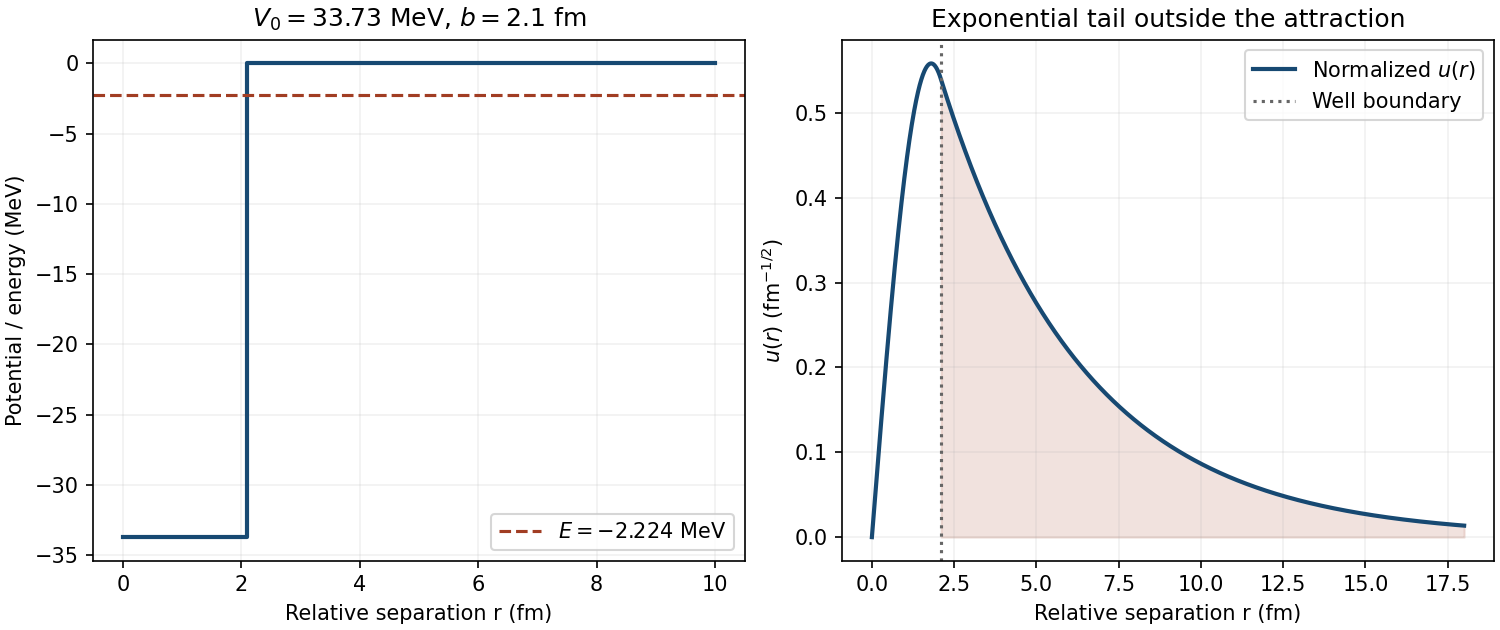
A weakly bound radial state extends beyond the finite nuclear well
. Original calculation from the stated masses, radius and binding. The reduced radial function is normalized with and matches its derivative at the well edge. The central-well model omits the tensor-induced D component. Details. Past exam of the particle and nuclear physics course of the University of Cambridge 2016 Paper 1 4 c Solution by Codex 0 2026-10-20
Codex 0 2026-10-20In a pure stretched state both spins point along the total angular momentum, with no orbital contribution. The nuclear magnetic moment would beThe measured differs. More decisively, a pure S wave spatial state is isotropic and has zero electric quadrupole moment. Its nonzero value requires a nonspherical component of the quantum charge distribution.
Positive parity allows even ; coupling to permits and . The state contains a deuteron D-state admixture:with radial wavefunctions implicit. A nuclear tensor force couples the orbital components. The quadrupole moment involves their interference as well as a D-state contribution, making it sensitive to a small admixture. This is a quantum angular correlation, not two particles permanently fixed in space.
In the nonrelativistic one-body magnetic-moment approximation,The D-state coupling has and at ; the proton supplies approximately half the relative orbital magnetic moment. ThusThe robust conclusion is a predominantly S wave state with a small tensor-induced D wave component. The 4% estimate is model dependent: exchange currents and other corrections also affect the magnetic moment, and a wavefunction component probability is not itself a uniquely measured observable.[ref]
Modern Theory of Nuclear Forces by Evgeny Epelbaum and others. §I.F, Observables and not-so observable quantities; §II.B, spin-dependent nuclear interactions
Past exam of the particle and nuclear physics course of the University of Cambridge 2016 Paper 1 4 b Solution by Codex 0 2026-10-20
Codex 0 2026-10-20The nuclear binding energy is the separated-nucleon rest energy minus the bound-state rest energy. Consistent nuclear masses avoid atomic-electron bookkeeping:It is positive because the bound deuteron has lower total energy.
Past exam of the particle and nuclear physics course of the University of Cambridge 2016 Paper 1 4 a Solution by Codex 0 2026-10-20
Codex 0 2026-10-20An S wave has and positive parity. The deuteron's therefore requires a spin-one-half triplet state, . The two-nucleon isospin description makes this the antisymmetric channel. Its existence proves sufficient attraction to bind in the -dominated channel.
A spin one-half pair could also form . The absence of a bound deuteron indicates that the singlet interaction does not bind, not that it is everywhere repulsive. Together with triplet binding, this shows that a spin-independent central attraction is insufficient. No radial excited bound level also constrains the strength and range: the attraction supports only a shallow low-energy bound state.
For identical neutrons or protons, two-particle isospin has and is symmetric. At even , spatial exchange is symmetric, so the Pauli exclusion principle requires an antisymmetric spin state, . A low-energy or pair cannot occupy the deuteron's channel. With approximate charge independence of nuclear forces, their singlet strong interaction corresponds to the unbound neutron-proton singlet; proton-proton electrostatic repulsion further disfavors binding. There is no bound dineutron or diproton in these physical low-energy channels. The inference uses charge independence and singlet-channel behavior; the deuteron's quantum numbers alone do not constrain every imaginable potential.
Past exam of the particle and nuclear physics course of the University of Cambridge 2016 Paper 1 3 d Solution by Codex 0 2026-10-20
Codex 0 2026-10-20Use an inclusive spectator model: one heavy constituent decays through the Fermi interaction, and sum the open charged-current channels. In weak-decay channel counting, each massless final lepton pair gives basic widthA quark pair contributes three colors multiplied by its squared Cabibbo-Kobayashi-Maskawa matrix element. Do not multiply by three just because the initial quark has three colors: its lifetime is the width of one initial state, averaged over initial color when appropriate. Define
For the tau lepton, two leptonic channels contain an electron or a muon; light hadronic channels have or . ThereforeNo charmed hadron can be produced: the lightest charmed meson exceeds the tau mass. [ref]
Review of Particle Physics by Particle Data Group (2022). D-zero and D-plus listings, physical page 1 of each, masses 1864.84 and 1869.66 MeV
The supplied charm-quark parameter is not a free asymptotic final-particle mass. The leading count neglects electron and muon masses and light hadronic threshold effects.For the charm quark, and dominate. The emitted current has two light leptonic channels and the same light hadronic channels as above; a tau cannot be produced:
For the bottom quark, retain with the supplied and neglect the much smaller channel. The emitted current can produce three lepton flavors and two up-type quark families, with three colors for each family. In particular is open at the given masses, although suppressed by phase space. Counting each open channel as massless givesSetting Cabibbo sums to one recovers the familiar counts , and . Despite its larger mass, the bottom quark is slowed by its small interfamily mixing factor.
These are leading estimates rather than precise lifetimes of free quarks. confinement makes charm and bottom observable in hadrons, whose lifetimes involve spectator interactions, Quantum chromodynamics corrections and bound-state effects. mass corrections are significant for bottom: even the single-charm channel with massless leptons has the three-body weak-decay mass correctionTau and double-charm channels have different suppressions, so multiplying the entire width by this one factor is inconsistent. Accurate hadron lifetimes require those channel-dependent factors and hadronic dynamics; the exercise supports the explicitly stated leading counts.
Past exam of the particle and nuclear physics course of the University of Cambridge 2016 Paper 1 3 c Solution by Codex 0 2026-10-20
Codex 0 2026-10-20The negative muon emits a virtual and becomes a muon neutrino; the boson creates an electron and an electron antineutrino:Both vertices are weak charged currents.
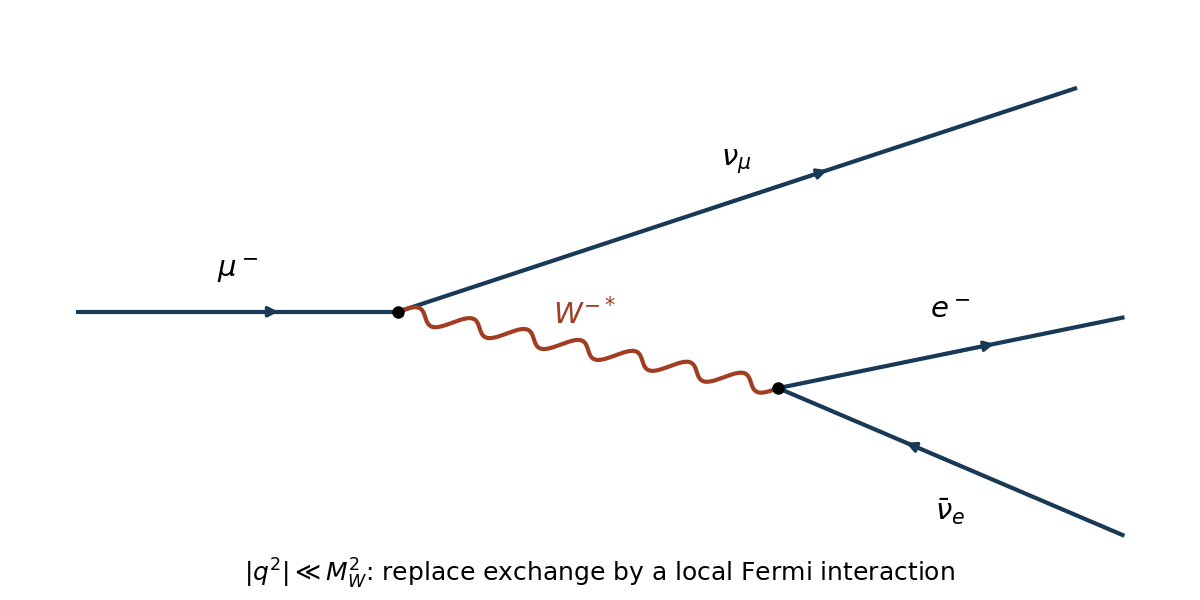
Typical transfers satisfy , so the propagator factor expands as plus small corrections. Contracting this short-distance exchange produces the local Fermi interaction, with strength contained in . This effective description does not assume that the real W mass vanishes. The same treatment applies to leptonic tau decays with the relevant masses changed.[ref]
Review of Particle Physics by Particle Data Group (2022). Muon Decay Parameters, §57.1 introduction and §57.2
In GeV units, and . ThusThe modest difference from a precision experimental lifetime is expected from the rounded mass and omitted radiative and final-electron-mass corrections.
Past exam of the particle and nuclear physics course of the University of Cambridge 2016 Paper 1 3 b Solution by Codex 0 2026-10-20
Codex 0 2026-10-20Assume allowed beta decay, so the leading matrix element has negligible lepton-momentum dependence. Neglect nuclear recoil and neutrino mass. Let be the kinetic energy available to the electron and antineutrino, , and . The neutrino energy and momentum magnitude are .
Fermi's golden rule weights accessible final states. After angular integration, the momentum-space factors are and . The energy-conserving Dirac delta function removes the neutrino integral:The constant includes the allowed nuclear matrix element, weak-coupling and angular factors. Including the usual Fermi function for electron-nucleus Coulomb distortion givesFor the kinetic-energy spectrum, instead yieldsThe two distributions differ by a Jacobian; forgetting it changes the shape.
A pure fifth-power law additionally neglects electron mass and Coulomb distortion and keeps the nuclear matrix element fixed. Then , , andTwo momentum powers come from each final particle and one from the remaining integration. This is the origin of the Sargent rule. Exact dependence requires the relativistic-electron, constant-matrix-element limit. For , the same approximation without Coulomb distortion has and instead scales as . Forbidden-transition factors, nuclear-structure changes and Coulomb distortion also modify the simple law.
Pinned article: Introduction to the OurBigBook Project
Welcome to the OurBigBook Project! Our goal is to create the perfect publishing platform for STEM subjects, and get university-level students to write the best free STEM tutorials ever.
Everyone is welcome to create an account and play with the site: ourbigbook.com/go/register. We belive that students themselves can write amazing tutorials, but teachers are welcome too. You can write about anything you want, it doesn't have to be STEM or even educational. Silly test content is very welcome and you won't be penalized in any way. Just keep it legal!
Intro to OurBigBook
. Source. We have two killer features:
- topics: topics group articles by different users with the same title, e.g. here is the topic for the "Fundamental Theorem of Calculus" ourbigbook.com/go/topic/fundamental-theorem-of-calculusArticles of different users are sorted by upvote within each article page. This feature is a bit like:
- a Wikipedia where each user can have their own version of each article
- a Q&A website like Stack Overflow, where multiple people can give their views on a given topic, and the best ones are sorted by upvote. Except you don't need to wait for someone to ask first, and any topic goes, no matter how narrow or broad
This feature makes it possible for readers to find better explanations of any topic created by other writers. And it allows writers to create an explanation in a place that readers might actually find it.
Figure 1. Screenshot of the "Derivative" topic page. View it live at: ourbigbook.com/go/topic/derivativeVideo 2. OurBigBook Web topics demo. Source. - local editing: you can store all your personal knowledge base content locally in a plaintext markup format that can be edited locally and published either:This way you can be sure that even if OurBigBook.com were to go down one day (which we have no plans to do as it is quite cheap to host!), your content will still be perfectly readable as a static site.
- to OurBigBook.com to get awesome multi-user features like topics and likes
- as HTML files to a static website, which you can host yourself for free on many external providers like GitHub Pages, and remain in full control

Figure 2. You can publish local OurBigBook lightweight markup files to either OurBigBook.com or as a static website.
Figure 3. Visual Studio Code extension installation.
Figure 5. . You can also edit articles on the Web editor without installing anything locally. Video 3. Edit locally and publish demo. Source. This shows editing OurBigBook Markup and publishing it using the Visual Studio Code extension. 
- Infinitely deep tables of contents:




All our software is open source and hosted at: github.com/ourbigbook/ourbigbook
Further documentation can be found at: docs.ourbigbook.com
Feel free to reach our to us for any help or suggestions: docs.ourbigbook.com/#contact