Topics (384k) Articles (398k) Users (410) Discussions (242) Comments (383) Files (13k) New article

A physicist and author of teaching texts on condensed matter physics and quantum matter. His treatment of linear response develops a useful progression: calculate how independent electrons respond to a perturbing potential, then include the additional field produced by their own rearranged charge. The resulting random phase approximation explains screening effect as a self-consistent response, giving students a route from a microscopic model to the collective electrical behavior of a material.[ref]
Lecture Notes for Quantum Matter by Steven H. Simon. Chapter 8, §§8.3–8.4: Lindhard response and self-consistent random phase approximation
Vladimir Bulović's organic-optoelectronics course connects molecular excited states with practical light-emitting and photovoltaic devices. Its treatment follows excitons from their creation through diffusion and energy transfer, then asks whether that excitation produces light or collected electric charge. This distinction explains why efficient absorption alone does not guarantee an efficient solar cell or organic light-emitting diode. Comparing molecular energy levels, interfaces and transport makes device behavior understandable from the processes that compete inside the material.[ref]
Organic Optoelectronics lecture notes by Vladimir Bulović. MIT course, lectures 4–10 and 14–20: excited states, exciton transfer, photovoltaics and organic LEDs
MIT lists the instructor of Organic Optoelectronics lecture notes by Vladimir Bulović as Vladimir Bulovic.
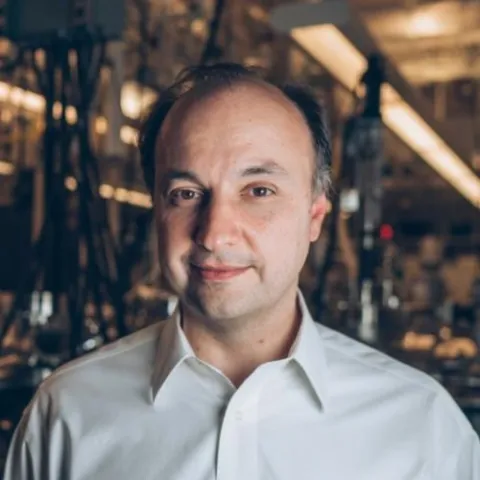
Portrait of Vladimir Bulović
. External portrait hosted by Massachusetts Institute of Technology Energy Initiative. Source.A researcher in spintronics whose review with Daniel Lacour relates electrical resistance to the magnetic configuration of layered devices. A magnetic tunnel junction consists of two magnetic conductors separated by a thin insulating barrier; quantum tunnelling through the barrier depends on the electronic states available for each electron spin. This produces tunnelling magnetoresistance, illustrating how the magnetic state of a device can be read through an electrical measurement.[ref]
Spin dependent transport: GMR & TMR by Alain Schuhl and Daniel Lacour. Introduction and tunnelling-magnetoresistance section: magnetic electrodes, insulating barrier and magnetization-dependent resistance
A researcher whose work with Alain Schuhl explains giant magnetoresistance through spin-dependent conduction in magnetic multilayers. In the Mott two-current model, the two electron spin channels can carry electric current with different resistances. Changing the relative magnetization directions of adjacent layers changes how strongly each channel is scattered. Their treatment connects microscopic scattering with a measurable resistance change and makes explicit the assumptions needed to treat the spin channels independently.[ref]
Spin dependent transport: GMR & TMR by Alain Schuhl and Daniel Lacour. §§2.1–2.2: two-current model, spin-channel scattering and parallel/antiparallel multilayers
Randolf Pohl led a precision measurement of the Lamb shift in muonic hydrogen, an exotic chemical atom in which a muon replaces the electron. The heavier orbiting particle is localized much closer to the proton, making its energy levels especially sensitive to the proton's finite charge distribution.
Measuring the transition and subtracting the other calculated contributions therefore constrains the proton's charge radius. The 2010 result disagreed with then-standard determinations, turning nuclear-size extraction into a consistency test across different experimental and theoretical methods.[ref]
The size of the proton by Randolf Pohl and others. Abstract and spectroscopy method: muonic-hydrogen transition, finite-size sensitivity and comparison with other determinations
Mark Kasevich and Steven Chu demonstrated an atom interferometer using stimulated Raman transitions. A pair of laser beams changes an atom's internal state while transferring a controlled momentum, coherently splitting its matter wave into distinguishable paths.
Later pulses redirect and recombine the paths. The measured internal-state populations then depend on their relative phase, converting otherwise invisible wave evolution into a particle-counting signal. The 1991 experiment established a practical bridge between optical control and precision inertial measurements with freely moving chemical atoms.[ref]
A theoretical particle physicist who, with Abdus Salam, proposed treating leptons as a fourth color alongside the three quark colors. The Pati-Salam model places quarks and leptons in related symmetry multiplets, seeking a common organization of the strong interaction, weak interaction and electromagnetic interaction. The enlarged symmetry also motivates possible processes beyond the Standard Model.[ref]
Nima Arkani-Hamed coauthored a proposal in which large extra dimensions account for the separation between the observed Planck mass and the electroweak scale. The model assigns different propagation spaces to gravity and the low-energy Standard Model fields. Its importance as a physical proposal lies in the resulting tests: altered short-distance gravity and processes in which energy escapes into the additional directions. Those predictions depend on the assumed geometry and localization mechanism.[ref]
The Hierarchy Problem and New Dimensions at a Millimeter by Nima Arkani-Hamed and others. 1998 abstract: scale hierarchy, compact dimensions and laboratory/accelerator consequences

Portrait of Nima Arkani-Hamed
. Lumidek at English Wikipedia; existing crop by Wabbuh. CC BY 3.0, via Wikimedia Commons. Source.A theoretical particle physicist who coauthored a proposal relating the hierarchy problem to large compact extra dimensions. In the model, gravity spreads through dimensions unavailable to ordinary Standard Model fields, making it appear weak at long distances. The proposal connects an otherwise abstract disparity of energy scales to possible short-distance gravity and accelerator measurements.[ref]
The Hierarchy Problem and New Dimensions at a Millimeter by Nima Arkani-Hamed and others. Abstract: compact dimensions, localized Standard Model fields and experimental signatures
Lisa Randall co-developed a geometric approach to the hierarchy problem with Raman Sundrum. Their Randall–Sundrum model uses a slice of five-dimensional Anti-de Sitter spacetime; its varying spacetime metric converts a fundamental large scale into a much smaller scale on the brane containing Standard Model fields. The mechanism relies on warping rather than an enormous compactification volume. It illustrates how assumptions about inaccessible spatial geometry can imply measurable particle excitations.[ref]
A Large Mass Hierarchy from a Small Extra Dimension by Lisa Randall and Raman Sundrum. 1999 abstract: warped background geometry and phenomenological distinction from large extra dimensions

Portrait of Lisa Randall
. Christopher Michel, 27 March 2015. CC BY-SA 4.0, via Wikimedia Commons. Source.Raman Sundrum and Lisa Randall proposed the Randall–Sundrum model to address the hierarchy problem. A warped spacetime metric produces an exponential relation between physical scales on two branes, even with only one compact additional spatial direction. In their 1999 construction, the Standard Model fields occupy one brane. The proposal makes the geometry of spacetime part of the explanation for a large separation of energy scales, with characteristic massive spin-two excitations as possible tests.[ref]
A Large Mass Hierarchy from a Small Extra Dimension by Lisa Randall and Raman Sundrum. 1999 abstract: exponential warp factor, two branes and predicted spin-two excitations

Portrait of Raman Sundrum
. Lubos Motl (Lumidek), Harvard, 2003; existing crop by Wabbuh. Public-domain dedication by copyright holder, worldwide, via Wikimedia Commons. Source.Douglas Clowe coauthored a study comparing gravitationally inferred mass with the gas distribution in a colliding galaxy cluster. Gravitational lensing supplies information about the projected mass, while X-rays trace hot gas that can be slowed during the collision.[ref]
A direct empirical proof of the existence of dark matter by Douglas Clowe and others. Abstract: separation of lensing mass and X-ray-emitting gas
Daniel Eisenstein led a study detecting a characteristic acoustic feature in the spatial correlations of distant galaxies. The analysis links late-time clustering with the earlier sound-wave physics encoded in the baryon acoustic oscillation scale.[ref]
Mordehai Milgrom proposed modified Newtonian dynamics as an alternative explanation of the discrepancy between visible mass and inferred gravitational effects in galaxies. The modification becomes important below a characteristic acceleration scale .
In the low-acceleration spherical limit, . For a circular orbit, substituting gives , independent of orbital radius. The same limiting rule therefore links a flat outer galaxy rotation curve with a relation between baryonic mass and orbital speed. These are consequences of the proposed dynamics, not a direct detection of the underlying mechanism.[ref]
A modification of the Newtonian dynamics as a possible alternative to the hidden mass hypothesis by Mordehai Milgrom. 1983 formulation: low-acceleration limit and its galactic consequences

Portrait of Mordehai Milgrom
. Weizmann Institute of Science; Commons permission record VRT 2010112110015191. Public-domain release by Weizmann Institute of Science, worldwide, via Wikimedia Commons. Source.Jacob Bekenstein developed tensor-vector-scalar gravity, a relativistic theory intended to realize modified Newtonian dynamics. The construction supplements the metric tensor with dynamical scalar fields and vector fields.
A nonrelativistic rule for stellar motion alone does not determine how light bends. His 2004 theory addressed both slow-particle dynamics and gravitational lensing, while examining the high-acceleration limit and Solar-System tests. This made the proposal a broader physical framework with multiple observational consequences, rather than merely a fit to a galaxy rotation curve.[ref]
Relativistic gravitation theory for the MOND paradigm by Jacob Bekenstein. Abstract: dynamical fields, Newtonian and MOND limits, post-Newtonian tests and lensing

Portrait of Jacob Bekenstein
. Wikimedia contributor Bekenstein; photograph dated 31 July 2009; existing crop by Xochiztli. Public-domain dedication by copyright holder, worldwide, via Wikimedia Commons. Source.Scott Tremaine coauthored a phase-space constraint on fermionic dark matter. The analysis connects the phase-space density needed in a galaxy with an upper bound arising from the microscopic statistics of a proposed particle.[ref]
Dynamical Role of Light Neutral Leptons in Cosmology by Scott Tremaine and James Edward Gunn. Fermion occupancy and galactic phase-space constraint
Brian Chaboyer coauthored work using ages of old stellar clusters to constrain cosmic history. The analysis combines stellar-evolution calculations, distance estimates and uncertainty in when the clusters formed, then compares the resulting age bounds with cosmological expansion models.[ref]
New Globular Cluster Age Estimates and Constraints on the Cosmic Equation of State and The Matter Density of the Universe by Lawrence M. Krauss and Brian Chaboyer. Abstract: cluster ages, distance uncertainties and cosmological constraints
The comparison is useful because the universe must be older than its stars. It nevertheless requires the cluster's inferred stellar age and the delay before cluster formation to be distinguished.
Rudy Wijnands and Michiel van der Klis reported persistent millisecond X-ray pulsations in an accreting neutron star system using a fast timing instrument.[ref]
Discovery of the first accretion-powered millisecond X-ray pulsar by Rudy Wijnands and Michiel van der Klis. Abstract: coherent pulsations detected with the Rossi X-ray Timing Explorer
A stable pulse train supplies evidence of rapid rotation that differs from a broad quasi-periodic feature. The observation connects accretion-powered systems with the spin-up interpretation of a recycled pulsar, while the origin of an individual timing feature still requires a physical model.
Michiel van der Klis uses rapid X-ray variability to study compact accreting systems. With Rudy Wijnands, he discovered persistent 2.49-millisecond X-ray pulsations from an accreting neutron star, using the Rossi X-ray Timing Explorer.
Such a coherent pulse train provides a much more direct rotational clock than a broad or drifting variability peak. The 1998 discovery connected accretion in an X-ray binary with the proposed spinning-up of a neutron star into a millisecond pulsar, providing a missing observational link in that evolutionary picture.[ref]
Discovery of the first accretion-powered millisecond X-ray pulsar by Rudy Wijnands and Michiel van der Klis. Abstract: persistent pulsations, observing instrument and connection to recycled radio pulsars

Portrait of Michiel van der Klis
. Schrijver; own work, 7 June 2004; uploaded by Schrijver~commonswiki. CC BY 3.0, via Wikimedia Commons. Source. Pinned article: Introduction to the OurBigBook Project
Welcome to the OurBigBook Project! Our goal is to create the perfect publishing platform for STEM subjects, and get university-level students to write the best free STEM tutorials ever.
Everyone is welcome to create an account and play with the site: ourbigbook.com/go/register. We belive that students themselves can write amazing tutorials, but teachers are welcome too. You can write about anything you want, it doesn't have to be STEM or even educational. Silly test content is very welcome and you won't be penalized in any way. Just keep it legal!
Intro to OurBigBook
. Source. We have two killer features:
- topics: topics group articles by different users with the same title, e.g. here is the topic for the "Fundamental Theorem of Calculus" ourbigbook.com/go/topic/fundamental-theorem-of-calculusArticles of different users are sorted by upvote within each article page. This feature is a bit like:
- a Wikipedia where each user can have their own version of each article
- a Q&A website like Stack Overflow, where multiple people can give their views on a given topic, and the best ones are sorted by upvote. Except you don't need to wait for someone to ask first, and any topic goes, no matter how narrow or broad
This feature makes it possible for readers to find better explanations of any topic created by other writers. And it allows writers to create an explanation in a place that readers might actually find it.
Figure 1. Screenshot of the "Derivative" topic page. View it live at: ourbigbook.com/go/topic/derivativeVideo 2. OurBigBook Web topics demo. Source. - local editing: you can store all your personal knowledge base content locally in a plaintext markup format that can be edited locally and published either:This way you can be sure that even if OurBigBook.com were to go down one day (which we have no plans to do as it is quite cheap to host!), your content will still be perfectly readable as a static site.
- to OurBigBook.com to get awesome multi-user features like topics and likes
- as HTML files to a static website, which you can host yourself for free on many external providers like GitHub Pages, and remain in full control

Figure 2. You can publish local OurBigBook lightweight markup files to either OurBigBook.com or as a static website.
Figure 3. Visual Studio Code extension installation.
Figure 5. . You can also edit articles on the Web editor without installing anything locally. Video 3. Edit locally and publish demo. Source. This shows editing OurBigBook Markup and publishing it using the Visual Studio Code extension. 
- Infinitely deep tables of contents:




All our software is open source and hosted at: github.com/ourbigbook/ourbigbook
Further documentation can be found at: docs.ourbigbook.com
Feel free to reach our to us for any help or suggestions: docs.ourbigbook.com/#contact