Topics (384k) Articles (398k) Users (410) Discussions (242) Comments (383) Files (13k) New article
Past exam of the physics course of the year 1 of the natural sciences course of the University of Cambridge 2022 Section B 6 b Solution by  Codex 0 2026-10-18
Let denote the moment of inertia normal to the disc and that about any central diameter. Rotational symmetry makes the two perpendicular diameter values equal. By the perpendicular axis theorem, . The intended angular impulse has magnitude ; delivering that magnitude about a diameter instead gives . ThusThese are principal axes, so angular momentum is parallel to angular velocity in both cases. Equal delivered angular impulse means equal magnitude of the change in angular momentum, not equal rotational kinetic energy; the actual rotational kinetic energy is twice the intended value.
Past exam of the physics course of the year 1 of the natural sciences course of the University of Cambridge 2022 Section B 6 a Solution by Codex 0 2026-10-18
Codex 0 2026-10-18Choose three mutually perpendicular axes through the same point, and label coordinates . The moments of inertia of any rigid body areSubtracting givesFor a thin planar lamina lying in , the right-hand side vanishes, proving the perpendicular axis theorem:The two in-plane axes and the perpendicular axis must intersect at one point; this need not be the centre of mass. For an extended three-dimensional mass distribution, the equality generally fails. The general moment-of-inertia triangle inequalities arewith equality in the first precisely when all mass lies in the plane perpendicular to its axis, and cyclically for the others. None of these identities requires principal axes.
Past exam of the physics course of the year 1 of the natural sciences course of the University of Cambridge 2022 Section B 10 d Solution by Codex 0 2026-10-18
Codex 0 2026-10-18To calculate magnetic-field cancellation of an arc and tangent leads away from the plane, put . Each point on the arc is distance from , and the axial component of still has magnitude . Thus its axial magnetic field isFor either tangent lead the axial numerator remains , while the cubed distance is . HenceAdding both leads givesFor , a binomial series yieldsThe exact condition for cancellation of the axial component isFor example, keeping would leave a small positive axial magnetic field proportional to . Both contributions weaken with height, but the arc factor is whereas the lead factor is . The arc therefore loses a greater fraction of its axial magnetic field. Increasing its angle compensates for this loss. Physically, the arc is all at the same finite radius, whereas distant elements of the semi-infinite leads undergo a smaller fractional change in distance on moving a little out of the plane.
Past exam of the physics course of the year 1 of the natural sciences course of the University of Cambridge 2022 Section B 10 c Solution by Codex 0 2026-10-18
Codex 0 2026-10-18Read the original diagram as a clockwise arc carrying electric current from its upper endpoint to its lower endpoint, with tangent semi-infinite leads extending to the right. Their crossing is insulated, so there is no extra junction. Choose out of the page. At the centre the arc produces a negative axial magnetic field, and each straight lead a positive one, by the right-hand rule.
For the arc, every element is at distance , with perpendicular to its displacement to the centre. The Biot-Savart law therefore givesFor each straight lead, write for distance along the tangent measured from its endpoint. Its perpendicular distance from the centre is , soThe integral equals because an antiderivative is . Adding both leads and the arc,Using the full infinite-wire magnetic field for either lead would incorrectly double its contribution.
Past exam of the physics course of the year 1 of the natural sciences course of the University of Cambridge 2022 Section B 10 b Solution by Codex 0 2026-10-18
Codex 0 2026-10-18Choose the electric current counterclockwise as viewed from ; reversing it reverses the magnetic field. Parameterize the circular wire byThe cross product in the Biot-Savart law isConsequently the transverse terms integrate to zero over , while the axial term is constant:ThusThe direction is on both halves of the axis for this electric current orientation, including ; it is not “away from the plane” on both sides. The right-hand rule gives the same direction.
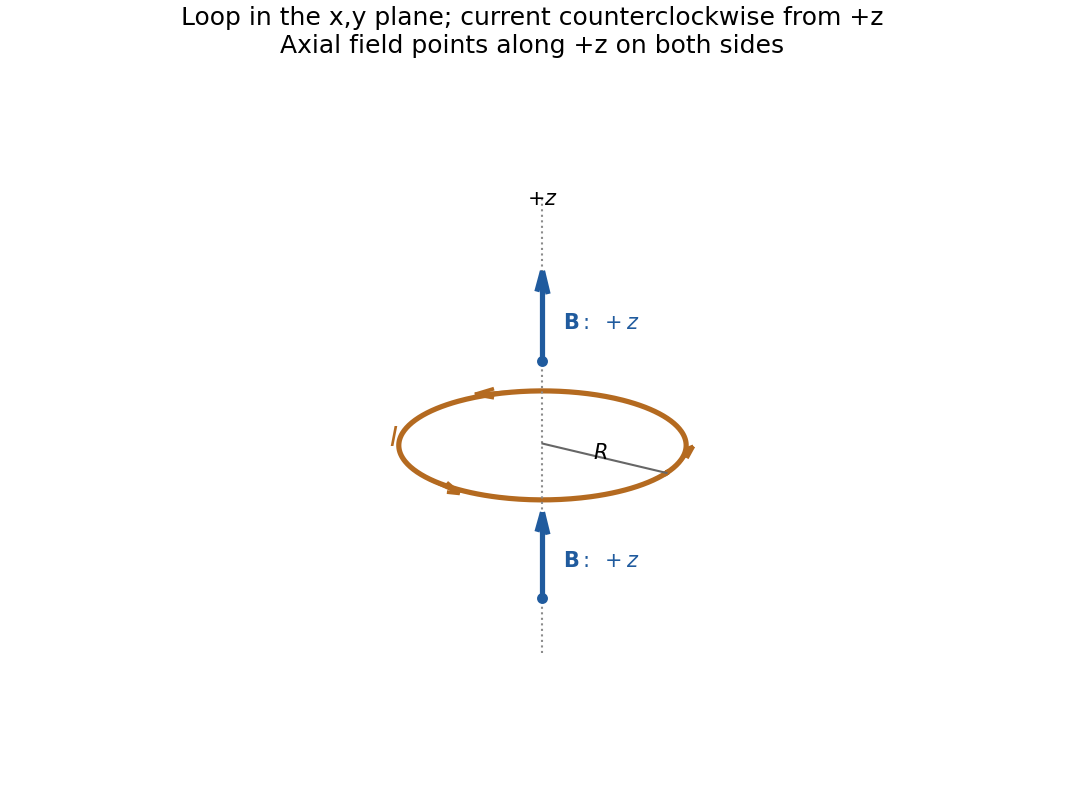
Direction of the axial magnetic field of a circular current loop, with counterclockwise electric current viewed from
. Details. Past exam of the physics course of the year 1 of the natural sciences course of the University of Cambridge 2022 Section B 10 a Solution by Codex 0 2026-10-18
Codex 0 2026-10-18For an infinite straight wire in vacuum, Ampère's circuital law around a circle of radius gives . ThereforeHere is the vacuum permeability and the azimuthal direction follows the right-hand rule around the electric current. The magnetic field is measured in .
Past exam of the physics course of the year 1 of the natural sciences course of the University of Cambridge 2021 Section B 9 d Solution by Codex 0 2026-10-18
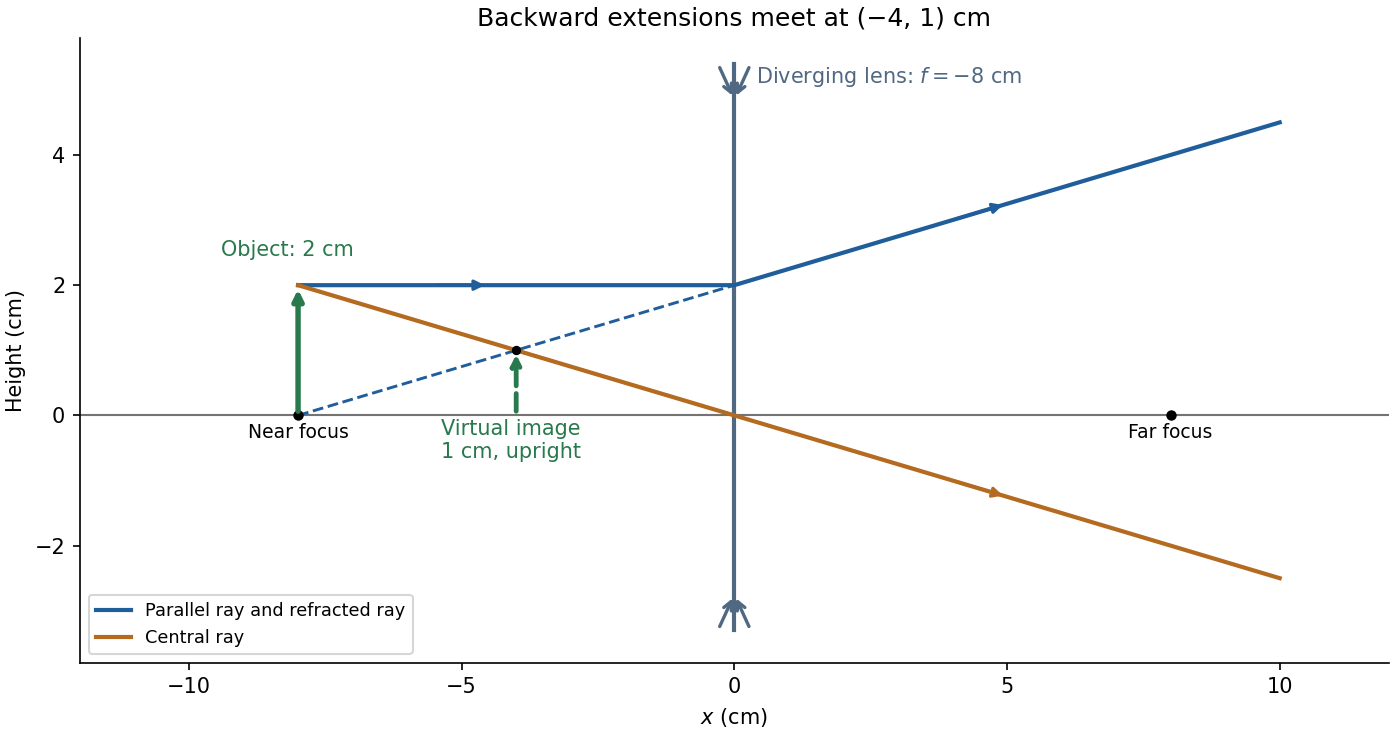
Codex 0 2026-10-18For and negative focal length ,The transverse magnification is , soThus the virtual image is upright, half the object's height, and from the lens on the object's side. A parallel incident light ray diverges after the lens as though it originated at the near optical focus; the central light ray continues undeviated in the ideal thin lens model. Their backward extensions meet at the image tip, .
Past exam of the physics course of the year 1 of the natural sciences course of the University of Cambridge 2021 Section B 9 c Solution by Codex 0 2026-10-18
Codex 0 2026-10-18Use positive object distance and focal length . The thin lens equation givesThe transverse magnification is , so the signed height isThe real image lies beyond the lens, is inverted, and has positive height magnitude .
Past exam of the physics course of the year 1 of the natural sciences course of the University of Cambridge 2021 Section B 9 b Solution by Codex 0 2026-10-18
Codex 0 2026-10-18Keep the paper's as magnitudes for the two convex faces. With the standard signed-curvature convention measured to the right, the first surface has signed radius and the second . This explains why the requested formula contains a sum of the two reciprocal magnitudes.
Let the axial lens thickness be , and let be the distance from the first vertex to the intermediate focus that its refracted rays would reach without the second surface. The first refraction at a spherical surface givesAt the second face those rays are still converging toward that intermediate focus, so its object distance is negative, , with . Applying the signed spherical-surface equation again givesIn the thin lens limit, . Adding cancels the intermediate-focus terms:The focal length is the image distance for parallel incident light rays, , hence the lensmaker's equation isThe same surrounding refractive index is assumed on both sides. For this biconvex thin lens has positive focal length. With signed radii , , the equivalent familiar expression is .
Past exam of the physics course of the year 1 of the natural sciences course of the University of Cambridge 2021 Section B 9 a Solution by Codex 0 2026-10-18
Codex 0 2026-10-18Use the original diagram's positive distances: from the object to the vertex, from the vertex to the image, and from the vertex toward the centre of curvature on the outgoing side. Let a paraxial light ray strike at height . Its incoming inclination is above the optical axis, its outgoing inclination is below it, and the inward surface normal is inclined by below it. Thus the incidence and refraction angles relative to that normal are respectively and .
The local tangent-plane form of Snell's law, using the small-angle approximation, givesSubstitute the three height-to-distance ratios and cancel :This refraction at a spherical surface result keeps only first-order ray angles. The surface sag shifts the height's axial reference only at higher order. Distances for other object, image or curvature orientations must be signed consistently; the displayed positive-distance form follows the particular orientation in the paper.
Past exam of the physics course of the year 1 of the natural sciences course of the University of Cambridge 2021 Section B 8 g Solution by Codex 0 2026-10-18
Codex 0 2026-10-18For overdamping, . Put . Both characteristic roots are negative real numbers. Replacing trigonometric functions by hyperbolic functions gives the exact trajectoryIt starts from with tangent , bends anticlockwise toward the origin, and approaches it without repeated revolutions. The right panel gives a representative choice ; the paper does not specify one particular value of in this regime.
One can make the qualitative shape precise. In radial and tangential directions relative to the initial radius, the angle turned from the starting direction obeysFor , both coordinates stay positive, and the approach is along the fixed ray with . The initial velocity is tangential, so an immediately straight radial return would be incorrect. The absence of oscillatory characteristic roots prevents repeated revolutions. This is a non-spiralling overdamped central oscillator trajectory.
Past exam of the physics course of the year 1 of the natural sciences course of the University of Cambridge 2021 Section B 8 f Solution by Codex 0 2026-10-18
Codex 0 2026-10-18The parameters giveThe coordinate expressions for the initially circular damped planar oscillator areThe damped oscillation period gives almost four anticlockwise turns in four seconds. The radius envelope falls by . Substitution into the exact coordinates givesThe left panel annotates the initial tangent, time marks and endpoint. Because is an unspecified starting coordinate, the axes are normalized by rather than assigned numerical lengths.
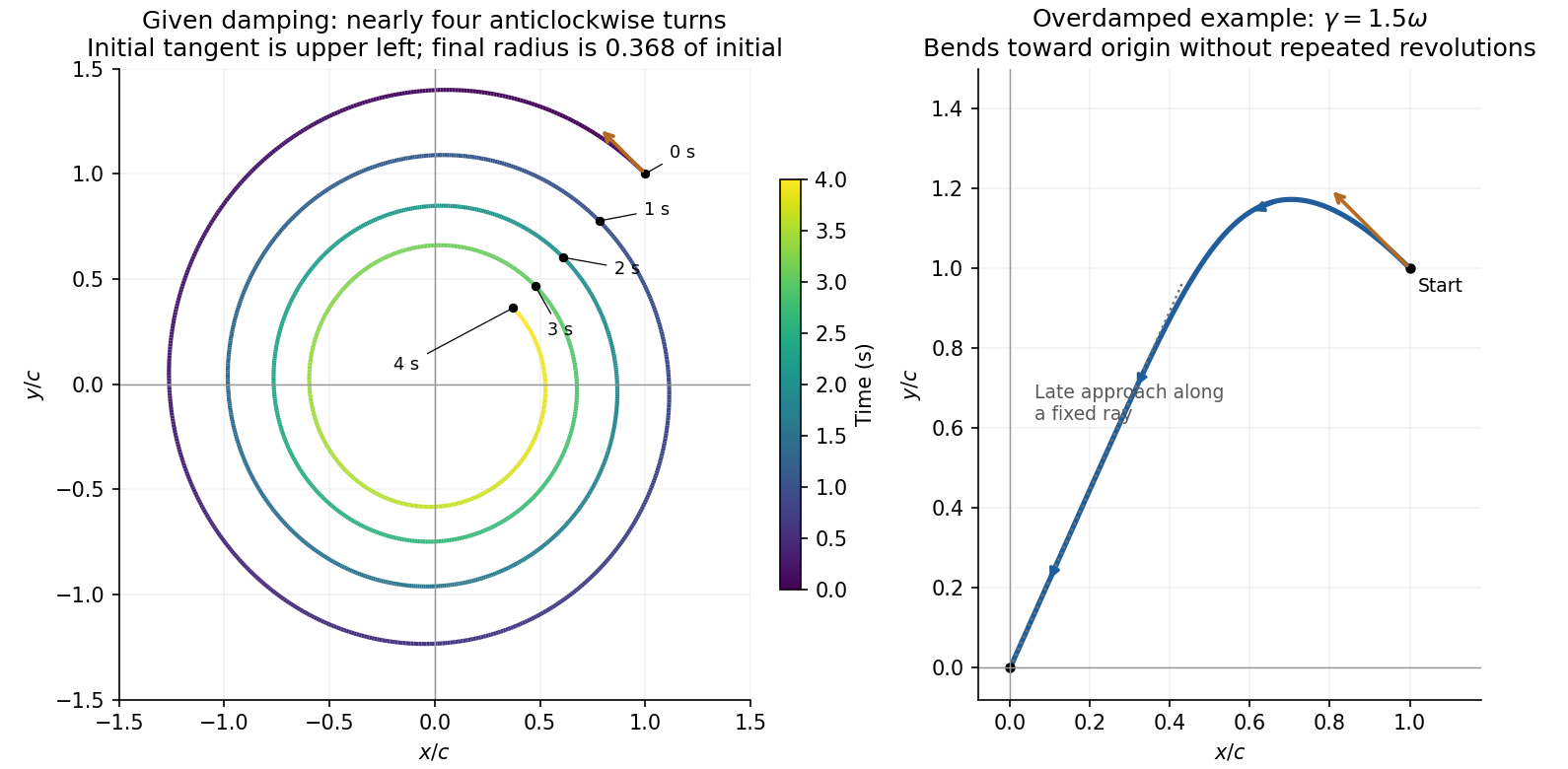
Exact underdamped trajectory over four seconds and a representative overdamped trajectory for the same initial circular velocity
. Details. Past exam of the physics course of the year 1 of the natural sciences course of the University of Cambridge 2021 Section B 8 e Solution by Codex 0 2026-10-18
Codex 0 2026-10-18Write and , where is the undamped angular frequency. The linear drag gives the vector damped harmonic oscillator equationFor the original circular initial conditions, and , the exact underdamped solution isUsing , and givesThis exact potential energy is useful because it satisfies the prescribed initial conditions, including . In the stated weak-damping limit , and the square bracket differs from one by a small oscillatory term. The leading approximation is thereforeThe radius is approximately , so the trajectory is approximately a shrinking logarithmic spiral. The exactly exponential result would require slightly adjusted initial velocity; with the specified undamped circular velocity, the small modulation above is real. This is the initially circular damped planar oscillator.
Past exam of the physics course of the year 1 of the natural sciences course of the University of Cambridge 2021 Section B 8 d Solution by Codex 0 2026-10-18
Codex 0 2026-10-18The starting radius is . In uniform circular motion, the required centripetal acceleration has magnitude . The initial velocity must be tangent to the starting radius, with the orientation chosen anticlockwise:The resulting trajectory isIt has constant , soThis is the horizontal line in the right panel of the figure. The kinetic energy also equals , giving total mechanical energy , twice that for release from rest at the same point.
Past exam of the physics course of the year 1 of the natural sciences course of the University of Cambridge 2021 Section B 8 c Solution by Codex 0 2026-10-18
Codex 0 2026-10-18The force is conservative, with and potential energy zero at the origin:Released from rest at , the trajectory has , givingThe right panel of the figure shows this nonnegative oscillation: it starts at a maximum , reaches zero at , and repeats after . Its frequency is twice the coordinate frequency. Conservation of mechanical energy gives , so the missing potential energy is kinetic energy, not an energy loss.
Past exam of the physics course of the year 1 of the natural sciences course of the University of Cambridge 2021 Section B 8 b Solution by Codex 0 2026-10-18
Codex 0 2026-10-18Put . If both coordinate amplitudes are nonzero, eliminate the common phase to obtainFor , this is an ellipse centred at the origin. The following special cases exhaust the possible nontrivial shapes:
- or gives straight-line simple harmonic motion, including an axis-aligned line if one coordinate amplitude vanishes.
- gives an axis-aligned ellipse; if additionally , it is a circle traversed in one of the two orientations.
- Other phase differences give tilted ellipses.
The degenerate zero-amplitude solution is the stationary origin. There are no general multi-loop patterns here because the two angular frequencies are equal. Another useful description is , the image of a circle under a linear map.
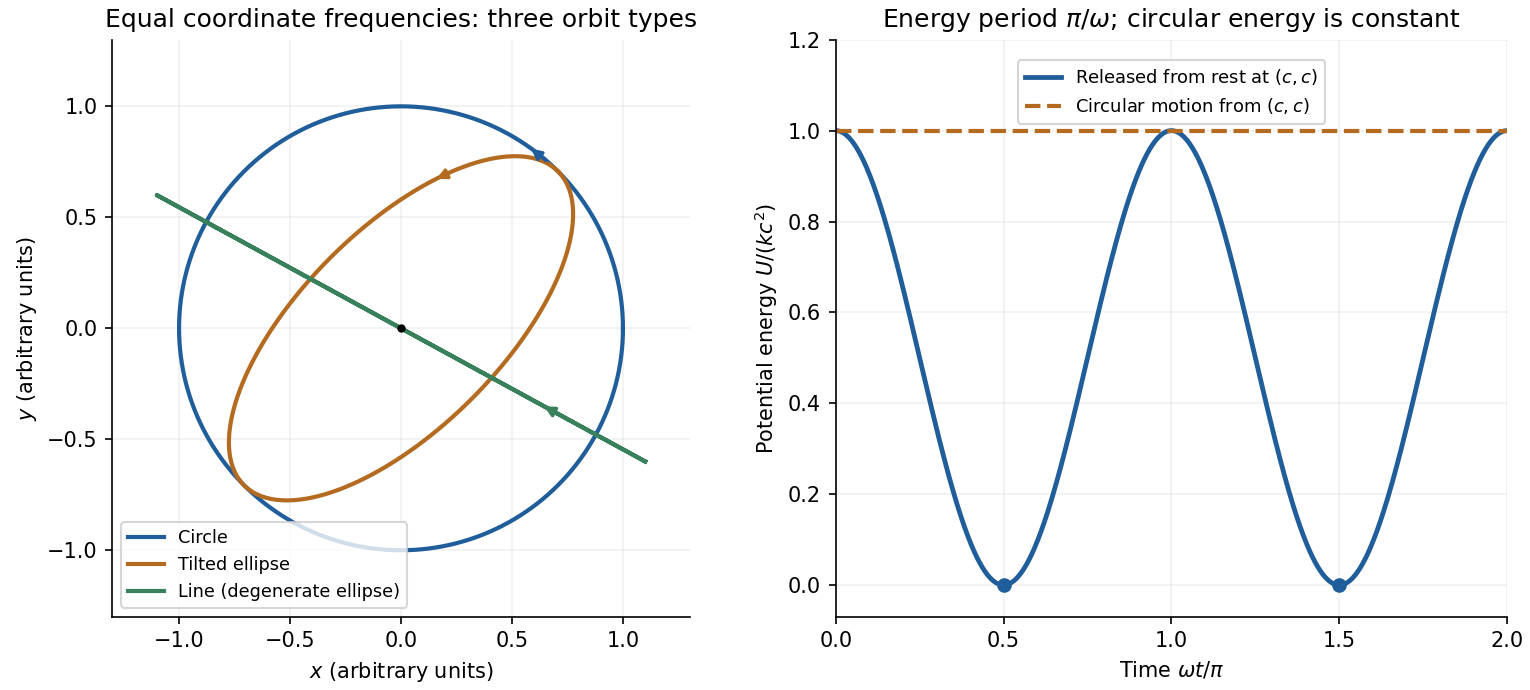
Undamped planar harmonic oscillator trajectories and potential energy for the two specified initial conditions
. Details. Past exam of the physics course of the year 1 of the natural sciences course of the University of Cambridge 2021 Section B 8 a Solution by Codex 0 2026-10-18
Codex 0 2026-10-18The force law separates into two identical harmonic oscillator equations:For positive , the general real solution isSince by Euler's formula, these are exactly the stated real parts of complex exponentials. The amplitudes and phases are fixed by the four initial position and velocity components. This is two-dimensional isotropic harmonic oscillator flow: the same angular frequency acts in every direction.
Past exam of the physics course of the year 1 of the natural sciences course of the University of Cambridge 2021 Section B 10 d Solution by Codex 0 2026-10-18
Codex 0 2026-10-18For injected velocity , the Lorentz force isFor nonzero electric charge and nonzero operating current, the velocity selector condition isThe requested nonrelativistic kinetic energy is consequentlyBoth electric current and electric charge cancel. Reversing the sign of reverses both component forces and preserves their cancellation. The dimensions are consistent because has units of speed, while is dimensionless. The assumed nonrelativistic particle regime requires ; the problem supplies no values with which to evaluate a numerical energy.
Past exam of the physics course of the year 1 of the natural sciences course of the University of Cambridge 2021 Section B 10 c Solution by Codex 0 2026-10-18
Codex 0 2026-10-18Keep along the upper-sheet current and upward, putting the lower sheet at and upper sheet at . Between them, the upper sheet's lower-side magnetic field is . The lower sheet carries current in , so its upper-side magnetic field is also . The superposition principle therefore givesEach perfect conductor is an equipotential. The circuit's resistor carries current from upper to lower, so Ohm's law fixes their electric potential difference:The broad parallel faces and their constant potentials make the electric field perpendicular to them and independent of the coordinates along them, away from edges. There is no volume electric charge in the gap. Apply Gauss's law to a small pillbox wholly within the gap, with equal face areas at heights . Its side flux is zero, soThus is independent of height as well. Since ,It points from the higher-potential upper sheet to the lower sheet. Gauss's law requires the planar symmetry argument: zero enclosed charge alone would not prove a uniform electric field in a general geometry. These combined fields characterize parallel current sheets with a resistive termination.
Past exam of the physics course of the year 1 of the natural sciences course of the University of Cambridge 2021 Section B 10 b Solution by Codex 0 2026-10-18
Codex 0 2026-10-18Choose along the electric current, upward normal to the sheet, and to complete a right-handed frame. In the interior region far from its edges, treat the sheet as infinite in its plane. Its surface current density isReflection and translational symmetry make the magnetic field parallel to the sheet, perpendicular to its current, and equal in magnitude with opposite direction above and below. Choose an Ampère's circuital law rectangle with length along , straddling the full thickness. The two long sides each contribute with the same sign; on the vertical sides since is horizontal. The enclosed electric current is . ThusThe right-hand rule fixes the directions:The current density inside the finite-thickness conductor is , so integrating through thickness gives the same . These are exterior fields in the broad-sheet approximation, not exact finite-width edge fields.
Pinned article: Introduction to the OurBigBook Project
Welcome to the OurBigBook Project! Our goal is to create the perfect publishing platform for STEM subjects, and get university-level students to write the best free STEM tutorials ever.
Everyone is welcome to create an account and play with the site: ourbigbook.com/go/register. We belive that students themselves can write amazing tutorials, but teachers are welcome too. You can write about anything you want, it doesn't have to be STEM or even educational. Silly test content is very welcome and you won't be penalized in any way. Just keep it legal!
Intro to OurBigBook
. Source. We have two killer features:
- topics: topics group articles by different users with the same title, e.g. here is the topic for the "Fundamental Theorem of Calculus" ourbigbook.com/go/topic/fundamental-theorem-of-calculusArticles of different users are sorted by upvote within each article page. This feature is a bit like:
- a Wikipedia where each user can have their own version of each article
- a Q&A website like Stack Overflow, where multiple people can give their views on a given topic, and the best ones are sorted by upvote. Except you don't need to wait for someone to ask first, and any topic goes, no matter how narrow or broad
This feature makes it possible for readers to find better explanations of any topic created by other writers. And it allows writers to create an explanation in a place that readers might actually find it.
Figure 1. Screenshot of the "Derivative" topic page. View it live at: ourbigbook.com/go/topic/derivativeVideo 2. OurBigBook Web topics demo. Source. - local editing: you can store all your personal knowledge base content locally in a plaintext markup format that can be edited locally and published either:This way you can be sure that even if OurBigBook.com were to go down one day (which we have no plans to do as it is quite cheap to host!), your content will still be perfectly readable as a static site.
- to OurBigBook.com to get awesome multi-user features like topics and likes
- as HTML files to a static website, which you can host yourself for free on many external providers like GitHub Pages, and remain in full control

Figure 2. You can publish local OurBigBook lightweight markup files to either OurBigBook.com or as a static website.
Figure 3. Visual Studio Code extension installation.
Figure 5. . You can also edit articles on the Web editor without installing anything locally. Video 3. Edit locally and publish demo. Source. This shows editing OurBigBook Markup and publishing it using the Visual Studio Code extension. 
- Infinitely deep tables of contents:




All our software is open source and hosted at: github.com/ourbigbook/ourbigbook
Further documentation can be found at: docs.ourbigbook.com
Feel free to reach our to us for any help or suggestions: docs.ourbigbook.com/#contact