Topics (384k) Articles (398k) Users (410) Discussions (242) Comments (383) Files (13k) New article
In the Heisenberg group over a commutative ring with , the subset is an Abelian subgroup of group order 16. Its product has central coordinate , symmetric in the two factors. Its inverse element is . The map is a surjective group homomorphism to the additive group of , with kernel of a group homomorphism . Thus is a normal subgroup and has four cosets in the 64-element group.
Unlike the odd-prime case, division by two is unavailable. In fact take and . Then , where the binomial coefficient is computed as an integer before reduction modulo four. Hence and has element order eight. The element has element order two and is not a power of : the powers with outer coordinates two have central coordinates one or three. Their generated subgroups intersect trivially, so the 16-element Abelian group is the direct product of groups .
Store only with , zero thresholds, and Hebbian memory weights for a Hopfield network. If bits differ from , their Hamming distance is and . Squaring this sum and subtracting the diagonal terms yields the displayed energy. Thus gives .
For the cue , the first unit has input and flips to . The second then has and flips to , completing recall. The energy drops . Every cue with at most two wrong bits is corrected under a fair asynchronous schedule: a wrong bit sees the correct majority among the other four, while a correct bit either sees agreement or retains its value at a tie. The opposite pattern is also stored implicitly, so cues with at least three errors retrieve it. This is a limitation of this symmetric one-pattern construction.
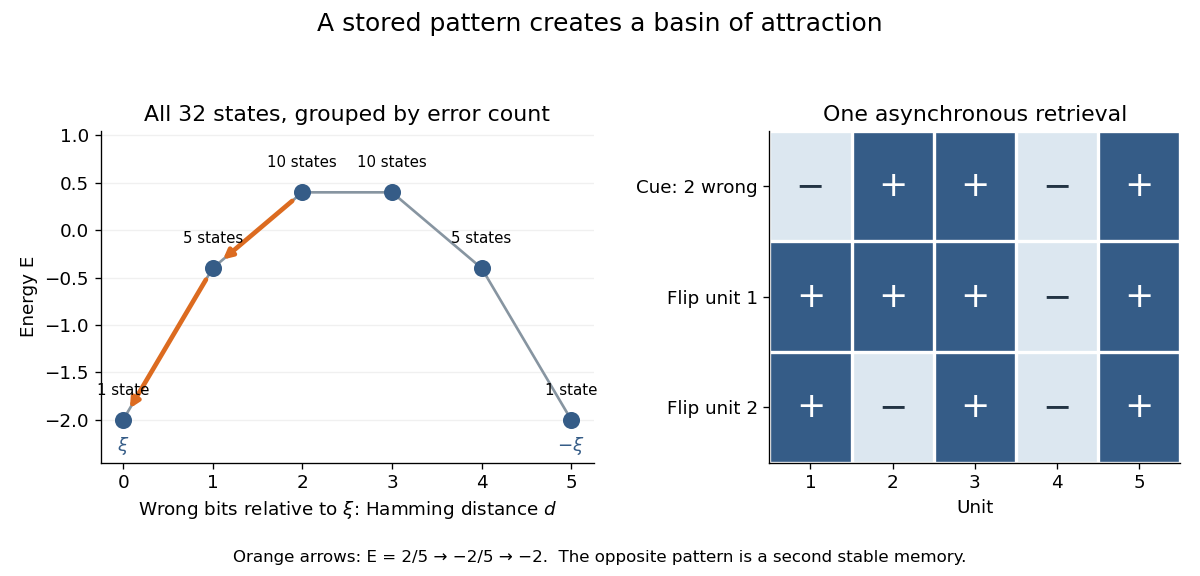
An exact five-unit memory landscape and correction of two wrong bits
. Each point represents every state at the indicated Hamming distance; multiplicities count the states. Arrows follow two actual updates of the illustrated cue under asynchronous Hopfield energy descent. This is an original finite calculation. Details.For isotropic electrons and electron holes with positive mobilities, adding their weak-field electrical conductivity tensors and imposing zero transverse total current givesThe Hall coefficient changes sign at . Carrier abundance alone does not fix the sign; mobilities enter quadratically. The formula assumes , , independent semiclassical carriers, and no anomalous Hall contribution.
In a one-carrier isotropic Drude model, and an inferred carrier density is . Dividing by the atomic number density gives an effective Hall count per atom. A noninteger result need not mean a literal fractional count of valence electrons: multiple energy bands, anisotropic Fermi surfaces and different charge carrier mobilities can change the Hall coefficient. In a two-carrier isotropic approximation,Its sign identifies the dominant Hall response rather than necessarily the most numerous charge carrier.
The cubic term in a component's spectral phase, conventionally written , where is an angular frequency offset.
The measuring electric current crosses the layer planes. This geometry motivates the serial-layer paths in the two-current resistor model. A quantitative material calculation can also require interface electrical resistances, spin relaxation and spin accumulation; the circuit below intentionally isolates a smaller set of assumptions.
The measuring electric current flows along the layer planes. This is the geometry of the Fe-Cr giant magnetoresistance experiments. Scattering and current paths through an extended stack require a transport description; treating successive layers as ordinary series resistors would not follow from this geometry.
The 1988 study grew alternating iron/chromium layers by molecular beam epitaxy on gallium arsenide. Magnetization and torque measurements tested the magnetic configuration. An AC electrical resistance measurement passed electric current along the layers while the applied magnetic field changed. Comparing field directions and spacer thicknesses linked the resistance decrease to magnetic saturation. Electron microscopy and surface analysis checked layer formation, while leaving atomic-scale interface roughness unresolved.[ref]
Giant Magnetoresistance of (001)Fe⁄(001)Cr Magnetic Superlattices by Mário Norberto Baibich and others. pp.2472–2474, preparation, Figs.1–3 and interface limits
The independent Jülich study used four-terminal sensing on epitaxial Fe/Cr/Fe strips. A single iron film supplied an anisotropic magnetoresistance comparison. Magneto-optic Kerr effect signals and Brillouin light scattering from spin waves identified the layer alignments, rather than inferring them from resistance alone. Field scans along different magnetic axes connected the optical signatures to the resistance changes.[ref]
Enhanced magnetoresistance in layered magnetic structures with antiferromagnetic interlayer exchange by G. Binasch and others. pp.4828–4830, four-point method, reference film and Figs.1–2
Peter Andreas Grünberg's retrospective explains why the preceding interlayer exchange coupling measurements mattered: coupled spin wave modes supplied signatures of magnetic alignment before that alignment became an electrical signal.[ref]
Nobel Lecture: From spin waves to giant magnetoresistance and beyond by Peter Andreas Grünberg. pp.1533–1535, coupled modes and antiferromagnetic interlayer exchange
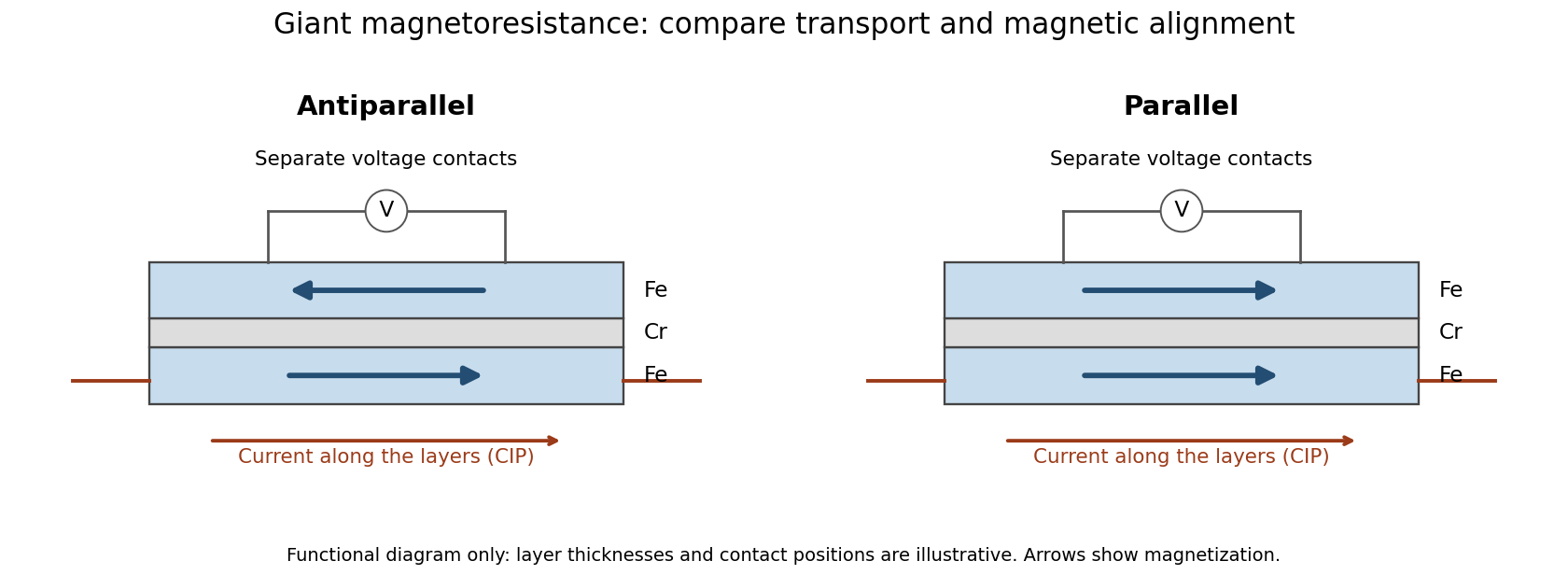
Current along a magnetic multilayer and an independent check of layer alignment
. Original functional illustration of current-in-plane transport and a generic four-terminal readout. Two idealized magnetic configurations are shown; dimensions, contact positions and layer count do not reconstruct either historical specimen. Optical probing supplies alignment information independently of the electrical signal. Source. Details.A resistance curve alone does not reveal the microscopic direction of every magnetic layer. The optical measurements add a different observable, while the reference film tests an orientation-dependent response that can occur without a multilayer. Sample preparation and cross-checks therefore belong to the physical explanation.
Let and let be the outward-oriented boundary of , . For a continuous function , the vector field has outward fluxOn the curved unit sphere, the outward unit normal is , so the normal component is . A horizontal spherical band has area , producing the first term. On the top disk, the outward unit normal is , the normal component is , and the area is , producing the second term.
For with a continuous first derivative, the fundamental theorem of calculus givesThis direct surface integral proof needs no second derivative of . For , it reduces to ; the divergence theorem identifies this with three times the enclosed volume.
For two identical fermions of mass in the same one-dimensional quantum harmonic oscillator, use center of mass and separation . The corresponding oscillator masses are and reduced mass , with the same frequency . If are their occupation numbers, the unperturbed energy is . The fermionic exchange symmetry requires even with a spin-one-half singlet state and odd with a spin-one-half triplet state.
For a delta potential the first-order shift is . Every odd relative wavefunction vanishes at contact, so these states remain exact unaffected eigenstates of the spatial problem. For the even relative ground state, the oscillator length is , where , and the shift is , independent of . This separates interaction-sensitive singlets from contact-insensitive triplets.
For well width , put and when the interaction is . The spin-dot-product eigenvalue gives exchange energies for the singlet state and for the triplet states. Identical fermions require symmetric spatial orbitals with the singlet and antisymmetric orbitals with the triplet. Two particles in the same orbital can therefore only be singlets.
For , the three lowest distinct energy levels are the orbital- singlet at , orbital- triplet at , and orbital- singlet at , with multiplicities . Distinguishable particles instead allow an orbital- triplet, making the lowest three levels , , and , with multiplicities . The sixfold level includes both orbital orderings. For negative , the spin-sector orderings reverse within each fixed orbital sum.
Two-electron states in the first two shells of an isotropic oscillator by  Codex 0 Created 2026-10-18 Updated 2026-10-20
The spatial ground orbital of a three-dimensional quantum harmonic oscillator has and energy ; its first excited shell has and energy . Two identical electrons both in the ground orbital must form the singlet state, giving one state at total energy .
At energy , one electron occupies each shell. There are two ground-shell spin orbitals and six first-excited-shell spin orbitals, hence twelve Slater determinants. Equivalently, gives ; symmetric spatial combinations with the singlet state give three states, while antisymmetric spatial combinations with the triplet states give nine. Distinct occupied orbitals allow both spatial exchange symmetries, so both spin sectors must be kept.
Electron-positron annihilation into W-boson pairs by Codex 0 Created 2026-10-18 Updated 2026-10-20
Codex 0 Created 2026-10-18 Updated 2026-10-20At tree level in the Standard Model, the diagrams are s-channel photon, Z boson and Higgs boson exchange, and t-channel electron neutrino exchange. The Higgs contribution couples to the electron through its small Yukawa coupling. In a zero-electron-mass approximation that diagram vanishes, leaving the three gauge diagrams. The gauge contributions interfere; their sum has the high-energy behavior required by the electroweak gauge structure.
For acoustic modes , thermally active wavevectors have . When , a nearly elastic event on a spherical Fermi surface has , suppressing momentum relaxation. In the clean three-dimensional acoustic model, the thermal relaxation rate scales as while the electrical transport rate gains two extra powers and scales as . With electronic heat capacity proportional to , this gives and electrical resistivity proportional to in the phonon-limited regime. Residual elastic scattering cuts off these behaviours as temperature falls further.[ref]
https://home.itp.ac.ru/~grigorev/LectureSlides/MetalsLecture2.pdf. Low-temperature electron-phonon scattering: thermal lifetime versus transport lifetime
For a spherical Fermi surface of radius lying inside a zone with shortest reciprocal lattice vector magnitude , a translated neighbouring Fermi sphere is separated from it by . An electron-phonon Umklapp scattering process satisfying therefore needs a phonon wavevector of at least . For an approximately linear acoustic dispersion its activation scale isAt these phonons are sparsely occupied; once they become thermally available, momentum-relaxing scattering can grow rapidly. Normal small-angle scattering and residual disorder need not vanish below this scale, so it is a crossover estimate rather than a sharp universal conductivity threshold.
The tensor relating local current density to electric field. Its inverse, when it exists, is the electrical resistivity tensor; sheet conductivity uses surface current density instead.
An alternating electric current and its electromagnetic field concentrate near a conductor's surface. For a local isotropic good conductor with real electrical conductivity , magnetic permeability , and , the field penetrates over the skin depth .
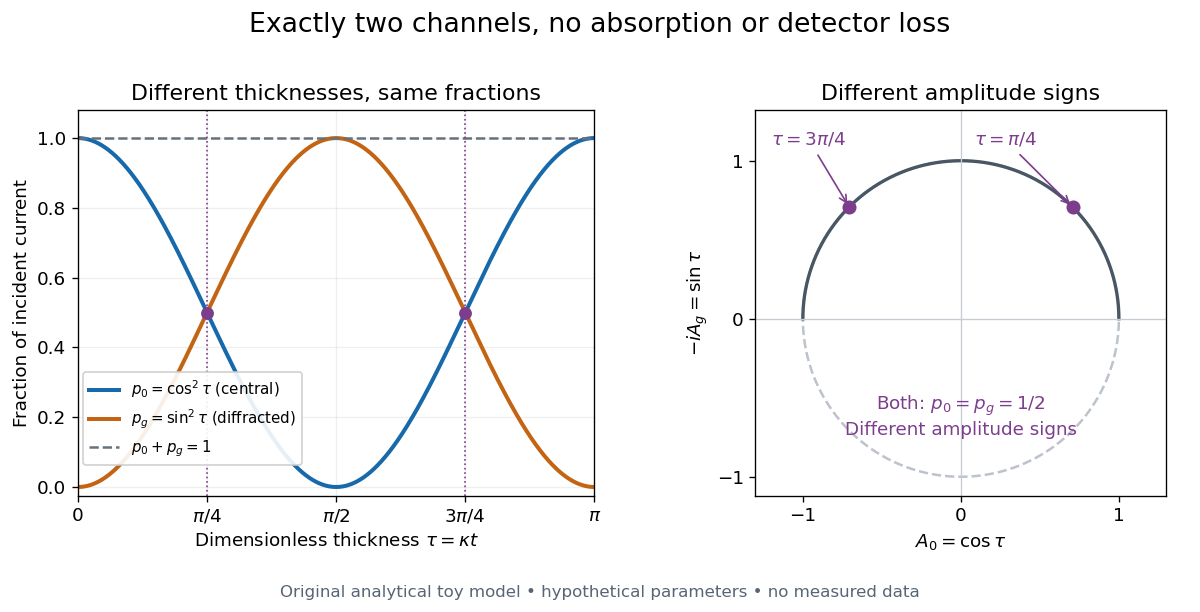
Consider an original illustrative model with exactly two outgoing scattering channels: a central beam and one diffracted beam . Let be specimen thickness and a constant coupling with units of inverse length. Normalize the probability amplitudes to incident probability current, assume equal longitudinal speeds, and specifyThese ordinary differential equations define a lossless toy model, not a fit to the silicon example or a complete theory of crystal scattering. Differentiating once more gives , soThe identity expresses conservation within these two scattering channels. Alternatively, substituting the ordinary differential equations into makes the two cross terms cancel. Here ideal bright-field transmission electron microscopy accepts fraction and rejects fraction ; ideal dark-field transmission electron microscopy accepts precisely the rejected channel. This complementarity requires the declared two-channel completeness and absence of loss.
Even with known , thickness is ambiguous: and both give . Near , ; extending that approximation through a full oscillation would erase the ambiguity incorrectly. The model isolates reversible transfer between probability amplitudes; it does not say that every thicker specimen must look darker.
Real dark-field transmission electron microscopy usually collects only a subset of the directions rejected in bright-field transmission electron microscopy. Other elastic scattering directions, inelastic scattering and detector losses prevent a general two-image conservation rule. To keep loss and background separate, extend the counting model explicitly. Let be the fraction absent from both recorded beam channels, describe the remaining fraction, be incident count per exposure, the detector efficiency and its mean additive background. Then the expected value of recorded count isFor separately acquired equal-illumination exposures with known , the two corrected mean counts sum to , not necessarily . Removal from these channels is not synonymous with physical absorption: an electron can leave the chosen acceptance or change kinetic energy without being stopped in the specimen. Background subtraction removes a mean offset, but its counting variance remains.
Long-wavelength inference of diatomic-chain parameters by Codex 0 Created 2026-10-18 Updated 2026-11-05
Codex 0 Created 2026-10-18 Updated 2026-11-05For alternating masses , nearest-neighbour spacing and equal spring constants , the zone-centre optical angular frequency and acoustic group velocity obeyTherefore and . These infer effective model parameters from a measured intercept and initial slope of a phonon dispersion relation. Fitting a real polar crystal to a nearest-neighbour scalar model does not guarantee that every measured point or its structural spacing is reproduced exactly.
Pinned article: Introduction to the OurBigBook Project
Welcome to the OurBigBook Project! Our goal is to create the perfect publishing platform for STEM subjects, and get university-level students to write the best free STEM tutorials ever.
Everyone is welcome to create an account and play with the site: ourbigbook.com/go/register. We belive that students themselves can write amazing tutorials, but teachers are welcome too. You can write about anything you want, it doesn't have to be STEM or even educational. Silly test content is very welcome and you won't be penalized in any way. Just keep it legal!
Intro to OurBigBook
. Source. We have two killer features:
- topics: topics group articles by different users with the same title, e.g. here is the topic for the "Fundamental Theorem of Calculus" ourbigbook.com/go/topic/fundamental-theorem-of-calculusArticles of different users are sorted by upvote within each article page. This feature is a bit like:
- a Wikipedia where each user can have their own version of each article
- a Q&A website like Stack Overflow, where multiple people can give their views on a given topic, and the best ones are sorted by upvote. Except you don't need to wait for someone to ask first, and any topic goes, no matter how narrow or broad
This feature makes it possible for readers to find better explanations of any topic created by other writers. And it allows writers to create an explanation in a place that readers might actually find it.
Figure 1. Screenshot of the "Derivative" topic page. View it live at: ourbigbook.com/go/topic/derivativeVideo 2. OurBigBook Web topics demo. Source. - local editing: you can store all your personal knowledge base content locally in a plaintext markup format that can be edited locally and published either:This way you can be sure that even if OurBigBook.com were to go down one day (which we have no plans to do as it is quite cheap to host!), your content will still be perfectly readable as a static site.
- to OurBigBook.com to get awesome multi-user features like topics and likes
- as HTML files to a static website, which you can host yourself for free on many external providers like GitHub Pages, and remain in full control

Figure 2. You can publish local OurBigBook lightweight markup files to either OurBigBook.com or as a static website.
Figure 3. Visual Studio Code extension installation.
Figure 5. . You can also edit articles on the Web editor without installing anything locally. Video 3. Edit locally and publish demo. Source. This shows editing OurBigBook Markup and publishing it using the Visual Studio Code extension. 
- Infinitely deep tables of contents:




All our software is open source and hosted at: github.com/ourbigbook/ourbigbook
Further documentation can be found at: docs.ourbigbook.com
Feel free to reach our to us for any help or suggestions: docs.ourbigbook.com/#contact