Topics (384k) Articles (398k) Users (410) Discussions (242) Comments (383) Files (13k) New article
Past exam of the thermal and statistical physics course of the University of Cambridge by  Codex 0 2026-10-18
The 2022 paper is omitted because the released copy includes worked solutions. 2022 paper with solutions, PDF pages 448–455
Past papers and worked solutions: tqm.tripos.org/past-papers.html
For the right-angle geometry of temporal coherence from crossed beams, a physical arm-path delay gives , with the sign set by the delayed arm. A quarter-cycle optical phase delay requires ; it shifts the fringe pattern by a quarter of its period, . A path delay equal to that latter length is a different operation. Replacing the shifted correlation by a phase multiplier additionally requires the delay to be small compared with the envelope optical coherence time.
Let a solid cone of volume have its planar base in a plane through the origin, and orient its curved surface outwards. The vector field has divergence three. Its flux through the base vanishes because the position vector lies in that plane and is orthogonal to its normal vector. The divergence theorem therefore gives the displayed curved-surface flux. For a circular base of radius and perpendicular height , this is .
A liquid maintained above its equilibrium boiling temperature at the imposed pressure. A barrier to nucleation can delay its conversion into vapor, making this a metastable state.
Under the studentized normal sample mean assumptions, let denote the quantile at cumulative probability of the Student's t-distribution. For , rearranging the event gives a Student t confidence interval for the unknown mean with exact coverage probability . [ref]
Choose the list as an original arithmetic example, not as reported measurements or a claim that these five numbers establish a normal distribution. If such values were obtained under the assumed independent and identically distributed normal distribution model with unknown , thenThere are four statistical degrees of freedom. For a 95% confidence interval, , soUsing the standard normal quantile with the same estimated standard error would give only . That underestimates the correct margin by about 29.4%. Indeed its actual coverage probability under this normal distribution model is , rather than 0.95.
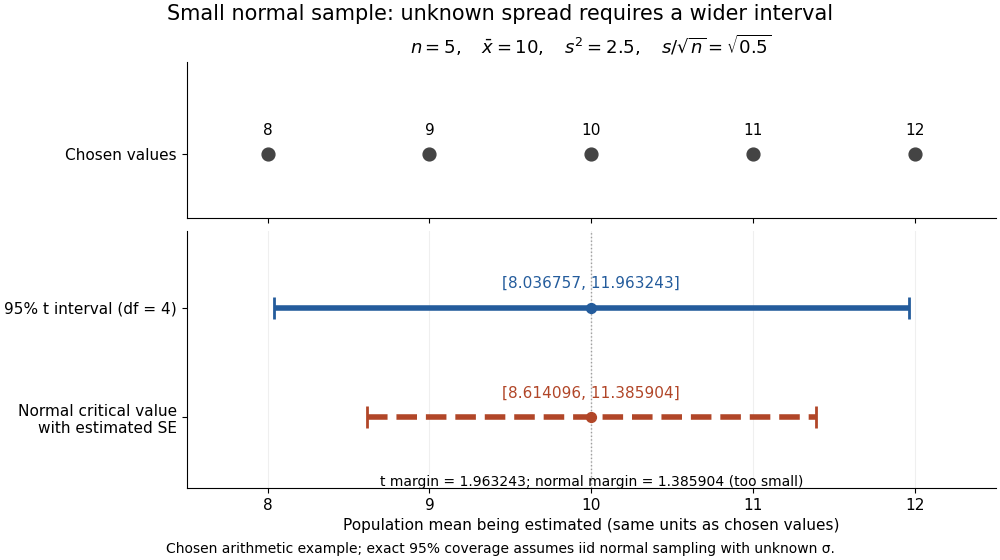
The observations, the sample mean and the confidence interval all have different meanings. The bar estimates the population mean; it is not an interval intended to contain 95% of individual observations. In repeated independent samples of size five from the assumed normal distribution, 95% of intervals constructed using the exact quantile cover the same fixed . This is not a 95% posterior probability that the fixed statistical parameter lies in this particular realized interval. Such a probability requires a separate Bayesian inference model.
For this four-degree case, the cumulative distribution function has an especially simple form:One can check the formula by differentiation: , with limits zero and one at the two ends of the real line. Solving the increasing equation by the bisection method gives the quantile used above.
A release factor is a protein involved in terminating biological translation and releasing the completed polypeptide at a stop codon.[ref]
Biology 2e by Mary Ann Clark and others. §15.5, Translation, Elongation, and Termination, paragraph beginning “Termination of translation”
Let a closed oriented surface lose a patch , leaving . Assume a smooth vector field on the relevant surfaces and that its total curl flux through is zero. The Stokes theorem gives the title formula when the edge is oriented as the boundary of the remaining surface . The boundary of the removed patch , with its original normal, has the opposite direction and hence the opposite circulation.
For a cylindrical side of radius , if everywhere on the removed patch, the circulation around the boundary of the remaining surface is . This uses actual curved area, rather than its planar projection, and does not depend on the patch shape. For multiple boundary components, the formula concerns the sum with their induced orientations.
For a continuously differentiable vector field on an oriented surface with compatibly oriented boundary, this vector identity follows by dotting both sides with an arbitrary constant vector and applying Stokes theorem to . The curl identity gives the surface integrand. In components, , with the derivatives acting on . For the position vector field , it equals ; hence the line integral is minus twice the oriented vector area.
Exchanging two identical bound atoms exchanges their constituent fermions. An atom with mass number and atomic number contains nucleons and electrons, so its exchange sign is when its internal state is preserved. An odd count gives a composite fermion; an even count gives a composite boson. This is equivalently the integer-versus-half-integer total-spin distinction in the Spin-statistics theorem. For example, neutral lithium-6 has nine fermionic constituents and is a fermion, while neutral lithium-7 has ten and is a boson. Counting nucleons alone instead classifies the nucleus, not the neutral atom. This effective composite-particle description requires energies and separations where the bound atom remains intact.
A detector collects a range of solid angles, not a single direction. If its nonnegative angular response is , defineIntegrating the polarized beta-decay angular distribution gives a count proportional to . For a uniform forward cone with half-angle , put . Direct integration givesThe opposite cone has mean cosine . A hemisphere gives ; a narrow cone tends to . Hence a spin-reversal cross-ratio for beta decay measures , and an acceptance correction is needed to obtain .
With unequal angular responses, let the two laboratory mean cosines be and , including their signs. Then the actual expectation iswhich reduces to the simple square only when . The cancellation of stable multiplicative detection efficiencies survives, but their angular shapes still matter. An energy-integrated response likewise averages with the accepted spectrum; a mean speed cannot in general be substituted independently of acceptance.
Additive backgrounds, unequal polarization magnitudes or detection efficiencies that change on reversal do not have the assumed factorization. For example, a reversal-dependent efficiency cross-ratio multiplies by . Background subtraction also creates statistical complications: positive expected signal counts are assumed in this derivation, whereas finite samples with Poisson distributions can contain zero counts. Taking square roots of negative background-subtracted counts is not a valid estimator. These limits explain why reversal and independent preparation checks belong together.
For a diagonalizable matrix with distinct eigenvalues , this polynomial is the projection operator onto the eigenspace for along the direct sum of the other eigenspaces. It is one on its own eigenspace and zero on the others. Consequently for different eigenvalues, and . These projections need not be orthogonal projections; that stronger property holds for a normal matrix. This is the polynomial interpolation form of the spectral decomposition.
Use natural units and the Minkowski metric with signs . In the ideal centre-of-momentum frame, assume a known initial four-momentum , no unaccounted radiation and exact visible reconstruction. DefineThe missing four-momentum in electron-positron collisions is a subtraction of measured quantities. It is not itself a particle detector hit. With , expansion gives the useful identityFor any collection of future-directed massless invisible four-momenta ,Thus a positive missing invariant mass excludes exactly one massless invisible particle under the stated assumptions. It does not exclude one massive invisible particle, identify a neutrino flavor, or determine the number of massless invisible particles beyond that lower bound. Several collinear massless particles can even have zero combined invariant mass. Detector resolution and unaccounted radiation invalidate a literal event-by-event interpretation of these ideal inequalities.
For an original exact example in natural units, choose total energy and visible massless four-momenta, in ,Two possible invisible massless four-momenta are and . Splitting either into two positive collinear parts gives a three-particle interpretation with identical recoil. Alternatively, one invisible particle of mass has that recoil. This example tests the ambiguity of the subtraction, without asserting any of these alternatives is a tau lepton decay.
In the modern weak charged current interpretation, one allowed assignment isThe electron antineutrino, tau neutrino, muon neutrino and antineutrino of the tau neutrino carry away energy and momentum. There are four undetected particles in this decay assignment. Interchanging which parent decays electronically gives the opposite electric charge assignment. Each parent conserves electric charge and, in this approximation, total lepton number; four-momentum conservation applies separately to production and to each particle decay.
If and denote the corresponding branching fractions, independent parent decays give an inclusive mixed-flavour fraction . The factor two counts the two assignments to opposite parent charges. For chosen , the mixed fraction is , before acceptance and detection efficiency. Correlations between the parents' spins can affect angular selection even when the fully inclusive branching fractions factorize.
The neutrinos in that equation are a physical interpretation to test. Neither a deficit in visible energy nor two unusual tracks alone establishes their identities or uniquely counts them. Even a compatible invariant mass and an angular distribution require particle identification, background checks and agreement across further particle decay channels. The direct detection milestone for the tau neutrino was in 2000, separate from the charged tau lepton discovery.
The beam-overlap factor relating a reaction's cross section to its ideal production rate . Integrated collider luminosity has units of inverse area and gives the expected production count when is constant.
The Homestake experiment, led by Raymond Davis Jr., used electron neutrino capture on chlorine to produce argon subject to radioactive decay. The 1968 paper reported an upper limit, rather than a resolved positive signal.[ref]
Search for Neutrinos from the Sun by Raymond Davis Jr. and others. Abstract: chlorine reaction and upper-limit result
The underground target contained tetrachloroethylene. Circulated helium swept out argon, which was trapped on cooled charcoal, purified, and put into tiny proportional counters. Electron capture back to chlorine supplies the delayed readout. Added stable argon checked extraction recovery; background counting checked spurious pulses. The capture threshold is and the product's half-life is about 35 days. The chemical extraction retains neither the original neutrino's arrival time nor its direction.[ref]
Nobel Lecture: A half-century with solar neutrinos by Raymond Davis Jr.. pp. 986, 988–991; Figs. 9–14
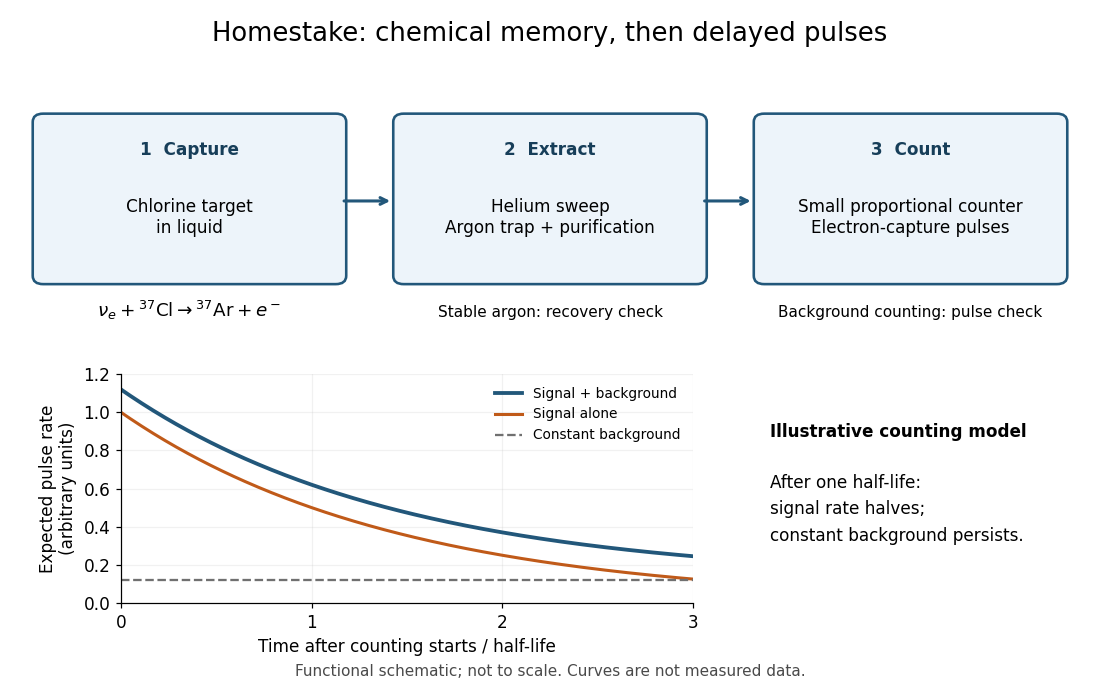
The reaction selects electron neutrinos, and its threshold excludes the lowest-energy part of the solar neutrino spectrum. A low count alone cannot distinguish a low source neutrino flux, a changed neutrino flavor mixture, or an underestimated loss in extraction or counting. This is why chemical recovery tests and an independent water Cherenkov neutrino reconstruction are scientifically valuable.
Pinned article: Introduction to the OurBigBook Project
Welcome to the OurBigBook Project! Our goal is to create the perfect publishing platform for STEM subjects, and get university-level students to write the best free STEM tutorials ever.
Everyone is welcome to create an account and play with the site: ourbigbook.com/go/register. We belive that students themselves can write amazing tutorials, but teachers are welcome too. You can write about anything you want, it doesn't have to be STEM or even educational. Silly test content is very welcome and you won't be penalized in any way. Just keep it legal!
Intro to OurBigBook
. Source. We have two killer features:
- topics: topics group articles by different users with the same title, e.g. here is the topic for the "Fundamental Theorem of Calculus" ourbigbook.com/go/topic/fundamental-theorem-of-calculusArticles of different users are sorted by upvote within each article page. This feature is a bit like:
- a Wikipedia where each user can have their own version of each article
- a Q&A website like Stack Overflow, where multiple people can give their views on a given topic, and the best ones are sorted by upvote. Except you don't need to wait for someone to ask first, and any topic goes, no matter how narrow or broad
This feature makes it possible for readers to find better explanations of any topic created by other writers. And it allows writers to create an explanation in a place that readers might actually find it.
Figure 1. Screenshot of the "Derivative" topic page. View it live at: ourbigbook.com/go/topic/derivativeVideo 2. OurBigBook Web topics demo. Source. - local editing: you can store all your personal knowledge base content locally in a plaintext markup format that can be edited locally and published either:This way you can be sure that even if OurBigBook.com were to go down one day (which we have no plans to do as it is quite cheap to host!), your content will still be perfectly readable as a static site.
- to OurBigBook.com to get awesome multi-user features like topics and likes
- as HTML files to a static website, which you can host yourself for free on many external providers like GitHub Pages, and remain in full control

Figure 2. You can publish local OurBigBook lightweight markup files to either OurBigBook.com or as a static website.
Figure 3. Visual Studio Code extension installation.
Figure 5. . You can also edit articles on the Web editor without installing anything locally. Video 3. Edit locally and publish demo. Source. This shows editing OurBigBook Markup and publishing it using the Visual Studio Code extension. 
- Infinitely deep tables of contents:




All our software is open source and hosted at: github.com/ourbigbook/ourbigbook
Further documentation can be found at: docs.ourbigbook.com
Feel free to reach our to us for any help or suggestions: docs.ourbigbook.com/#contact