Topics (384k) Articles (398k) Users (410) Discussions (242) Comments (383) Files (13k) New article

The quantum lifetime determines the broadening of a single-particle spectral level by scattering. It need not equal the momentum relaxation time: small-angle scattering broadens levels while relaxing current weakly. A common Lorentzian broadening convention is a half-width .
An electron lens uses an electric field or magnetic field to make trajectories from an object point converge towards an image point. It has no glass for the electrons to pass through. In a paraxial approximation, an effective focal length permits the same first-order image geometry used for a thin lens; finite beam angles, energy spread and misalignment limit this approximation.
An electron biprism uses the electric field around a biased fine wire to overlap coherent electron waves for interference. It provides object–reference overlap in electron holography.[ref]
A cold cathode supplies electrons without relying on deliberate heating for thermionic emission. The term describes that operating distinction rather than one universal microscopic emission mechanism.
A strong surface electric field can produce field emission; in a gas discharge, particle impact and secondary electron emission can sustain the supply. A cathode may still warm during operation, so cold does not guarantee room temperature. Comparing emitted current as a function of field, illumination or discharge conditions helps distinguish mechanisms. The source's energy spread, stability and emitting geometry matter when it is used in an electron gun.
The free electron model approximates conduction electrons by noninteracting particles with the displayed parabolic dispersion relation, filling one-particle states according to Fermi-Dirac distribution. A uniform positive background supplies charge neutrality. Periodic boundary conditions give one spatial state per -space volume in dimensions; the physical spin degeneracy is two. The model captures basic state counting and degeneracy but omits the periodic lattice potential, interaction corrections and detailed electronic band structure.
Cherenkov radiation is electromagnetic radiation from a charged particle exceeding the medium's phase velocity: . Here is the positive refractive index at angular frequency . The threshold uses phase velocity, not group velocity.[ref]
Passage of Particles Through Matter by Donald E. Groom and Spencer Klein. §34.7.1, equation (34.41), Fig. 34.26: phase-speed threshold
The beauty of Cherenkov radiation is that uniform motion can generate a sharply directed electromagnetic wave: the medium's response along successive portions of the track adds with matching wave phase on a cone. The moving electric charge drives the medium's electric polarization; the resulting radiation depends on the collective refractive index. This differs from luminescence, where excitation of material is followed by light emission. Both mechanisms can contribute to the same irradiated sample. A visible blue glow alone therefore identifies neither Cherenkov radiation nor a particular radioactive source.
The Cherenkov cone angle turns a measured direction into a constraint on particle speed when the refractive index is known. The Frank-Tamm formula instead predicts the number of emitted photons in a specified wavelength interval. These are complementary observables: the finite-band Cherenkov yield model below shows why both depend on optical dispersion and on which wavelengths are collected. This makes Cherenkov radiation useful for particle detectors, with photon production, transport and detection treated separately.
A transverse electromagnetic mode has both electric field and magnetic field transverse to its propagation axis. An ideal two-conductor guide can support such a mode without a geometric waveguide cutoff frequency; an empty simply connected perfect conductor pipe cannot.
For a plane electromagnetic wave in a homogeneous, linear, lossless, isotropic medium with permittivity and magnetic permeability , the wave impedance relates the field amplitudes by . Its units are ohms. Impedance differences determine the normal-incidence amplitude Fresnel equations, and , with a common tangential electric-field axis.
A closed rectangular perfect conductor cavity has discrete normal modes selected by zero tangential electric field at the walls. Each frequency has the displayed form. With all three indices positive there are two independent polarizations of an electromagnetic wave; modes with exactly one zero index have one, and those with two zero indices are absent. For example the family can have , independent of . It satisfies the wall conditions because is normal to the faces and tangential to the side walls. Omitting such zero-index families is harmless for leading bulk density of states, but changes the low-temperature physics of a thin cavity.
Synchrotron radiation is electromagnetic radiation emitted by relativistic charged particles undergoing transverse acceleration, typically when a magnetic field bends their paths. For ultrarelativistic particles, emission is concentrated near the instantaneous direction of motion rather than distributed isotropically.
A circulating electron beam therefore loses energy even when the bending magnet itself does no work. Radiofrequency accelerating fields replenish that loss in a storage ring. The extracted radiation is useful as an intense source for spectroscopy and imaging; its angular distribution, polarization and optical spectrum depend on particle energy and magnetic geometry. In synchrotron cooling, those same radiation losses reshape a particle population.
Radiation reaction is the influence on a source's motion of its own electromagnetic field, including the balance of radiated energy and momentum with changes of the near field. For sufficiently weak radiation loss, an averaged power balance can give the leading damping law without solving the full self-field dynamics. Replacing a constant-frequency radiation formula by its instantaneous slowly varying value requires an additional time-scale assumption; it is not an exact treatment of arbitrarily rapid motion changes.
Mutual induction is electromagnetic induction in one electrical circuit associated with a changing electric current in another. In a fixed linear arrangement, mutual inductance quantifies the coupling.
Changing the magnetic flux through a long solenoid produces an exterior azimuthal electric field by Faraday's law of induction. A charge whose displacement is negligible during the switching receives mechanical momentumThe result assumes the usual quasistatic field approximation and neglects the particle's displacement while the pulse acts. It describes an electromagnetic induction effect, distinct from the static Aharonov-Bohm effect.
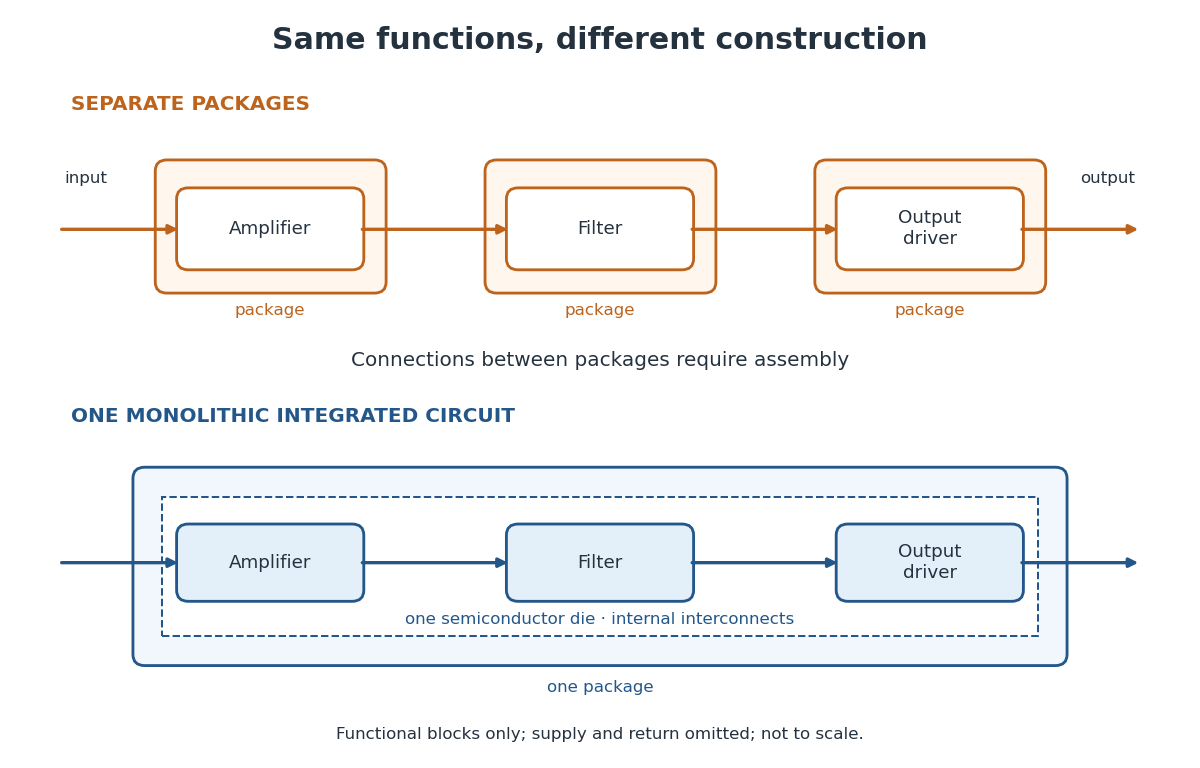
An integrated circuit combines interconnected electrical circuit elements in a fabricated structure. A monolithic integrated circuit forms its elements in or on one piece of semiconductor, rather than merely putting separately manufactured components into one enclosure. Transistors supply control in electronic amplifiers; resistors and capacitors can supply bias and timing. Jack St. Clair Kilby's patent describes making such functions from a common semiconductor body with compatible fabrication steps.[ref]
Miniaturized electronic circuits by Jack St. Clair Kilby. Description, opening statement of the invention and discussion preceding Figs. 1–5a
The useful change is to fabricate connections and functions together. Shrinking an enclosure still leaves individual parts to position and join. Integration makes their relative arrangement part of a repeatable fabrication pattern. The distinction is functional as well as geometric: one small piece can implement a whole electrical circuit, while its external terminals expose only the connections needed by its surroundings.
A gas-discharge tube conducts electric current through a gas made partially ionized by an applied electric field. Initial free electrons gain energy between collisions and can cause further ionization and excitation, producing a conducting discharge rather than ordinary conduction through a metal.
The behavior depends on gas composition, pressure, electrode spacing and the external circuit. Excited species can emit light, making a gas-discharge lamp; other designs use the discharge to switch current. A current-limiting external element often matters because discharge voltage need not increase with current like an ordinary resistor.
Setting steady electric potential differences and electric currents in an electrical circuit to choose its operating point.
A series circuit connects components along one unbranched path, so any electric current through the connected components is the same. Oriented terminal electric potential differences add along that path. In an open-circuit measurement, negligible electric current permits the electromotive forces of serially connected sources to add without appreciable internal electrical resistance drops.
A current-voltage characteristic describes the relation between terminal electric potential difference and electric current for specified physical conditions. A resistor obeying Ohm's law gives a straight line; a diode has an asymmetric relation.
An ideal electrical circuit exchanges energy between an inductor and a capacitor. With no electrical resistance or applied drive, the electric charge obeys , giving angular frequency . A series RLC circuit adds dissipation and can include an external drive.
Pinned article: Introduction to the OurBigBook Project
Welcome to the OurBigBook Project! Our goal is to create the perfect publishing platform for STEM subjects, and get university-level students to write the best free STEM tutorials ever.
Everyone is welcome to create an account and play with the site: ourbigbook.com/go/register. We belive that students themselves can write amazing tutorials, but teachers are welcome too. You can write about anything you want, it doesn't have to be STEM or even educational. Silly test content is very welcome and you won't be penalized in any way. Just keep it legal!
Intro to OurBigBook
. Source. We have two killer features:
- topics: topics group articles by different users with the same title, e.g. here is the topic for the "Fundamental Theorem of Calculus" ourbigbook.com/go/topic/fundamental-theorem-of-calculusArticles of different users are sorted by upvote within each article page. This feature is a bit like:
- a Wikipedia where each user can have their own version of each article
- a Q&A website like Stack Overflow, where multiple people can give their views on a given topic, and the best ones are sorted by upvote. Except you don't need to wait for someone to ask first, and any topic goes, no matter how narrow or broad
This feature makes it possible for readers to find better explanations of any topic created by other writers. And it allows writers to create an explanation in a place that readers might actually find it.
Figure 1. Screenshot of the "Derivative" topic page. View it live at: ourbigbook.com/go/topic/derivativeVideo 2. OurBigBook Web topics demo. Source. - local editing: you can store all your personal knowledge base content locally in a plaintext markup format that can be edited locally and published either:This way you can be sure that even if OurBigBook.com were to go down one day (which we have no plans to do as it is quite cheap to host!), your content will still be perfectly readable as a static site.
- to OurBigBook.com to get awesome multi-user features like topics and likes
- as HTML files to a static website, which you can host yourself for free on many external providers like GitHub Pages, and remain in full control

Figure 2. You can publish local OurBigBook lightweight markup files to either OurBigBook.com or as a static website.
Figure 3. Visual Studio Code extension installation.
Figure 5. . You can also edit articles on the Web editor without installing anything locally. Video 3. Edit locally and publish demo. Source. This shows editing OurBigBook Markup and publishing it using the Visual Studio Code extension. 
- Infinitely deep tables of contents:



All our software is open source and hosted at: github.com/ourbigbook/ourbigbook
Further documentation can be found at: docs.ourbigbook.com
Feel free to reach our to us for any help or suggestions: docs.ourbigbook.com/#contact