Topics (384k) Articles (398k) Users (410) Discussions (242) Comments (383) Files (13k) New article

A double heterostructure laser electrically pumps its central layer for stimulated emission. Band offsets confine charge carriers; refractive index contrast confines the optical normal mode.[ref]
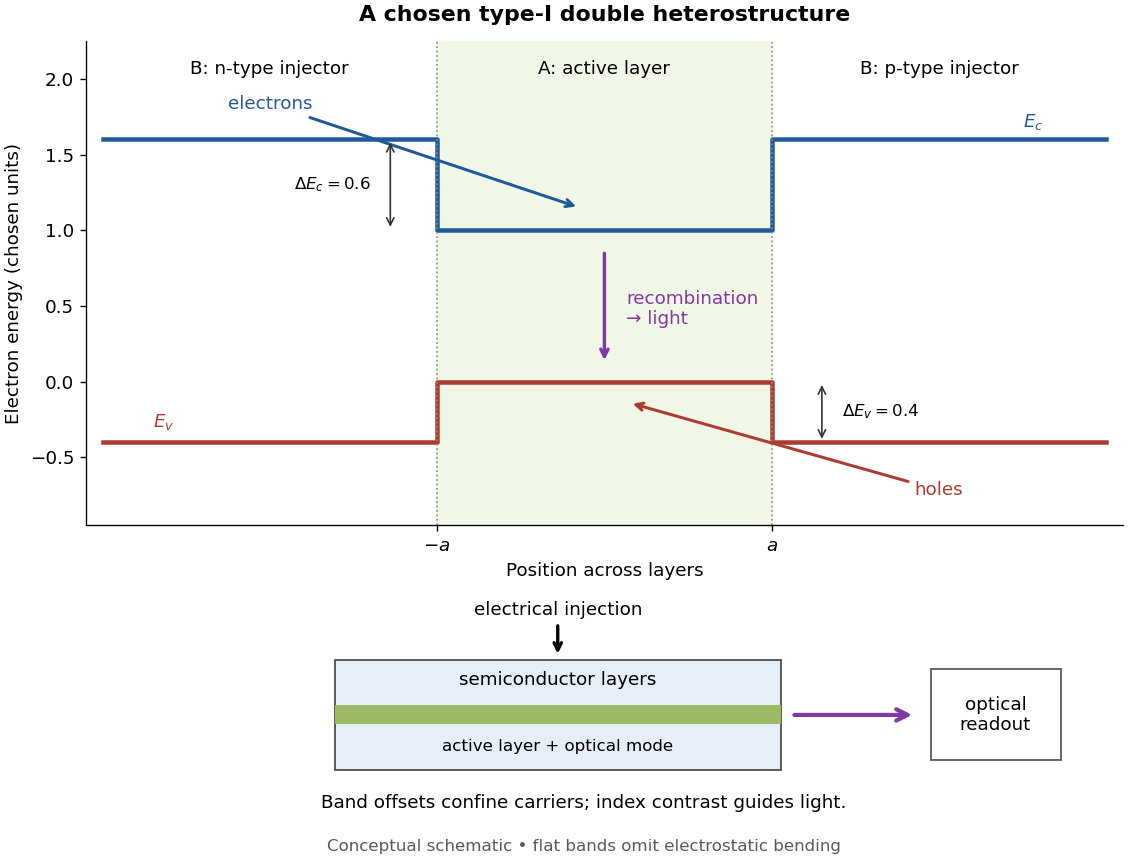
Chosen type-I band alignment: carrier injection and optical readout
. Original schematic using stipulated energy units. The upper panel plots electron energy band edges across the layers; the lower panel separates electrical pumping from the emerging light. Flat segments omit band bending. The curves do not reproduce a historical device. Source. Details.For an original bookkeeping model, let be the injected pair rate per unit area, the active-layer thickness, its excess pair number density, a recombination lifetime, and an escape time. Before appreciable stimulated emission, supposeChoose two otherwise identical devices with and . The resulting steady state populations are and : improved confinement raises the population by a factor at fixed injection. This linear model assumes equal excess electron and electron hole densities, fixed lifetimes, and no laser gain clamping.
Optical confinement enters separately. For a chosen optical normal mode, define as its gain-overlap factor with the active layer. With material optical gain , internal loss , and mirror loss , a simple laser threshold condition isFor stipulated losses in inverse-length units, requires , whereas requires . This calculation varies optical overlap only; the preceding population calculation varies carrier escape only. Their combination explains the usefulness of controlling both the energy band profile and the optical normal mode.
Herbert Kroemer proposed the double heterostructure laser in 1963; he did not participate in its 1970 experimental realization.[ref]
Nobel Lecture: Quasielectric fields and band offsets: teaching electrons new tricks by Herbert Kroemer. §IV, p. 787
Zhores I. Alferov describes his group's independent 1963 proposal and later experimental program.[ref]Sanger sequencing determines a DNA nucleotide sequence by extending a common sequencing primer and occasionally incorporating a dideoxynucleoside triphosphate. A normal deoxynucleoside triphosphate already has hydrogen in place of a hydroxy group; it retains the hydroxy group. A dideoxynucleoside triphosphate lacks that hydroxy group too. It can join the growing strand because the preceding nucleotide supplies the reacting hydroxy group. Once incorporated, its own end cannot form the next phosphodiester bond. Thus the blocked step is the next addition, not attachment of the terminator itself.[ref]
Isolating, Cloning, and Sequencing DNA. Alberts and others, Molecular Biology of the Cell, 4th edition (2002), Isolating, Cloning, and Sequencing DNA, Figure 8-36 and accompanying dideoxy-method explanation
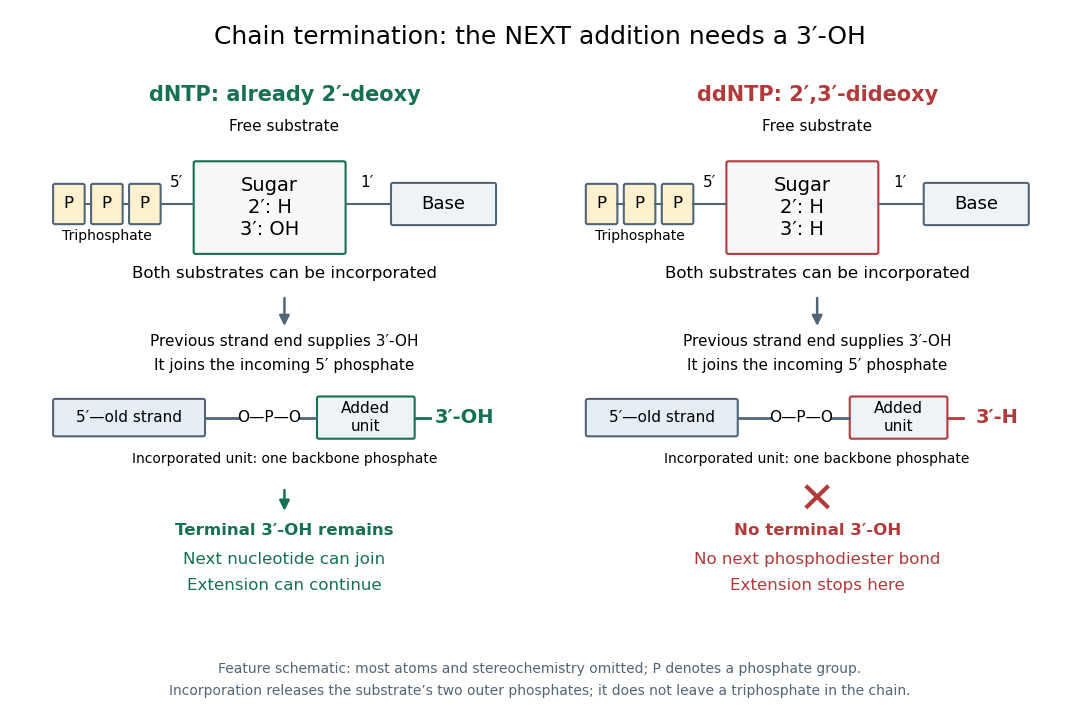
In the historical four-reaction format, each tube receives copies of the same template, the same sequencing primer, a DNA polymerase and all four ordinary deoxynucleoside triphosphates. The tubes differ in their terminating substrate: ddATP, ddCTP, ddGTP or ddTTP. In the A reaction, ordinary dATP can allow copying to continue past one A position, whereas incorporation of ddATP stops another copy there. Competition produces a family of endpoints, rather than every strand stopping at the first A. Adjusting substrate proportions makes later endpoints detectable. A lane identifies the terminating nucleobase in the new strand, not the complementary template letter.[ref]
Sequencing Genomes. T. A. Brown, Genomes, 2nd edition (2002), section 6.1.1, Chain termination sequencing in outline
The readout requires gel electrophoresis capable of separating single-stranded DNA fragments differing by one nucleotide. Historical denaturing polyacrylamide gel electrophoresis suppressed strand folding and resolved these adjacent lengths; radioactive labels were detected by autoradiography. An ordinary agarose gel electrophoresis comparison with a 100-base pair DNA ladder does not supply that resolution. Four separate reaction lanes carry the identities in this format.[ref]
An origin of replication is a DNA region at which DNA replication is initiated. Its function depends on compatible cellular machinery.
Like-charged colloids can resist aggregation because bringing their electric double layers together costs free energy. In DLVO theory, screened electrostatic repulsion competes with attractive Van der Waals forces. A repulsive barrier much larger than suppresses thermally activated aggregation, although the dispersion can remain metastable. Lower ionic strength generally lengthens the Debye–Hückel screening length, while multivalent counterions or added salt shorten it and can lower the barrier. The surface charge, charge regulation and solvent-dependent attraction also matter; screening length alone does not guarantee stability.
For a nonzero normal vector and the plane equation , the closest point on a plane to isIt subtracts only the normal displacement. Substituting gives , so lies on the plane; the difference is a scalar multiple of its normal vector. These two checks identify the orthogonal projection onto a plane without solving a three-variable minimization problem.
For , , and , the residual givesIndeed, , and . Choosing the plane point instead gives distance : being on the plane does not make a point the nearest one.
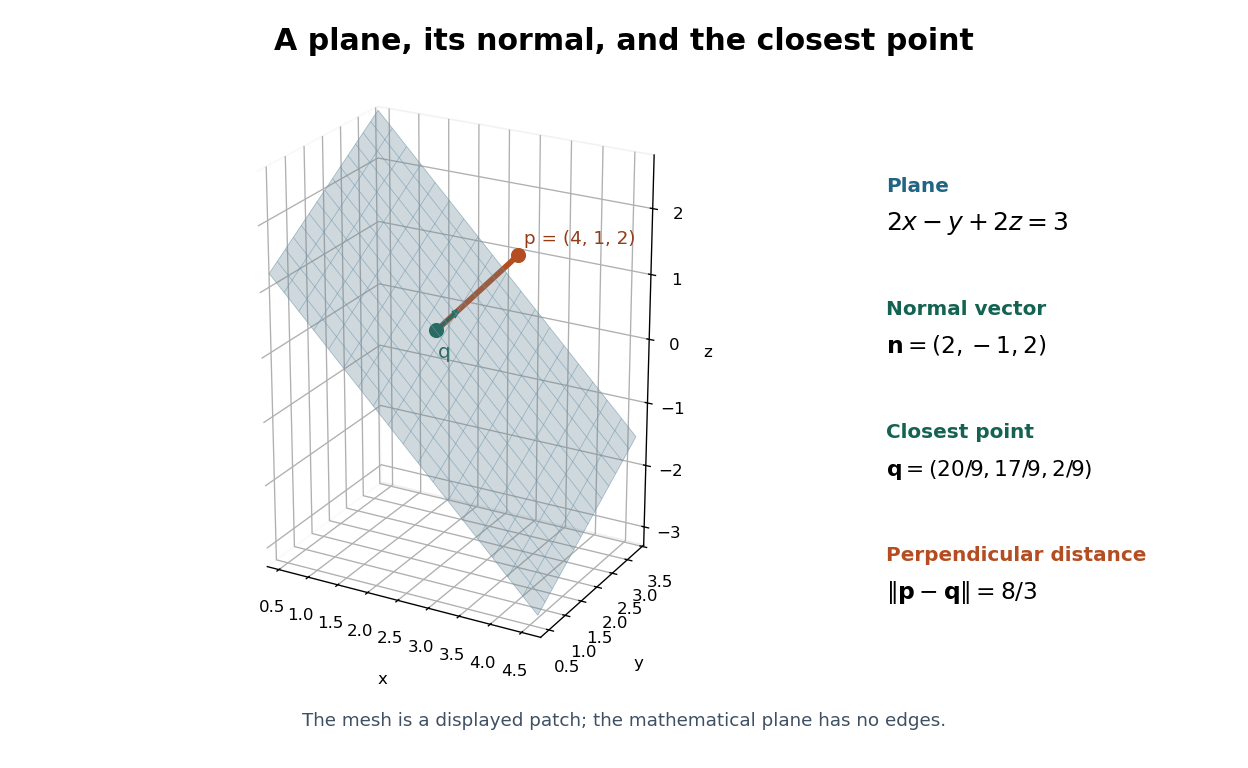
The closest point on a plane is reached along its normal vector
. Original three-dimensional example , with and . The finite mesh is only a displayed patch of the infinite plane; it is not a physical measurement. Details.As a function of , this projection isIt is an affine map, becoming a linear map when . Projecting a second time changes nothing. It preserves displacements along the plane and removes the normal displacement, so it is a concrete example of an idempotent map.
The mean displacement is the expected value of a particle's displacement over a time interval. It describes systematic transport, while the mean squared displacement also measures fluctuations. For one component with finite second moment,For constant drift speed and ordinary diffusion of coefficient , the mean displacement is and its centered variance is , so the uncentered mean squared displacement is . With fixed initial velocity and free inertial Langevin dynamics, the mean displacement is , where is the velocity relaxation time. Its fluctuation variance is given by the integrated Ornstein-Uhlenbeck displacement.
Path compression changes parent pointers during a disjoint-set find operation so that future queries traverse fewer edges. Full path compression first follows the entire parent route to its root of a tree, then makes every member on that route point directly to that same root of a tree. No member changes its block of a set partition or its disjoint-set representative. Pointers outside the traversed route stay as they were. The following iterative Python implements full path compression and union by rank;
parent and rank are initially indexed arrays with parent[x] = x and rank[x] = 0 for every valid member.def find(x):
root = x
while parent[root] != root:
root = parent[root]
while parent[x] != x:
following = parent[x]
parent[x] = root
x = following
return root
def unite(x, y):
a, b = find(x), find(y)
if a == b:
return False
if rank[a] < rank[b]:
a, b = b, a
parent[b] = a
if rank[a] == rank[b]:
rank[a] += 1
return TrueStarting from the displayed disjoint-set forest,
find(3) traverses , returns and changes only from to . The route still has two edges. Then find(5) changes only from to . The final parent array is ; every stored rank retains its displayed value. The rooted tree at now has height one although its root's rank is two. Root still represents a separate singleton set.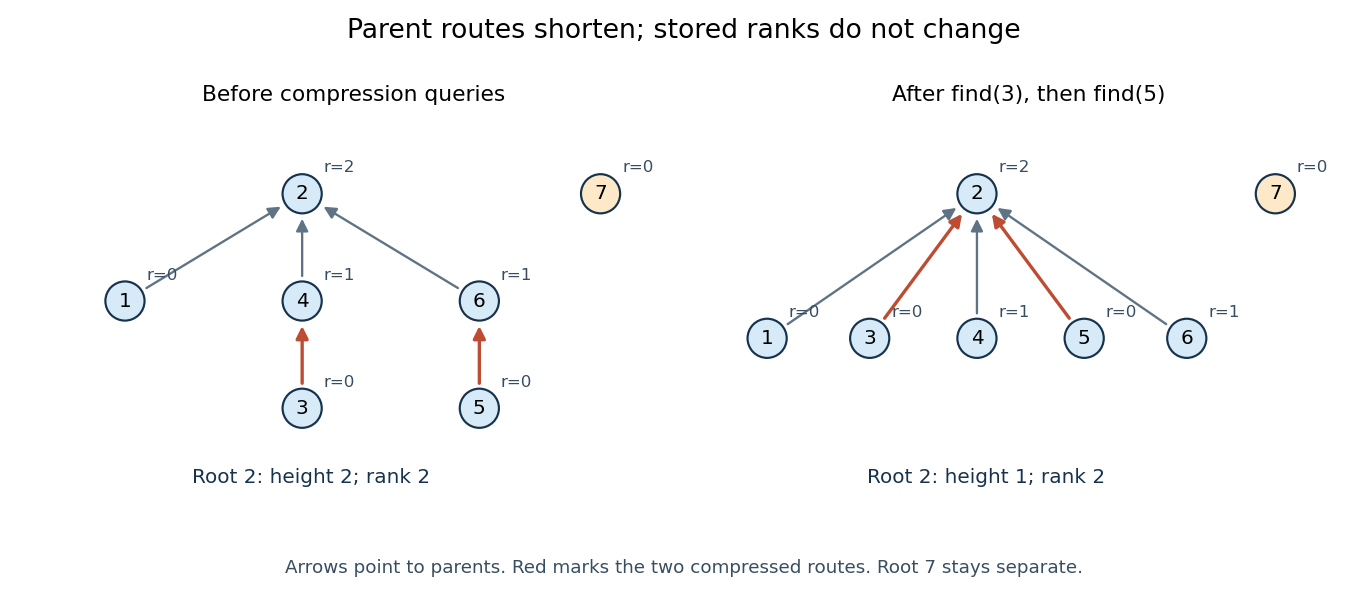
find(3) followed by find(5). Labels record stored ranks, including historical ranks at nonroots. Details.The two-pass algorithm first discovers the answer and then reuses it. During the second pass, saving
following before overwriting the pointer preserves the remaining route. Every replacement pointer targets the original root of a tree, proving that the partition of a set is unchanged.Full path compression is one specific rule. The authored
UF.java implementation instead uses path halving, redirecting a visited member to its parent's parent while advancing along the route. Its union by rank rule agrees with the one above.[ref]UF.java. Algorithms, 4th edition by Robert Sedgewick and others; UF.java, find and union methods: halving assignment versus the full-compression algorithm here; lower-rank linking and equal-rank increment
Union by rank keeps a nonnegative integer rank, initially zero, for each member. For each input, obtain its root of a tree using the disjoint-set find operation, then compare the resulting ranks. Attach the lower-rank root of a tree below the higher-rank root of a tree, leaving both ranks unchanged. When the two disjoint-set representatives differ but their ranks are equal, choose either survivor and increase its rank by exactly one. A redundant disjoint-set union operation changes no ranks. Path compression also changes no ranks. The surviving root's rank bounds the height of its rooted tree, measured in edges; after path compression it need not equal that height.[ref]
COS 226 Bob’s Notes 1: Union-Find and Percolation (Version 2) by Robert Tarjan. Robert Tarjan, COS 226 Bob’s Notes 1: Union-Find and Percolation, Version 2, Fall 2010, p. 4: rank linking, equal-rank increment and upper-bound interpretation after compression
In our example, let the first argument's root of a tree survive equal-rank ties. The first two merges create roots , each of rank . The third gives and increases the rank of to . The fourth creates root of rank . The fifth attaches below without increasing any rank. Before any subsequent compression queries, the indexed arrays areThe redundant call on leaves these arrays unchanged. In particular, the disjoint-set representative of is , although is the minimum member of its block of a set partition.
Two short arguments explain the rank invariant. First, a root of rank has at least members in its block of a set partition: rank zero starts with one, and increasing rank combines two disjoint blocks of a set partition with at least members each. Unequal-rank linking only adds members. Thus every rank is at most for stored members, using the floor function and logarithm. Second, height is initially zero; unequal-rank linking adds at most one to the lower height, while equal-rank linking raises the available bound by one. Path compression only shortens routes. These arguments prove a height bound, not the stronger amortized analysis below.
A harmonic extension of boundary data is a harmonic function satisfying those Dirichlet boundary data in a specified solution class. Existence and uniqueness depend on the domain, the regularity of the data and, on unbounded domains, growth conditions. A Poisson kernel constructs such an extension on standard domains.
In outside the circle with , the displayed bounded harmonic function is zero on the imaginary axis and on the circle. Put . The circle is the Apollonius circle ; its centre and radius are and . The point lies inside the excluded disk and outside the half-plane, so the logarithmic modulus is harmonic throughout the physical domain. Local branches of the complex logarithm suffice; its real part is globally single-valued even though a global complex logarithm need not exist. The potential tends to zero at infinity. A boundedness or far-field condition is needed to infer uniqueness from the finite boundary data. This is also the geometry of cylinder-plane image charges.
Pinned article: Introduction to the OurBigBook Project
Welcome to the OurBigBook Project! Our goal is to create the perfect publishing platform for STEM subjects, and get university-level students to write the best free STEM tutorials ever.
Everyone is welcome to create an account and play with the site: ourbigbook.com/go/register. We belive that students themselves can write amazing tutorials, but teachers are welcome too. You can write about anything you want, it doesn't have to be STEM or even educational. Silly test content is very welcome and you won't be penalized in any way. Just keep it legal!
Intro to OurBigBook
. Source. We have two killer features:
- topics: topics group articles by different users with the same title, e.g. here is the topic for the "Fundamental Theorem of Calculus" ourbigbook.com/go/topic/fundamental-theorem-of-calculusArticles of different users are sorted by upvote within each article page. This feature is a bit like:
- a Wikipedia where each user can have their own version of each article
- a Q&A website like Stack Overflow, where multiple people can give their views on a given topic, and the best ones are sorted by upvote. Except you don't need to wait for someone to ask first, and any topic goes, no matter how narrow or broad
This feature makes it possible for readers to find better explanations of any topic created by other writers. And it allows writers to create an explanation in a place that readers might actually find it.
Figure 1. Screenshot of the "Derivative" topic page. View it live at: ourbigbook.com/go/topic/derivativeVideo 2. OurBigBook Web topics demo. Source. - local editing: you can store all your personal knowledge base content locally in a plaintext markup format that can be edited locally and published either:This way you can be sure that even if OurBigBook.com were to go down one day (which we have no plans to do as it is quite cheap to host!), your content will still be perfectly readable as a static site.
- to OurBigBook.com to get awesome multi-user features like topics and likes
- as HTML files to a static website, which you can host yourself for free on many external providers like GitHub Pages, and remain in full control

Figure 2. You can publish local OurBigBook lightweight markup files to either OurBigBook.com or as a static website.
Figure 3. Visual Studio Code extension installation.
Figure 5. . You can also edit articles on the Web editor without installing anything locally. Video 3. Edit locally and publish demo. Source. This shows editing OurBigBook Markup and publishing it using the Visual Studio Code extension. 
- Infinitely deep tables of contents:




All our software is open source and hosted at: github.com/ourbigbook/ourbigbook
Further documentation can be found at: docs.ourbigbook.com
Feel free to reach our to us for any help or suggestions: docs.ourbigbook.com/#contact