Topics (384k) Articles (398k) Users (410) Discussions (242) Comments (383) Files (13k) New article

Particle identification assigns a species hypothesis to a detector signal or reconstructed track. Curvature in a magnetic field supplies magnetic rigidity; additional responses, such as those of a Cherenkov detector or a particle shower, help distinguish an electron from a hadron. The identity hypothesis enters the energy–momentum relation and therefore the reconstructed invariant mass. An apparatus can observe a peak before it can identify every decay channel, as the SPEAR psi energy-scan experiment illustrates.
The reconstructed location at which a particle decays, inferred from the trajectories of its decay products. Comparing two decay vertices can determine a decay-time difference when the motion of the parent system is known.
Inferring a quark flavor from the charges and identities of observed decay products. A mistaken assignment dilutes a flavour-dependent decay rate difference.
A transition-edge sensor detects deposited energy using the strong change in electrical resistance near a superconducting transition temperature.
A microorganism is an organism too small to study in ordinary detail without magnification. The category includes members of different evolutionary lineages, including bacteria and many members of the fungus group; it describes scale rather than one natural taxonomic group.
Nuclear fission splits an atomic nucleus into two major fragments, usually accompanied by emitted neutrons and gamma rays. It can follow neutron absorption or occur spontaneously in some heavy nuclides. When the products have greater total nuclear binding energy, the decrease in rest energy supplies fragment kinetic energy and radiation.
The fragments are often neutron-rich and undergo subsequent beta decay, producing an evolving inventory of fission products. Some emitted neutrons can cause further nuclear fission, enabling a nuclear chain reaction; others are absorbed without fission or escape.
The discovery combined chemical and physical evidence. Otto Hahn and Fritz Strassmann identified barium among products of neutron-irradiated uranium, rather than merely an adjacent heavy element. Lise Meitner and Otto Robert Frisch interpreted this as division of the atomic nucleus and estimated the large released energy from mass differences. Chemical separation identified the unexpected product: the same procedure could separate a radium isotope from barium, whereas the new radioactive activity followed barium. This chemical comparison did not by itself measure every fragment's motion.[ref]
Disintegration of Uranium by Neutrons: a New Type of Nuclear Reaction by Lise Meitner and Otto Robert Frisch. Opening barium discussion and mass-defect interpretation, Nature 143, pp. 239–240
The mean orientation of nuclear spin angular momentum in a chosen direction. For nuclei with nonzero spin quantum number , the vector-polarization component is and lies between and . Equal populations of all projections give ; complete alignment gives .
Nuclear symmetry energy is the energy cost associated with proton-neutron imbalance in nuclear matter or finite nuclei. A finite-nucleus semi-empirical mass formula includes the positive asymmetry term . The Pauli exclusion principle and strong-interaction dynamics both contribute.
A spin echo is a reappearance of transverse magnetization after a pulse sequence reverses an earlier spread of phases. An ensemble can have almost no net transverse magnetization while its components retain enough individual phase memory to reassemble. In the ideal Hahn echo below, a short 90° pulse prepares transverse magnetization, a 180° pulse follows after time , and the signal refocuses at . The receiver observes freely precessing magnetization, as in free induction decay; no third driving pulse is needed at the echo time.
The useful distinction is between cancellation in an ensemble average and loss of recoverable phase memory. A static spread of Larmor precession frequencies can make free induction decay much faster than transverse nuclear magnetization decay. A spin echo can remove that static spread from the echo amplitude, allowing a more selective measurement of transverse relaxation. It does not in general reverse noise, population relaxation, or every interaction between spins.
For constant drive, set the three rotating frame derivatives to zero. Substitution first gives , then , henceThe absorption is proportional to . With , its frequency dependence is a Cauchy distribution profile, often called a Lorentzian. With appreciable , the response broadens and on resonance: nuclear magnetic resonance saturation limits the response. The short-pulse amplitude in the previous example is not a weak continuous drive; these are different operating regimes of the same equations.
Free induction decay is a receiving signal from freely precessing transverse magnetization after excitation ends. Faraday's law of induction gives coil voltage proportional to the time derivative of linked magnetic flux, with sign set by the winding. At its envelope follows the transverse magnetization; a fixed receiver phase can absorb the derivative's near-quadrature shift. We define the calibrated complex signal below to represent magnetization, not raw coil voltage.
For an original teaching model, take positive , a circular drive , and axes rotating at about . Define , , and . The Bloch equations becomeA linearly oscillating field of peak amplitude has a co-rotating component of amplitude ; neglecting its counter-rotating component requires near resonance.
At resonance, a short pulse starting from gives with , neglecting relaxation during duration . A receiver phase rotation can make a pulse's initial transverse signal real. After the pulse, direct integration givesThese are the two components extracted by quadrature demodulation. Differentiating verifies ; taking its magnitude separates decay from detuning.
Choose rounded illustrative , , , and . Then and the duration is , short relative to both relaxation times. For receiver detuning and , and . These are calculated examples, not 1946 measurements.
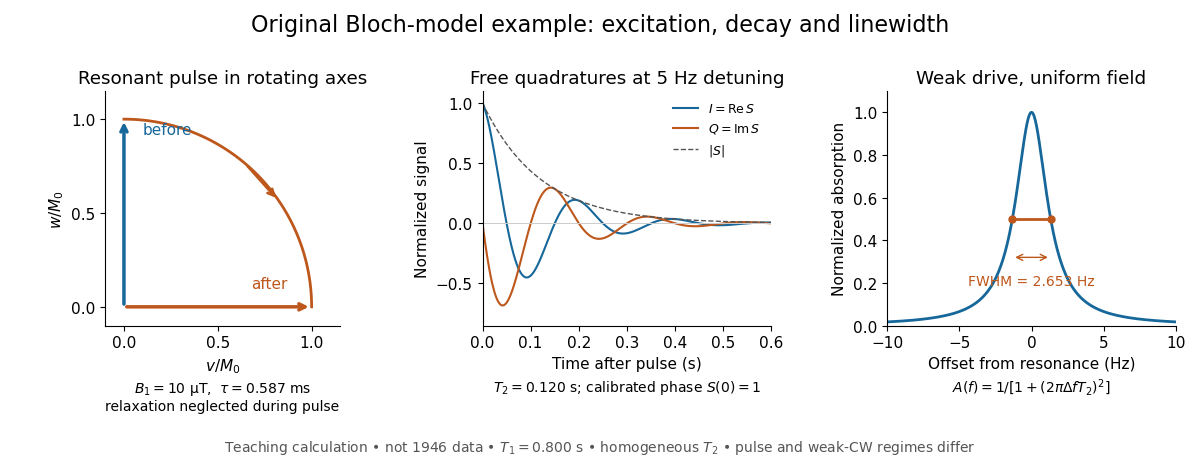
The Bloch equations describe an ensemble magnetization with Larmor precession plus phenomenological recovery and decay:Here are model parameters, not a microscopic explanation of relaxation. The precession term follows from the torque on a magnetic moment; the two dissipative terms prescribe exponential decay. Bloch explicitly introduced this macroscopic relaxation description as a simplifying approximation.[ref]
Nuclear Induction by Felix Bloch. §4, pp. 467–468, equations (32), (37) and (38): longitudinal recovery and assumed exponential transverse decay
For positive and no transverse drive, rotates as : its signed rotation is negative about , although the resonance angular frequency is positive. This distinction prevents a hidden sign change when choosing a rotating frame.
Edward Mills Purcell, Henry Cutler Torrey, and Robert Vivian Pound placed paraffin wax in a capacitively loaded coaxial cavity near 30 MHz between magnet poles. Coupling loops supplied and extracted power; oscillating and steady fields were perpendicular. Output balanced against a generator reference fed amplification, detection and a microammeter. A slow field sweep revealed absorption above fluctuations at room temperature. Weak drive avoided population equalization. Calibration was rough; field inhomogeneity could contribute to linewidth.[ref]
Resonance Absorption by Nuclear Magnetic Moments in a Solid by Edward Mills Purcell and others. pp. 37–38, apparatus and results; weak drive, balanced cavity output, microammeter, field sweep, calibration and linewidth limitations
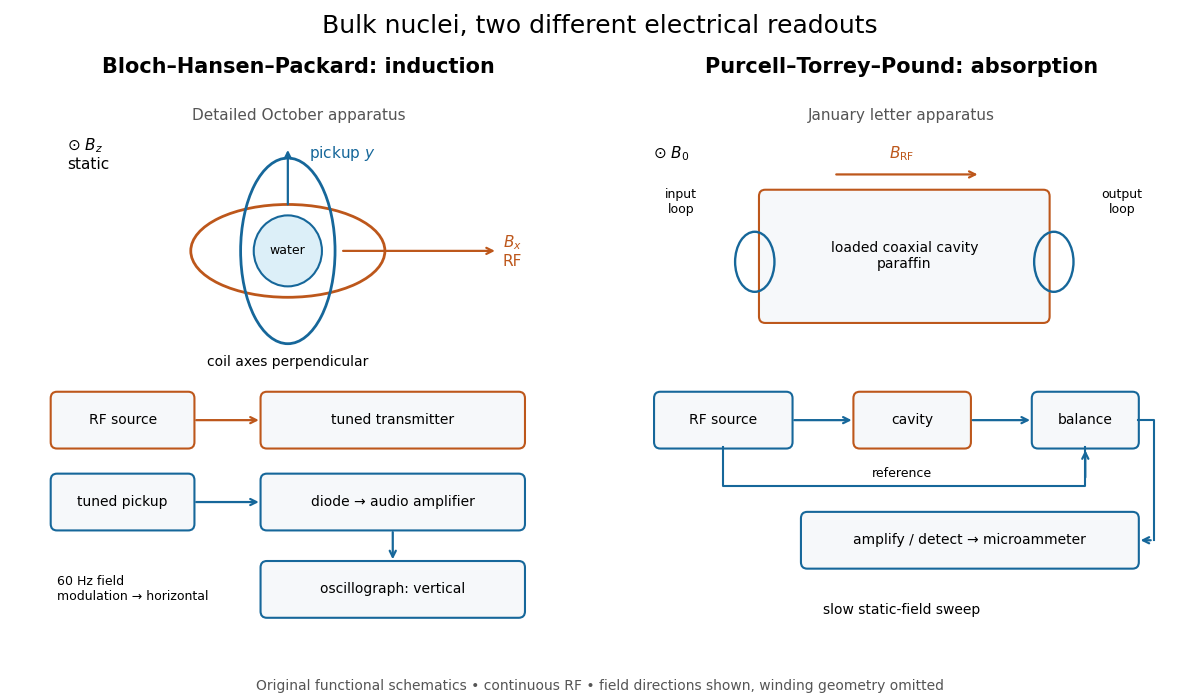
Two electrical routes to bulk nuclear magnetic resonance
. Original functional diagrams of the distinct instruments described above. Arrows show connections and field directions, not scale or winding geometry. Details.These are driven experiments with continuous radiofrequency excitation and changing static field, not demonstrations of modern pulsed Fourier transform nuclear magnetic resonance. Bloch's theoretical paper explicitly distinguishes proposed free precession after a pulse from the forced precession actually studied.[ref]
Nuclear Induction by Felix Bloch. pp. 460–461, introduction: proposed pulse/free-precession experiment versus performed forced-precession experiment
An experimental failure need not mean absent nuclear magnetic moments. In the model below, excessive drive reduces the population imbalance through nuclear magnetic resonance saturation; waiting too briefly can leave insufficient polarization. Separately, ordinary electrical losses can cause heating without identifying a nuclear resonance. The absorption experiment measured a balanced electrical signal, rather than using heating as its readout. Useful diagnostic checks include moving off resonance, changing the frequency, checking field uniformity and reducing drive. These are general checks; the historical operations actually documented are specified above.
In their 1946 letter, Felix Bloch, William Webster Hansen, and Martin Packard reported water at room temperature. A steady magnetic field along and an oscillating field along produced a signal in a pickup coil along , displayed on an oscilloscope. Some samples included paramagnetic additives to accelerate thermal equilibrium. Resonance fields at two frequencies gave the same field-to-frequency ratio, consistent with the proton value.[ref]
Nuclear Induction by Felix Bloch and others. p. 127, Nuclear Induction, entire letter; geometry, water, additives, readout and two-frequency check
The detailed paper describes glass water bulbs inside tuned receiving coils. Transmitter coils, shields and a conducting paddle controlled leakage. Field modulation at 60 Hz drove the horizontal oscilloscope sweep. A diode and audio amplification supplied the vertical trace. Vibration changed coupling: their largest difficulty. Coil tuning capacitors formed tank circuits. The actual receiver omitted the conceptual diagram's radiofrequency amplifier.[ref]
The Nuclear Induction Experiment by Felix Bloch and others. pp. 475–480, Figs. 1–4, APPARATUS and opening RESULTS; actual diode receiver versus conceptual amplifier
The orthogonal coil axes suppress direct transmitter pickup, but do not eliminate it. A field-dependent signal at the nuclear resonance must be distinguished from leakage and noise; merely detecting a radiofrequency voltage is insufficient. This is why the field sweep and the independently checked field-to-frequency ratio matter.
The molecular mass is the mass of a molecule; relative molecular mass compares it with a reference mass.
The mass fraction of component in a mixture is . It is dimensionless, lies between zero and one, and the component mass fractions sum to one when all material is included.
For example, a mixture containing grams of solute and grams of solvent has solute mass fraction , or five percent by mass. This differs from a mole fraction, which counts amounts of substance, and from a mass-per-volume concentration. A temperature-dependent volume change does not by itself change the mass fraction of a closed sample.
A colloid contains dispersed particles in a continuous medium. A fine particle suspension can form a colloid; the particles in the Perrin sedimentation experiment illustrate this case.
A unit of measurement is a chosen reference for comparing magnitudes of a physical quantity. A value written as a number times a measurement unit changes its numerical part when the measurement unit changes, while representing the same physical quantity.
Measurement resolution is the smallest change in an instrument indication that its reading method can distinguish. It contributes to measurement uncertainty, but does not by itself establish accuracy or remove systematic error. The manometer height-to-pressure calibration shows how a height scale affects the inferred pressure.
Measurement of length and geometrical dimensions. A length standard supplies a reference; a differential length comparator measures the difference between two lengths rather than treating its own structure as perfectly invariant.
Pinned article: Introduction to the OurBigBook Project
Welcome to the OurBigBook Project! Our goal is to create the perfect publishing platform for STEM subjects, and get university-level students to write the best free STEM tutorials ever.
Everyone is welcome to create an account and play with the site: ourbigbook.com/go/register. We belive that students themselves can write amazing tutorials, but teachers are welcome too. You can write about anything you want, it doesn't have to be STEM or even educational. Silly test content is very welcome and you won't be penalized in any way. Just keep it legal!
Intro to OurBigBook
. Source. We have two killer features:
- topics: topics group articles by different users with the same title, e.g. here is the topic for the "Fundamental Theorem of Calculus" ourbigbook.com/go/topic/fundamental-theorem-of-calculusArticles of different users are sorted by upvote within each article page. This feature is a bit like:
- a Wikipedia where each user can have their own version of each article
- a Q&A website like Stack Overflow, where multiple people can give their views on a given topic, and the best ones are sorted by upvote. Except you don't need to wait for someone to ask first, and any topic goes, no matter how narrow or broad
This feature makes it possible for readers to find better explanations of any topic created by other writers. And it allows writers to create an explanation in a place that readers might actually find it.
Figure 1. Screenshot of the "Derivative" topic page. View it live at: ourbigbook.com/go/topic/derivativeVideo 2. OurBigBook Web topics demo. Source. - local editing: you can store all your personal knowledge base content locally in a plaintext markup format that can be edited locally and published either:This way you can be sure that even if OurBigBook.com were to go down one day (which we have no plans to do as it is quite cheap to host!), your content will still be perfectly readable as a static site.
- to OurBigBook.com to get awesome multi-user features like topics and likes
- as HTML files to a static website, which you can host yourself for free on many external providers like GitHub Pages, and remain in full control

Figure 2. You can publish local OurBigBook lightweight markup files to either OurBigBook.com or as a static website.
Figure 3. Visual Studio Code extension installation.
Figure 5. . You can also edit articles on the Web editor without installing anything locally. Video 3. Edit locally and publish demo. Source. This shows editing OurBigBook Markup and publishing it using the Visual Studio Code extension. 
- Infinitely deep tables of contents:




All our software is open source and hosted at: github.com/ourbigbook/ourbigbook
Further documentation can be found at: docs.ourbigbook.com
Feel free to reach our to us for any help or suggestions: docs.ourbigbook.com/#contact