Topics (384k) Articles (398k) Users (410) Discussions (242) Comments (383) Files (13k) New article

Edward W. Morley and Albert A. Michelson tested whether the orientation of an interferometer revealed motion through the proposed luminiferous aether. Perpendicular optical paths were recombined to form interference fringes; rotating the instrument tested for the predicted change in their relative travel times. The measured shift was much smaller than the prediction based on a stationary luminiferous aether and the Earth's orbital motion. The experiment constrained that model through a differential optical measurement, rather than directly timing a single light pulse.[ref]
On the Relative Motion of the Earth and the Luminiferous Ether by Albert Abraham Michelson and Edward W. Morley. 1887 report, perpendicular paths, rotation and comparison of measured with predicted fringe displacements

Portrait of Edward W. Morley
. Photographer not identified; portrait of Edward Williams Morley in 1887; source University of Maryland aether-drift page. Public domain in the United States as asserted by Commons. Source usage terms, via Wikimedia Commons. Source.An experimental nuclear physicist who, with Hans Geiger, related the range of emitted alpha particles to a radioactive substance's transformation period. The Geiger-Nuttall law connects the particle's escape energy with the enormous variation in alpha decay lifetimes. It began as an empirical correlation, before quantum tunnelling supplied a mechanism for nuclear escape.[ref]
The ranges of the alpha particles from various radioactive substances and a relation between range and period of transformation by Hans Geiger and John Mitchell Nuttall. Original title and range–transformation-period relation, pp. 613–621
Photoelectron spectroscopy measures the kinetic energies of photoelectrons produced by illuminating matter with photons of known energy. The photoelectric effect supplies the emission mechanism; spectroscopy turns the distribution of emitted electron energies into information about occupied energy levels and chemical bonds. A broad survey helps identify chemical elements, while small shifts within one element's lines can distinguish different chemical surroundings. These are different questions: finding carbon does not establish which chemical bonds its chemical atoms form.
The useful inversion is an energy balance. A known incoming photon energy pays for removal of an electron and for its outgoing kinetic energy. To apply that balance to a solid, specify the zero of energy and the work function of the instrument. Photoelectron binding energy reference derives the conversion for a conducting sample in electrical contact with its analyzer. A free molecule instead has an ionization energy referenced to an electron at rest in vacuum; it need not share a Fermi level with the analyzer.
Absorption takes a chemical substance into a material's bulk, as when carbon dioxide dissolves in water. Adsorption instead concerns accumulation at a boundary. Bulk uptake and interfacial accumulation can coexist; total uptake alone does not separate their contributions. This use of absorption concerns material uptake, whereas absorbance describes attenuation of electromagnetic radiation.
Chemical thermodynamics studies energy, entropy, and equilibrium in chemical systems. At fixed temperature and pressure, the direction of spontaneous change is constrained by Gibbs free energy, and equilibrium corresponds to an appropriate minimum subject to the system's conserved quantities.
For a reaction, , where is the reaction quotient. Setting gives for the dimensionless equilibrium constant. This connects measurable composition with free energy. It does not determine the reaction rate, which also depends on the accessible pathway and its activation barriers.
Electrophoresis is motion of charged dispersed species relative to a surrounding medium under an applied electric field. The drift depends on electrical driving and friction, including the surrounding ionic atmosphere. Gel electrophoresis adds a porous matrix that makes migration sensitive to molecular size and conformation.
A nuclear emulsion is a photographic emulsion prepared for recording charged particles. The sensitive material serves as both target and record: a particle may slow, stop, decay or cause a nuclear reaction inside it. Reading that record requires track reconstruction, not recognizing a miniature picture of a particle. Unlike a cloud chamber photograph, the exposed nuclear emulsion itself retains the record until it is developed and examined.
A developed grain is a visible deposit of silver produced during photographic processing. The chain of developed grains in a nuclear emulsion records interactions along a charged particle's path. Its width is a property of the recording and viewing process, not a measurement of the particle's diameter.
A latent image is the pattern of exposure-induced changes in a photographic emulsion before photographic processing makes it visible. A missing visible mark before development therefore says nothing about whether a charged particle passed through the coating.
A particle number counts the particles of a specified kind in a system. For a fixed collection, is a nonnegative integer. In a variable-number quantum system, distinguish a measured particle number, the particle number operator, and its expected value.
Choose the beam as the direction. A particle's transverse momentum is its momentum projected onto the perpendicular plane; . A Lorentz boost along the beam changes energy and longitudinal momentum, while leaving transverse momentum unchanged. Large transverse momentum identifies motion substantially across the beam rather than merely along it.
A W boson decay can leave one visible charged lepton and a large missing transverse momentum; a Z boson decay can instead supply two visible leptons whose four-momenta determine an invariant mass. The two signatures answer the same existence question with different missing information. The electroweak unification history recognized by the 1979 Nobel Prize in Physics predates these 1983 observations: the W boson and Z boson were predictions to test, rather than particles first proposed in 1983.
The Super Proton-Antiproton Synchrotron stored counterrotating proton and antiproton beams; stochastic cooling made accumulation of the scarce antiprotons practical. Carlo Rubbia's 1984 lecture describes track reconstruction in a large drift chamber inside a magnetic field, surrounded by segmented particle calorimeters. Their nearly complete angular coverage allowed an imbalance test for unobserved neutrinos.[ref]
A particle range is the distance a charged particle travels through a specified material before stopping; it depends on kinetic energy, particle identity, and the material.
In 1974, Samuel Chao Chung Ting's Brookhaven team and Burton Richter's SPEAR team independently found the narrow state now called the J/psi meson. Each discovery paper notes learning of the other result during manuscript preparation.[ref]
Experimental Observation of a Heavy Particle J by J. J. Aubert. Aubert and others, p. 1406, note 5: independent SPEAR result
[ref]Discovery of a Narrow Resonance in e+e- Annihilation by J.-E. Augustin. Augustin and others, p. 1408, note 3: independent Brookhaven result
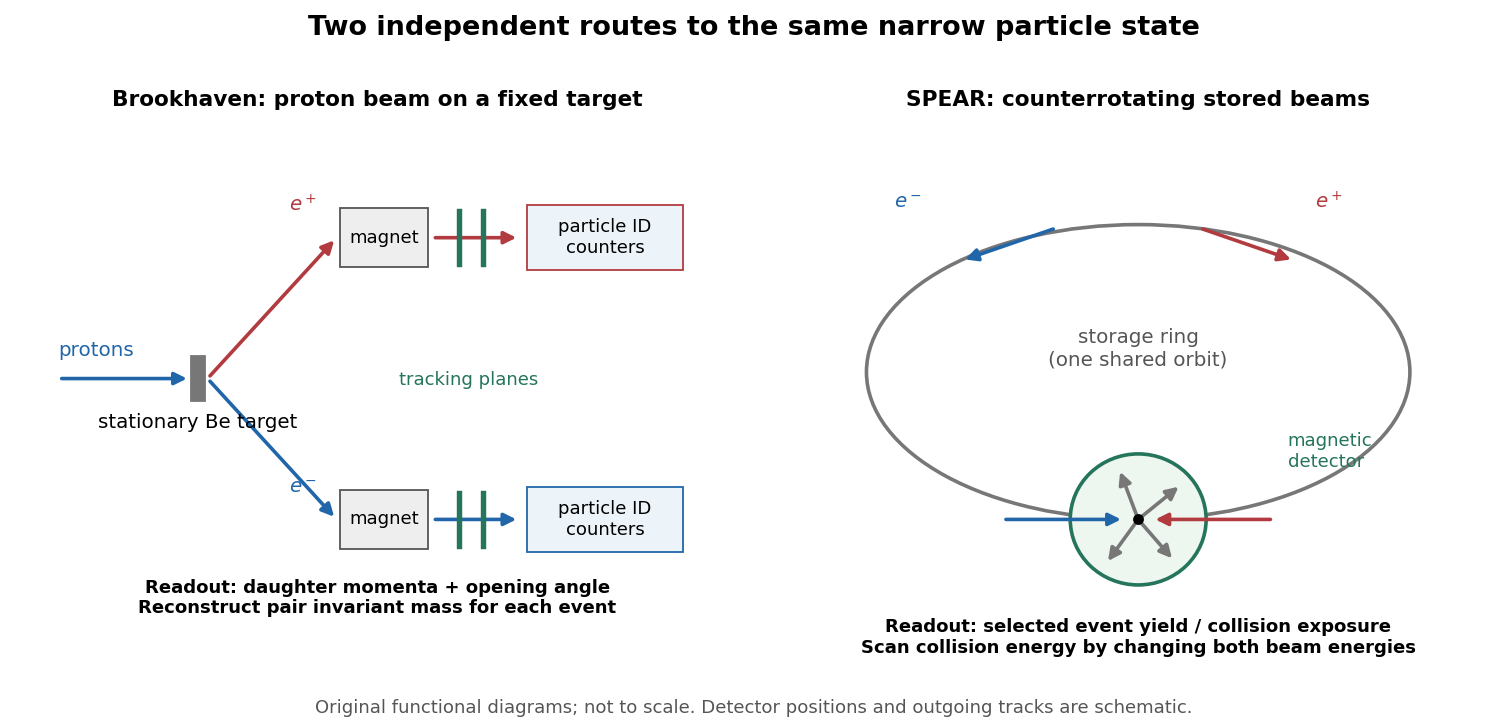
The common question was whether the observed excess represented a new particle resonance, rather than a peculiarity of particle identification, acceptance or calibration. The important difference was the horizontal coordinate of the search: Brookhaven reconstructed a final-state invariant mass; SPEAR scanned an initial-state center-of-mass energy. The invariant-mass selection of bubble-chamber events uses the first kind of reasoning, despite a very different recording medium.
A cascade producing multiple secondary particles from an initial energetic interaction. Its observed multiplicity depends on which particles reach the detector and on detection efficiency.
Inferring a particle trajectory from recorded detector positions or a continuous trail. The inferred trajectory depends on spatial resolution, detector geometry and the assumed particle-motion model; it is not a direct picture of the particle itself.
Pinned article: Introduction to the OurBigBook Project
Welcome to the OurBigBook Project! Our goal is to create the perfect publishing platform for STEM subjects, and get university-level students to write the best free STEM tutorials ever.
Everyone is welcome to create an account and play with the site: ourbigbook.com/go/register. We belive that students themselves can write amazing tutorials, but teachers are welcome too. You can write about anything you want, it doesn't have to be STEM or even educational. Silly test content is very welcome and you won't be penalized in any way. Just keep it legal!
Intro to OurBigBook
. Source. We have two killer features:
- topics: topics group articles by different users with the same title, e.g. here is the topic for the "Fundamental Theorem of Calculus" ourbigbook.com/go/topic/fundamental-theorem-of-calculusArticles of different users are sorted by upvote within each article page. This feature is a bit like:
- a Wikipedia where each user can have their own version of each article
- a Q&A website like Stack Overflow, where multiple people can give their views on a given topic, and the best ones are sorted by upvote. Except you don't need to wait for someone to ask first, and any topic goes, no matter how narrow or broad
This feature makes it possible for readers to find better explanations of any topic created by other writers. And it allows writers to create an explanation in a place that readers might actually find it.
Figure 1. Screenshot of the "Derivative" topic page. View it live at: ourbigbook.com/go/topic/derivativeVideo 2. OurBigBook Web topics demo. Source. - local editing: you can store all your personal knowledge base content locally in a plaintext markup format that can be edited locally and published either:This way you can be sure that even if OurBigBook.com were to go down one day (which we have no plans to do as it is quite cheap to host!), your content will still be perfectly readable as a static site.
- to OurBigBook.com to get awesome multi-user features like topics and likes
- as HTML files to a static website, which you can host yourself for free on many external providers like GitHub Pages, and remain in full control

Figure 2. You can publish local OurBigBook lightweight markup files to either OurBigBook.com or as a static website.
Figure 3. Visual Studio Code extension installation.
Figure 5. . You can also edit articles on the Web editor without installing anything locally. Video 3. Edit locally and publish demo. Source. This shows editing OurBigBook Markup and publishing it using the Visual Studio Code extension. 
- Infinitely deep tables of contents:




All our software is open source and hosted at: github.com/ourbigbook/ourbigbook
Further documentation can be found at: docs.ourbigbook.com
Feel free to reach our to us for any help or suggestions: docs.ourbigbook.com/#contact