Topics (384k) Articles (398k) Users (410) Discussions (242) Comments (383) Files (13k) New article

Nearest-neighbor interpolation assigns each requested location the value of its nearest available sample, with a specified convention for ties. In lossy block averaging, samples are placed at block centres and each is copied into its four original pixel positions. This enlarges the raster image without recovering discarded detail.
Quantization maps numerical values to a specified discrete collection of representable values. In lossy block averaging, maps block arithmetic means in to eight-bit integers. Thus and . Different means can share a stored value, making this step irreversible.
A universal hash family is a finite collection of hash functions into an output set of size such that, for any fixed distinct inputs ,The choice of uses the uniform distribution on a finite set. The keys are fixed before that choice: the randomness belongs to the hash function, so the guarantee does not assume naturally random keys. Choose one member and keep it while using the table; changing it requires redistributing the stored records. The bound holds separately for every distinct pair, without requiring uniform individual outputs or independent random variables. A strongly universal hash family supplies those stronger properties.
The practical payoff follows from linearity of expectation. If stored keys are distinct from a fixed query, let count how many share its bucket. Then : each key contributes at most to the expected value. With stored keys and buckets, an unsuccessful search encounters at most one record on average over the random choice of hash function. This is an expected value, not a limit on every search; one unlucky choice can still create a long chain.
This calculation needs no independence between the collision events: linearity of expectation adds their individual probabilities. The fixed-query condition matters, since deliberately choosing keys after inspecting the selected hash function can target a crowded bucket.
Carter and Wegman introduced this way of analyzing storage and retrieval in their 1977 paper: average over a chosen class of hash functions while allowing any fixed sequence of inputs. Their 1979 journal version develops the same universal-pair collision condition and constructions. The insight is useful because a randomized algorithm can obtain a performance guarantee through its own choices, even when its inputs have inconvenient patterns.[ref]
https://dl.acm.org/doi/10.1145/800105.803400. Carter and Wegman, Universal classes of hash functions, STOC 1977
[ref]https://www.cs.princeton.edu/courses/archive/fall09/cos521/Handouts/universalclasses.pdf. Carter and Wegman, Universal Classes of Hash Functions, 1979
An almost strongly universal hash family relaxes the exact ordered pair balance of a strongly universal hash family. In the convention used here, choose with the uniform distribution on a finite set from a family with possible outputs. Every individual output remains uniform, and for every distinct pair of inputs and every specified ordered pair of outputs ,Equivalently, the conditional probability is at most . This asks how predictable a second output can become after the first is known.
For , strongly universal hash families give : learning one output leaves each specified second output with conditional probability . A looser guarantee permits a specified ordered pair to have probability as large as , while each individual output still has probability . Summing over the five equal ordered pairs bounds the collision probability by , rather than the required of a universal hash family. Thus an almost strongly universal hash family need not be a universal hash family. Necessarily , because the conditional probabilities sum to one; equality recovers a strongly universal hash family. This relaxation is useful in Wegman–Carter authentication, where efficiency can be traded against a quantified forgery bound within a complete message authentication protocol.
A hash collision is a function collision of a hash function : two distinct inputs have the same output, . Repeating the same input is not a hash collision. Unequal hash values prove the keys differ; equal hash values only identify candidates that might be equal. This makes a hash function useful as a compact filter before comparing the original data.
Here is a deliberately simple example using modular arithmetic. Let for nonnegative integer keys, and let a four-bucket hash table use the further bucket index . For keys , the hash values are , while all three bucket indices are . Thus and form a hash collision for ; and share a table bucket even though their full hash values differ. Always specify which function is being compared: a table collision concerns the bucket-index function, which may discard more information than the original hash function.
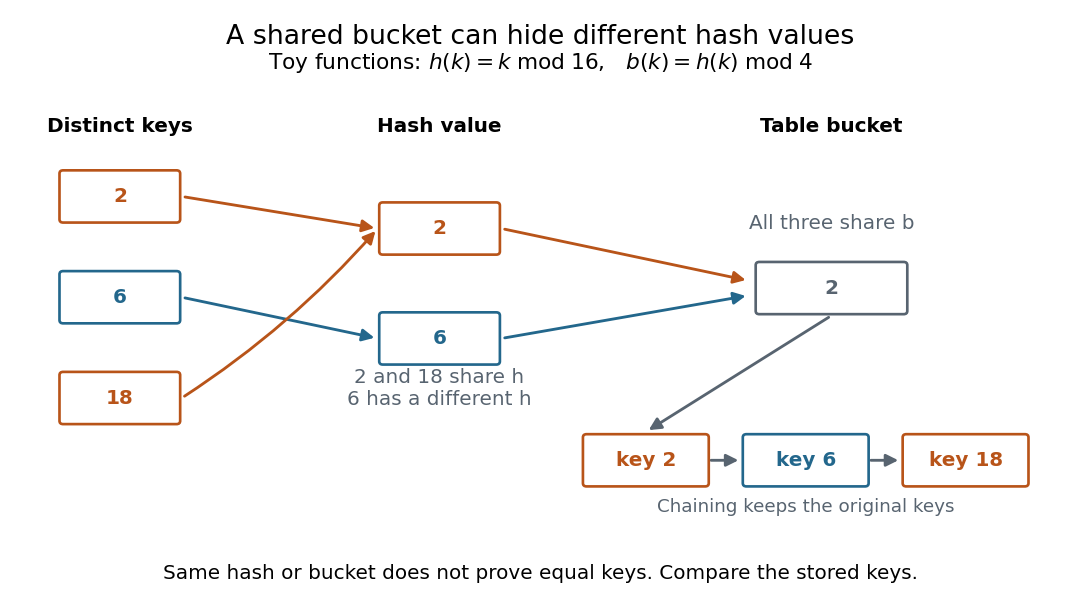
With separate chaining, bucket holds all three records in a linked list. A search for visits that bucket and compares the stored keys until it finds ; a search for visits the same bucket but rejects every stored key. A hash collision changes the search work, while key comparison preserves correctness. Storing only one record per hash value would incorrectly merge distinct keys. This is the purpose of collision handling in a hash table.[ref]
The pigeonhole principle explains inevitability: if a hash function has only possible outputs, any distinct inputs contain a hash collision. In particular, a function whose domain of a function is larger than its finite codomain cannot be an injective function. This is an existence statement; it gives neither an efficient way to find the pair nor a probability for a smaller collection of keys. A particular small collection might have no hash collision at all.
For a cryptographic hash function, collision resistance asks that finding any two distinct messages with equal full digests be computationally infeasible under the specified model and resources. It does not mean that hash collisions do not exist. Preimage resistance asks a different question: given a target digest , how hard is it to find a message with ? The collision finder may choose both messages and their common digest; the preimage finder is given the digest in advance. These definitions distinguish two search tasks, independently of how a hash table stores records.[ref]
https://nvlpubs.nist.gov/nistpubs/Legacy/SP/nistspecialpublication800-107r1.pdf. Quynh Dang, NIST SP 800-107 Revision 1 (2012), section 3.1 and section 4.1, definitions of collision and preimage resistance
In Newtonian gravity, the gravitational field specifies the acceleration of a freely falling test particle at each position. A gravitational potential gives , with the gradient taken in the spatial geometry of the model. In general relativity, the metric tensor describes gravitational effects, and tidal forces are encoded by spacetime curvature.
Population genetics studies the frequencies of alleles and genotypes in biological populations, and their changes through inheritance, mutation, selection, migration and random sampling. Kingman's coalescent describes a neutral sample's ancestry backward in time.
An allele is one of the alternative inherited states at a genetic locus, often distinguished by a difference in DNA sequence. A population can contain many alleles, although a two-copy diploid individual carries at most two at that genetic locus, one inherited from each parent. See NHGRI: allele.
Count copies, not just individuals, when computing allele frequency: in 100 individuals with genotype counts , , , there are copies of among 200, so . The heterozygotes contribute to both allele counts. This converts observed genotypes into the population quantity needed by the Hardy-Weinberg principle.
A genotype records the inherited alleles carried by an individual at one or more genetic loci. At a two-copy diploid genetic locus with alleles , the possible unordered genotypes are . The first and last are homozygotes; the middle is a heterozygote. The notation records inherited states, without yet asserting their phenotypes. See NHGRI: genotype.
An unordered combines the two parental orders and . This small bookkeeping point explains the factor two in Hardy-Weinberg proportions and in an cross. If parental origin or arrangement across several genetic loci matters, a phase-known genotype retains extra information about the two haplotypes.
A phenotype is an observable characteristic of an organism, arising from its genotype, environment and other influences. Seed shape is a phenotype; is a genotype. The distinction prevents appearance from being mistaken for a complete inherited description. See NHGRI: phenotype.
For a specified binary phenotype , let its penetrance in genotype be . The law of total probability gives . Thus the ideal example has : the familiar follows only when these penetrances are . A pedigree likelihood keeps inheritance and the conditional phenotype model as separate factors.
A pedigree records parent–offspring relationships. A founder in a pedigree has no recorded parents; all other individuals have a genotype conditional on their parental genotypes. Inbreeding can produce loops in the undirected diagram while the directed ancestry remains acyclic.
Genetic recombination rearranges inherited genetic material into new combinations. In the meiosis example considered here, chromosomal crossover exchanges segments between nonsister chromatids of homologous chromosomes. A transmitted chromatid can consequently contain DNA from both parental homologues. This produces new haplotypes without requiring a new mutation at either scored genetic locus. See Meiosis.
For phase-known genotype , a single chromosomal crossover between the selected genetic loci can yield and on the participating chromatids; the other two chromatids can remain and . Thus an exchange in the four-chromatid bundle does not mean every resulting gamete is recombinant. Only a chromosomal crossover encountered along the transmitted chromatid within the selected interval affects its two-locus score.
Follow parental origin along the transmitted chromatid from the first genetic locus to the second. Each exchange switches that origin. An odd number of such chromosomal crossovers changes the endpoint combination; an even number restores parental phase. Two exchanges can therefore leave the scored haplotype as even though an internal segment came from the other parental homologous chromosome. Recombinant status is relative to the chosen genetic loci, not a complete record of exchanges along the chromosome.
This integer parity distinction connects the physical process of genetic recombination to the observed recombination fraction. It also explains why a long genetic map interval can accumulate many exchanges while its endpoint recombination fraction approaches in the Haldane mapping function model.
Why can two individually fair allele transmissions fail to be independent? Genetic loci on the same chromosome can travel together through meiosis. This tendency is genetic linkage; in an ordinary two-locus model, detectable genetic linkage means a recombination fraction below . A genetic marker can therefore help track a neighboring genetic locus through a pedigree. See Clark, Douglas and Choi, Biology 2e: chromosomal theory and genetic linkage.
Take a diploid individual heterozygous at two genetic loci, with phase-known genotype : one homologous chromosome carries alleles , the other . The parental haplotypes are ; the recombinant haplotypes are . Assume fair Mendelian segregation, equal probabilities within each reciprocal pair of gametes, and no allele-dependent differences in gamete recovery. If the recombination fraction is , the gamete probabilities are in that order. Each genetic locus still transmits its two alleles equally, but exceeds : fairness at each genetic locus does not imply independence between genetic loci.
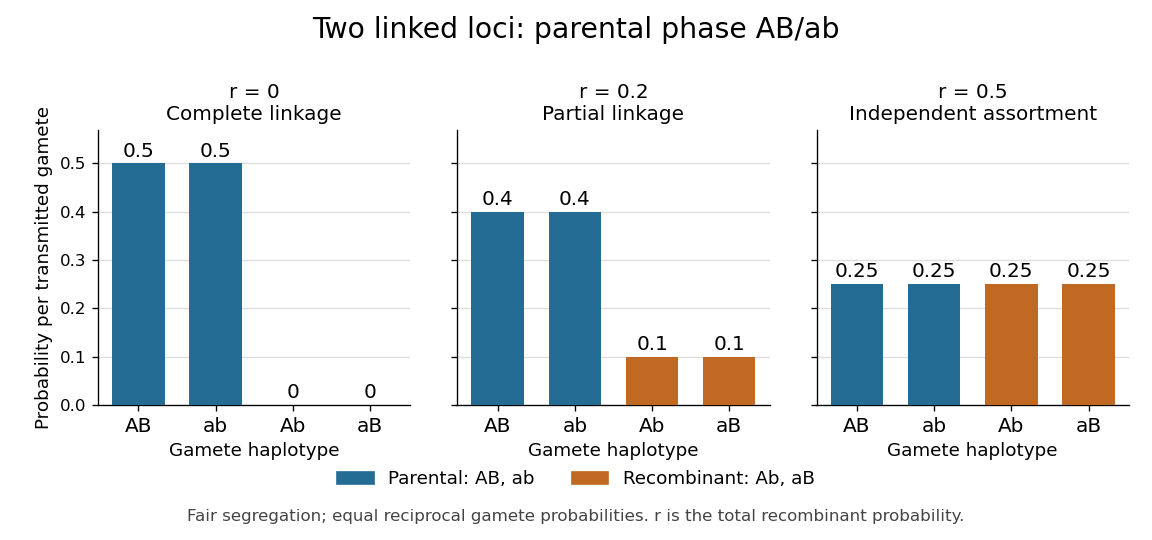
Gamete probabilities from the phase-known genotype AB/ab: parental versus recombinant haplotypes at three recombination fractions
. Details. At , only the parental haplotypes occur, each with probability : this is complete genetic linkage. At , all four haplotypes have probability , giving independent assortment. A recombination fraction near alone cannot establish whether the genetic loci lie on different chromosomes or far apart on one chromosome.
Genetic linkage concerns joint transmission through meiosis. Linkage disequilibrium concerns haplotype frequencies in a population, while genetic association compares allele or genotype frequencies with a phenotype. These questions require different observations; pedigrees directly reveal co-transmission.
A genetic association is a statistical dependence between a genetic variant and a phenotype. An associated marker need not be causal: linkage disequilibrium can correlate it with a causal locus, and population stratification can produce an association without such a link.
Allele copies are identical by descent if they derive from the same specified ancestral copy. Identical observed states need not imply this ancestry. Two diploid individuals are 2-IBD when both of their allele copies can be paired as identical by descent; autozygous individuals carrying two copies of the same ancestral copy are mutually 2-IBD when that ancestor is shared.
A genetic marker is an observed inherited genomic state used to track chromosomes, test genetic association, or perform genetic linkage analysis. Genetic marker alleles need not themselves cause the phenotype. Several genetic markers on one nonrecombining region form a single observed haplotype.
In ordinary diploid meiosis, the two copies at a genetic locus separate: each gamete receives one copy. With fair transmission, a heterozygote produces gametes carrying or with probability each. This is a transmission mechanism conditional on a parental genotype, rather than a statement about how common either allele is in a population.
For the one-locus cross , assume independent parental transmissions, no new mutation, and no differences in fertilization or survival between the resulting genotypes. Multiplying the two gamete probabilities gives four equally likely ordered outcomes: , each with probability . Combining the two orders of the heterozygote givesOnly under the additional ideal model of complete dominance of , complete penetrance, and no environmental changes to the scored characteristic do and share the dominant phenotype. Its probability is then . The inheritance calculation alone does not determine a phenotype or predict a generic disease risk.
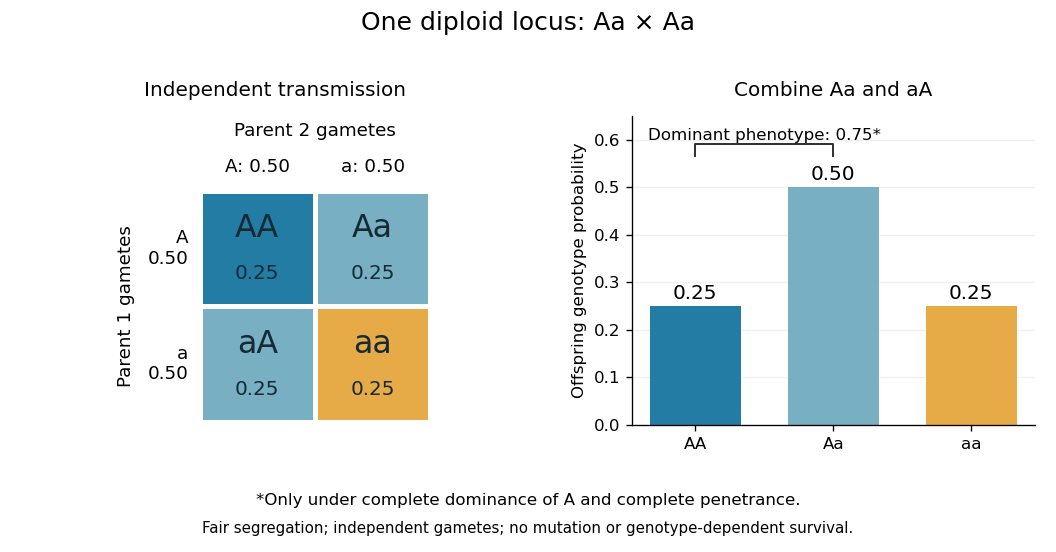
Fair Mendelian transmission in an Aa × Aa cross, with phenotype grouping under complete dominance and penetrance
. Details. These are probabilities, not a requirement that every four offspring contain one , two and one . For 100 independent offspring under the ideal model, the expected values of the three counts are ; the count has a binomial distribution with standard deviation . Each new transmission keeps the same conditional probabilities given the parental genotypes.
In his paper published in 1866, Mendel reported 5,474 round and 1,850 wrinkled pea seeds: round, close to the ideal . Following descendants also distinguished two inherited classes within the round phenotype, illustrating why genotype cannot always be read from appearance.[ref] At several genetic loci, transmission patterns additionally depend on genetic linkage and genetic recombination.
Meiosis reduces two sets of chromosomes to one. In the ordinary diploid life cycle, this makes it possible for fertilization of two haploid gametes to restore the diploid state rather than double the number of sets in every generation. Its two divisions perform different tasks: meiosis I separates homologous chromosomes, whereas meiosis II separates sister chromatids. One round of DNA replication precedes both divisions; there is no second round between them. See [ref]
Molecular Biology of the Cell, 4th edition. Meiosis, “Duplicated Homologous Chromosomes Pair During Meiosis” and “Gametes Are Produced by Two Meiotic Cell Divisions”, Figures 20-6–20-7
.Two homologous chromosomes carry corresponding genetic loci, potentially with different alleles; two sister chromatids originate by DNA replication of one chromosome. After chromosomal crossover between nonsister chromatids, the sister chromatids need not carry identical alleles everywhere. Separating the two relationships explains why a haploid product of meiosis I still contains replicated chromosomes.
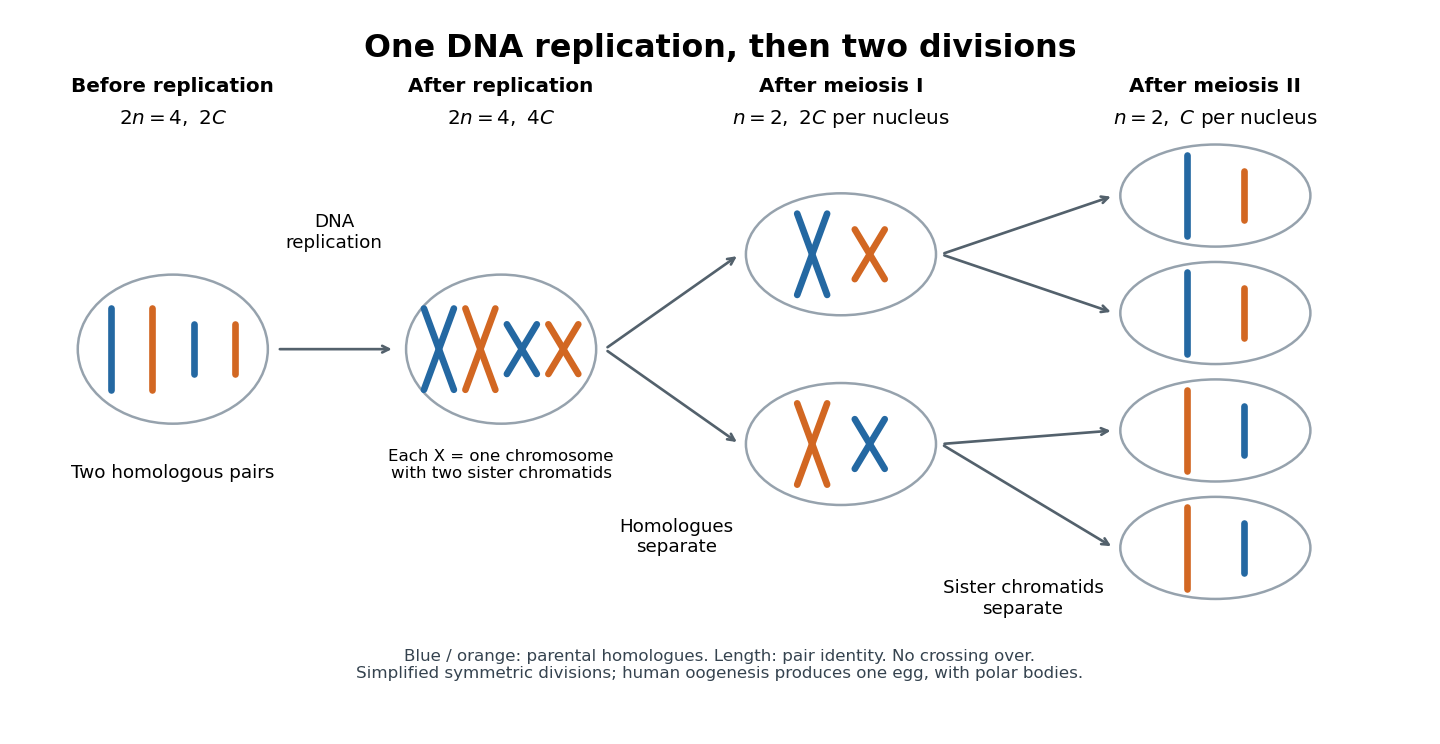
One DNA replication followed by homologous chromosome separation and separation of sister chromatids
. Original simplified model with two homologous chromosome pairs, no chromosomal crossover, and symmetric divisions. The four final compartments represent haploid products, not four functional ova. Human oogenesis uses unequal divisions, retaining most cytoplasm in one developing ovum and producing polar bodies. Details.The two divisions explain Mendelian segregation; variable orientation of different homologous chromosome pairs connects it to independent assortment. Genetic recombination adds another source of allele combinations. These mechanisms reshuffle inherited material without requiring a new mutation.
The symmetric diagram is useful for counting, but human oogenesis produces one functional ovum rather than four. The polar bodies receive discarded chromosomes and little cytoplasm. See Human Reproductive Anatomy and Gametogenesis (§43.3, Oogenesis and Figure 43.13: unequal divisions and polar bodies).
Pinned article: Introduction to the OurBigBook Project
Welcome to the OurBigBook Project! Our goal is to create the perfect publishing platform for STEM subjects, and get university-level students to write the best free STEM tutorials ever.
Everyone is welcome to create an account and play with the site: ourbigbook.com/go/register. We belive that students themselves can write amazing tutorials, but teachers are welcome too. You can write about anything you want, it doesn't have to be STEM or even educational. Silly test content is very welcome and you won't be penalized in any way. Just keep it legal!
Intro to OurBigBook
. Source. We have two killer features:
- topics: topics group articles by different users with the same title, e.g. here is the topic for the "Fundamental Theorem of Calculus" ourbigbook.com/go/topic/fundamental-theorem-of-calculusArticles of different users are sorted by upvote within each article page. This feature is a bit like:
- a Wikipedia where each user can have their own version of each article
- a Q&A website like Stack Overflow, where multiple people can give their views on a given topic, and the best ones are sorted by upvote. Except you don't need to wait for someone to ask first, and any topic goes, no matter how narrow or broad
This feature makes it possible for readers to find better explanations of any topic created by other writers. And it allows writers to create an explanation in a place that readers might actually find it.
Figure 1. Screenshot of the "Derivative" topic page. View it live at: ourbigbook.com/go/topic/derivativeVideo 2. OurBigBook Web topics demo. Source. - local editing: you can store all your personal knowledge base content locally in a plaintext markup format that can be edited locally and published either:This way you can be sure that even if OurBigBook.com were to go down one day (which we have no plans to do as it is quite cheap to host!), your content will still be perfectly readable as a static site.
- to OurBigBook.com to get awesome multi-user features like topics and likes
- as HTML files to a static website, which you can host yourself for free on many external providers like GitHub Pages, and remain in full control

Figure 2. You can publish local OurBigBook lightweight markup files to either OurBigBook.com or as a static website.
Figure 3. Visual Studio Code extension installation.
Figure 5. . You can also edit articles on the Web editor without installing anything locally. Video 3. Edit locally and publish demo. Source. This shows editing OurBigBook Markup and publishing it using the Visual Studio Code extension. 
- Infinitely deep tables of contents:




All our software is open source and hosted at: github.com/ourbigbook/ourbigbook
Further documentation can be found at: docs.ourbigbook.com
Feel free to reach our to us for any help or suggestions: docs.ourbigbook.com/#contact