Topics (384k) Articles (398k) Users (410) Discussions (242) Comments (383) Files (13k) New article

Pierre Wantzel proved impossibility results for straightedge and compass constructions, including general angle trisection and doubling the cube. His 1837 work translated geometric constructions into restrictions on algebraic numbers.
Each permitted construction extends the coordinate field by at most a square root. Constructing a number of irreducible degree three over the rationals therefore cannot be achieved by such a tower of quadratic extensions. This explains why failure to find a construction can have a structural mathematical cause rather than merely reflecting lack of ingenuity.[ref]
https://mathshistory.st-andrews.ac.uk/Biographies/Wantzel/. Biography, 1837 construction paper and impossibility results
Nicomachus was an ancient writer on arithmetic and musical theory whose Introduction to Arithmetic strongly influenced later teaching about numbers. His work treats classifications such as odd numbers, even numbers, perfect numbers and figurate patterns, largely through statements and numerical examples. His life is known only imperfectly from surviving references.[ref]
https://mathshistory.st-andrews.ac.uk/Biographies/Nicomachus/. Biography, dating and Introduction to Arithmetic
The work also illustrates a lasting mathematical caution: several attractive generalizations drawn from a few examples were false. A pattern seen in the first several numbers can suggest a conjecture, but establishing a universal statement requires a proof, and one counterexample is enough to disprove it.
Portrait of Nicomachus
. Unknown medieval artist; German Wikipedia, Datei:Nikomachos von Gerasa.jpeg. Public domain artwork and faithful reproduction (PD-Art / life-plus-70); Public Domain Mark. Source and usage information on the linked Wikimedia file page. Source.William Thurston was a mathematician who transformed the study of three-dimensional manifolds by connecting topology with geometry, especially hyperbolic geometry. His work showed that geometric structures could organize broad classes of spaces previously approached mainly through topological constructions. He received the Fields Medal in 1982 for work in low-dimensional topology.[ref]
https://news.cornell.edu/stories/2012/08/mathematics-innovator-william-thurston-dies-65. Cornell institutional obituary, topology, geometry and Fields Medal
The central shift was to seek a geometry adapted to the space: distances and curvature then become tools for understanding its topological structure. His work also connected knot theory, complex analysis and computational questions about manifolds.
Portrait of William Thurston
. George M. Bergman, 1991; Oberwolfach Photo Collection, photo 6119. GNU Free Documentation License 1.2 only; no invariant sections or cover texts; copyright-holder permission recorded., via Wikimedia Commons. Source.Carl Friedrich Gauss (1777–1855) connected number theory, geometry, astronomy and measurement. His work on quadratic reciprocity and the straightedge-and-compass construction of the regular 17-gon made concrete arithmetic structure control a geometric construction. His prediction of the position of Ceres from a short observed orbital arc helped recover the object in 1801, showing why orbit determination and least squares belonged together.[ref]
https://mathshistory.st-andrews.ac.uk/Biographies/Gauss/. University of St Andrews, MacTutor biography, sections on the17-gon, Disquisitiones Arithmeticae and recovery of Ceres
The least squares viewpoint illustrates the bridge: observations rarely satisfy every model equation exactly, so one selects parameters minimizing a sum of squared discrepancies. In differential geometry, Gaussian curvature instead detects an intrinsic property of a surface. These contributions link discrete arithmetic questions, continuous geometry and inference from imperfect observations.

Portrait of Carl Friedrich Gauss
. Gottlieb Biermann (1887), after Christian Albrecht Jensen's 1840 Gauss portrait; Gauß-Gesellschaft Göttingen e.V., photograph A. Wittmann. Public domain (Commons PD-Art / life+100; faithful reproduction). Source and usage information on the linked Wikimedia file page. Source.Christiaan Huygens (1629–1695) connected mathematical mechanics with the design of a more accurate pendulum clock, and worked on astronomy, probability and the wave account of light. His optical account treats a wavefront as generating secondary wavelets, the geometric idea behind Huygens' principle.[ref]
https://mathshistory.st-andrews.ac.uk/Biographies/Huygens/. University of St Andrews, MacTutor biography, pendulum-clock work and discussion of the wave theory of light
The clock provides a useful scientific motivation: a small-amplitude simple pendulum has period approximately , so a stable length supplies a repeatable time scale. Finite-amplitude corrections show why an approximate classroom formula does not by itself produce a perfect timekeeper. In wave propagation, the wavefront construction addresses a different problem: how a disturbance advances through space and changes direction under refraction.

Portrait of Christiaan Huygens
. Photograph by Prof. Jos van den Broek; Museum Boerhaave, Leiden. CC BY-SA 3.0, via Wikimedia Commons. Source.Richard Dedekind was a mathematician whose work helped give analysis and algebraic number theory their modern structural form. His Dedekind cuts construct real numbers from the order structure of the rational numbers, making completeness a mathematical construction rather than a geometric assumption. He also introduced ideals in the arithmetic of number fields.[ref]
https://mathshistory.st-andrews.ac.uk/Biographies/Dedekind/. Biography, cuts, algebraic number fields and ideals
Both contributions replace a difficulty about individual numbers with a better-organized system of objects: cuts fill gaps in the rational numbers, while ideals recover a useful form of unique factorization in rings where factorization of elements can fail.
Portrait of Richard Dedekind
. Johannes Ganz (1821–1886); ETH-Bibliothek, E-Pics Bildarchiv, doi:10.3932/ethz-a-000046496. Public domain; Commons life-plus-70 and Public Domain Mark. Source and usage information on the linked Wikimedia file page. Source.Kepler's laws describe three connected features of an elliptic orbit: its shape, how fast it is traversed, and how its size determines its orbital period. Kepler's first law gives an ellipse with the attracting centre at one focus of a conic; Kepler's second law gives equal swept areas in equal times; Kepler's third law relates the squared orbital period to the cubed semi-major axis. Together they turn a drawing of a Kepler orbit into a prediction of where the bodies will be and when they will return. [ref]
Here the mathematical model is an isolated two-body problem in Newtonian gravity, with point masses and a bound, noncolliding elliptic orbit. Let be the relative displacement, the separation, and the gravitational parameter, where is the gravitational constant. Newton's law of universal gravitation then givesThe relative Kepler orbit has semi-major axis and orbital eccentricity . Both bodies move around their shared astronomical barycenter, the system's centre of mass. In its rest frame their displacements are and . Their individual semi-major axes therefore add to ; the relative ellipse's attracting focus of a conic represents zero separation, rather than a body fixed in space.
One example will connect all three laws. After nondimensionalization, choose , and . The semi-minor axis is , while the periapsis distance and apoapsis distance areThus measures the ellipse's size even though the separation changes fourfold. The specific angular momentum will be , the two endpoint speeds and , and the orbital period . These are values in the chosen scaled units, not measurements of a particular planet.
Johannes Kepler published Kepler's first law and Kepler's second law in Astronomia Nova in 1609 and Kepler's third law in Harmonices Mundi in 1619. These publication dates are documented by [ref]. Their appeal is that three short statements organize both geometry and timing; Newtonian gravity supplies a common dynamical explanation.
An electric field shifts and can split the energy eigenvalues of an atom. This is the Stark effect; its hydrogen atom ground-state case is quadratic in a weak field.
The observable in Stark effect spectroscopy is a change in a spectral line, rather than a direct reading of an individual energy eigenvalue. If an upper energy eigenstate emits a photon into a lower energy eigenstate , the Planck constant relates its frequency to the difference:Here denotes the applied electric field component along a chosen axis. Both levels can move, and electric-dipole selection rules for hydrogen decide which pairs produce observable spectral lines. This makes Stark effect spectroscopy a probe of energy eigenstates and their electric dipole moments: the slope is the corresponding dipole component by the Hellmann–Feynman theorem. The comparison with Zeeman splitting is useful: there an applied magnetic field supplies the perturbation.
Compactification makes some spatial dimensions compact, so modes along them acquire discrete momenta. At energies below the first nonzero compact-mode mass, a dimensional reduction to the zero modes gives a lower-dimensional effective field theory. The compact volume fixes the gravitational kinetic coefficient in an unwarped product background.
General equilibrium theory studies simultaneous market clearing through a common price vector, allowing demand in one market to depend on prices and resources in other markets.
Utility represents how a decision maker ranks outcomes. A utility function assigns numbers to alternatives consistently with those preference relations; ordinal comparisons depend on the ordering rather than the particular numerical scale.
Mass resolving power compares a peak coordinate with a stated width or separation criterion . With taken as full width at half maximum, a Gaussian function of standard deviation hasAt the neon-20 coordinate in the synthetic mass spectrum, gives and , while gives and . The width criterion and relative peak areas both matter when judging whether a small neighboring isotope can be distinguished. Mass resolution also differs from the accuracy of a calibrated peak position.
A mass spectrum displays detected signal against mass-to-charge ratio. Peak positions identify candidate ions; peak areas give isotopic abundances only after the response and overlapping contributions have been accounted for.
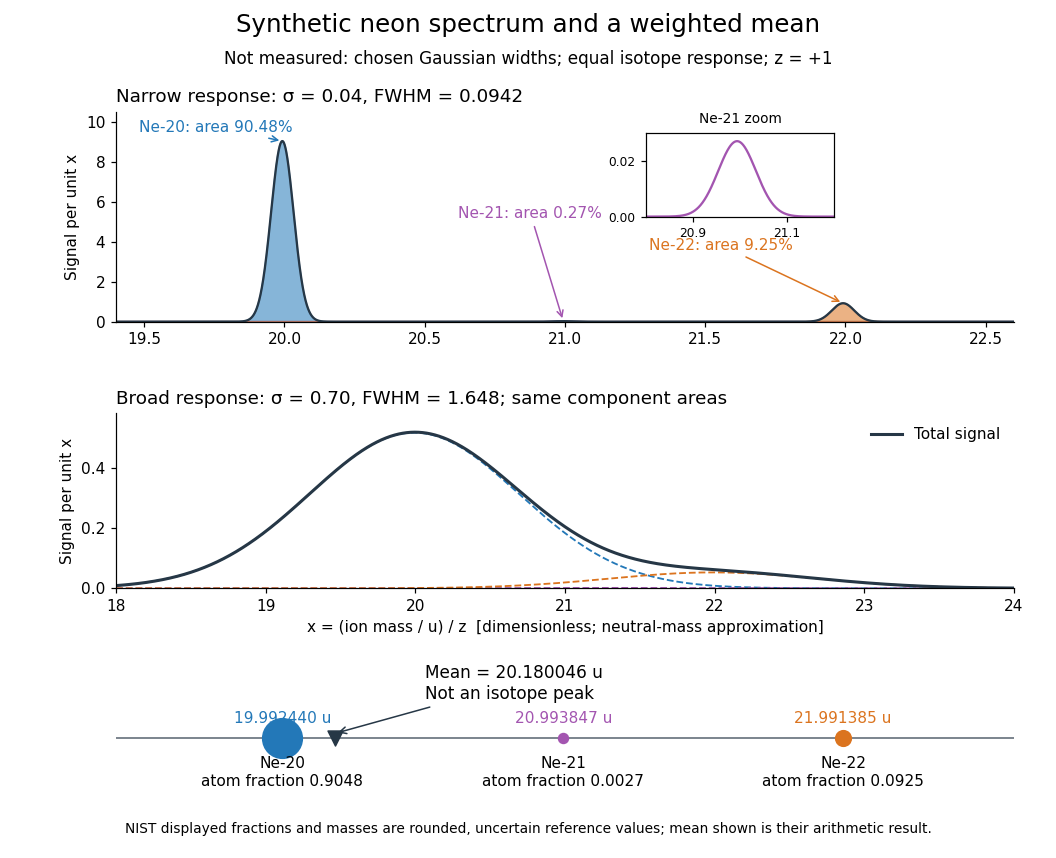
Broadening can hide a weak component without changing its area in this ideal model. An actual mass spectrum can also contain molecular ions, different electric charge states, background, and unequal detection responses. A missing visible peak therefore cannot by itself prove the absence of an isotope. Conversely, a fractional atomic weight is a property of a population: there is no requirement for an ion peak at the weighted mean.
The ratio of an ion's mass to its electric charge; in SI it has units . A convenient numerical mass spectrum coordinate is , with and positive integer here. This is dimensionless. Doubling at fixed mass halves , so the electric charge state must be identified before assigning an isotope.
A mass spectrometry instrument with a photographic readout. In the 1919 apparatus described in Chapter V: The Mass-Spectrograph, a gas discharge produced positive ions. Two narrow slits formed a ribbon beam in a vacuum; plates applied an electric field to spread it, an aperture selected part of it, and a magnetic field bent it oppositely. Focusing reduced the spread caused by differing ion speeds, concentrating a given mass-to-charge ratio into a line on a photographic plate.
The observed quantity was line displacement from a fiducial spot. Known reference lines calibrated displacement against mass-to-charge ratio; repeated exposures with changed magnetic field tested the calibration. Evacuation limited collisions. Comparing line shapes with narrow and wide apertures helped distinguish geometric broadening from photographic spreading. Finite slit widths, plate response, and overlapping molecular or multiply charged ions limited interpretation. See Chapter V: The Mass-Spectrograph (§§33–40: apparatus and photographic procedure; §§43 and 45–46: calibration, aperture comparisons, and accuracy).
In Mass spectra and isotopes by Francis William Aston (Nobel lecture, 12 December 1922), the reported neon lines at 20 and 22 have companions at 10 and 11 from doubly charged ions. That paired pattern and comparison with reference lines support different atomic masses within one chemical element, rather than an atomic mass concentrated at the bulk average. The lecture also describes an earlier failed separation by distillation and partial separation by diffusion, showing why the focused mass spectrum supplied stronger evidence. These numbers used a historical oxygen-based reference scale. The lecture's whole-number rule was an empirical approximation at its stated accuracy, not the modern exact definition .[ref]
Mass spectra and isotopes by Francis William Aston. pp. 9–13: separation attempts, focusing, reference lines, charge orders, and neon; pp. 15–17: whole-number rule and historical nuclear interpretation
Its activity is linked to hydronium through the ionization equilibrium of water, with the equilibrium constant dependent on temperature. It is chemically different from the neutral hydroxyl radical, whose unpaired electron gives it a very different reaction pattern.
Hydronium is the ion formed when a water molecule accepts a proton. It provides the usual aqueous shorthand for the hydrogen ion used in pH calculations.
In acid-base chemistry, hydrogen ion usually refers to positively charged hydrogen, represented by . In water, this notation describes solvated species, commonly represented by hydronium, rather than an isolated bare proton. The hydrogen ion thermodynamic activity defines pH.
Pinned article: Introduction to the OurBigBook Project
Welcome to the OurBigBook Project! Our goal is to create the perfect publishing platform for STEM subjects, and get university-level students to write the best free STEM tutorials ever.
Everyone is welcome to create an account and play with the site: ourbigbook.com/go/register. We belive that students themselves can write amazing tutorials, but teachers are welcome too. You can write about anything you want, it doesn't have to be STEM or even educational. Silly test content is very welcome and you won't be penalized in any way. Just keep it legal!
Intro to OurBigBook
. Source. We have two killer features:
- topics: topics group articles by different users with the same title, e.g. here is the topic for the "Fundamental Theorem of Calculus" ourbigbook.com/go/topic/fundamental-theorem-of-calculusArticles of different users are sorted by upvote within each article page. This feature is a bit like:
- a Wikipedia where each user can have their own version of each article
- a Q&A website like Stack Overflow, where multiple people can give their views on a given topic, and the best ones are sorted by upvote. Except you don't need to wait for someone to ask first, and any topic goes, no matter how narrow or broad
This feature makes it possible for readers to find better explanations of any topic created by other writers. And it allows writers to create an explanation in a place that readers might actually find it.
Figure 1. Screenshot of the "Derivative" topic page. View it live at: ourbigbook.com/go/topic/derivativeVideo 2. OurBigBook Web topics demo. Source. - local editing: you can store all your personal knowledge base content locally in a plaintext markup format that can be edited locally and published either:This way you can be sure that even if OurBigBook.com were to go down one day (which we have no plans to do as it is quite cheap to host!), your content will still be perfectly readable as a static site.
- to OurBigBook.com to get awesome multi-user features like topics and likes
- as HTML files to a static website, which you can host yourself for free on many external providers like GitHub Pages, and remain in full control

Figure 2. You can publish local OurBigBook lightweight markup files to either OurBigBook.com or as a static website.
Figure 3. Visual Studio Code extension installation.
Figure 5. . You can also edit articles on the Web editor without installing anything locally. Video 3. Edit locally and publish demo. Source. This shows editing OurBigBook Markup and publishing it using the Visual Studio Code extension. 
- Infinitely deep tables of contents:




All our software is open source and hosted at: github.com/ourbigbook/ourbigbook
Further documentation can be found at: docs.ourbigbook.com
Feel free to reach our to us for any help or suggestions: docs.ourbigbook.com/#contact