Topics (384k) Articles (398k) Users (410) Discussions (242) Comments (383) Files (13k) New article

Albert Girard studied relations between the roots and coefficients of polynomials. His 1629 Invention nouvelle en l'algèbre treated sums of roots, products of roots and sums of their powers, connecting equation solving with what became the language of symmetric polynomials.
For a monic quadratic with roots , the identity makes the connection transparent. Girard's work extended this viewpoint beyond a single quadratic and included roots that could not be treated as ordinary positive magnitudes.[ref]
https://mathshistory.st-andrews.ac.uk/Biographies/Girard_Albert/. Biography, 1629 pamphlet and symmetric functions of roots
Luigi Guido Grandi was a mathematician and monk whose work included geometry and hydraulics. His name is associated with Grandi's series, , a simple example that exposes ambiguities in manipulating infinite sums.[ref]
https://mathshistory.st-andrews.ac.uk/Biographies/Grandi/. Biography, geometry, hydraulics and work on infinite series
Grouping consecutive terms as suggests zero, while separating the first term suggests one; neither is a valid proof of an ordinary sum. The partial sums do not converge. A specified method such as Cesàro summation can assign , but the method and its rules must be stated before using that value in a calculation.
Portrait of Luigi Guido Grandi
. Creator not supplied on Commons; University of Pisa historical photograph archive (source URL recorded on file page). Commons declares public domain under life-plus-70; author information is missing. Source and usage information on the linked Wikimedia file page. Source.Ernesto Cesàro was a mathematician whose work included differential geometry, number theory and divergent series. He studied with Eugène Charles Catalan and developed the summation method that now bears his name.[ref]
https://mathshistory.st-andrews.ac.uk/Biographies/Cesaro/. Biography, mathematical training and principal contributions
Cesàro summation replaces the sequence of partial sums of a series by their arithmetic averages. For , the partial sums alternate between one and zero, but their averages tend to . This supplies a generalized sum while preserving the distinction from ordinary convergence: the original sequence of partial sums still has no limit.
Portrait of Ernesto Cesàro
. Historical photograph by an unknown photographer, originally reproduced by MacTutor. Listed as public domain by Wikimedia Commons. Source.Richard P. Stanley works in enumerative combinatorics and algebraic combinatorics, including connections among partially ordered sets, generating functions and symmetric functions. His Enumerative Combinatorics, Volume 1 (second-edition draft) by Richard Stanley develops systematic methods for counting combinatorial structures. His later Catalan-number monograph organizes many different counting interpretations of the Catalan numbers, showing how the same sequence can encode different discrete objects.[ref]
https://math.mit.edu/~rstan/ec/. Author information page, Enumerative Combinatorics volumes and Catalan monograph
[ref]Homepage: math.mit.edu/~rstan/

Portrait of Richard P. Stanley
. Photograph identified on the MIT Mathematics profile.Karol Borsuk was a mathematician whose work helped develop topology, particularly the study of retracts and the relationship between geometric and topological structure. His collaboration with Stanisław Ulam produced results about continuous mappings and topological invariants.[ref]
https://mathshistory.st-andrews.ac.uk/Biographies/Borsuk/. Biography, dissertation on retracts and collaboration with Ulam
The Borsuk-Ulam theorem states that every continuous map from the sphere to takes the same value at some pair of antipodal points. The equal-value pair is forced by global topology, even though the map may have no explicit symmetry. This provides a tool for existence proofs rather than a recipe for locating the pair.
Portrait of Karol Borsuk
. MacTutor History of Mathematics archive. Free Art License, via Wikimedia Commons. Source.Josiah Willard Gibbs was a mathematical scientist whose work gave thermodynamics and statistical mechanics powerful geometric and analytical formulations. His studies of heterogeneous equilibrium connected the behavior of multiple phases and chemical components, while his later work developed a systematic account of statistical ensembles. He also helped establish the practical language of vector calculus.[ref]
https://mathshistory.st-andrews.ac.uk/Biographies/Gibbs/. Biography, thermodynamic papers, vector methods and statistical mechanics
His Gibbs free energy combines internal energy, pressure, volume, temperature and entropy as . Under the appropriate fixed-temperature and fixed-pressure conditions, its minimization expresses equilibrium, turning a physical stability question into a variational problem.
Portrait of Josiah Willard Gibbs
. Photographer unidentified; Science History Institute, padig:SHI-ywkj3wc; contributed via Digital Public Library of America / PA Digital. Public domain in United States, as declared by Commons; no worldwide status or CC license asserted. Source and usage information on the linked Wikimedia file page. Source.Joseph Fourier (1768–1830) developed the mathematical study of heat conduction by combining a partial differential equation for diffusion with expansions in trigonometric functions. His 1822 publication on the analytical theory of heat made the use of Fourier series central to this physical problem.[ref]
https://mathshistory.st-andrews.ac.uk/Biographies/Fourier/. University of St Andrews, MacTutor biography, heat-conduction research and1822 publication
For the heat equation on a periodic domain, a spatial mode acquires the amplitude . Shorter wavelengths therefore decay faster, making the physical smoothing visible one mode at a time. Reconstructing general initial data from those modes leads to questions of orthogonality, convergence of Fourier series and function-space approximation. The same decomposition later became useful far beyond heat, in wave equations and signal processing.

Portrait of Joseph Fourier
. Attributed to Pierre-Claude Gautherot (died 1825), circa 1802–1803; Musée d'Auxerre; reproduction source listed on Commons. Public domain (life-plus-100, pre-1931 U.S. publication), faithful reproduction / PD-Art. Source and usage information on the linked Wikimedia file page. Source.Pafnuty Chebyshev's 1867 paper “Des valeurs moyennes” develops bounds for deviations of sums in terms of their expected values and second moments. This connects his historical work with the modern Chebyshev's inequality and its use in the weak law of large numbers. [ref]
https://www.numdam.org/item/JMPA_1867_2_12__177_0.pdf. Chebyshev's original paper in French translation
.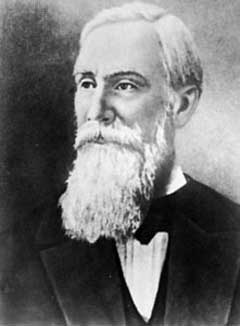
Historical portrait of Pafnuty Chebyshev
. Source. Richard Bellman developed dynamic programming, organizing multistage decisions through the optimal value of a smaller remaining problem. The Bellman equation expresses that recursive relationship between a present choice and its future consequences.
The approach connects optimization, control theory and stochastic decision models. It can replace enumeration of complete decision histories by a reusable state description, although a large state space can still make computation expensive. His 1957 book collected central results of this program.[ref]
Johan Jensen was a mathematician and engineer whose work included convex functions, infinite series and complex analysis. His 1906 work on convex functions established the inequality now known as Jensen's inequality. He also related the zeros of a holomorphic function to the average of the logarithm of its absolute value around a circle.[ref]
https://mathshistory.st-andrews.ac.uk/Biographies/Jensen/. Biography, formula for zeros and 1906 convexity paper
A basic instance of Jensen's inequality is for a real random variable with a finite second moment. Thus applying a convex function after averaging gives no larger a result than averaging after applying that function.
Portrait of Johan Jensen
. Theodor Vilhelm Rieger; Royal Danish Library, Copenhagen, object166670; photograph dated 1902–1913. Public domain under Commons PD-Denmark50 and PD-US templates. Source and usage information on the linked Wikimedia file page. Source.John Napier was a mathematical scholar whose 1614 publication introduced logarithms as a tool for reducing difficult calculations. His construction was expressed through a motion analogy and used a scaling different from the modern convention; identifying his original tables directly with ordinary base-ten tables is misleading. He also developed calculating rods and methods for spherical trigonometry.[ref]
https://mathshistory.st-andrews.ac.uk/Biographies/Napier/. Biography, 1614 publication and construction of logarithms
In modern notation, for positive real . Tables therefore turn multiplication into addition and division into subtraction, followed by an inverse lookup. This was especially valuable for long astronomical and navigational calculations before electronic computers.
Portrait of John Napier
. Unknown artist, 1616; painting presented to University of Edinburgh by Margaret, later Baroness Napier; scan source listed on Commons. Public domain (life-plus-100, pre-1931 U.S. publication), faithful reproduction / PD-Art. Source and usage information on the linked Wikimedia file page. Source.Brook Taylor was a mathematician whose 1715 work developed methods of finite differences and the expansion now called the Taylor series. He also studied vibrations of mechanical strings and mathematical perspective projection.[ref]
https://mathshistory.st-andrews.ac.uk/Biographies/Taylor/. Biography, Methodus incrementorum and Linear Perspective
A Taylor polynomial uses the derivatives of a function at one point to build a local polynomial approximation. For instance, near zero, . The remainder is essential: a finite approximation can have a controlled error without asserting that an infinite Taylor series converges to the function. This distinction makes the method useful in numerical analysis and local analysis of differential equations.
Portrait of Brook Taylor
. Probably Louis Goupy, circa 1720; National Portrait Gallery, London, NPG 1920. Public domain (author died 1747; life-plus-100, pre-1931 U.S. publication) and faithful reproduction / PD-Art. Source and usage information on the linked Wikimedia file page. Source.William George Horner worked on transformations and numerical solution of algebraic equations. His name is attached to Horner's method, which uses a nested polynomial expression to reduce arithmetic work in evaluation and related computations.
The history is more complicated than the name alone suggests: the MacTutor account distinguishes his 1819 and 1830 publications and discusses earlier methods. An eponym identifies a conventional name, but does not by itself establish sole priority.[ref]
https://mathshistory.st-andrews.ac.uk/Biographies/Horner/. Biography, publication chronology and earlier methods
Maurice Fréchet was a mathematician whose 1906 dissertation helped establish the abstract study of metric spaces and functionals. His work made it possible to treat points, sequences and functions within a common framework of distance and convergence. He also contributed to probability theory and the representation of functionals.[ref]
https://mathshistory.st-andrews.ac.uk/Biographies/Frechet/. Biography, 1906 dissertation and 1907 representation theorem
For example, the distance between two continuous functions can be their largest pointwise difference. With that choice, convergence in the metric is uniform convergence. The abstraction is productive because a theorem proved using only metric properties can then apply to many spaces whose elements look completely different.
Portrait of Maurice Fréchet
. Unknown photographer and date; source: MacTutor History of Mathematics archive. Commons labels PD-because (MacTutor); underlying quoted permission only says most images believed public domain. No CC license verified. Source and usage information on the linked Wikimedia file page. Source.Simon Stevin was a mathematician and engineer who promoted the practical use of terminating decimals and made important contributions to statics and hydrostatics. His 1585 booklet on decimal arithmetic presented an accessible system for calculation and measurement; he did not invent terminating decimals, which had earlier precedents. His mechanical writings appeared the following year.[ref]
https://mathshistory.st-andrews.ac.uk/Biographies/Stevin/. Biography, La Thiende and works on statics and hydrostatics
In hydrostatics, the pressure difference in a liquid of constant density depends on vertical depth through . This explains why equal depths give equal pressures even in vessels of very different shapes, separating pressure from the total amount of liquid.
Portrait of Simon Stevin
. Anonymous seventeenth-century Dutch painter/engraver; Leiden University Library, Icones Leidenses 40. Public domain (life-plus-100) and faithful reproduction / PD-Art; Public Domain Mark. Source and usage information on the linked Wikimedia file page. Source.Blaise Pascal was a mathematician and natural philosopher whose scientific work covered projective geometry, probability theory and hydrostatics. His correspondence with Pierre de Fermat in 1654 helped establish methods for calculating chances and dividing the stakes of an interrupted game. He also studied atmospheric pressure and developed a mechanical calculating machine.[ref]
https://mathshistory.st-andrews.ac.uk/Biographies/Pascal/. Biography, Fermat correspondence, pressure experiments and calculator
The Pascal triangle connects these interests through binomial coefficients: its addition rule counts choices according to whether a specified object is selected. The same coefficients describe the distribution of the number of successes in repeated independent trials with a fixed success probability.
Portrait of Blaise Pascal
. Paul Prieur, portrait; photograph Anna Danielsson / Nationalmuseum, Stockholm. Creative Commons Attribution-ShareAlike 4.0 International., via Wikimedia Commons. Source.Saunders Mac Lane was a mathematician whose research and books helped shape modern algebra, homological algebra and category theory. His collaboration with Samuel Eilenberg introduced categories, functors and natural transformations as a language for relationships among mathematical constructions.[ref]
https://mathshistory.st-andrews.ac.uk/Biographies/MacLane/. Biography, Eilenberg collaboration and 1945 paper
One illuminating example treats a group as a category with one object and invertible arrows: composition of arrows is the group operation. This viewpoint allows the same language to describe both a familiar algebraic structure and maps between entire mathematical theories. His expository work helped make such abstract ideas usable in everyday mathematical reasoning.
Portrait of Saunders Mac Lane
. Konrad Jacobs, circa 1972; Oberwolfach Photo Collection, photo 2684. Creative Commons Attribution-ShareAlike 2.0 Germany; VRT permission recorded., via Wikimedia Commons. Source.Samuel Eilenberg was a mathematician whose work connected algebraic topology, homological algebra and category theory. With Saunders Mac Lane, he introduced the language of categories, functors and natural transformations; with Norman Steenrod, he gave an axiomatic account of homology and cohomology.[ref]
https://mathshistory.st-andrews.ac.uk/Biographies/Eilenberg/. Biography, Mac Lane collaboration and axioms for homology
This language records more than the invariants attached to spaces: a continuous map also induces a map between the corresponding algebraic objects. Tracking those induced maps makes it possible to compare constructions and explain why many apparently different versions of a theory express the same underlying structure.
Portrait of Samuel Eilenberg
. Konrad Jacobs, Erlangen, 1970; Mathematisches Forschungsinstitut Oberwolfach Photo Collection, photo 1010. Creative Commons Attribution-ShareAlike 2.0 Germany., via Wikimedia Commons. Source.Leonhard Euler (1707–1783) developed analysis as a working language for mechanics, geometry and number theory. His 1736–1737 treatment of Newtonian mechanics put motion into the methods of differential equations, while his work on surfaces and polyhedra connected geometric quantities with structural relations such as the Euler characteristic.[ref]
https://mathshistory.st-andrews.ac.uk/Biographies/Euler/. University of St Andrews, MacTutor biography, discussion of Mechanica and contributions to differential geometry and polyhedra
The Euler's formula exemplifies the resulting unity: the complex exponential describes rotation, so oscillations can be manipulated through multiplication and differentiation. The Euler characteristic of a convex polyhedron, , concerns a different invariant altogether. Distinguishing these meanings makes his many eponyms useful connections rather than interchangeable formulas.

Portrait of Leonhard Euler
. Jakob Emanuel Handmann, 1753; Kunstmuseum Basel, inventory 276; reproduction cropped from Euler-2007 document. Public domain (life-plus-100, pre-1931 U.S. publication) and faithful reproduction / PD-Art. Source and usage information on the linked Wikimedia file page. Source.Pierre de Fermat (1601–1665) was a lawyer and government official whose mathematical work helped shape number theory, early calculus and probability. His 1654 correspondence with Blaise Pascal on games of chance helped turn questions about fair division of stakes into systematic probability calculations.[ref]
https://mathshistory.st-andrews.ac.uk/Biographies/Fermat/. University of St Andrews, MacTutor biography, legal career and1654 Pascal correspondence
Fermat's little theorem states that for a prime number and an integer ; it gives a reusable arithmetic relation, not a guarantee that every number satisfying one modular test is prime. Fermat's last theorem is the separate assertion that has no positive-integer solution for . The two statements illustrate the range of his arithmetic questions and must not be conflated with one another or with a proof of the latter assertion by Fermat himself.

Portrait of Pierre de Fermat
. Rolland Lefebvre (1608–1677); portrait in Musée des Beaux-Arts de Narbonne; reproduction via source listed on Commons. Public domain (life-plus-100, pre-1931 U.S. publication) and faithful reproduction / PD-Art. Source and usage information on the linked Wikimedia file page. Source. Pinned article: Introduction to the OurBigBook Project
Welcome to the OurBigBook Project! Our goal is to create the perfect publishing platform for STEM subjects, and get university-level students to write the best free STEM tutorials ever.
Everyone is welcome to create an account and play with the site: ourbigbook.com/go/register. We belive that students themselves can write amazing tutorials, but teachers are welcome too. You can write about anything you want, it doesn't have to be STEM or even educational. Silly test content is very welcome and you won't be penalized in any way. Just keep it legal!
Intro to OurBigBook
. Source. We have two killer features:
- topics: topics group articles by different users with the same title, e.g. here is the topic for the "Fundamental Theorem of Calculus" ourbigbook.com/go/topic/fundamental-theorem-of-calculusArticles of different users are sorted by upvote within each article page. This feature is a bit like:
- a Wikipedia where each user can have their own version of each article
- a Q&A website like Stack Overflow, where multiple people can give their views on a given topic, and the best ones are sorted by upvote. Except you don't need to wait for someone to ask first, and any topic goes, no matter how narrow or broad
This feature makes it possible for readers to find better explanations of any topic created by other writers. And it allows writers to create an explanation in a place that readers might actually find it.
Figure 1. Screenshot of the "Derivative" topic page. View it live at: ourbigbook.com/go/topic/derivativeVideo 2. OurBigBook Web topics demo. Source. - local editing: you can store all your personal knowledge base content locally in a plaintext markup format that can be edited locally and published either:This way you can be sure that even if OurBigBook.com were to go down one day (which we have no plans to do as it is quite cheap to host!), your content will still be perfectly readable as a static site.
- to OurBigBook.com to get awesome multi-user features like topics and likes
- as HTML files to a static website, which you can host yourself for free on many external providers like GitHub Pages, and remain in full control

Figure 2. You can publish local OurBigBook lightweight markup files to either OurBigBook.com or as a static website.
Figure 3. Visual Studio Code extension installation.
Figure 5. . You can also edit articles on the Web editor without installing anything locally. Video 3. Edit locally and publish demo. Source. This shows editing OurBigBook Markup and publishing it using the Visual Studio Code extension. 
- Infinitely deep tables of contents:




All our software is open source and hosted at: github.com/ourbigbook/ourbigbook
Further documentation can be found at: docs.ourbigbook.com
Feel free to reach our to us for any help or suggestions: docs.ourbigbook.com/#contact