
Past exam of the mathematics course of the University of Cambridge 2003 ib Paper 3 7G Solution Created 2026-09-24 Updated 2026-10-14
If , the two endomorphisms commute. The distinct real eigenvalues of have one-dimensional real eigenspaces, since their direct sum is the -dimensional vector space. Take a nonzero real eigenvector . Its eigenspace is invariant under , so for a real scalar . Squaring givesThe simple-spectrum hypothesis is essential: the real -degree rotation matrix squares to in dimension two, whose negative eigenvalue has a two-dimensional eigenspace.
Past exam of the mathematics course of the University of Cambridge 2003 ib Paper 3 6B b Created 2026-09-24 Updated 2026-09-24
Past exam of the mathematics course of the University of Cambridge 2003 ib Paper 3 6B a Created 2026-09-24 Updated 2026-09-24
Past exam of the mathematics course of the University of Cambridge 2003 ib Paper 3 5H Solution Created 2026-09-24 Updated 2026-10-14
Player A maximizes the payoff, while B minimizes it. The fourth row is strictly worse for A than the first in every column, so remove by dominated strategy elimination. On the remaining rows, column is strictly better for B than , so remove . Now is strictly worse than in the two remaining columns. The reduced zero-sum game has payoff matrixwith rows and columns .
If A uses mixed strategy , the expected payoffs against these columns are and . The first increases and the second decreases, so their minimum is maximized where they are equal: . ThusFor an optimality certificate, B uses mixed strategy , making A's first two row payoffs and . Equality gives . Against this B strategy the four row payoffs are , while against the displayed A strategy the three column payoffs are . Therefore A guarantees and B holds A to , verifying the value of a zero-sum game and the original, unreduced mixed strategy.
Past exam of the mathematics course of the University of Cambridge 2003 ib Paper 3 4F Solution Created 2026-09-24 Updated 2026-10-14
Let be the isometry. Since , it preserves norms, and the polarization identity applied to distances gives . For an orthonormal basis , the vectors are again an orthonormal basis, andExpanding in that basis proves . Hence is a linear map represented by an orthogonal matrix .
A reflection in a hyperplane with nonzero normal is . If , choose . Because , substitution shows . If they agree, no reflection is needed. The resulting orthogonal transformation fixes and preserves its orthogonal complement. Apply the same construction there to fix ; the second normal is perpendicular to , so the first vector remains fixed. Finally the restriction to the remaining line is either the identity or negation; in the latter case a third reflection, normal to , fixes it. Reversing these steps writes as a product of at most three reflections, each in a plane through the origin. This proves the three-dimensional case of the Cartan–Dieudonné theorem.
Three reflections are sometimes necessary. The map is the product of the three coordinate-plane reflections. Its determinant is , excluding zero or two reflections. A single plane reflection fixes a two-dimensional vector subspace, whereas fixes only zero, excluding one. Thus the bound is sharp.
Past exam of the mathematics course of the University of Cambridge 2003 ib Paper 3 3E b Created 2026-09-24 Updated 2026-09-24
Past exam of the mathematics course of the University of Cambridge 2003 ib Paper 3 3E a Created 2026-09-24 Updated 2026-09-24
Past exam of the mathematics course of the University of Cambridge 2003 ib Paper 3 2D Solution Created 2026-09-24 Updated 2026-10-14
Write the cone as , with the distance from its axis and . Its Euclidean metric givesConsequently a differentiable path expressed as has arc lengthFor , the Euler-Lagrange equation has the Beltrami identity because has no explicit dependence:For a nonradial minimizing path, . Rearranging and integrating givesThe endpoint conditions determine and on the selected angular branch.
To verify that this stationary path really minimizes arc length, use the local isometry from a circular cone to the plane. Set and ; then is the plane metric. The displayed path is a straight line , so its segment realizes the plane distance. Choose endpoint angular lifts with ; then , and the joining segment avoids the apex. Its length isOther lifts with developed angular difference less than give at least this distance; an angular change of at least has infimum at least , attained only if passage through the apex is allowed. This proves the global choice above. Endpoints on a common generator have the radial segment as shortest path, which is the limiting case omitted by the parametrization. If an endpoint is the apex, its shortest path is a generator. Thus shortest paths are straight segments after developing the cone.
Past exam of the mathematics course of the University of Cambridge 2003 ib Paper 3 20A Solution Created 2026-09-24 Updated 2026-10-14
The time-independent Schrödinger equation is , with attractive Coulomb potential , where . Separating uses the spherical harmonic angular eigenvalue of the unit-sphere Laplacian. The radial kinetic contribution is , the angular kinetic contribution is the centrifugal term , and the remaining term is the attractive potential energy. The right side is the energy eigenvalue times the radial wavefunction. Here the stated neglects nuclear recoil; including it replaces the electron mass by the reduced mass.
For , substitution of the ground-state exponential givesIts coefficient must vanish and its constant coefficient determines the energy, soHere is the Bohr radius.
For , direct differentiation yieldsCancel the nonzero exponential in the radial Schrödinger equation and compare coefficients of , the constant term, and . They give, respectively,ConsequentlyThe positive decay constants ensure normalizability; the second radial wavefunction has one positive-radius node at , as appropriate to the first radial excitation.
If the entire energy gap is carried by one photon, neglecting atomic recoil, conservation of energy gives the requested frequencyThere is a physical qualification: these are the and states, so the usual single-photon electric-dipole transition is forbidden by the electric-dipole selection rules for hydrogen. Explicitly, both angular factors are , and , so every component of vanishes. The leading isolated-atom decay is instead two-photon emission, for which and individual frequencies are not fixed. This metastability and the two-photon channel are documented in NIST's hydrogen spectral-data compilation. Thus the boxed answer is the energy-gap frequency under the printed single-photon assumption, rather than an assertion of an allowed electric-dipole line.
Past exam of the mathematics course of the University of Cambridge 2003 ib Paper 3 1F Solution Created 2026-09-24 Updated 2026-10-14
The integral is finite because a continuous function on a compact closed interval is bounded. Nonnegativity is immediate, and absolute homogeneity of a norm follows from . The pointwise triangle inequality givesFor positive definiteness, if , continuity gives a relative interval of positive length on which . Its integral is positive, including when is an endpoint. Thus implies , and this is a norm on the given vector space.
For the given sequence,The last bound tends to zero as both indices tend to infinity, proving the Cauchy sequence property. Moreover, the sequence converges to the zero function in this norm:There is no conflict with the nonzero endpoint values: convergence in this norm does not imply pointwise convergence.
Past exam of the mathematics course of the University of Cambridge 2003 ib Paper 3 19G d Created 2026-09-24 Updated 2026-09-24
Past exam of the mathematics course of the University of Cambridge 2003 ib Paper 3 19G c Created 2026-09-24 Updated 2026-09-24
Past exam of the mathematics course of the University of Cambridge 2003 ib Paper 3 19G b Created 2026-09-24 Updated 2026-09-24
Past exam of the mathematics course of the University of Cambridge 2003 ib Paper 3 19G a Created 2026-09-24 Updated 2026-09-24
Past exam of the mathematics course of the University of Cambridge 2003 ib Paper 3 18C Solution Created 2026-09-24 Updated 2026-10-14
For an inviscid flow that is an incompressible flow and an irrotational flow, write . The Euler equations for an inviscid fluid, without gravity, integrate spatially to the Unsteady Bernoulli equationA time-dependent addition to can absorb .
In the ideal uniform tube-plug model, let be the axial speed toward the outlet. Incompressibility and fixed cross-section make the speed the same at both ends. With , the kinetic terms cancel when the Unsteady Bernoulli equation is subtracted between entrance and exit, givingConservation of volume in the spherical balloon gives , or . Differentiating and eliminating yieldsThis is the constant-tension balloon discharge equation; entrance losses and a reservoir-to-tube kinetic-head correction are excluded by this ideal plug model.
Multiplication by turns the equation intoThe printed time formula additionally assumes the water is initially at rest, , although only is explicitly specified in the question. Under that assumption . On the shrinking branch,Set and . The integral becomes , hencePutting , or , gives the ideal emptying timeFor an independently prescribed initial rate , the first integral instead has , so radius alone does not determine that emptying time. This explicitly identifies the extra initial datum needed for the displayed answer.
Past exam of the mathematics course of the University of Cambridge 2003 ib Paper 3 17G Solution Created 2026-09-24 Updated 2026-10-14
Use the Leibniz definition of the determinant:For the permuted-column matrix, . Reindex the sum by . The sign of a permutation is multiplicative, so . It follows directly thatFor the matrix transpose, the products in its determinant are . Set to obtain , and use . This proves . These facts also show that equal columns, or equal rows by transposition, force the determinant to be zero: exchanging the equal pair leaves the matrix unchanged but changes the determinant's sign.
Let be the matrix obtained by deleting row and column , with the empty determinant taken as one for . Define the cofactor and the adjugate matrix by . Grouping the Leibniz sum according to the column chosen in row gives the cofactor expansion : deleting that row and its chosen column leaves a permutation of entries, with sign factor . ThereforeWhen this is . When it is the cofactor expansion along row of the matrix formed by replacing that row with row ; its remaining minors are unchanged, and its two equal rows give determinant zero. The column version proves the other product in the same way. Thus the adjugate identity is
For the real matrices , let . The determinant definition makes this a real polynomial of degree of a polynomial at most . Since is invertible, the allowed converse implies , so is not the zero polynomial. It has at most real roots of a polynomial. Choose a real outside those roots; the adjugate argument proves that is invertible.
Finally write the given complex similarity transformation as . The relation , with real, yields and by comparing real and imaginary parts. Choose the preceding and put . Then , soThis proves real similarity from complex similarity by constructing a real intertwiner, rather than requiring or separately to be invertible.
Past exam of the mathematics course of the University of Cambridge 2003 ib Paper 3 16B b Created 2026-09-24 Updated 2026-09-24
Past exam of the mathematics course of the University of Cambridge 2003 ib Paper 3 16B a Created 2026-09-24 Updated 2026-09-24
Past exam of the mathematics course of the University of Cambridge 2003 ib Paper 3 15H Solution Created 2026-09-24 Updated 2026-10-14
A balanced transportation problem chooses nonnegative shipments minimizing , subject to and , where the total supply equals total demand. For multipliers , its Lagrangian isTaking its infimum over produces the linear programming duality problem of maximizing subject to . These are the transportation dual potentials.
The transportation simplex algorithm starts with a feasible transportation spanning tree of basic entries, obtainable by filling the north-west available cell with the smaller remaining supply or demand. Set on basic cells; this determines all potentials up to adding a constant to all and subtracting it from all . If all nonbasic reduced costs are nonnegative, feasibility and the dual bound prove optimality. Otherwise let a negative-cost cell enter. It closes a unique cycle in the basic tree. Alternate additions and subtractions around that cycle and choose the largest amount preserving nonnegativity, namely the minimum shipment on the subtraction cells. A cell that reaches zero leaves the basis. The cost changes by the entering reduced cost times the pivot amount. Zero basic cells and an anti-cycling rule can handle degeneracy; all pivots below are nondegenerate.
The north-west initial shipment matrix isWith , its transportation dual potentials are and . The most negative reduced cost is . The cycle is ; the pivot amount is . HenceNow and . Enter , of reduced cost , on cycle . The amount is , givingThe new potentials are and . Enter , of reduced cost , on cycle . The amount is . ThusTo certify optimality in the original transportation problem, take and . Their entire reduced-cost matrix isThey satisfy dual feasibility, and their value is , equal to the shipment cost. The minimum transportation cost is therefore , with no unproved optimality assertion from the iterations alone.
Past exam of the mathematics course of the University of Cambridge 2003 ib Paper 3 14F Solution Created 2026-09-24 Updated 2026-10-14
Work first on the unit sphere. A spherical lune of angle has area : its fraction of sphere area is . The three great circles extending the sides of a nondegenerate spherical triangle divide the sphere into four antipodal pairs of triangular regions. Call the desired region , of area , and its three adjacent regions , of areas . These four regions contain one region from each antipodal pair, so . The lune at each vertex consists of and one of these adjacent regions. Therefore, if the three interior angles are ,which proves the spherical excess formula, the spherical-triangle form of the Gauss-Bonnet theorem:For a sphere of radius , multiply this area by .
Triangulate a convex spherical -gon by diagonals from a vertex. There are spherical triangles, and their angles add to the polygon's interior angle sum. Thus its unit-sphere area isFor a nondegenerate convex regular polygon in an open hemisphere, area is positive and each angle is less than , giving . Every angle in this interval occurs. Indeed place vertices at equal longitude spacings and colatitude about a pole, and join consecutive vertices by shorter great circle arcs. The polygon is convex and regular. Split a central isosceles spherical triangle along the perpendicular to its edge. The resulting right spherical triangle has angles , , , and hypotenuse . The angular spherical law of cosines yieldsso . As increases from to , increases continuously through exactlyThe endpoints are degenerate limits, not strict convex polygons.
For the spherical triangle reflection group, positive area requires . Each angle is less than , so the integer denominators are at least two. Arrange . If the sum is at most one, hence . If the sum is again at most one; thus either and any works, or and . These triangles exist, for example as the reflection chambers of a regular dihedral configuration, tetrahedron, cube, and dodecahedron, respectively.
To count group elements using the assumed tessellation, first label the original triangle's three vertices by their types and propagate these labels through side reflections. Around a type- vertex there are sectors; the associated alternating reflections make a full turn and return the labels unchanged. The same holds at the other types. Every closed path in the dual tessellation is generated by these circuits around vertices, since the sphere is simply connected. Thus the labels are globally consistent, including when two angle denominators coincide. Every generated isometry preserves these labels. An element stabilizing a triangle therefore fixes its three vertices and is the identity. Consequently group elements correspond bijectively to triangles, and area givesThe possibilities, including permutations of the entries, are
Here is an explicit dodecahedron construction for the last case, avoiding an assumption about which vertices of the tessellation to join. Put , and take the convex hull of the twenty pointswith independent signs. They all have squared radius three. The supporting plane contains the five verticesin cyclic order. Consecutive distances are , and nonconsecutive distances are , so this is a regular pentagon. Changing the two signs in its normal and cyclically permuting coordinates gives twelve supporting planes, all with a congruent pentagon. Each listed vertex lies on three of these faces; the sixty face-edge incidences pair into thirty edges. The faces form a closed convex polyhedral surface with , hence exhaust the boundary of the convex hull. This constructs a regular dodecahedron.
Choose the spherical directions of a face center , the midpoint of its edge between , and that edge's endpoint . Normalize these to the unit sphere. The three side planes of triangle are , , and with . Their reflections are coordinate sign changes in the first two cases andin the third, since . Substitution in the twenty listed vertices, using , shows that all three reflections permute the vertex set. The side-plane angles give interior angles at , at , and at because and . Thus this triangle is congruent to , and its side-generated group is , conjugated by the aligning isometry.
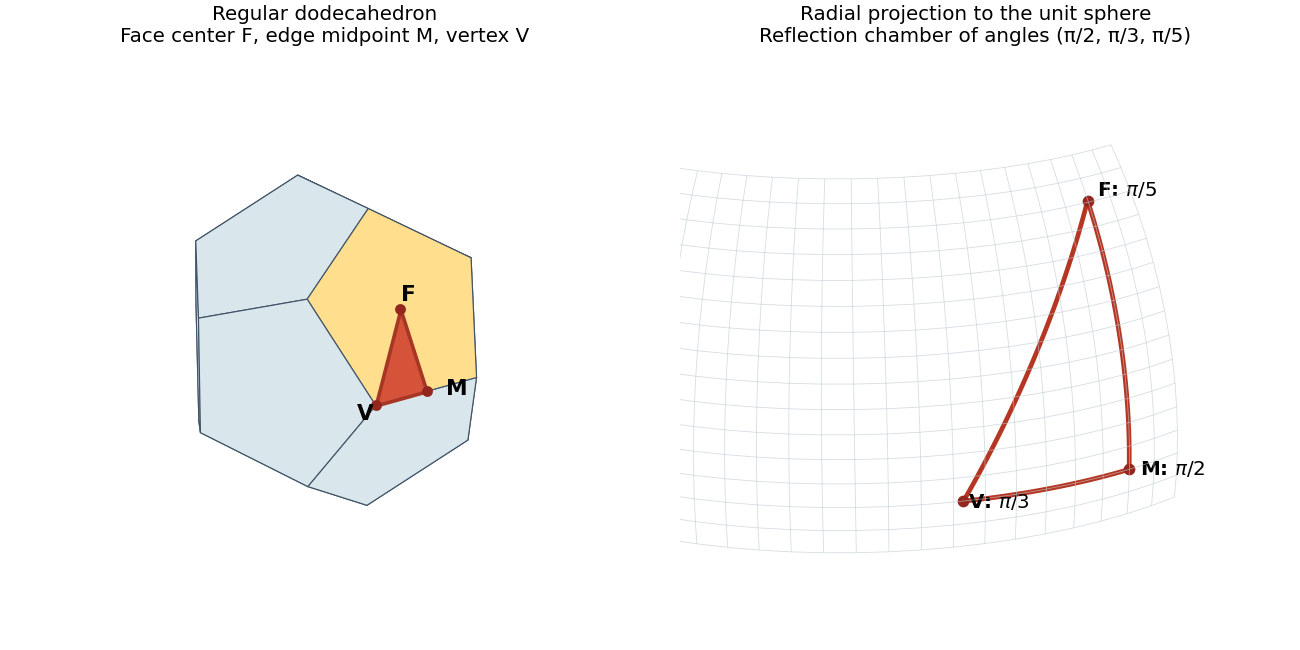

It already has elements. Conversely, a symmetry of the dodecahedron is determined by the image of one face, one vertex on that face, and the orientation along its boundary: there are at most choices. An isometry fixing these choices fixes that face pointwise and must preserve the polyhedron's interior side, hence is the identity. Therefore the complete symmetry group of the constructed dodecahedron is , including orientation-reversing symmetries.
There are unlisted articles, also show them or only show them.