
Spin eigenstate Created 2026-10-18 Updated 2026-11-05
A spin eigenstate along a specified axis is a simultaneous eigenstate of the squared spin operator and its component . Its eigenvalues are and , where . The axis must be specified because components along different axes generally do not commute. For spin one-half, the two field-axis eigenstates have projections and form the branches of a Stern-Gerlach experiment.
Two-spin XY Hamiltonian Created 2026-10-18 Updated 2026-10-20
The two-site quantum version of an XY model couples the transverse components of two spin one-half degrees of freedom. In the ordered basis , its only off-diagonal entries are . The parallel states have energies and ; the symmetric and antisymmetric opposite-spin combinations have energies and respectively. The latter is the singlet state. The formulas remain valid at accidental degeneracies.
Bound-state thresholds of a spherical square well Created 2026-10-18 Updated 2026-10-20
For a spherical square well of radius , depth and reduced mass , the regular zero-orbital angular momentum solution has reduced radial wavefunction inside and outside. Wavefunction matching at a finite potential step gives , where and . The th radial branch first reaches at , for . A normalizable negative-energy state on that branch requires . Thus exactly one such state exists for ; the new zero-energy -wave solution at the upper equality is not normalizable.
For the first branch, the zero-energy exterior solution has . The regular interior solution is , where is a Spherical Bessel function. Matching logarithmic derivatives gives , or , with . Its first threshold is , so . Higher values of orbital angular momentum increase the positive centrifugal potential, so none can bind below this first -wave threshold. Spin-dependent nuclear forces are absent from this central-well model.
Volume of a spherical cap Created 2026-10-18 Updated 2026-10-20
For a solid spherical cap of height cut from a sphere of radius ,Centre the sphere at the origin with the cap on the side . Its cross-section at height is a circle of squared radius . A volume integral in cylindrical coordinates givesThe formula includes caps larger than a hemisphere, when , and the whole solid sphere, when . For the retained region with , set to obtain . Multiplying by uniform mass density gives its mass.
For with integer , the Frobenius method gives or . The general coefficient equation is , taking negative-index coefficients as zero. The regular branch has and . The singular branch has except at . That resonant equation is compatible because its earlier odd coefficient vanishes; the newly free coefficient adds a multiple of the regular solution. Setting it to zero gives a pure even series times , independent of the regular branch, with no logarithmic term. For the resonance occurs already at .
The normalization on the regular branch gives the Spherical Bessel functionIn particular , with removable value one at zero.
A scalar field solving the Helmholtz equation inside a sphere of radius and Laplace's equation outside has a regular interior mode and a decaying exterior mode . Continuity of the field and its radial derivative gives, for ,The Spherical Bessel function recurrence turns this into , not . This elimination does not require division by a possibly vanishing boundary value.
For , and , so the first positive root is . For , the matching condition is , whose first positive root is . The distinction matters when a scalar model permits the monopole sector but a physical multipole model excludes it.
To compare angular sectors, put . Its equation and boundary conditions are , and . Its Rayleigh quotient isBoth added terms are nonnegative and increase with . Thus the lowest scalar eigenvalue is in the sector; if only is admitted, the lowest is in the sector. Zeros at caused by the vanishing normalization of are not additional eigenvalues.
Circle of intersection of two spheres 2026-10-18
Two spheres with centres and positive radii intersect in a nondegenerate circle exactly under the displayed strict triangle inequalities. Put . Subtracting and gives its plane,The circle centre is , where , and its squared radius is . This is positive exactly under the strict inequalities. Equality gives internal or external tangency; coincident equal spheres have an entire sphere in common rather than a unique intersection circle.
Spherical wedge Created 2026-10-18 Updated 2026-10-20
A spherical wedge is the portion of a solid sphere between two meridional half-planes meeting at a dihedral angle , with . Put the common axis along and its azimuthal bisector along . For radius , use spherical coordinates , , . Its volume is .
For constant mass density, reflection symmetries put the centre of mass on the bisector. The first moment isDividing by volume gives . It decreases from the limiting value for an infinitesimal wedge to zero for a full sphere.
The curved boundary is a spherical lune. Its outward vector area is . Indeed, its component has the same angular integrals as the first moment, multiplied by ; the other components cancel by symmetry. Its scalar surface area is , which is generally different from the magnitude of its vector area.
Magnetic spectrometer 2026-10-18
A spectrometer that selects charged particles using the bending of their trajectories in a magnetic field. For a uniform magnetic field of magnitude , the perpendicular momentum component is , where is the electric charge and is the curvature radius of the projected trajectory.
Electron energy analyzer Created 2026-10-18 Updated 2026-10-20
An electron energy analyzer selects electrons by kinetic energy, allowing their count rate to be recorded as an energy scan.
Electron spectrometer Created 2026-10-18 Updated 2026-11-05
An electron spectrometer measures an electron energy distribution. A time of flight design infers kinetic energy from calibrated travel times.
Near the axis of a solenoid, the magnetic vector potential givesThe radial fringe component enforces the solenoidal magnetic-field constraint. A sharp axial step in must retain this fringe as a distributional field; a purely axial field that jumps to zero violates Gauss's law for magnetism. The hard-edge model is a convenient limit for near-axis trajectories, not a literal monopole sheet.
Helical solenoid trajectory with zero incident angular momentum Created 2026-10-18 Updated 2026-11-05
Let a particle enter a uniform solenoid at transverse position with zero radial velocity after an ideal fringe. Define signed and initial field-free speed . Its Lorentz force trajectory inside isThe transverse motion is a circle about the guiding centre at cyclotron angular frequency . Cylindrical radius is ; its apparent azimuthal jumps when the orbit crosses the axis are coordinate singularities. Forward entry requires in this ideal model.
Relativistic solenoid magnetic lens Created 2026-10-18 Updated 2026-11-05
For a near-axis beam of equal incoming speed through a uniform solenoid of length , define . Neglecting the small axial-speed changes, the internal radius is . The exit fringe removes the azimuthal velocity for zero incident canonical angular momentum. The field-free radial trajectory then reaches the axis a distancebeyond the exit, when . In the weak-lens limit, . Without the paraxial approximation, the radius-dependent axial speed produces aberration; the ideal common focus is then only approximate.
Radial solar-wind magnetic flux Created 2026-10-18 Updated 2026-11-05
Magnetic flux freezing in a highly conducting solar wind can carry open magnetic field lines outward. A nearly radial flux tube occupying fixed solid angle has area proportional to , so constant magnetic flux gives . If a field is approximately dipolar inside an opening radius and radial beyond it, its radial component at is enhanced by order compared with continued dipolar decay. Opposite polarities preserve zero net flux through a closed surface; this approximation does not introduce a magnetic monopole.
Nominal solar mass parameter Created 2026-10-18 Updated 2026-11-05
The exact conversion factor . Dividing a measured gravitational parameter by this factor expresses a mass in nominal solar units, avoiding a separate conversion through the measured gravitational constant.[ref]
Small oscillations of a disk attached to prestretched radial springs Created 2026-10-18 Updated 2026-11-05
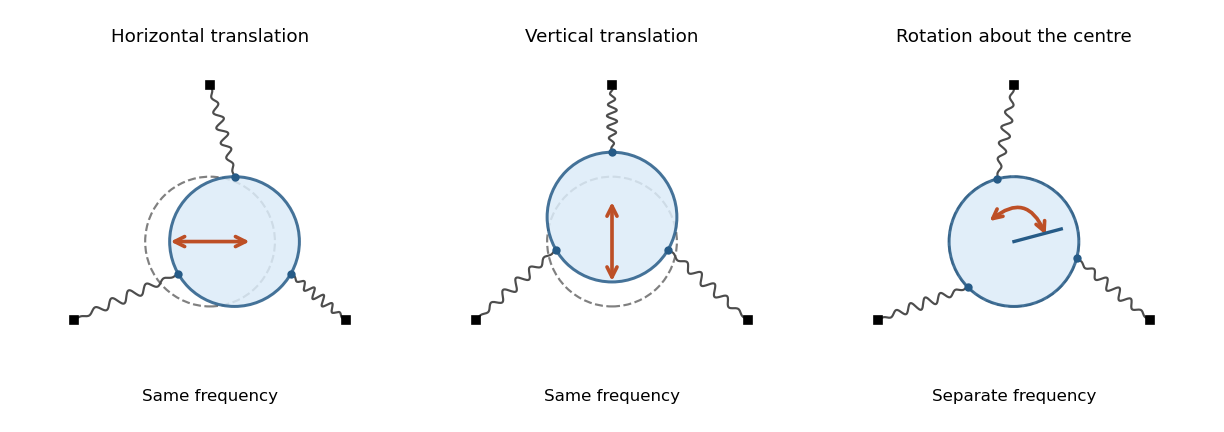
A uniform rigid body disk of mass and radius moves in a frictionless plane. Let identical springs attach equally spaced rim points to fixed anchors in their radial directions. The equilibrium spring length is , natural length , and spring constant . Write the small centre displacement as and the rotation as . For a spring with radial and tangential unit vectors , its length isThis follows by a second-order Taylor series for the distance between and . In the elastic potential energy , the equilibrium tension multiplies the second-order change of length. Thus it contributes to the linearized stiffness even though the displacement is small.
The equally spaced directions satisfy and . Summing the spring energies givesThe kinetic energy is , using the moment of inertia of a uniform disc. The Euler-Lagrange equations give the displayed squared angular frequencies. The translational normal modes are degenerate; rotation is independent. At zero prestretch the rotational frequency vanishes at quadratic order, and finite-angle spring stretching first contributes at higher order.

For point masses on concentric horizontal rings in parallel planes, set , , and . A spring of zero natural length gives . The inertia-weighted angle separates the Lagrangian into a free common rotor with inertia and a relative rotor with inertia . Static equilibria have or . Their normal modes are the common displacement with zero frequency and the relative displacement with the displayed squared frequency. The aligned family has a restoring relative mode; the antipodal family has an exponentially growing one. The zero mode is required by rotational symmetry. Small nonzero total angular momentum produces common drift, so stability of the aligned family modulo rotations should be distinguished from Lyapunov stability of one fixed equilibrium point.
Consider three beads of masses on a horizontal hoop, connected in cyclic order by identical springs constrained to follow the arcs. Their common natural length affects only a constant in the potential energy, since the sum of the three arc lengths is fixed. About the equally spaced configuration, angular displacements haveThe generalized eigenvalue problem has the rigid rotation as a zero mode. Exchanging the equal masses separates an antisymmetric normal mode , with squared angular frequency , from a symmetric normal mode , with squared angular frequency . The last mode shape has zero total angular momentum. The hoop radius cancels from both the kinetic energy and the restoring quadratic form. These formulas use arc-constrained springs; straight chord springs have a different potential energy.
A cart of mass moves horizontally on a spring of stiffness , carrying a simple pendulum of bob mass and length . Let be cart displacement and the small angle from downward vertical. The quadratic Lagrangian isThe kinetic cross term comes from the bob's horizontal velocity to first order. The generalized eigenvalue problem has mass matrix and restoring matrix . Their characteristic determinant gives the displayed polynomial in . For , the squared angular frequencies are , with mode shapes . The bob and cart move in phase in the lower normal mode and in opposite phases in the higher normal mode.
There are unlisted articles, also show them or only show them.